
Nicolas Toussaint Charlet
Charlet was born in Paris. He was the son of a dragoon in the Republican army, whose death in the ranks left the widow and orphan in very poor circumstances. Madame Charlet, however, a woman of determined spirit and an extreme Bonapartist, managed to give her boy a moderate education at the Lycée Napoléon, and was repaid by his lifelong affection.
Also recorded as Nicolas-Toussaint Charlet · Nicholas-Toussaint Charlet · charlet nicolas toussaint · charlet n. t.
Nicolas Toussaint Charlet
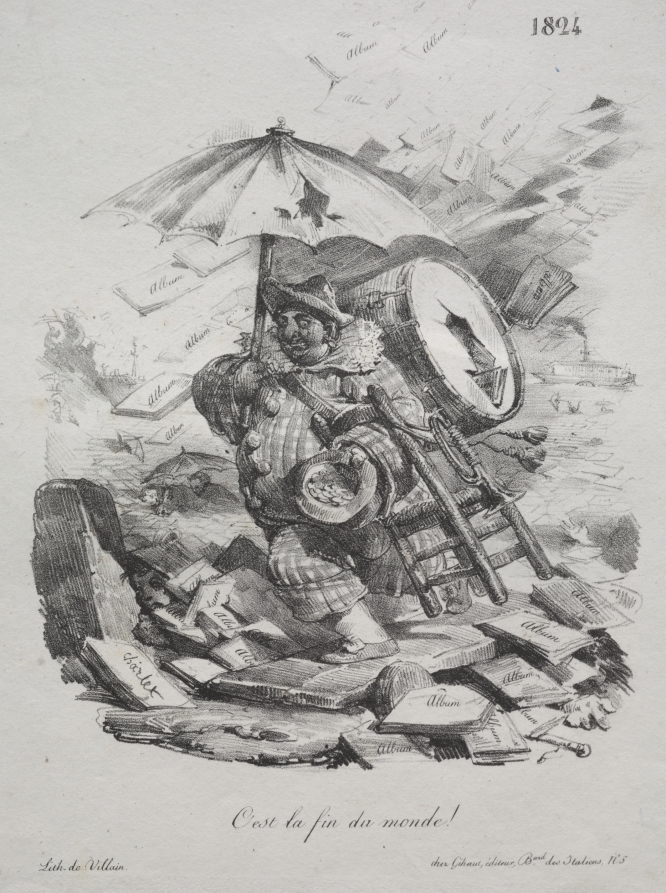
Nicolas Toussaint Charlet · The Cleveland Museum of Art · Anonymous gift in honor of John Bonebrake · CC0
- Born
- 1792.
- Died
- sources differ (1845 and 1845).
- Nationality
- France.
- Known for
- Head of a Dog.
VALÉORINE Encyclopedia
VALÉORINE documentary reading
Documentary summary
Charlet was born in Paris. He was the son of a dragoon in the Republican army, whose death in the ranks left the widow and orphan in very poor circumstances. Madame Charlet, however, a woman of determined spirit and an extreme Bonapartist, managed to give her boy a moderate education at the Lycée Napoléon, and was repaid by his lifelong affection.
Admitted source layer · organised and presented by VALÉORINE
Reference Check
Propose documentary evidence for Nicolas Toussaint Charlet. A contribution is never written directly as fact: identity, source, rights and evidence gates still decide.
Sign in to contribute
Documentary evidence
Documentary basis
Authority files
gnd · 3071903-3 · wikidata · Q1347175 · wikipedia · Nicolas-Toussaint Charlet
In this article
Life
Life
He then, having from a very early age had a propensity for drawing, entered the atelier of the distinguished painter Baron Gros, and soon began issuing the first of those lithographed designs which eventually brought him renown. It was only towards 1822, however, that he began to be successful in a professional sense. Lithographs (about 2000 altogether), watercolours, sepia drawings, numerous oil sketches, and a few etchings followed one another rapidly. Later in his life there were also three exhibited oil pictures, the especially admired Episode in the Campaign of Russia (1836), the Passage of the Rhine by Moreau (1837), and Wounded Soldiers Halting in a Ravine (1843). His military subjects particularly delighted Charlet, and they found an energetic response in the popular heart where they kept alive a feeling of pride and regret for the recent past of the French nation and discontent with the present. These feelings increased upon the artist himself towards the close of his career as Charlet designed many subjects of town life, peasant life, and the ways of children with much wit and whim in his descriptive mottoes. One of the most famous sets is the Vie civile, politique, et militaire du Caporal Valentin, 50 lithographs dating from 1838 to 1842. In 1838 his health began to fail owing to an affection of the chest. Charlet was an uncommonly tall man, with an expressive face, bantering and good natured. His character was full of boyish fun and high spirits, with manly independence and a vein of religious feeling. He was a hearty favourite among his intimates, one of whom was the painter Théodore Géricault. Charlet married in 1824, and two sons survived him.
Charlet was born in Paris. He was the son of a dragoon in the Republican army, whose death in the ranks left the widow and orphan in very poor circumstances. Madame Charlet, however, a woman of determined spirit and an extreme Bonapartist, managed to give her boy a moderate education at the Lycée Napoléon, and was repaid by his lifelong affection. His first employment was a minor post in the Paris city administration, where he had to register recruits: he served in the National Guard in 1814, fought bravely at the Barrière de Clichy, and, being thus unacceptable to the Bourbon party, was dismissed from the city administration in 1816. He then, having from a very early age had a propensity for drawing, entered the atelier of the distinguished painter Baron Gros, and soon began issuing the first of those lithographed designs which eventually brought him renown. His Grenadier de Waterloo, 1817, with the motto "The Guard Dies and Does Not Surrender" (La Garde meurt et ne se rend pas)—a famous phrase frequently attributed to Cambronne but which he never uttered, and which cannot, perhaps, be traced farther than to this lithograph by Charlet—was particularly popular. It was only towards 1822, however, that he began to be successful in a professional sense. Lithographs (about 2000 altogether), watercolours, sepia drawings, numerous oil sketches, and a few etchings followed one another rapidly. Later in his life there were also three exhibited oil pictures, the especially admired Episode in the Campaign of Russia (1836), the Passage of the Rhine by Moreau (1837), and Wounded Soldiers Halting in a Ravine (1843). His military subjects particularly delighted Charlet, and they found an energetic response in the popular heart where they kept alive a feeling of pride and regret for the recent past of the French nation and discontent with the present. These feelings increased upon the artist himself towards the close of his career as Charlet designed many subjects of town life, peasant life, and the ways of children with much wit and whim in his descriptive mottoes. One of the most famous sets is the Vie civile, politique, et militaire du Caporal Valentin, 50 lithographs dating from 1838 to 1842. In 1838 his health began to fail owing to an affection of the chest. Charlet was an uncommonly tall man, with an expressive face, bantering and good natured. His character was full of boyish fun and high spirits, with manly independence and a vein of religious feeling. He was a hearty favourite among his intimates, one of whom was the painter Théodore Géricault. Charlet married in 1824, and two sons survived him.
Life and career
Dated record
Life and career
Explore 1792–1845
The full dated record · 3 entries
1792
Nicolas Toussaint Charlet was born in 1792.
1826
Les jolis soldats, tableau militaire, civil et vaudeville, imité de Charlet (1826) is digitised and catalogued by Internet Archive.
1845
Nicolas Toussaint Charlet died at Paris.
Legacy
A life of Charlet was published in 1856 by a military friend, De la Combe.
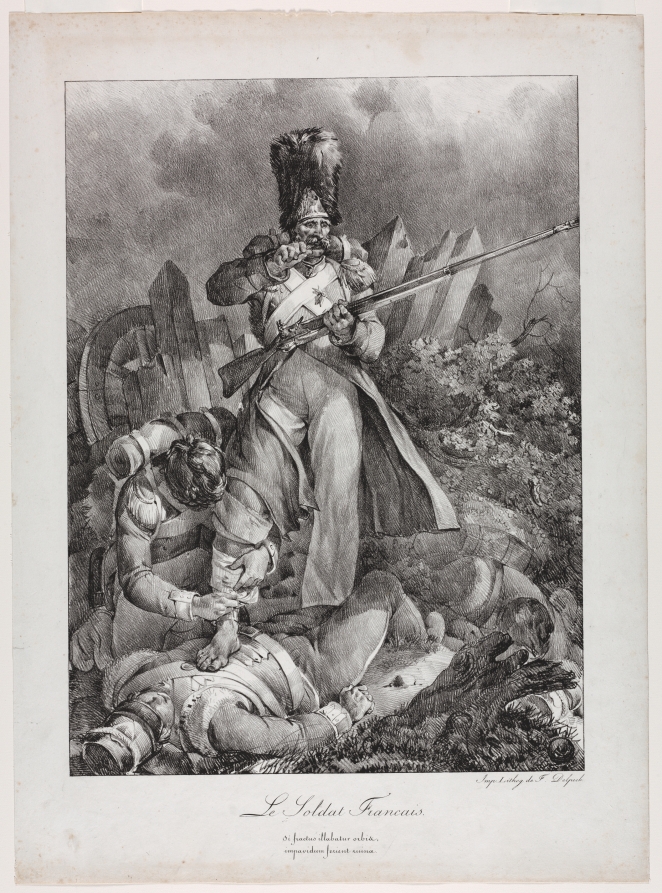
The French Soldier (Le Soldat français), 1818, by Nicolas Toussaint Charlet
Nicolas Toussaint Charlet · The Cleveland Museum of Art · Gift of John Bonebrake
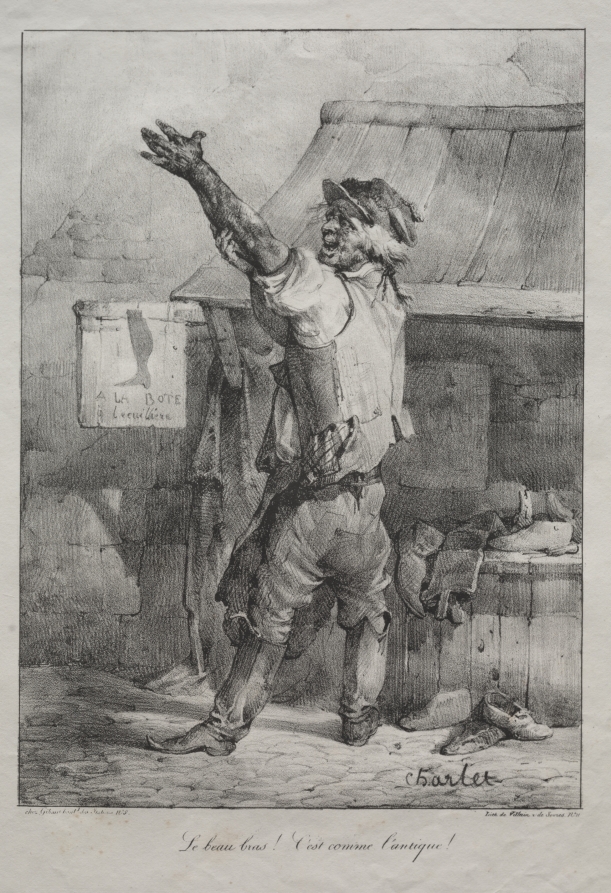
Le beau bras: C'est comme l'antique!, c. 1822, by Nicolas Toussaint Charlet
Nicolas Toussaint Charlet · The Cleveland Museum of Art · Twenty-fifth anniversary gift, Mr. and Mrs. Lewis B. Williams Collection
Notes from the source article
Cited by Wikipedia
Notes from the source article
These works are cited by the source article, in its own numbering. They are recorded as its citations, not as sources VALÉORINE has verified.
- 1.Base Joconde 000PE000424 Grenadier de la Garde
- 2.Base Léonore LH/491/43 .
- 3.Malika Dorbani-Bouabdeellah La défaite de l'Empire.
- 4.Emile de Labédollière, Le Nouveau Paris, Gustave Barba Libraire-Éditeur, Paris, 1860, .
- 5.« Charlet, Nicolas-Toussaint », in: Janine Bailly-Herzberg, Dictionnaire de l'estampe en France 1830-1950, Paris, AMG-Flammarion, 1985, .
- 6.Pierre et Rolande Miquel avec la collaboration du professeur Gérard_Bonin et de Michael Tazi Klaa, De l'aube romantique à l'aube impressionniste, éditions Somogy, 2011, p. 122.
- 7.Les Collections du musée Condé.
- 8.Dans un chemin forestier, un soldat est endormi avec son fusil posé près de lui.
- 9.Base Joconde 000PE027808 Épisode de la retraite de Russie .
- 10.Le Temps des passions. Collections romantiques des musées d'Orléans. musée des Beaux-Arts. 1997. 2-910173-07-0.
- 11.Dessins français du musée des Beaux-Arts d’Orléans. Le Trait et l’Ombre. musée des Beaux-Arts. 2022. 9 788836 651320.
- 12.Catalogue de la Exposition d'Amiens de 1885, organisée par la Société des Amis des Arts de la Somme, .
- 13.Square de l'Abbé-Migne. paris.fr.
- 14.La légende napoléonienne en images. leparisien.fr. 2009-04-09.
- 15.Adrien Goetz. Grognards et moutards. Le Figaro. 9 mars 2009. 29.
Bibliography printed in the source article · 4
- Ferdinand Hoefer, Nouvelle biographie générale, , Paris, Firmin-Didot, 1854, .
- Collectif, Charlet : aux origines de la légende napoléonienne 1792-1845, catalogue de l'exposition du musée municipal de La Roche-sur-Yon, du au , Bernard Giovanangeli éditions, 159 p. .
- J. F. Leblanc de la Combe, Charlet, sa vie, ses lettres et ses œuvres (lire en ligne).
- Dictionnaire Bénézit.
References
Citations
References
Each reference names the institution holding it, so a reader may go to the document itself.
reference work
Wikidata, structured authority record Q1347175: Nicolas Toussaint CharletWikimedia Foundation
Secondary witness
The Encyclopedia exists whether or not anything is for sale. Corrections are recorded rather than overwritten, and every version of this record is kept. Published 14 August 2026.
Elsewhere in Prints
4,138 published records in this field, each with its sources named.
- Nicolas PerelleEngraver
- Nicolas PerignonEngraver
- Nicolas PitauEngraver
- Nicolas RobertEngraver
- Nicolas van HouyEngraver
- Nicolas-Auguste LeisnierEngraver
- Nicolas-Didier BoguetEngraver
- Nicolas-Gabriel DupuisEngraver
Best supported in this field
For owners
Own a work by Nicolas Toussaint Charlet?
A specialist will read what you send and tell you what the house can establish, what it cannot, and whether the object is suited to sale. There is no charge and no obligation. The object stays with you throughout; nothing is shipped to us unless it is arranged in writing beforehand.