
Nicolas de Largillière
Nicolas de Largillière (lang; baptised 10 October 1656 – 20 March 1746) was a French painter and draughtsman. From 1733 until 1735, he was director of the Académie de Peinture et de Sculpture.
Also recorded as Nicolas de Largillierre · L'Argillière · Nicolas de L'argiliere · Nicholas Largilliere
Nicolas de Largillière
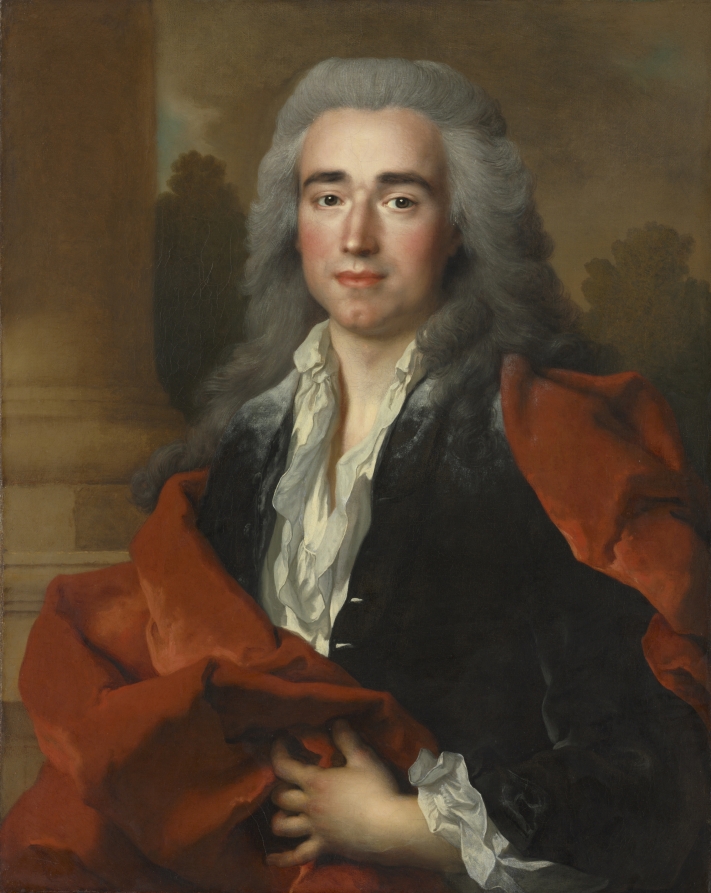
Nicolas de Largillière · The Cleveland Museum of Art · Mr. and Mrs. William H. Marlatt Fund · CC0
- Name
- Nicolas de Largillière
- Birthplace
- Paris, Kingdom of France
- Died
- 20 March 1746
- Known for
- Painter
- Movement
- Baroque
- Education
- Anton Goubau, Peter Lely, Antonio Verrio
- Spouse
- Marguerite Élisabeth Forest
- Born
- 1656
- Nationality
- France
- Occupation
- painter · portraitist · architectural drafter · visual artist
- Fields
- history painting · portrait
VALÉORINE Encyclopedia
VALÉORINE documentary reading
Documentary summary
Nicolas de Largillière (lang; baptised 10 October 1656 – 20 March 1746) was a French painter and draughtsman. From 1733 until 1735, he was director of the Académie de Peinture et de Sculpture.
Admitted source layer · organised and presented by VALÉORINE
Reference Check
Propose documentary evidence for Nicolas de Largillière. A contribution is never written directly as fact: identity, source, rights and evidence gates still decide.
Sign in to contribute
Documentary evidence
Documentary basis
Authority files
wikidata · Q550302 · wikipedia · Nicolas de Largillière
In this article
Key facts
Key facts
• Name — Nicolas de Largillière • Birthplace — Paris, Kingdom of France • Died — 20 March 1746 • Place of death — Paris, Kingdom of France • Known for — Painter • Movement — Baroque • Baptised — 10 October 1656 • Resting Place — Church of Saint-Merri • Education — Anton Goubau, Peter Lely, Antonio Verrio • Spouse — Marguerite Élisabeth Forest • Notable Works — Self-portraits La Belle Strasbourgeoise (1703)
Early life
Early life
Largillière was baptised at the Église Saint-Barthélemy de Paris in Paris on 10 October 1656. The son of a merchant hatmaker, his family moved to Antwerp when Largillière was around three years old. Following a trip to London, Largillière's father apprenticed him to the Flemish painter Anton Goubau. However, he left at the age of eighteen and again went to England, where he was befriended and employed by Sir Peter Lely for four years at Windsor, Berkshire. While there, Largillière also worked under the direction of Italian painter Antonio Verrio.
Early career
Early career
His painting caught the attention of Charles II, who wished to retain Largillière in his service, but the controversy aroused by the Rye House Plot against Roman Catholics alarmed Largillière. He left for Paris, where he was well received by the public as a painter. Upon ascending to the throne in 1685, James II requested Largillière to return to England. James II offered Largillière the office of keeper of the royal collections, but he declined due to being uneasy about Rye House Plot. However, during a short stay in London, he painted portraits of the king, the queen Mary of Modena, and the prince of Wales James Francis Edward Stuart. The portrait of the Prince of Wales could not have been painted during Largillière's stay in London because the prince was not born until 1688. The three portraits painted by Largillière of the prince in his youth must have been executed in Paris, where he returned sometime before March 1686. The portrait of King James II was painted in 1686. King James is portrayed in golden armor with a white cravat and is positioned in front of a watercolour-like background set in a round frame.
Later career
Later career
• Illustration — Self-portrait of Nicolas de Largillierre. Engraving by François Chereau (1715). • Illustration — Study of hands (Musée du Louvre) Towards the end of his life, Largillière painted a repetition of anonymous male portraits of Parisian nobles. One example was painted in 1710, of a man standing with spread fingers that conceal a letter held in the other hand. Another portrait from about 1715 shows a frontal three quarter view of a man dressed in similar clothes and wig with a Doric column in the background. In 1714, Largillière painted King Augustus II the Strong of Poland. Largillière also painted the artist Jacques-Antoine Arlaud in a red robe in a similar fashion to Largillière's portrait of the painter Charles Le Brun, as well as the sculptor Nicolas Couston. Around the next year, Largillière painted The Study of Different Types of Hands, which currently resides in the Louvre. In 1718, Largillière painted the French poet and essayist Voltaire. The Entry of Christ into Jerusalem was a landscape painting that Largillière painted in 1720. Largillière made his last self-portrait in 1725. This portrait displays the artist at his easel staring toward the audience. Largillière was appointed as chancellor of the French Academy in 1743.
Death
Death
Nicolas de Largillière died on 20 March 1746 at the age of 89. Upon his death, he donated to France several small landscapes and still life pictures he had created.
Gallery
Gallery
• Illustration — Portrait of Elizabeth Throckmorton • Illustration — Portrait of Augustus III of Poland • Illustration — Portrait of Louise-Madeleine Bertin, Countess of Montchal • Illustration — Portrait of a Man in a Purple Robe • Illustration — Portrait of Voltaire • Illustration — Self-portrait with family • Illustration — Portrait of Marguerite de Sève • Illustration — La belle Strasbourgeoise (1703) • Illustration — Portrait of Marguerite Bécaille • Illustration — Portrait of Pierre-Joseph Titon de Cogny • Illustration — Portrait of Jeanne-Cécile Le Guay de Montgermon • Illustration — Portrait of Catherine Coustard with her son Léonor, Minneapolis Institute of Arts • Illustration — Portrait of Maria Theresia Countess of Wrbna born Countess of Kollonitz, often wrongly descripted as a portrait of French jeweller Jean-Baptiste Tavernier • Illustration — Portrait of an officer, oil on canvas, 1714–15, Art Gallery of New South Wales • Illustration — Oil on canvas portrait of Helene Lambert de Thorigny by Nicolas de Largillière (portrait) and Jean-Baptiste Belin (flowers), c. 1696–1700, 63 × 45 in., Honolulu Museum of Art • Illustration — Infanta Mariana Victoria of Spain, one-time fiancée of Louis XV • Illustration — Anne Geneviève de Lévis, duchessede Rohan-Rohan by marriage and only daughter of Madame de Ventadour • Illustration — An Alderman of Paris, 1703, oil on canvas, The Detroit Institute of Arts • Illustration — Portrait of a lady with a dog and a monkey (1700–1710) • Illustration — André François Alloys de Theys d'Herculais (1692–1779), in the Metropolitan Museum of Art • Illustration — Portrait of Thomas Germain and his wife Anne-Denise Gauchelet in 1736 • Illustration — Portrait of Barthélemy-Jean-Claude Pupil, 1729, Timken Museum of Art, San Diego • Illustration — Portrait of the Comtesse de Montsoreau and her sister as Diana and an attendant, 1714, in the Dallas Museum of Art
Identity and origins
Identity and origins
The authorities additionally record the headings Nicolas de Largillierre, L'Argillière, Nicolas de L'argiliere, Nicholas Largilliere and Nicolas de Argilieres. His recorded language was French. He married Marguerite Elisabeth Forest. One child is recorded: Marguerite Elisabeth de Largillierre.
Identity
Identity
Nicolas de Largillière is recorded as painter, portraitist, architectural drafter and visual artist.
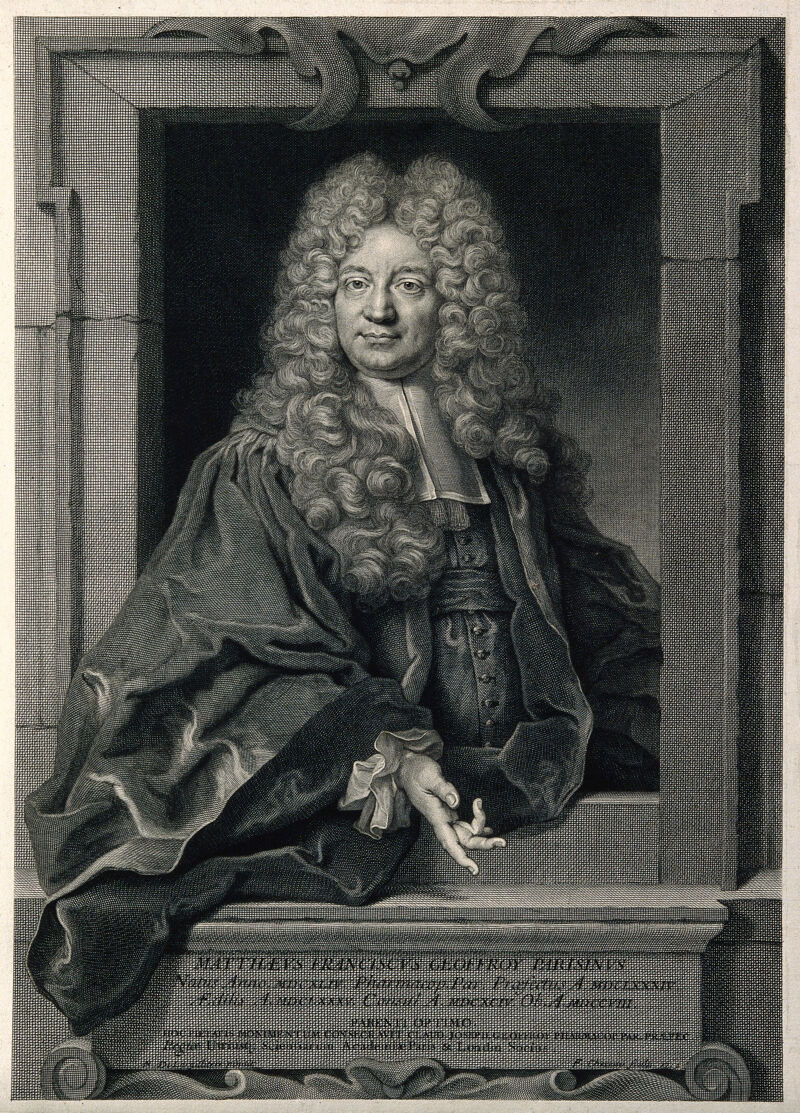
Mathieu François Geoffroy. Line engraving by F. Chéreau, 1718, after N. de Largillière., 1718, by Nicolas de Largillière
Nicolas de Largillière · Wellcome Collection, London · Wellcome Collection
Life and career
Dated record
Life and career
Explore 1656–1746
The full dated record · 6 entries
1656
Nicolas de Largillière was born in 1656.
1718
Portrait of Baroness Le Leu d'Aubilly and her daughter Madame de Guinaumont is dated 1718.
1730
Portrait of Jacques-François de Chastenet, Marquis de Puysegur is dated 1730.
1730
Portrait of Madame de Noirmont as Diana is dated 1730.
1739
Portrait of a Lady is dated 1739.
1746
Nicolas de Largillière died at Paris.
Legacy
The Ashmolean Museum (University of Oxford), the Fitzwilliam Museum (University of Cambridge), the Metropolitan Museum of Art (New York City), the Honolulu Museum of Art, the Louvre, the National Gallery of Art (Washington D.C.), the Nelson-Atkins Museum of Art (Kansas City, Missouri), the Musée des Beaux-Arts de Strasbourg and Pinacoteca di Brera (Milan), Calouste Gulbenkian Museum, Museu Nacional de Arte Antiga (Lisbon), Museum de Fundatie (Zwolle), the Detroit Institute of Arts (Detroit) and the Speed Art Museum (Louisville) are among the public collections holding works by Nicolas de Largillière. Jean-Baptiste Oudry and Jacob van Schuppen, Largillière's pupil and nephew respectively, were also rococo painters.
Primary material
Documents and archives
scholarly publication
- LargilliÈRe, Nicolas De (1656–1746), Historical Dictionary of Baroque Art and Architecture, 2018
Scholarly · Crossref registry · 2018
- Un autoportrait inédit de Nicolas de Largillière chez Anne-Louis Girodet-Trioson, Revue de l'art, 2015
Scholarly · Crossref registry · 2015
reference work
- “Nicolas de Largillière”, English Wikipedia, consulted as further reading
Reputable secondary · Wikipedia
- Wikidata, structured authority record Q550302: Nicolas de Largillière
Reputable secondary · Wikimedia Foundation
French Academy
In 1686, Largillière produced a portrait of the painter Charles Le Brun for admittance to the Académie royale de peinture et de sculpture. The portrait shows Le Brun, then the chairman of the academy, at work on an entombment, surrounded by classical busts and figurines scattered upon the floor and table within the picture. Le Brun, impressed by Largillière's portrait, accepted him to the academy. In 1690, Largillière was documented by the French Academy as a historical painter, which was a prominent artistic trend of the academy. In 1693, Largillière painted the Governor of Arras, Pierre de Montesquiou, to celebrate his promotion to brigadier in 1691. In 1694, Largillière's made a multi-figure work that is displayed in the church of Saint-Étienne-du-Mont. In 1709, Largillière painted the royal family portrait of The Family of Louis XIV. This portrait shows King Louis XIV, Madame de Ventadour (governess of the children of the Duke of Burgundy), the 3-year old Louis, Duke of Brittany, Louis, Grand Dauphin and Louis, Duke of Burgundy, future dauphin. The King displays a sense of slight uneasiness unlike the other figures especially. In the painting, Largillière used the Renaissance technique of structured disposition. • Illustration — Charles LeBrun (1686) A year later, Largillière painted a self-portrait which also contained two female members of his family. Following the death of directeur Louis de Boullogne on 28 November 1733, the painter Hyacinthe Rigaud proposed that the four rectors of the Académie, Largillière, Claude-Guy Hallé, Guillaume Coustou, and himself, rotate the post. This oligarchy would persist until the election of Coustou as sole director on 5 February 1735. Largillière became director in 1738 and remained in that position until 1742.
Notes from the source article
Cited by Wikipedia
Notes from the source article
These works are cited by the source article, in its own numbering. They are recorded as its citations, not as sources VALÉORINE has verified.
- 1.Pascal, Georges. Largillierre. Les Beaux-Arts. 1. 1928.
- 2.Conisbee, Philip. French Paintings of the Fifteenth through the Eighteenth Century. Princeton University Press. 292–293. 2010. 978-0691145358.
- 3.Largillière, Nicolas. 16. 216.
- 4.Éditions Gründ. Benezit Dictionary of Artists. 8, Koort-Maekava. 467. 2006.
- 5.J. Baur. Procès-Verbaux de l'Académie Royale de peinture et de sculpture, 1648-1793. V. 127–128. 1883.
- 6.Michel, Christian. The Académie Royale de Peinture Et de Sculpture: The Birth of the French School, 1648-1793. Getty Research Institute. 352. 2018.
- 7.Williams, Hannah. Académie Royale: A History in Portraits. Routledge. 294. 2016. 978-1-4094-5742-8.
- 8.Williams 2016, p. 45.
- 9.http://www.collectienederland.nl/dimcon/defundatie/3136
References
Citations
References
Each reference names the institution holding it, so a reader may go to the document itself.
scholarly publication
LargilliÈRe, Nicolas De (1656–1746), Historical Dictionary of Baroque Art and Architecture, 2018Crossref registry
Institutional witnessscholarly publication
Un autoportrait inédit de Nicolas de Largillière chez Anne-Louis Girodet-Trioson, Revue de l'art, 2015Crossref registry
Institutional witnessreference work
Secondary witnessreference work
Wikidata, structured authority record Q550302: Nicolas de LargillièreWikimedia Foundation
Secondary witness
Further particulars
Held on the record
Further particulars
Open the remaining particulars
He trained under Anton Goubau. His recorded influences include Peter Lely. Each of those relationships is stated by the authority record rather than inferred from style.
Nicolas de Largillière worked in painting. His work is associated with Baroque. He belonged to Académie royale de peinture et de sculpture. He worked at Great Britain, Antwerp, Paris and London.
Career and activity
Recognition and collections
Work by Nicolas de Largillière is
Minneapolis Institute of Art, Museo del Prado, The Nelson-Atkins Museum of Art and J. Paul Getty Museum
The Encyclopedia exists whether or not anything is for sale. Corrections are recorded rather than overwritten, and every version of this record is kept. Published 14 August 2026.
Elsewhere in Paintings
19,261 published records in this field, each with its sources named.
- Nicolas CaroneArtist
- Nicolas ColombelArtist
- Nicolás CuéllarArtist
- Nicolas De CorsiArtist
- Nicolás de VillacisArtist
- Nicolas DelobelArtist
- Nicolas DipreArtist
- Nicolás EchevarríaArtist
Best supported in this field
For owners
Own a work by Nicolas de Largillière?
A specialist will read what you send and tell you what the house can establish, what it cannot, and whether the object is suited to sale. There is no charge and no obligation. The object stays with you throughout; nothing is shipped to us unless it is arranged in writing beforehand.