
Nicanor Parra
Nicanor Segundo Parra Sandoval (5 September 1914 – 23 January 2018) was a Chilean physicist and poet. He has been considered one of the most influential Spanish-language Chilean poets of the 20th century. Parra described himself as an "anti-poet" on account of his distaste for poetry's pompous pretences.
Also recorded as Nicanor Segundo Parra Sandoval
Nicanor Parra

Biblioteca del Congreso Nacional · William Turpin Thayer Arteaga · CC BY 3.0 cl
- Name
- Nicanor Parra Sandoval
- Birth Name
- Nicanor Segundo Parra Sandoval
- Born
- 5 September 1914
- Birthplace
- San Fabián de Alico, Chile
- Occupation
- Poet
- Died
- 23 January 2018
- Place of death
- La Reina, Chile
- Awards
- Miguel de Cervantes Prize (2011)
- Nationality
- Chile
- Fields
- poetry
- Education
- Brown University · St Catherine's College · University of Chile · Internado Nacional Barros Arana
- Honours
- Guggenheim Fellowship · Miguel de Cervantes Prize · FIL Award · National Prize for Literature (Chile) · Bicentennial Prize · Reina Sofía Award
VALÉORINE Encyclopedia
VALÉORINE documentary reading
Documentary summary
Nicanor Segundo Parra Sandoval (5 September 1914 – 23 January 2018) was a Chilean physicist and poet. He has been considered one of the most influential Spanish-language Chilean poets of the 20th century. Parra described himself as an "anti-poet" on account of his distaste for poetry's pompous pretences.
Admitted source layer · organised and presented by VALÉORINE
Note VALÉORINE
Nicanor Parra (1914–2018) was an academic, mathematician and physicist, among other activities, of Chilean nationality. The academic was born in San Fabián and died in La Reina.
Nicanor Parra was educated at Brown University, Internado Nacional Barros Arana and St Catherine's College, among others. The academic worked for University of Chile. Activity centred on poetry.
The work spans poetry. Languages used include Spanish. Honours include Bicentennial Prize, FIL Award and Guggenheim Fellowship, among others.
Composed from admitted, traceable facts · 01 October 2026
VALÉORINE
Reference Check
Propose documentary evidence for Nicanor Parra. A contribution is never written directly as fact: identity, source, rights and evidence gates still decide.
Sign in to contribute
Documentary evidence
Documentary basis
Authority files
gnd · 1100929207 · wikidata · Q360832 · wikipedia · Nicanor Parra
In this article
Biography
Biography
After his recitations, he would say: "Me retracto de todo lo dicho." ("I take back everything I've said.")
Nicanor Parra studied at Brown University, St Catherine's College and University of Chile. The recorded working language is Spanish. The field of work recorded is poetry. Subjects and genres recorded for the work are poetry. Employment is recorded with University of Chile. Work by Nicanor Parra is recorded in the collections of Memoria Chilena. Distinctions recorded are Guggenheim Fellowship, Miguel de Cervantes Prize, FIL Award and National Prize for Literature (Chile).
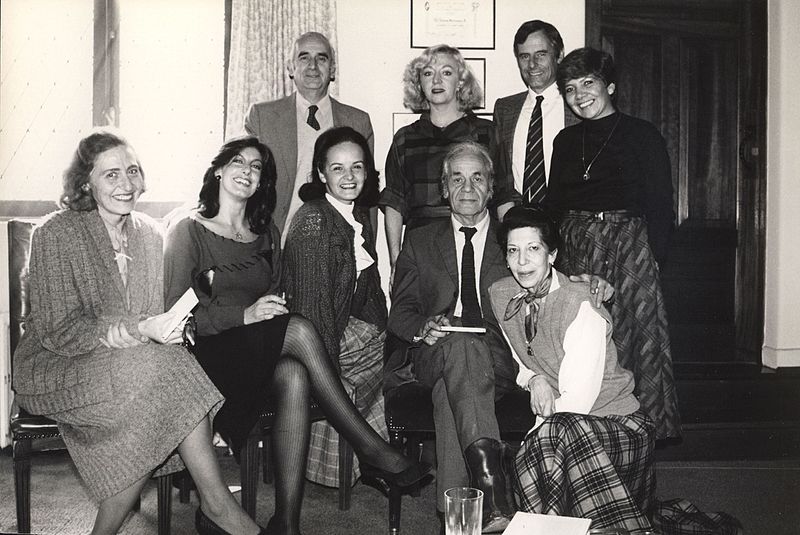
Nicanor Parra y visitantes, entre ellos políticos.
Biblioteca del Congreso Nacional · William Turpin Thayer Arteaga
Key facts
Key facts
• Name — Nicanor Parra Sandoval • Birth Name — Nicanor Segundo Parra Sandoval • Born — 5 September 1914 • Birthplace — San Fabián de Alico, Chile • Occupation — Poet • Died — 23 January 2018 • Place of death — La Reina, Chile • Awards — Miguel de Cervantes Prize (2011)
Life
Life
• Illustration — Parra in 1935 Parra, the son of a schoolteacher, was born in 1914 in San Fabián de Alico, near Chillán, in Chile. He came from the artistically prolific Parra family of performers, musicians, artists, and writers. His sister, Violeta Parra, was a folk singer, as was his brother Roberto Parra Sandoval. In 1933, he entered the Instituto Pedagógico of the University of Chile, where he qualified as a teacher of mathematics and physics in 1938, one year after the publication of his first book, Cancionero sin Nombre. After teaching in Chilean secondary schools, in 1943 he enrolled in Brown University in the United States to study physics. In 1948, he attended Oxford University to study cosmology. He returned to Chile as a professor at the Universidad de Chile in 1952. Parra served as a professor of theoretical physics at the University of Chile from 1952 to 1991, and was a visiting professor at Louisiana State University, New York University, and Yale University. He read his poetry in England, France, Russia, Mexico, Cuba, and the United States. He published dozens of books. As a young man, he was promoted by Gabriela Mistral and Pablo Neruda. He came to Mistral's attention when she visited Chillán. The national anthem was played in her honor, as Latin America's first Nobel laureate; at its conclusion, Parra leapt onto the stage and recited a poem he'd written for her the previous night. Mistral, standing for the anthem, remained standing until Parra finished, and later introduced him to important people in Santiago as a poet of future global renown. Subsequently, Neruda arranged for Parra's collection Poemas y Antipoemas to be published in Buenos Aires, in 1954. Poemas y Antipoemas is a classic of Latin American literature, one of the most influential Spanish poetry collections of the twentieth century. It is cited as an inspiration by American Beat writers such as Allen Ginsberg. • Illustration — Nicanor Parra at the age of 100 A fictionalized version of Parra appeared in Alejandro Jodorowsky's autobiographical film Endless Poetry (2016).
Death
Death
Parra died on 23 January 2018, in La Reina in Santiago, at the age of 103.
Style
Style
Parra's poetry changed greatly over time. For a short period in his youth, at the end of the 1930s, he was a proponent of "poetry of clarity," a movement strongly inspired by the recent assassination of Federico García Lorca, created as a critical response to the hermeticism and subjectivity of the historical avant-garde movements led by Huidobro, Neruda, or the new surrealist poets of La Mandrágora. After leaving this pursuit, instead of adhering himself to Socialist realism, which he criticized for its poor credibility and its doctrinal abstraction, Parra decided to continue on a path that was more Avant-garde or even post-Avant-garde. Aided by his scientific background, he was particularly interested in the structures and mechanisms of creation. His poetry is markedly critical, questioning, and anticlerical. Along with his Postmodernist and analytical anti-poems, he had poems that were ecological, and others that came from oral traditions. Through his usage of absurdism, humor, street art, and popular culture, Parra was characterized by democratizing poetry, bringing it to readers of many different sociocultural backgrounds. As for his use of metre, in his earlier poems he utilized octosyllable to write romances, and hendecasyllable for parodic sonnets, although he also experimented with free verse. His poems exhibited strong variation in both voice and style. In the 1990s, he started to use a more relaxed form of iambic pentameter, favoring fluency in his translations of William Shakespeare. Parra was very demanding with his poems before publishing them, so that future publications of his poems would have very few changes. Despite this, he seemed particularly unconcerned about punctuation, which tended to vary between editions.
List of works
List of works
• Cancionero sin nombre (Songbook without a Name), 1937. • Poemas y antipoemas (Poems and Antipoems), 1954; Nascimento, 1956; Cátedra, 2005, • La cueca larga (The Long Cueca), 1958 • Versos de salón (Parlor Verses), 1962 • Manifiesto (Manifesto), 1963 • Canciones rusas (Russian Songs), 1967 • Obra gruesa (Thick Works), 1969 • Los profesores (The Teachers), 1971 • Artefactos (Artifacts), 1972 • Sermones y prédicas del Cristo de Elqui (Sermons and Teachings of the Christ of Elquí), 1977 • Nuevos sermones y prédicas del Cristo de Elqui (New Sermons and Teachings of the Christ of Elquí), 1979 • El anti-Lázaro (The Anti-Lazarus), 1981 • Plaza Sésamo (Sesame Street), 1981 • Poema y antipoema de Eduardo Frei (Poem and Antipoem of Eduardo Frei), 1982 • Cachureos, ecopoemas, guatapiques, últimas prédicas, 1983 • Chistes parRa desorientar a la policía/poesía (Jokes to Confuse the Police/Poetry), 1983 • Coplas de Navidad (Christmas Couplets), 1983 • Poesía política (Political Poetry), 1983 • Hojas de Parra (Grape Leaves / Pages of Parra (Spanish pun)), 1985 • Nicanor Parra: biografía emotiva (Nicanor Parra: Emotional Biography), Ediciones Rumbos, 1988 • Poemas para combatir la calvicie (Poems to Combat Baldness), 1993 • Páginas en blanco (White Pages), 2001 • Lear, Rey & Mendigo (Lear, King & Beggar), 2004 • Obras completas I & algo + (Complete Works I and Something More), 2006 • Discursos de Sobremesa (After Dinner Declarations), 2006 • Obras Completas II & algo + (Complete Works II and Something More), 2011 • Así habló Parra en El Mercurio, entrevistas dadas al diario chileno entre 1968 y 2007 (Thus Spoke Parra in El Mercurio, Interviews Given to the Chilean Newspaper Between 1968 and 2007), 2012 • El último apaga de luz (The Last One to Leave Turns Off the Lights), 2017 English translations * * * * * *
Life and career
Dated record
Life and career
Explore 1914–2018
The full dated record · 3 entries
1914
Nicanor Parra born at San Fabián.
1954
Poemas y antipoemas / Nicanor Parra (1954) is digitised and catalogued by Internet Archive.
2018
Nicanor Parra died at La Reina.
Places
Named by the record
Places
Only places the record itself states, plotted where the house gazetteer settles their coordinates. Nothing is inferred from a name or a nationality.
San Fabián.
Birth place
La Reina.
Death place
Awards
Parra was proposed on four occasions for the Nobel Prize in Literature. On 1 December 2011, Parra won the Spanish Ministry of Culture's Cervantes Prize, the most important literary prize in the Spanish-speaking world. On 7 June 2012, he won the Pablo Neruda Ibero-American Poetry Award.
Notes from the source article
Cited by Wikipedia
Notes from the source article
These works are cited by the source article, in its own numbering. They are recorded as its citations, not as sources VALÉORINE has verified.
- 1.EL UNIVERSAL, Compañía Periodística Nacional. Nicanor Parra un antipoeta, matemático y físico. EL UNIVERSAL. 1 December 2011.
- 2.Los desconocidos años de Nicanor en Oxford , Qué Pasa (in Spanish), 5 August 2009
- 3.Holmes, Anne. Literary Treasures: Chilean Poet Nicanor Parra Reading from his Work From the Catbird Seat: Poetry & Literature at the Library of Congress. blogs.loc.gov. 2018-01-23.
- 4.Parra, Nicanor. Antipoems: New and Selected. New Directions Publishing. x. 1985. 0811209598.
- 5.Chilean poet Nicanor Parra wins Cervantes Prize. CBC News. 1 December 2011.
- 6.Nicanor Parra Havana 1965. Allen Ginsberg Project.
- 7.Otis, John. Nicanor Parra, Chile's eminent poet and 'anti-poet,' dies at 103. Washington Post. 23 January 2018. 0190-8286.
- 8.Parra, Nicanor (2006). Binns, Niall; Echevarría, Ignacio, eds. Obras completas & algo + (1935-1972). Barcelona: Galaxia Gutenberg/Círculo de Lectores. ISBN 978-956-9105-01-2 . OCLC 907005296 .
- 9.Binns, Niall, ed. (2012). La antología de Nicanor Parra según Niall Binns. Santiago de Chile: Consejo Nacional de la Cultura y las Artes. p. 174. ISBN 978-956-8327-83-5 .
- 10.Emol.com. Nicanor Parra va nuevamente tras el Nobel, respaldado por Bachelet. 5 January 2012.
- 11.Nicanor Parra awarded Cervantes Prize. BBC News. 1 December 2011.
- 12.Rodriguez M., Javier. El poeta chileno Nicanor Parra, premio Cervantes. El Pais. 1 December 2011.
- 13.Latercera. Nicanor Parra gana Premio de Poesía Pablo Neruda. Cultura Latercera. 6 July 2012.
References
Citations
References
Each reference names the institution holding it, so a reader may go to the document itself.
reference work
Wikidata, structured authority record Q360832: Nicanor ParraWikimedia Foundation
Secondary witnessreference work
Secondary witness
Further particulars
Held on the record
Further particulars
Open the remaining particulars
The authorities additionally record the heading Nicanor Segundo Parra Sandoval. His recorded language was Spanish. Formation and teaching. Parra studied at Brown University, St Catherine's College, University of Chile and Internado Nacional Barros Arana. Parra received Guggenheim Fellowship, Miguel de Cervantes Prize, FIL Award, National Prize for Literature (Chile), Bicentennial Prize and Reina Sofía Award. Recorded as poet, mathematician, physicist, academic and writer.
Identity and origins
Recognition and collections
Work by Nicanor Parra is
Memoria Chilena
The Encyclopedia exists whether or not anything is for sale. Corrections are recorded rather than overwritten, and every version of this record is kept. Published 14 August 2026.
Elsewhere in Books
38,960 published records in this field, each with its sources named.
- Nic WaalAuthor
- Nica NoelleAuthor
- Nicaenetus of SamosAuthor
- NicanderAuthor
- Nicasio Álvarez de CienfuegosAuthor
- Niccolò and Maffeo PoloAuthor
- Niccolò BarbaroAuthor
- Niccolò de' NiccoliAuthor
Best supported in this field
For owners
Own a work by Nicanor Parra?
A specialist will read what you send and tell you what the house can establish, what it cannot, and whether the object is suited to sale. There is no charge and no obligation. The object stays with you throughout; nothing is shipped to us unless it is arranged in writing beforehand.