
neo-futurism
Neo-futurism is a late-20th- to early-21st-century movement in the arts, design, and architecture. Described as an avant-garde movement, as well as a futuristic rethinking of the thought behind aesthetics and functionality of design in growing cities, the movement has its origins in the mid-20th-century structural expressionist work of architects such as Alvar Aalto and Buckminster Fuller. Futurist architecture began in the early 20th century in Italy focusing on the future, valuing speed, risk and heroism; while Neo-futurism was defined in the 1980s as a broader movement that appeared in the 1950s and continues today.
neo-futurism

Andrew Dunn · CC BY-SA 2.0
- Name
- Neo-futurism
- Field
- futurist architecture
VALÉORINE Encyclopedia
VALÉORINE documentary reading
Documentary summary
Neo-futurism is a late-20th- to early-21st-century movement in the arts, design, and architecture. Described as an avant-garde movement, as well as a futuristic rethinking of the thought behind aesthetics and functionality of design in growing cities, the movement has its origins in the mid-20th-century structural expressionist work of architects such as Alvar Aalto and Buckminster Fuller. Futurist architecture began in the early 20th century in Italy focusing on the future, valuing speed, risk and heroism; while Neo-futurism was defined in the 1980s as a broader movement that appeared in the 1950s and continues today.
Admitted source layer · organised and presented by VALÉORINE
Note VALÉORINE
No house-authored Note is published until its assertions and sources pass the VALÉORINE evidence contract. The documentary article remains available in full while that enrichment is being consolidated.
Documentary enrichment in progress · no unsupported statement published
Reference Check
Propose documentary evidence for neo-futurism. A contribution is never written directly as fact: identity, source, rights and evidence gates still decide.
Sign in to contribute
World of VALÉORINE
Documentary connections
Only confirmed graph relationships appear here. Images are shown only when their identity and reuse rights both pass the documentary gate.
Documentary evidence
Evidence Panel
not yet certified
- Identity
- resolved
- Independent source families
- 0
- Admitted assertions
- 0
- Open conflicts
- 0
Authority files
wikidata · Q17012219 · wikipedia · Neo-futurism
In this article
Key facts
Key facts
• Name — Neo-futurism • Yearsactive — 1990s–present • Country — International • Majorfigures — Peter Cook, Cedric Price, Renzo Piano, Richard Rogers, Norman Foster, Santiago Calatrava, Zaha Hadid • Influences — Futurism, high-tech architecture • Influenced — Parametricism
Origins
Origins
Beginning in the late 1960s and early 1970s by architects such as Buckminster Fuller and John C. Portman Jr.; architect and industrial designer Eero Saarinen, Archigram, an avant-garde architectural group (Peter Cook, Warren Chalk, Ron Herron, Dennis Crompton, Michael Webb and David Greene, Jan Kaplický and others); it is considered in part an evolution out of high-tech architecture, developing many of the same themes and ideas. Although it was never built, the Fun Palace (1961), interpreted by architect Cedric Price as a "giant neo-futurist machine", influenced other architects, notably Richard Rogers and Renzo Piano, whose Centre Pompidou extended many of Price's ideas.
Definition
Definition
Neo-futurism was in part revitalised in 2007 after the publication of "The Neo-Futuristic City Manifesto" included in the candidature presented to the Bureau International des Expositions (BIE) and written by innovation designer Vito Di Bari (a former executive director at UNESCO), to outline his vision for the city of Milan at the time of the Universal Expo 2015. Di Bari defined his neo-futuristic vision as the "cross-pollination of art, cutting edge technologies and ethical values combined to create a pervasively higher quality of life"; he referenced the Fourth Pillar of Sustainable Development Theory and reported that the name had been inspired by the United Nations report Our Common Future. Soon after Di Bari's manifesto, a collective in the UK called The Neo-Futurist Collective, launched their own version of the Neo-futurist manifesto, written by Rowena Easton, on the streets of Brighton on 20 February 2008, to mark the 99th anniversary of the publication of the Futurist manifesto by FT Marinetti in 1909. The collective's take on Neo-Futurism was much different to Di Bari's, in a sense that it focused on acknowledging the legacy of the Italian Futurists as well as criticising our current state of despair over climate change and the financial system. On their introduction to their manifesto, The Neo-Futurist Collective noted: “In an age of mass despair over the state of the planet and the financial system, the futurist legacy of optimism for the power of technology uniting with the imagination of humanity has a powerful resonance for our modern age”. This shows an interpretation of Neo-Futurism that is more socially involved – one that speaks directly to its followers rather than denoting certain outlooks through actions (e.g. choice of eco-aware materials in Neo-Futurist architecture). Jean-Louis Cohen has defined neo-futurism as a corollary to technology, noting that a large amount of the structures built today are byproducts of new materials and concepts about the function of large-scale constructions in society. Etan J. Ilfeld wrote that in the contemporary neo-futurist aesthetic "the machine becomes an integral element of the creative process itself, and generates the emergence of artistic modes that would have been impossible prior to computer technology." Reyner Banham's definition of "une architecture autre" is a call for an architecture that technologically overcomes all previous architectures but possessing an expressive form, as Banham stated about neo-futuristic "Archigram's Plug-in Computerized City, form does not have to follow function into oblivion." Matthew Phillips defined the Neo-Futurist aesthetic as a "manipulation of time, space, and subject against a backdrop of technological innovation and domination, [that] posits new approaches to the future contrary to those of past avant-gardes and current technocratic philosophies". This definition agrees with the work of Neo-Futurist architects whose approach is situated in the context of technological innovation, but does not mention the ecological mindfulness that stems from architectural Neo-Futurism.
In art and architecture
In art and architecture
Neo-futurism was inspired partly by Futurist architect Antonio Sant'Elia and pioneered from the early 1960s and the late 1970s by Hal Foster, with architects such as William Pereira, Charles Luckman and Henning Larsen.
People
People
The relaunch of neo-futurism in the 21st century has been creatively inspired by the Pritzker Architecture Prize-winning architect Zaha Hadid and architect Santiago Calatrava. Neo-futurist architects, designers and artists include people like Denis Laming, Patrick Jouin,Thomas Canto, Yuima Nakazato, artist Simon Stålenhag and graphic designer Charis Tsevis. Neo-futurism has absorbed some high-tech architectural themes and ideas, incorporating elements of high-tech industry and technology іnto building design: Technology and context has been a focus for some architects such as Buckminster Fuller, Norman Foster, Kenzo Tange, Renzo Piano and Richard Rogers.
Gallery
Gallery
• Illustration — The Pavilions of Futuroscope in Poitiers by Denis Laming, 1984 • Illustration — The Tour de Montréal in Montreal by Roger Taillibert, 1987 • Illustration — L'Hemisfèric in the City of Arts and Sciences, Valencia by Santiago Calatrava, 1998 • Illustration — The British Library of Political and Economic Science in London by Norman Foster, 2000 • Illustration — L'Oceanogràfic in the City of Arts and Sciences, Valencia by Félix Candela, 2003 • Illustration — Auditorio de Tenerife in Santa Cruz de Tenerife by Santiago Calatrava, 2003 • Illustration — El Palau de les Arts Reina Sofía in the City of Arts and Sciences, Valencia by Santiago Calatrava, 2005 • Illustration — The Turning Torso in Malmö by Santiago Calatrava, 2005 • Illustration — Hungerburgbahn top station in Innsbruck by Zaha Hadid, 2007 • Illustration — The Gherkin in London by Foster + Partners and Arup Group, 2007 • Illustration — Shanghai World Financial Center by Kohn Pedersen Fox, 2008 • Illustration — Liège-Guillemins railway station in Liège by Santiago Calatrava, 2009 • Illustration — L'Àgora in the City of Arts and Sciences, Valencia by Santiago Calatrava, 2009 • Illustration — The Burj Khalifa in Dubai by Adrian Smith, 2010 • Illustration — Iceberg Palace in Sochi by Andrey Bokov, 2012 • Illustration — Heydar Aliyev Center in Baku by Zaha Hadid, 2012 • Illustration — The Shard in London by Renzo Piano, 2012 • Illustration — Jockey Club Innovation Tower in Hong Kong by Zaha Hadid, 2013 • Illustration — Pearl River Tower in Guangzhou by Skidmore, Owings & Merrill, 2013 • Illustration — The Evolution Tower in Moscow by RMJM and Philipp Nikandrov, 2014 • Illustration — Ilham Tower in Kuala Lumpur by Foster + Partners, 2015 • Illustration — Museum of Tomorrow in Rio de Janeiro by Santiago Calatrava, 2015 • Illustration — The World Trade Center Hub in New York City by Santiago Calatrava, 2016 • Illustration — TK Elevator Test Tower in Rottweil by Werner Sobek, 2017 • Illustration — Aerial view of Apple Park in Cupertino by Norman Foster, 2017 • Illustration — 520 West 28th Street in New York City by Zaha Hadid, 2017 • Illustration — Landmark 81 in Ho Chi Minh City by Atkins, 2018 • Illustration — The Central Library Oodi in Helsinki by Arkkitehtitoimisto ALA, 2018 • Illustration — The Lakhta Center in Saint Petersburg by RMJM (until 2011), GORPROJECT, 2019

The Turning Torso in Malmö
Knuckles at Swedish Wikipedia
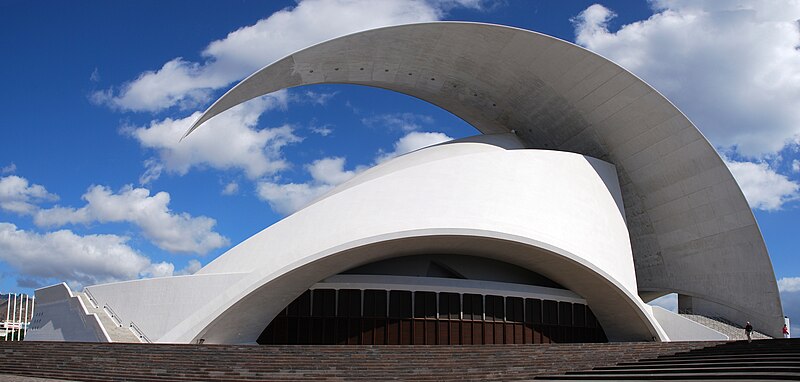
The Auditorio de Tenerife, in Santa Cruz de Tenerife (Spain).
Wladyslaw · Taxiarchos228
Notes from the source article
Cited by Wikipedia
Notes from the source article
These works are cited by the source article, in its own numbering. They are recorded as its citations, not as sources VALÉORINE has verified.
- 1.Bethune, Meredith. An Inside Look at One of Zaha Hadid's Final Projects: China's Futuristic Jumeirah Nanjing Hotel. Robb Report. 31 July 2019.
- 2.Neo-futurism. Designing Buildings, the Construction Wiki. 14 May 2021.
- 3.Santiago Calatrava's Neo-Futuristic Architecture. Special Travel International.
- 4.Neo-futurism: An Overview for Students in Architecture Training. digitalschool.ca. 14 June 2018.
- 5.Tyc, Grzegorz. (Re)searching Forms of the Future. Futurism and Contemporary Architecture. 2018.
- 6.Asim, Farhan. A Century of Futurist Architecture: from Theory to Reality. Journal of Civil Engineering and Environmental Technology. 5. 6. 338–343. July–September 2018. 2349-8404.
- 7.Mathieu Lehanneur. Mathieu Lehanneur recommends. TED (conference). 17 November 2009.
- 8.Kristi York Wooten. How 1980s Atlanta Became the Backdrop for the Future. The Atlantic. 30 March 2015.
- 9.John portman News, Videos, Reviews and Gossip – io9. io9.
- 10.Big dreams and angry protests swirl at abandoned Athens airport. Reuters.com. 26 June 2014.
- 11."Jan Kaplický" Video – Buildings and Interviews. OVGuide.
- 12.If Famous Buildings And Paintings Made Babies, They'd Look Like This. Co.Design. 5 September 2014.
- 13.Christie Chu. Imagining the Artist-Architect Collabos That Never Were. artnet News. 14 September 2014.
- 14.Amstel Art Gallery London Archivio Marco Lodola Pop Art Design.
- 15.Asiacontemporaryart.com. ASIA CONTEMPORARY ART – Amstel Art Gallery.
- 16.Fieramilanonews.it. In Brief – Fiera Milano News.
- 17.neo-futurism. designingbuildings.
- 18.Anthony Vidler. Histories of the immediate present: inventing architectural modernism. MIT Press, Massachusetts Institute of Technology. 2008.
- 19.Erskine Design. Frieze Magazine – Archive – The Enclosure Business. frieze.
- 20.Vito Di Bari vuelve a Colombia. Computer World Colombia. 3 October 2014.
- 21.Di Bari, Vito. Manifesto of Neo-Futuristic City. Helena Pinillos. 2014.
- 22.From Manifesto to Futurist Architecture. World Architecture.
- 23.BIE – Bureau International des Expositions. bie-paris.org.
- 24.MoreArtCulture Messenger: Vito Di Bari on Wednesday and Your Week in Arts + Culture. constantcontact.com.
- 25.The economic renaissance led by the Internet of Things. I-cioc.om.
- 26.UNESCO. Agreement between UNESCO and the City of Milan concerning the International Multimedia Institute (IMI) – Appointment of Executive Director – UNESCO Archives ICA AtoM catalogue. 8 October 1999.
- 27.Manifesto of Neo-Futuristic City in www.neofuturistic.com
- 28.The Concept Of "Sustainable Development" And The Challenges Of Economic Growth And Development In Nigeria. Katsina-Ala Multidisciplinary Journal. 24 July 2014.
- 29.World Commission on Environment and Development. Our Common Future. Oxford University Press. 27. 2007. 978-0192820808.
- 30.Young, J. Now That's What I Call Neo-Futurism. Surrealist Taxi BV. 2018.
- 31.The Neo-Futurist Manifesto. Neo-Futurist Collective. 26 October 2014.
- 32.The Future of Architecture Since 1889. Cool Hunting.
- 33.Library.stmarytx.edu. Blume Library Mobile.
- 34.Ilfeld, Etan Jonathan. Beyond Contemporary Art. Vivays Publishing. 2012. 978-1-908126-22-1.
- 35.Whiteley, Nigel. Reyner Banham: Historian of the Immediate Future. MIT Press. 2002. 978-0262731652.
- 36.Banham, Reyner. A Clip-on Architecture. Architectural Design. 35. 11.
- 37.Phillips, Matthew. The Neofuturist Aesthetic: Technology and counterfuture in the electronic avant-garde. Tiny Mixtapes. 7 August 2020.
- 38.Sma.sciarc.edu. Neofuturism Architecture And Technology, SCI-Arc Media Archive. 5 October 1987.
- 39.Los Angeles Forum for architecture and urban design, Scott Johnson
- 40.The Los Angeles Chapter of The American Institute for Architects, Alan Hess, William Pereira: Designing Modern Los Angeles, 2013
- 41.Hugh Pearman. Airports: A Century of Architecture. Laurence King Publishing. 2004. 978-1-85669-356-1.
- 42.Archived copy.
- 43.Sydney Opera House, Sydney - SkyscraperPage.com. skyscraperpage.com.
- 44.ឯកសារសំខាន់! ស្វែងយល់ពីស្ថាបត្យករអង់គ្លេសដើមកំណើតអ៉ីរ៉ាក់ លោកស្រី Zaha Hadid (មាន Video Clip). Village of Wonder.
- 45.Spotlight: Santiago Calatrava. ArchDaily.
- 46.Santiago Calatrava. Mediander.
- 47.Denis Laming Architectes. laming.fr.
- 48.Denis Laming, L'Architecte du Futuroscope. Sortir à Poitiers. 25 May 2012.
- 49.Williams, Nicola. The Loire. Lonely Planet. 47–. 2002. 978-1-86450-358-6.
- 50.King of good times. India Today. 19 October 2009.
- 51.Japanese Fashion Designer Literally Flexes Muscles with 3D Printing. Stratasys Blog.
- 52.Netcommunity.se. Yuima Nakazato creates neo-futuristic sportswear with an Objet500 Connex multi-material 3D Printer [7559] – Prototyp.
- 53.Boingboing.net. Swedish seventies neoretrofuturism: the paintings of Simon Stålenhag. 21 August 2013.
- 54.Neofuturistic Vectors by Charis Tsevis. Fatlace. 15 September 2010.
- 55.Caridad, Paul. Neofuturistic Vectors and Vibrant Mosaics. Visual News.
- 56.Lord Norman Foster. Encyclopædia Britannica.
- 57.Geocities.jp. My Gallery Space 『・・・・ノ、セカイ』.
Bibliography printed in the source article · 15
- Cohen, Jean-Louis. The Future of Architecture. Since 1889. Phaidon Press. 2012. 978-0714845982.
- Di Bari V. 100 years: From Manifesto of futurist architecture to the Neofuturistic city manifesto. 2007.
- Foster, Hal. Neo-Futurism: Architecture and Technology. AA Files. Architectural Association School of Architecture. 14. 25–27. 1987. 29543561.
- Foster, Hal. What's Neo about the Neo-Avant-Garde?. October. MIT Press. 70. 5–32. 1994. 10.2307/779051.
- Rowena Easton, The NeoFuturist Manifesto, 2008
- Klein, Caroline. Futuristic: Visions of Future Living. DAAB Media. 2013. 978-3942597098.
- A History of Neo-Futurism, Erica Anne Milkovich, 2010 - Avant-garde (Aesthetics)
- Gunther Berghaus, From Futurism to Neo-Futurism, in Avant-garde/Neo-avant-garde, 2005, published by Dietrich Scheunemann, Rodopi BV
- Colin Rowe, Fred Koetter, After the Millennium, in Collage City, 1983, published by Architecture – The MIT Press, Cambridge, MA
- Etan Jonathan Ilfeld, Beyond Contemporary Art, 2012, Vivays Publishing, London
- Anthony Vidler, Histories of the immediate present, 2008 MIT Press, Massachusetts Institute of Technology
- Reyner Banham, "A Clip-on Architecture," Architectural Design 35, no. 11
- Reyner Banham: Historian of the Immediate Future (Cambridge: MIT Press, 2002)
- Ru Brown, FUTURISM IS DEAD LONG LIVE FUTURISM The legacy of techno-love in contemporary design, 2011, University of Washington – MDes Design Investigations
- Gabriel Gyang Dung, Bridget Mlumun Akaakohol, J.C. Akor – The Concept Of Sustainable Development And The Challenges Of Economic Growth And Development In Nigeria – July 2014, Department of Economics, College of Education, Katsina-Ala.
References
Citations
References
Each reference names the institution holding it, so a reader may go to the document itself.
reference work
Partially resolvedreference work
Partially resolved
The Encyclopedia exists whether or not anything is for sale. Corrections are recorded rather than overwritten, and every version of this record is kept. Published 14 August 2026.
Elsewhere in Terminology
620 published records in this field, each with its sources named.
- NederbeatMovement
- neo kymaMovement
- Neo-conceptual artMovement
- neo-concrete movementMovement
- Neo-GrecMovement
- Neo-Mamluk architectureMovement
- neo-primitivismMovement
- NeoclassicismMovement
Best supported in this field
For owners
Own an object connected with neo-futurism?
A specialist will read what you send and tell you what the house can establish, what it cannot, and whether the object is suited to sale. There is no charge and no obligation. The object stays with you throughout; nothing is shipped to us unless it is arranged in writing beforehand.