
Neil Gaiman
Neil Richard MacKinnon Gaiman (born Neil Richard Gaiman; 10 November 1960) is an English author of short fiction, novels, comic books, audio theatre, and screenplays. His works include the comic series The Sandman (1989–1996) and the novels Good Omens (1990), Stardust (1999), American Gods (2001), Coraline (2002), Anansi Boys (2005), The Graveyard Book (2008) and The Ocean at the End of the Lane (2013). He co-created the TV adaptations of Good Omens and The Sandman.
Also recorded as Gaiman, Neil Richard MacKinnon · N. Gaiman · N. R. Gaiman
Neil Gaiman

Manfred Werner - Tsui · CC BY-SA 3.0
- Born
- 1960.
- Nationality
- United Kingdom.
- Occupation
- beekeeper, comics writer, novelist, journalist, blogger, film producer, writer, science fiction writer, poet and screenwriter.
- Fields
- fantasy, horror literature, science fiction, dark fantasy, comedy and feminist science fiction.
- Known for
- The Sandman, American Gods, Stardust, Coraline, The Graveyard Book and Good Omens.
VALÉORINE Encyclopedia
VALÉORINE documentary reading
Documentary summary
Neil Richard MacKinnon Gaiman (born Neil Richard Gaiman; 10 November 1960) is an English author of short fiction, novels, comic books, audio theatre, and screenplays. His works include the comic series The Sandman (1989–1996) and the novels Good Omens (1990), Stardust (1999), American Gods (2001), Coraline (2002), Anansi Boys (2005), The Graveyard Book (2008) and The Ocean at the End of the Lane (2013). He co-created the TV adaptations of Good Omens and The Sandman.
Admitted source layer · organised and presented by VALÉORINE
Note VALÉORINE
Neil Gaiman (born 1960) is a British beekeeper, blogger and comics writer, among other activities. The beekeeper worked in Cambridge, London and Minneapolis.
Works include American Gods, Coraline, Good Omens and Stardust, among others. Genres include comedy, dark fantasy and fantasy, among others.
Composed from admitted, traceable facts · 27 September 2026
VALÉORINE
Reference Check
Propose documentary evidence for Neil Gaiman. A contribution is never written directly as fact: identity, source, rights and evidence gates still decide.
Sign in to contribute
Documentary evidence
Evidence Panel
not yet certified
- Identity
- resolved
- Independent source families
- 0
- Admitted assertions
- 0
- Open conflicts
- 0
Authority files
wikidata · Q210059 · wikipedia · Neil Gaiman
In this article
Early life and education
Early life and education
Gaiman's awards include Hugo, Nebula, and Bram Stoker awards and Newbery and Carnegie medals. He is the first author to win the Newbery and the Carnegie medals for the same work, The Graveyard Book. The Ocean at the End of the Lane was voted Book of the Year in the British National Book Awards, and it was adapted into an acclaimed stage play at the Royal National Theatre in London. Beginning in 2024, news outlets published sexual assault accusations against Gaiman by numerous women. This affected or halted production on several adaptations of his work. One accuser sued Gaiman and his estranged wife Amanda Palmer for rape and human trafficking. Gaiman has denied these allegations.
Neil Richard Gaiman was born on 10 November 1960 in Portchester, Hampshire. Gaiman's family is of Polish-Jewish and other Ashkenazi origins. His great-grandfather emigrated to England from Antwerp before 1914 and his grandfather settled in Portsmouth and established a chain of grocery stores, changing the family name from Chaiman to Gaiman. His father, David Bernard Gaiman, worked in the same chain of stores; his mother, Sheila Gaiman (née Goldman), was a pharmacist. Neil has two younger sisters, Claire and Lizzy. The Gaimans moved in 1965 to the West Sussex town of East Grinstead, where his parents studied Dianetics at the Scientology centre in the town; one of Gaiman's sisters works for the Church of Scientology in Los Angeles. His other sister, Lizzy Calcioli, has said, "Most of our social activities were involved with Scientology or our Jewish family. It would get very confusing when people would ask my religion as a kid. I'd say, 'I'm a Jewish Scientologist.'" Gaiman says that he is not a Scientologist, and that like Judaism, Scientology is his family's religion. About his personal views, Gaiman has stated, "I think we can say that God exists in the DC Universe. I would not stand up and beat the drum for the existence of God in this universe. I don't know, I think there's probably a 50/50 chance. It doesn't really matter to me." Gaiman was able to read at the age of four. He said, "I was a reader. I loved reading. Reading things gave me pleasure. I was very good at most subjects in school, not because I had any particular aptitude in them, but because normally on the first day of school, they'd hand out schoolbooks, and I'd read them—which would mean that I'd know what was coming up because I'd read it." When he was about 10 years old, he read his way through the works of Dennis Wheatley; The Ka of Gifford Hillary and The Haunting of Toby Jugg made a special impact on him. Another work that made a particular impression was J. R. R. Tolkien's The Lord of the Rings, which he got from his school library. Although they only had the first two of the novel's three volumes, Gaiman consistently checked them out and read them. He later won the school English prize and the school reading prize, enabling him to finally acquire the third volume. For his seventh birthday, Gaiman received C. S. Lewis's The Chronicles of Narnia. He later recalled that "I admired his use of parenthetical statements to the reader, where he would just talk to you... I'd think, 'Oh, my gosh, that is so cool! I want to do that! When I become an author, I want to be able to do things in parentheses.' I liked the power of putting things in brackets." Narnia also introduced him to literary awards, specifically the Carnegie Medal, won by the concluding volume in 1956. When Gaiman won the 2010 Medal himself, he said "it had to be the most important literary award there ever was" and "if you can make yourself aged seven happy, you're really doing well – it's like writing a letter to yourself aged seven." Lewis Carroll's Alice's Adventures in Wonderland was another childhood favourite, and "a favourite forever. Alice was default reading to the point where I knew it by heart." He also enjoyed Batman comics. Gaiman was educated at several Church of England schools, including Fonthill School in East Grinstead, Ardingly College (1970–1974), and Whitgift School in Croydon (1974–1977). His father's position as a public relations official of the Church of Scientology was the cause of the seven-year-old Gaiman being forced to withdraw from Fonthill School and return to the school which he had previously attended. He lived in East Grinstead for many years, from 1965 to 1980 and again from 1984 to 1987. In the 1970s, he spent three years as an auditor for the Church of Scientology, an unusually high-ranking position given his age. He also sang in a punk rock band Ex Execs, formerly called Chaos. He met his first wife, Mary McGrath, while she was studying Scientology and living in a house in East Grinstead that was owned by his father. The couple were married in 1985 after having their first child.
Personal life
Personal life
Gaiman moved near Menomonie, Wisconsin, in 1992 to be closer to the family of his then-wife, Mary McGrath, with whom he has three children. Gaiman has also lived in Cambridge, Massachusetts. He was close friends with fellow author Terry Pratchett until the latter's death in 2015. Gaiman met Amanda Palmer in 2008, and the two entered a relationship in 2009, marrying in 2011. They have one son together. The two had an open marriage, and encouraged one another to have other partners, including fans of their work. Gaiman, Palmer and their son moved to New Zealand in March 2020. Weeks later, their marriage collapsed and Gaiman left the country, travelling from New Zealand to his holiday home on the Isle of Skye, which broke COVID-19 lockdown rules. Ross, Skye and Lochaber MP Ian Blackford described Gaiman's behaviour as unacceptable and dangerous. Gaiman published an apology on his website, saying he had endangered the local community. After Gaiman's departure, Palmer announced on Patreon that she and Gaiman had separated. Gaiman stated the split was "my fault, I'm afraid", and requested privacy. The couple later released a joint statement clarifying that they were not getting divorced, reconciled in 2021, but confirmed they would divorce in a November 2022 joint statement. As of January 2025, in the fifth year of proceedings, negotiations had become "ugly", with Palmer moving in with her parents due to financial difficulties.
Blog and social media
Other personal relationships
Other personal relationships
Gaiman is godfather to Tori Amos's daughter Tash, and wrote a poem called "Blueberry Girl" for Tori and Tash. The poem was adapted into a book by illustrator Charles Vess. Gaiman read the poem aloud to an audience at the Sundance Kabuki Theater in San Francisco on 5 October 2008 during his book reading tour for The Graveyard Book. It was published in March 2009 with the title Blueberry Girl.
Advocacy
Advocacy
In 2016, Gaiman, along with several other celebrities, appeared in the video "What They Took With Them", from the United Nations High Commissioner for Refugees, to help raise awareness of the issue of global refugees. Gaiman is a supporter of the Comic Book Legal Defense Fund and has served on its board of directors. In 2013, Gaiman was named co-chair of the organization's newly formed advisory board. In 2022, during the Russian invasion of Ukraine, Gaiman supported Ukraine by announcing on Twitter that he does not want to renew contracts with Russian publishers. Gaiman also encouraged donating to Ukrainian refugees. In 2023, Gaiman signed an open letter addressed to Russian president Vladimir Putin, alongside over 100 other public figures, calling for the release of Russian prisoner Alexei Navalny.
Journalism, early writings, and literary influences
Journalism, early writings, and literary influences
Gaiman has mentioned several writers who have influenced his work, including Mary Shelley, Rudyard Kipling, Edgar Allan Poe, Michael Moorcock, Dave Sim, Alan Moore, Steve Ditko, Will Eisner, Ursula K. Le Guin, Harlan Ellison, John Crowley, Lord Dunsany, G. K. Chesterton and Gene Wolfe. A lifetime fan of the Monty Python comedy troupe, he owned a copy of Monty Python's Big Red Book as a teenager. During a trip to France when he was 13, Gaiman became fascinated with the visually fantastic world in the stories of Métal Hurlant, even though he could not understand the words. When he was 19 or 20 years old, he contacted his favourite science fiction writer, R. A. Lafferty, requesting advice on becoming an author and including a Lafferty pastiche he had written. Lafferty sent Gaiman an encouraging and informative letter back, along with literary advice. Gaiman has named Roger Zelazny as the author who influenced him the most. Gaiman claims that other authors such as Samuel R. Delany and Angela Carter "furnished the inside of my mind and set me to writing". Gaiman takes inspiration from the folk tales tradition, citing Otta F Swire's book on the legends of the Isle of Skye as his inspiration for The Truth Is a Cave in the Black Mountains. In the early 1980s, Gaiman pursued journalism, conducting interviews and writing book reviews, as a means to learn about the world and to make connections that he hoped would later assist him in getting published. He wrote and reviewed extensively for the British Fantasy Society. His first professional short story publication was "Featherquest", a fantasy story, in Imagine magazine in May 1984. While waiting for a train at London's Victoria Station in 1984, Gaiman noticed a copy of Swamp Thing by Alan Moore, and read it. Moore's approach to comics had such an impact on Gaiman that he later wrote "that was the final straw, what was left of my resistance crumbled. I proceeded to make regular and frequent visits to London's Forbidden Planet shop to buy comics". In 1984, he wrote his first book, a biography of the band Duran Duran, and co-edited Ghastly Beyond Belief, a book of quotations, with Kim Newman. Although Gaiman thought he had done a terrible job, the book's first edition sold out very quickly. When he went to relinquish his rights to the book, he discovered the publisher had gone bankrupt. After this, he was offered a job by Penthouse. He refused the offer. He also wrote interviews and articles for many British magazines, including Knave. During this, he sometimes wrote under pseudonyms, including Gerry Musgrave, Richard Grey, and "a couple of house names". Gaiman has said he ended his journalism career in 1987 because British newspapers regularly publish untruths as fact. In the late 1980s, he wrote Don't Panic: The Official Hitchhiker's Guide to the Galaxy Companion in what he calls a "classic English humour" style. Following this, he wrote the opening of what became his collaboration with Terry Pratchett on the comic novel Good Omens, about the impending apocalypse.
Comics
Comics
After forming a friendship with Alan Moore, who taught him how to write comic scripts, Gaiman started writing comic books and picked up Miracleman after Moore finished his run on the series. He continued his professional relationship with Moore by contributing quotations for the supplemental materials in the Watchmen comic book series. Gaiman and artist Mark Buckingham collaborated on several issues of the series before its publisher, Eclipse Comics, collapsed, leaving the series unfinished. His first published comic strips were four short Future Shocks for 2000 AD in 1986–87. He wrote three graphic novels with his favourite collaborator and long-time friend Dave McKean: Violent Cases, Signal to Noise, and The Tragical Comedy or Comical Tragedy of Mr. Punch. Impressed with his work, DC Comics hired him in February 1987, and he wrote the limited series Black Orchid. Karen Berger, who later became head of DC Comics's Vertigo, read Black Orchid and offered Gaiman a job: to re-write an old character, the Sandman, but to put his own spin on him. The Sandman tells the tale of the ageless, anthropomorphic personification of Dream that is known by many names, including Morpheus. The series began in January 1989 and concluded in March 1996. The various artists who contributed to the series include Sam Kieth, Mike Dringenberg, Jill Thompson, Shawn McManus, Marc Hempel, and Michael Zulli, with lettering by Todd Klein, colours by Daniel Vozzo, and covers by Dave McKean. The series became one of DC's top selling titles, eclipsing even Batman and Superman. The 75 issues of the regular series, along with an illustrated prose text and a special containing seven short stories, have been collected into 12 volumes that remain in print. In the eighth issue of The Sandman, Gaiman and artist Mike Dringenberg introduced Death, the older sister of Dream, who became as popular as the series' title character. The limited series Death: The High Cost of Living launched DC's Vertigo line in 1993. Comics historian Les Daniels called Gaiman's work "astonishing" and noted that The Sandman was "a mixture of fantasy, horror, and ironic humor such as comic books had never seen before". DC Comics writer and executive Paul Levitz observed that "The Sandman became the first extraordinary success as a series of graphic novel collections, reaching out and converting new readers to the medium, particularly young women on college campuses, and making Gaiman himself into an iconic cultural figure." Gaiman and Jamie Delano were to become co-writers of the Swamp Thing series following Rick Veitch. An editorial decision by DC to censor Veitch's final storyline caused both Gaiman and Delano to withdraw from the title. Gaiman produced two stories for DC's Secret Origins series in 1989: a Poison Ivy tale drawn by Mark Buckingham and a Riddler story illustrated by Bernie Mireault and Matt Wagner. A story that Gaiman originally wrote for Action Comics Weekly in 1989 was shelved due to editorial concerns but it was finally published in 2000 as Green Lantern/Superman: Legend of the Green Flame. In 1990, Gaiman wrote The Books of Magic, a four-part mini-series that provided a tour of the mythological and magical parts of the DC Universe through a frame story about an English teenager who discovers that he is destined to be the world's greatest wizard. The miniseries was popular, and sired an ongoing series written by John Ney Rieber. Gaiman's adaptation of Sweeney Todd, illustrated by Michael Zulli for Stephen R. Bissette's publication Taboo, was stopped when the anthology itself was discontinued. In the mid-1990s, he also created a number of new characters and a setting that was to be featured in a title published by Tekno Comix. The concepts were then altered and split between three titles set in the same continuity: Lady Justice, Mr. Hero the Newmatic Man, and Teknophage, and tie-ins. Because the publisher aimed to expand their characters into other media such as television, Gaiman designed his concepts with potential TV and computer game adaptations in mind. Although his name appeared prominently as the creator of the characters, he was not involved in writing any of the above-mentioned books. Gaiman wrote a semi-autobiographical story about a boy's fascination with Michael Moorcock's anti-hero Elric of Melniboné for Ed Kramer's anthology Tales of the White Wolf. In 1996, Gaiman and Kramer co-edited The Sandman: Book of Dreams. Nominated for the British Fantasy Award, the original fiction anthology featured stories and contributions by Tori Amos, Clive Barker, Gene Wolfe, Caitlín R. Kiernan, Tad Williams, and others. Asked why he likes comics more than other forms of storytelling, Gaiman said: One of the joys of comics has always been the knowledge that it was, in many ways, untouched ground. It was virgin territory. When I was working on Sandman, I felt a lot of the time that I was actually picking up a machete and heading out into the jungle. I got to write in places and do things that nobody had ever done before. When I'm writing novels I'm painfully aware that I'm working in a medium that people have been writing absolutely jaw-droppingly brilliant things for, you know, three-four thousand years now. You know, you can go back. We have things like The Golden Ass. And you go, well, I don't know that I'm as good as that and that's two and a half thousand years old. But with comics I felt like – I can do stuff nobody has ever done. I can do stuff nobody has ever thought of. And I could and it was enormously fun. Gaiman wrote two series for Marvel Comics. Marvel 1602 was an eight-issue limited series published from November 2003 to June 2004 with art by Andy Kubert and Richard Isanove. The Eternals was a seven-issue limited series drawn by John Romita Jr., which was published from August 2006 to March 2007. In 2009, Gaiman wrote a two-part Batman story for DC Comics to follow Batman R.I.P. titled "Whatever Happened to the Caped Crusader?" a play-off of the classic Superman story "Whatever Happened to the Man of Tomorrow?" by Alan Moore. He contributed a twelve-part Metamorpho serial drawn by Mike Allred for Wednesday Comics, a weekly newspaper-style series. Gaiman and Paul Cornell co-wrote Action Comics #894 (December 2010), which featured an appearance by Death. In October 2013, DC Comics released The Sandman: Overture with art by J. H. Williams III. Gaiman's Angela character was introduced into the Marvel Universe in the last issue of the Age of Ultron miniseries in 2013. Gaiman oversaw The Sandman Universe, a line of comic books published by Vertigo. The four series — House of Whispers, Lucifer, The Books of Magic, and The Dreaming — were written by new creative teams. The line launched on 8 August 2018. After teaming with Colleen Doran for a series of graphic novel adaptations based on his short stories "Troll Bridge", "Chivalry", and "Snow, Glass, Apples", Gaiman and the Terry Pratchett estate chose Doran to adapt Good Omens into graphic novel form, and to self publish the work via the Pratchett estate's Dunmanifestin label. It was financed on Kickstarter where it became a record-setter in less than a week as the top fan-supported and top-earning comics project in the history of the platform.
Novels
Novels
In a collaboration with author Terry Pratchett, best known for his series of Discworld novels, Gaiman's first novel Good Omens was published in 1990. In 2011, Pratchett said that while the entire novel was a collaborative effort and most of the ideas could be credited to both of them, Pratchett did a larger portion of writing and editing if for no other reason than Gaiman's scheduled involvement with Sandman. The 1996 novelisation of Gaiman's teleplay for the BBC mini-series Neverwhere was his first solo novel. The novel was released in tandem with the television series, though it presents some notable differences from the television series. Gaiman has since revised the novel twice, the first time for an American audience unfamiliar with the London Underground, the second time because he felt unsatisfied with the originals. In 1999, the first printings of his fantasy novel Stardust were released. The novel has been released both as a standard novel and in an illustrated text edition. This novel was highly influenced by Victorian fairytales and culture. American Gods became one of Gaiman's best-selling and multi-award-winning novels upon its release in 2001. A special 10th Anniversary edition was released, with the "author's preferred text" 12,000 words longer than the original mass-market editions. Gaiman has not written a direct sequel to American Gods but he has revisited the characters. A glimpse at Shadow's travels in Europe is found in a short story which finds him in Scotland, applying the same concepts developed in American Gods to the story of Beowulf. The 2005 novel Anansi Boys deals with Anansi ('Mr. Nancy'), tracing the relationship of his two sons, one semi-divine and the other an unassuming bookkeeper, as they explore their common heritage. It debuted at number one on The New York Times Best Seller list. In 2002, Gaiman entered the world of children's books with the dark fairy tale Coraline. In 2008 he released a young adult novel, The Graveyard Book. It follows the adventures of a boy named Bod after his family is murdered and he is left to be brought up by a graveyard. It is heavily influenced by Rudyard Kipling's The Jungle Book and H. P. Lovecraft’s The Dream-Quest of Unknown Kadath. Literary critic Danel Olson defended it as one of the first canonical novels of 21st century Gothic literature. As of late January 2009, it had been on The New York Times Bestseller children's list for fifteen weeks. In 2013, The Ocean at the End of the Lane was voted Book of the Year in the British National Book Awards. The novel follows an unnamed man who returns to his hometown for a funeral and remembers events that began forty years earlier. Themes include the search for self-identity and the "disconnect between childhood and adulthood". It was later adapted into a critically acclaimed stage play at the Royal National Theatre in London. In September 2016, Neil Gaiman announced that he had been working for some years on retellings of Norse mythology. Norse Mythology was released in February 2017. Several of his novels have been published as paperbacks with retro covers by artist Robert McGinnis.
Radio
Radio
A six-part radio play of Neverwhere was broadcast in March 2013, adapted by Dirk Maggs for BBC Radio 4 and Radio 4 Extra. The performance featured James McAvoy as Richard, Natalie Dormer, Benedict Cumberbatch, Christopher Lee, Bernard Cribbens, and Johnny Vegas. In September 2014, Gaiman and Terry Pratchett joined forces with BBC Radio 4 to make the first-ever dramatisation of their co-penned novel Good Omens, which was broadcast in December in five half-hour episodes and culminated in an hour-long final apocalyptic showdown. In 2021, Gaiman was cast as Duke Aubrey in an adaptation of Hope Mirrlees' Lud-in-the-Mist, a novel Gaiman had previously proclaimed one of his favourites (and to which he had contributed a foreword for an edition by Cold Spring Press), for BBC Radio 4.
Public performances
Public performances
Gaiman frequently performs public readings from his stories and poetry, and has toured with his wife, musician Amanda Palmer. In some of these performances he has also sung songs, in "a novelist's version of singing", despite having "no kind of singing voice". In 2015, Gaiman delivered a 100-minute lecture for the Long Now Foundation entitled How Stories Last about the nature of storytelling and how stories persist in human culture. In April 2018, Gaiman made a guest appearance on the television show The Big Bang Theory, and his tweet about the show's fictional comic book store became the central theme of the episode "The Comet Polarization".
Intellectual property disputes
Intellectual property disputes
In 1993, Gaiman was contracted by Todd McFarlane to write a single issue of Spawn, for Image Comics, which McFarlane had recently co-founded. McFarlane was promoting his new title by having guest authors Gaiman, Alan Moore, Frank Miller, and Dave Sim each write a single issue. In issue No. 9 of the series, Gaiman introduced the characters Angela, Cogliostro, and Medieval Spawn. Prior to this issue, Spawn was an assassin who worked for the government and came back as a reluctant agent of Hell but had no real direction in his actions. In Angela, a cruel and malicious angel, Gaiman introduced a character who threatened Spawn's existence, as well as providing a moral opposite. Cogliostro was introduced as a mentor character for exposition and instruction, providing guidance. Medieval Spawn introduced a history and precedent that not all Spawns were self-serving or evil, giving additional character development to Malebolgia, the demon that creates Hellspawn. As intended, all three characters were used repeatedly throughout the next decade by Todd McFarlane within the wider Spawn universe. In papers filed by Gaiman in early 2002, however, he claimed that the characters were jointly owned by their scripter (himself) and artist (McFarlane), not merely by McFarlane in his role as the creator of the series. Disagreement over who owned the rights to a character was the primary motivation for McFarlane and other artists to form Image Comics (although that argument related more towards disagreements between writers and artists as character creators). As McFarlane used the characters without Gaiman's permission or royalty payments, Gaiman believed his copyrighted work was being infringed upon, which violated their original oral agreement. McFarlane initially agreed that Gaiman had not signed away any rights to the characters, and negotiated with Gaiman to effectively "swap" McFarlane's interest in the character Marvelman. McFarlane had purchased an interest in the character when Eclipse Comics was liquidated while Gaiman was interested in being able to continue his aborted run of the Marvelman title. McFarlane later changed his initial position, claiming that Gaiman's work had only been work-for-hire and that McFarlane owned all of Gaiman's creations entirely. The presiding judge, however, ruled against their agreement being work for hire, based in large part on the legal requirement that "copyright assignments must be in writing." The Seventh Circuit Court of Appeals upheld the district court ruling in February 2004 granting joint ownership of the characters to Gaiman and McFarlane. On the specific issue of Cogliostro, presiding Judge John C. Shabaz proclaimed, "The expressive work that is the comic-book character Count Nicholas Cogliostro was the joint work of Gaiman and McFarlane—their contributions strike us as quite equal—and both are entitled to ownership of the copyright". Similar analysis led to similar results for the other two characters, Angela and Medieval Spawn. This legal battle was brought by Gaiman and the specifically formed Marvels and Miracles, LLC, which Gaiman had previously created to help sort out the legal rights surrounding Marvelman. Gaiman had written Marvel 1602 in 2003 to help fund this project and all of Gaiman's profits for the original issues of the series were donated to Marvels and Miracles. The rights to Marvelman were subsequently purchased, from original creator Mick Anglo, by Marvel Comics in 2009. Gaiman returned to court again over the Spawn characters Dark Ages Spawn, Domina, and Tiffany, claiming that they were "derivative of the three he co-created with McFarlane." The judge ruled that Gaiman was right in these claims as well and gave McFarlane until the beginning of September 2010 to settle the matter.
Sexual assault and misconduct allegations
Sexual assault and misconduct allegations
In July and August 2024, five women accused Gaiman of sexual assault and abuse. All five were interviewed on the Tortoise Media podcast Master: The Allegations Against Neil Gaiman. One, using the pseudonym "Claire", was also interviewed by The New York Times. Claire described non-consensual kissing and groping by Gaiman after meeting him at a book tour event, as well as a $60,000 payment from Gaiman to her in August 2022. A woman identified as "K", who also first met Gaiman at a book signing, said that during their relationship he subjected her to painful sex that she "neither wanted nor enjoyed". Scarlett Pavlovich, a former nanny for Gaiman and Amanda Palmer's child, alleges that Gaiman sexually assaulted her within hours of their first meeting in February 2022. Pavlovich recalled that he said, "Amanda told me I couldn't have you" after the assault; according to one of Palmer's friends, Palmer had previously told Gaiman, "You could really hurt this person and break her; keep your hands off of her". Pavlovich said that Gaiman had anal sex with her in the presence of his son. Caroline Wallner, a former tenant of Gaiman's, alleges that he demanded sexual favours in exchange for being allowed to continue living on his property. Wallner says that on one occasion, Gaiman grabbed her hand and placed it on his penis while his young son was asleep in the same bed. In 2021, Wallner, her ex-husband, and Gaiman signed a non-disclosure agreement (NDA), and Gaiman paid Wallner $275,000. In early 2025, Gaiman and Wallner both requested arbitration, the dispute resolution method mandated by the NDA, each accusing the other of violating the agreement. The writer Julia Hobsbawm accused Gaiman of "an aggressive, unwanted pass" and described how Gaiman pushed her onto a sofa and French kissed her in 1986. In September 2024, Disney halted production on the film adaptation of The Graveyard Book due to a variety of factors, including the sexual assault allegations against Gaiman. That same month, production on season three of Good Omens was put on hold; Gaiman ultimately left the project in October. In January 2025, New York magazine published a cover story detailing the allegations against Gaiman. This article, which was published online on Vulture, included interviews with four of the women who had previously spoken to Tortoise Media, as well as four more women. Later the same month, Dark Horse Comics announced that they would cut ties with Gaiman over the allegations, including cancelling his ongoing comic adaptation of Anansi Boys. Gaiman was also dropped as a client by his agent Casarotto Ramsay. In February 2025, Pavlovich filed three federal lawsuits in the US that alleged human trafficking under the Trafficking Victims Protection Act, alongside formal allegations of sexual assault and coercion. One named Gaiman and Palmer as co-defendants and two were against Palmer alone, seeking at least US$7 million in damages. In his response to the lawsuit, Gaiman accused Pavlovich of lying, presenting text messages in which she appeared to confirm that no sexual abuse had taken place, and claimed that police in New Zealand had already investigated her claims and found them to be false. Gaiman also argued that the American court lacked jurisdiction to hear the case—because the alleged assaults happened in New Zealand—and asked for the case to be dismissed. A Wisconsin federal judge granted this request without ruling on the facts of the case, and Pavlovich appealed the dismissal. Pavlovich's remaining US lawsuits against Gaiman were dismissed in October 2025 and February 2026, noting the proper location to pursue any potential case is New Zealand. Gaiman has denied engaging in non-consensual sex, and dismissed Hobsbawm's allegations as misreading the situation. Gaiman's representatives claim that Wallner initiated their sexual encounters and that none of these occurred in the presence of Gaiman's child. In a blog post responding to coverage of the allegations against him, Gaiman said there were "moments I half-recognise and moments I don't". He denied engaging in any non-consensual sexual activity, but said he could have "done so much better" and was "trying to do the work needed".
Literary allusions
Literary allusions
Gaiman's work is known for its use of allusions. Meredith Collins, for instance, has commented upon the degree to which his novel Stardust depends on allusions to Victorian fairy tales and culture. In The Sandman, literary figures and characters appear often; the character of Fiddler's Green is modeled on G. K. Chesterton, and both William Shakespeare and Geoffrey Chaucer appear as characters, as do several characters from A Midsummer Night's Dream and The Tempest. The comic also draws from numerous mythologies. Analyzing Gaiman's The Graveyard Book, bibliographer and librarian Richard Bleiler detects patterns of and allusions to the Gothic novel, from Horace Walpole's The Castle of Otranto to Shirley Jackson's The Haunting of Hill House. He concludes that Gaiman is "utilizing works, characters, themes, and settings that generations of scholars have identified and classified as Gothic... [yet] subverts them and develops the novel by focusing on the positive aspects of maturation, concentrating on the values of learning, friendship, and sacrifice." Regarding another work's assumed connection and allusions to this form, Gaiman himself quipped: "I've never been able to figure out whether Sandman is a gothic." Clay Smith has argued that this sort of allusiveness serves to situate Gaiman as a strong authorial presence in his own works, often to the exclusion of his collaborators. However, Smith's viewpoint is in the minority: to many, if there is a problem with Gaiman's scholarship and intertextuality it is that "... his literary merit and vast popularity have propelled him into the nascent comics canon so quickly that there is not yet a basis of critical scholarship about his work." David Rudd takes a more generous view in his study of the novel Coraline, where he argues that the work plays and riffs productively on Sigmund Freud's concept of Unheimlich ("the Uncanny"). Though Gaiman's work is frequently seen as exemplifying the monomyth structure laid out in Joseph Campbell's The Hero with a Thousand Faces, Gaiman says that he started reading The Hero with a Thousand Faces but refused to finish it: "I think I got about halfway through The Hero with a Thousand Faces and found myself thinking if this is true – I don't want to know. I really would rather not know this stuff. I'd rather do it because it's true and because I accidentally wind up creating something that falls into this pattern than be told what the pattern is."
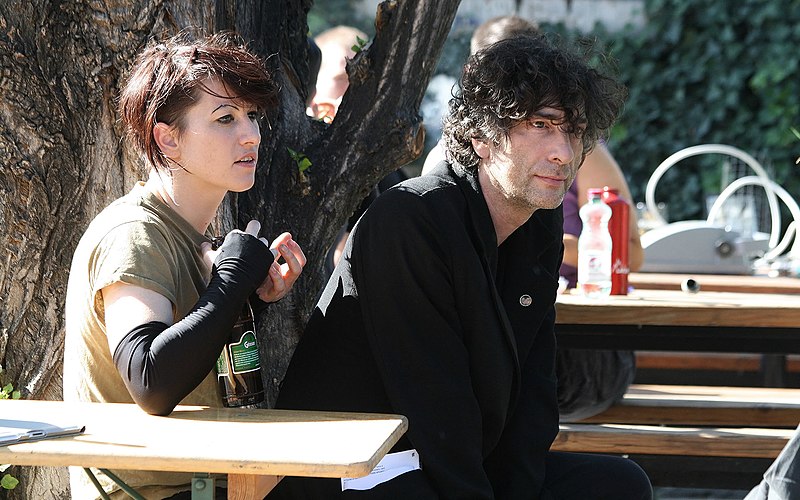
Amanda Palmer and Neil Gaiman during an interview for ORF radio before a concert at the Arena in Vienna, Austria.
Manfred Werner - Tsui

Amanda Palmer and Neil Gaiman during an interview for ORF radio before a concert at the Arena in Vienna, Austria.
Manfred Werner - Tsui
Life and career
Dated record
Life and career
Explore 1960–2021
The full dated record · 57 entries
1960
Neil Gaiman born at Portchester.
1991
Receives Eisner Award for Best Writer.
1991
Receives Inkpot Award.
1991
Receives Harvey Award for Best Writer.
1991
Receives World Fantasy Award for Best Short Fiction.
1992
Receives Eisner Award for Best Writer.
1993
Receives Adamson Awards.
1993
Receives Eisner Award for Best Writer.
1994
Receives Eisner Award for Best Writer.
1995
Receives Yellow Kid Award.
1999
Receives Julia-Verlanger Award.
1999
Receives Mythopoeic Fantasy Award for Adult Literature.
2001
Receives Bram Stoker Award for Novel.
2002
Receives Hugo Award for Best Novel.
2002
Receives Locus Award for Best Fantasy Novel.
2002
Receives BSFA Award for Best Short Fiction.
2003
Receives Nebula Award for Best Novel.
2003
Receives Locus Award for Best Short Story.
2003
Receives Hugo Award for Best Novella.
2003
Receives Bob Morane award for best foreign novel.
2003
Receives BSFA Award for Best Short Fiction.
2003
Receives Locus Award for Best Young Adult Book.
2004
Receives Nebula Award for Best Novella.
2004
Receives Hugo Award for Best Short Story.
2004
Receives Locus Award for Best Short Story.
2004
Receives Locus Award for Best Novelette.
2005
Receives Locus Award for Best Short Story.
2006
Receives August Derleth Award.
2006
Receives Locus Award for Best Short Story.
2006
Receives Locus Award for Best Fantasy Novel.
2006
Receives Mythopoeic Fantasy Award for Adult Literature.
2007
Receives Locus Award for Best Short Story.
2007
Receives Locus Award for Best Collection.
2007
Receives British Fantasy Award for Best Collection.
2008
Receives Hugo Award for Best Dramatic Presentation, Long Form.
2008
Receives Locus Award for Best Novelette.
2009
Receives Hugo Award for Best Novel.
2009
Receives Newbery Medal.
2009
Receives Locus Award for Best Young Adult Book.
2010
Receives Grand Prix de l'Imaginaire for Best Foreign-Language Short Story.
2010
Receives Carnegie Medal.
2010
Receives Shirley Jackson Award.
2010
Receives Audie Award for Narration by the Author or Authors.
2010
Receives Locus Award for Best Short Story.
2011
Receives Locus Award for Best Novelette.
2011
Receives Locus Award for Best Short Story.
2012
Receives Hugo Award for Best Dramatic Presentation, Short Form.
2012
Receives Locus Award for Best Short Story.
2014
Receives Locus Award for Best Fantasy Novel.
2014
Receives Locus Award for Best Novelette.
2015
Receives Geffen Award.
2016
Receives Locus Award for Best Collection.
2016
Receives Locus Award for Best Novelette.
2017
Receives Audie Award for Narration by the Author or Authors.
2019
Receives Bram Stoker Award for Best Graphic Novel.
2019
Receives Bob Morane award for best short story.
2021
Receives Will Eisner Hall of Fame.
Film and screenwriting
Gaiman wrote the 1996 BBC dark fantasy television series Neverwhere. He co-wrote the screenplay for the movie MirrorMask with his old friend Dave McKean for McKean to direct. In addition, he wrote the localised English language script for the anime movie Princess Mononoke, based on a translation of the Japanese script. After his disappointment with the production limitations of Neverwhere, Gaiman asked his agent to pull him out of an (unnamed) UK television series that was to begin production immediately afterwards. "I didn't want to do it unless I had more control than you get as a writer: in fantasy, the tone of voice, the look and feel, the way something is shot and edited is vital, and I wanted to be in charge of that." He co-wrote the script for Robert Zemeckis's Beowulf with Roger Avary, a collaboration that has proved productive for both writers. Gaiman has expressed interest in collaborating on a film adaptation of the Epic of Gilgamesh. He was the only person other than J. Michael Straczynski to write a Babylon 5 script in the series' last three seasons, contributing to the season five episode "Day of the Dead". The series also features a recurring alien race called the Gaim, who resemble the character of Dream and are named after Gaiman. Gaiman has also written at least three drafts of a screenplay adaptation of Nicholson Baker's novel The Fermata for director Robert Zemeckis, although the project was stalled while Zemeckis made The Polar Express and the Gaiman-Roger Avary-penned Beowulf film. Neil Gaiman was featured in the History Channel documentary Comic Book Superheroes Unmasked. Several of Gaiman's original works have been optioned or greenlighted for film adaptation, most notably Stardust, which premiered in August 2007 and stars Charlie Cox, Robert De Niro, Michelle Pfeiffer, Claire Danes and Mark Strong, directed by Matthew Vaughn. A stop-motion version of Coraline was released on 6 February 2009, directed by Henry Selick and starring the voices of Dakota Fanning and Teri Hatcher. In 2007, Gaiman announced that after a decade of development, the feature film of Death: The High Cost of Living would finally begin production with a screenplay by Gaiman that he would direct for Warner Independent. Gaiman said that he agreed to direct the film "with the carrot dangled in front of me that I could direct it. And we'll see if that happens, and if I'm a good director or not." Don Murphy and Susan Montford were named as producers, and Guillermo del Toro was named as the film's executive producer. By 2010, it had been reported that the film was no longer in production. Seeing Ear Theatre performed two of Gaiman's audio theatre plays, "Snow, Glass, Apples", Gaiman's retelling of Snow White, and "Murder Mysteries", a story of heaven before the Fall in which the first crime is committed. Both audio plays were published in the collection Smoke and Mirrors in 1998. At Guillermo del Toro's request, he rewrote the opening of Hellboy II: The Golden Army to make it look more like a fairy tale. Gaiman's 2009 Newbery Medal winning book The Graveyard Book will be made into a movie, with Ron Howard as the director. Gaiman wrote an episode of the long-running BBC science fiction series Doctor Who, broadcast in 2011 during Matt Smith's second series as the Doctor. Shooting began in August 2010 for this episode, the original title of which was "The House of Nothing" but which was eventually transmitted as "The Doctor's Wife". The episode won the 2012 Hugo Award for Best Dramatic Presentation (Short Form). Gaiman made his return to Doctor Who with an episode titled "Nightmare in Silver", broadcast on 11 May 2013. Gaiman returned to the Whoniverse in 2020 for the web series Doctor Who: Lockdown; he wrote the mini-episode "Rory's Story" which saw Arthur Darvill reprise his role of Rory Williams. Also in 2011, it was announced that Gaiman would be writing the script to a new film version of Journey to the West. Gaiman appeared as himself on The Simpsons episode "The Book Job", which was broadcast on 20 November 2011. In 2015, Starz greenlighted a series adaptation of Gaiman's novel American Gods. Bryan Fuller and Michael Green wrote and were showrunners for the series. Gaiman received a Best Dramatic Presentation, Long Form Hugo Award in 2020 for the TV miniseries adaptation of Good Omens, for which he wrote the screenplay. He voiced Gef in the black comedy film Nandor Fodor and the Talking Mongoose, one of the film's titular characters, in 2023.
Primary material
Documents and archives
scholarly publication
- Double-Vision: Neil Gaiman, Speculative Realism and Science Fiction, 2017
Scholarly · Crossref registry · 2017
authority record
- Wikidata, structured authority record Q210059: Neil Gaiman
Unverified · Wikidata
reference work
- “Neil Gaiman”, English Wikipedia, consulted as further reading
Reputable secondary · Wikipedia
Notes from the source article
Cited by Wikipedia
Notes from the source article
These works are cited by the source article, in its own numbering. They are recorded as its citations, not as sources VALÉORINE has verified.
- 1.Neil Gaiman. 12 October 2013.
- 2.Teachingbooks.net. Author Name Pronunciation Guide – Neil Gaiman.
- 3.Wedding: Palmer — Gaiman. Lexington Minuteman. 14 January 2011.
- 4.Miller, John Jackson. Comics Industry Birthdays. Comics Buyer's Guide. Krause Publications. 10 June 2005.
- 5.Graves, Kieran. Every Hampshire town and city's most famous person including Martin Freeman and Colin Firth. HampshireLive. 21 May 2022.
- 6.Wagner, Hank. Prince of Stories: The Many Worlds of Neil Gaiman. St. Martin's Press. 447–449. 2008. 978-0-312-38765-5.
- 7.Gaiman, Neil. Journeys End. Neil Gaiman's Journal. 16 January 2009.
- 8.Wearring, Andrew. Changing, Out-of-Work, Dead, and Reborn Gods in the Fiction of Neil Gaiman. Literature & Aesthetics. 19. 2. 236. December 2009.
- 9.Lancaster, James. Everyone has the potential to be great. The Argus. 10–11. 11 October 2005.
- 10.Gaiman, Neil. Trees. Neil Gaiman's Journal. 20 December 2008.
- 11.Goodyear, Dana. Kid Goth Neil Gaiman's fantasies. The New Yorker. 25 January 2010.
- 12.Whitaker, Steve. Neil Gaiman interview. FA. 109. 24–29. January 1989.
- 13.Omnigraphics Inc. Biography Today General Series. 66. 2010. 978-0-7808-1058-7.
- 14.Bloomsburyreader.wordpress.com. Before there was Ian Fleming, there was Dennis Wheatley. 10 October 2013.
- 15.Neil Gaiman wins children's book prize. BBC News. 25 June 2010.
- 16.Flood, Alison. Neil Gaiman wins Carnegie Medal. The Guardian. 24 June 2010.
- 17.Exclusive Books. Neil Gaiman.
- 18.Head Bars Son of Cult Man. The Times. 2. 13 August 1968.
- 19.East Grinstead Community Web Site. East Grinstead Hall of Fame – Neil Gaiman. n.d.
- 20.Punk is growing up, says singer Neil. East Grinstead Observer. 10. April 26, 1978.
- 21.Gaiman, Neil. The Ocean at the End of the Lane. William Morrow and Company. Back Flap. 18 June 2013. 978-0062255655.
- 22.Rabinovitch, Dina. A writer's life: Neil Gaiman. The Telegraph. 12 December 2005.
- 23.Dougary, Ginny. Good Omens: Neil Gaiman reveals what he and Terry Pratchett shared. The Sydney Morning Herald. 2019-06-07.
- 24.Shapiro, Lila. There Is No Safe Word. Vulture. 13 January 2025.
- 25.Amanda Palmer's Patreon Subscribes Found Out About Her Breakup Before Neil Gaiman Did. Vulture.com. 4 May 2020.
- 26.Zutter, Natalie. Amanda Palmer and Neil Gaiman Marry. Ology Magazine.
- 27.Portwood, Jerry. Amanda Palmer Gets Intimate. out.com. 20 September 2012.
- 28.Author's 11,000-mile lockdown trip to Scots island. BBC News. 17 May 2020.
- 29.Flood, Alison. Neil Gaiman apologises to people of Skye for breaking lockdown rules. The Guardian. 19 May 2020.
- 30.Gaiman, Neil. Where I am, what I'm doing, how I'm doing and how I got here. Journal.neilgaiman.com.
- 31.UK author Neil Gaiman reunites with his son and Amanda Palmer in Havelock North. 13 January 2021.
- 32.Kiefer, Halle. Neil Gaiman and Amanda Palmer Weren't Driven to Divorce by Quarantine After All. Vulture. 15 May 2020.
- 33.A joint statement from Amanda and me. NeilGaiman.com / Journal. 4 November 2022.
- 34.A joint statement from me and Neil. AmandaPalmer.net. 4 November 2022.
- 35.Official Neil Gaiman Website. Neilgaiman.com.
- 36.Neil Gaiman's journal, 2/11/2008. Journal.neilgaiman.com. 11 February 2008.
- 37.NEFSA Press. Adventures in the Dream Trade: Table of Contents. www.nefsa.org.
- 38.Gaiman, Neil. Death, and Free Revisited. Neil Gaiman Journal. 12 February 2011.
- 39.Yehl, Joshua. The Best Tweeters in Comics. 20 February 2013.
- 40.Neil Gaiman's Journal: listening to unresolving. Journal.neilgaiman.com. 30 November 2004.
- 41.Cochrane, Kira. Tori Amos on trauma, Trump and Neil Gaiman: 'It's a heartbreaking grief'. The Guardian. 3 December 2024.
- 42.Neil Gaiman's Journal: Blueberry Girls. Journal.neilgaiman.com. 7 July 2007.
- 43.Green Man Press. News from Green Man Press " Blog Archive " Blueberry Wanderings. 6 July 2007.
- 44.Neil Gaiman's Journal: Chapter Six in San Francisco yesterday. Journal.neilgaiman.com. 6 October 2008.
- 45.2016 Stories – #WithRefugees. Unhcr.
- 46.What They Took With Them – #WithRefugees. Unhcr. 7 September 2016.
- 47.Neil Gaiman Talks Sandman, CBLDF on NPR. 19 September 2003.
- 48.CBLDF Announces Advisory Board. ICv2. 8 April 2013.
- 49.Gaiman, Neil. I'm trying to find out right now what Russian contracts I control and where they are in the publishing cycle. I would not want to renew them while Putin and this administration was in power, that is for certain. 1500158016494125056. 5 March 2022.
- 50.Gaiman, Neil. 1 million refugees in one week. That's how many people have been forced to flee into neighbouring countries from Ukraine. If you do just one thing today, please donate to @Refugees. 1499366200077393927. 3 March 2022.
- 51.Killing, Gaiman, Evaristo: writers from around the world call for donations for Ukrainian refugees. chytomo.com. 4 March 2022.
- 52.A letter to Vladimir Putin: Release Alexei Navalny. The Economist. 28 April 2023.
- 53.Free Navalny! Western public figures sign open letter demanding Alexey Navalny's immediate release. Novaya Gazeta Europe. 28 April 2023.
- 54.Abbey p. 68
- 55.Gaiman, Neil. My hero : Mary Shelley by Neil Gaiman. The Guardian. 18 October 2014.
- 56.Neil Gaiman: By the Book. The New York Times. 3 May 2012.
- 57.Gaiman, Neil. 300 Good Reasons to Resent Dave Sim. Comics Buyer's Guide. Krause Publications. 7 August 1992.
- 58.Darren Wilshaw. In Search Of Steve Ditko (2007). 21 May 2017.
- 59.Gaiman, Neil. Neil Gaiman on Will Eisner: 'He thought comics were an artform – he was right'. The Guardian. 7 March 2017.
- 60.Gaiman, Neil. My Hero: Gene Wolfe. The Guardian. 13 May 2011.
- 61.Monty Python's greatest skits. The Guardian.
- 62.Goldsmith, Jeffrey. Heavy Metal - Interview with Neil Gaiman. 10–11. May 1998.
- 63.Ball, Natasha. Lafferty Lost and Found. This Land Press. 11 May 2014.
- 64.Barnett, David. RA Lafferty – the secret sci-fi genius more than ready for a comeback. The Guardian. 13 August 2014.
- 65."Of Meetings and Partings" by Neil Gaiman, introduction to This Mortal Mountain: Volume 3 of The Collected Stories of Roger Zelazny, NESFA Press, edited by David G. Grubbs, Christopher S. Kovacs, and Ann Crimmins, 2009, page 12.
- 66."Something Else Like ... Roger Zelazny " by Jo Walton, Tor.com, 11 November 2012.
- 67.Lee, Felicia R. A Literary Expert on Driving in the Dark. The New York Times. 13 June 2014.
- 68.Works by Gaiman – Book Reviews. NeilGaimanBibliography.com. n.d.
- 69.YouTube. Authors at Google – Neil Gaiman interview. 3 October 2006.
- 70.Gaiman, Neil. Rumour control?. Neil Gaiman's Journal. 2 January 2009.
- 71.Gaiman, Neil. This is why I stopped being a journalist in 1987. Just as true today. 8379971068. 29 January 2010.
- 72.Kanazawa, Satoshi. Psychology Today – British Newspapers Make Things Up. Psychologytoday.com. 24 January 2010.
- 73.Huddleston, Kathie. Neil Gaiman hitchhikes through Douglas Adams' hilarious galaxy. Science Fiction Weekly. n.d.
- 74.Williams, Gwyneth. Radio 4 to make first-ever dramatisation of Good Omens – Media Centre. BBC. 5 September 2014.
- 75.Olsen, Steven P. Neil Gaiman (Library of Graphic Novelists). Rosen Publishing. 16–18. 2005. 978-1404202856.
- 76.Neil Gaiman on the Secret History of 'The Sandman' & Killing a Bad Script by Leaking It Online. 24 August 2022.
- 77.Bender, Hy. The Sandman Companion. DC Comics. 20–22. 1999. 978-1563894657.
- 78.Irvine, Alex. The Vertigo Encyclopedia. Dorling Kindersley. 32–34. 2008. 978-0-7566-4122-1.
- 79.Manning, Matthew K. DC Comics Year By Year A Visual Chronicle. Dorling Kindersley. 235. 2010. 978-0-7566-6742-9.
- 80.Manning "1980s" in Dolan, p. 238: "In arguably one of the greatest achievements in serialized modern comic books, writer Neil Gaiman crafted the seventy-five-issue ongoing series The Sandman, introducing its readers to a complex world of horror and fantasy."
- 81.Hoad, Phil. Neil Gaiman and Dave McKean: how we made The Sandman. The Guardian. 21 October 2013.
- 82.Manning "1980s" in Dolan, p. 240: "Neil Gaiman, aided by penciller Mike Dringenberg, introduced the character Death to a fascinated readership...Death was an instant hit and arguably became more popular than the Sandman himself."
- 83.Manning "1990s" in Dolan, p. 262: "In March 1993, DC Comics debuted a three-issue limited series entitled Death: The High Cost of Living...Written by Neil Gaiman and drawn by future comics superstar Chris Bachalo, The High Cost of Living had one notable trait besides a brilliant story: its cover bore a new logo. With this debut, DC's provocative new mature-reader imprint, Vertigo, was born."
- 84.Daniels, Les. DC Comics: Sixty Years of the World's Favorite Comic Book Heroes. Bulfinch Press. 206. 1995. 978-0821220764.
- 85.The Inevitable Post About Neil Gaiman's 'The Sandman'. NPR.
- 86.Levitz, Paul. 75 Years of DC Comics The Art of Modern Mythmaking. Taschen. 567. 2010. 9783836519816.
- 87.Duncan, Randy. Icons of the American Comic Book: From Captain America to Wonder Woman, Volume 1. Greenwood Publishing Group. 741–742. 2013. 978-0313399237.
- 88.Manning, Matthew K. Batman: A Visual History. Dorling Kindersley. 183. 2014. 978-1465424563.
- 89.Manning "1980s" in Dougall (2014), p. 179: Secret Origins Special No. 1 "Gaiman wrote the Riddler's tale, with the help of artist Bernie Mireault."
- 90.Martin, Brian. Where the Action is.Weekly. Back Issue!. 98. 77. August 2017.
- 91.Manning "1990s" in Dolan, p. 247: "Neil Gaiman chronicled the adventures of magic pupil Timothy Hunter in this miniseries. each issue explored the realms of magic as portrayed by a different painter."
- 92.Andreasen, Henrik. Interview with John Ney Rieber. Serie Journalen. 1 December 1995.
- 93.Johnston, Rich. Get Your Free Neil Gaiman And Michael Zulli Sweeney Todd Comic Here. Bleeding Cool. 5 June 2012.
- 94.Teknophage. Neilgaiman.info. 23 July 2008.
- 95.Neil Gaiman's Mr. Hero Complete Comics Vol. 1: The Newmatic Man.
- 96.Ogline, Tim E. Myth, Magic and the Mind of Neil Gaiman. Wild River Review. 20 November 2007.
- 97.Manning, Matthew K. Marvel Chronicle A Year by Year History. Dorling Kindersley. 317. 2008. 978-0756641238.
- 98.Richards, Dave. Following in the Footsteps: Romita Talks Eternals. Comic Book Resources. 9 June 2006.
- 99.MacQuarrie, Jim. CCI XTRA: Spotlight on Neil Gaiman. Comic Book Resources. 3 August 2007.
- 100.Cowsill, Alan "2000s" in Dolan, p. 337: "Writer Neil Gaiman and art legend Andy Kubert teamed up to present a touching imaginary tale of a wake for the dead Batman...A love song to the Dark Knight's long history...it went on to win SFX's Best Comic award in 2010."
- 101.Tabu, Hannibal. CCI: DC One Weekend Later – Gaiman on Batman. Comic Book Resources. 27 July 2008.
- 102.Brady, Matt. SDCC '08 – More on Gaiman-Batman with Dan DiDio. Newsarama. 27 July 2008.
- 103.Cowsill "2000s" in Dolan, p. 338: "The [series] contained fifteen continuous stories, including...'Metamorpho' scripted by Neil Gaiman and illustrated by Michael Allred."
- 104.Minnick, Remy. Gaiman & Allred on Metamorpho. Comic Book Resources. 30 January 2009.
- 105.Johnston, Rich. Neil Gaiman Co-Wrote Action Comics #894?. BleedingCool.com. 23 September 2010.
- 106.Armitage, Hugh. Neil Gaiman returns to The Sandman – Comic Con 2012. Digital Spy. 13 July 2012.
- 107.Hudson, Laura. 25 Years Later, Neil Gaiman's Sandman Returns With a Prequel. Wired. 25 July 2013.
- 108.Sunu, Steve. Gaiman Returns to Marvel, Brings Spawn's Angela. Comic Book Resources. 21 March 2013.
- 109.Bishop, Bryan. Neil Gaiman is turning The Sandman into an expanded comics universe. The Verge. 1 March 2018.
- 110.Polo, Susana. The Sandman Universe is Neil Gaiman's next comics project. Polygon. 1 March 2018.
- 111.Myrick, Joe Anthony (7 August 2023). "Good Omens Campaign Sets a New Kickstarter Record (After Being Fully Funded in 10 Minutes)." Screen Rant. Retrieved 13 August 2023.
- 112.Pratchett, Terry. Words from the Master. Lspace.org. n.d.
- 113.Martinelli, Marissa. What Does It Mean When a Book Is Stamped With the Words 'Author's Preferred Text?'. Slate. 20 August 2015.
- 114.BOOKS: Stardust: Neil Gaiman & Charles Vess. Valdosta Daily Times. 27 June 2020.
- 115.Gaiman, Neil. Neil Gaiman on the importance of fairytales. The Guardian. 12 October 2007. 0261-3077.
- 116.American Gods wins a Hugo!. Neilgaiman.com. 17 September 2002.
- 117.Martinelli, Marissa. What Does It Mean When a Book Is Stamped With the Words "Author's Preferred Text?". Slate Magazine. 20 August 2015.
- 118.Best-Seller Lists: Hardcover Fiction. The New York Times. 9 October 2005.
- 119.Bleiler, Richard. 21st Century Gothic: Great Gothic Novels Since 2000. Scarecrow Press. 269–278. 2011. 9780810877283.
- 120.Olson. 21st Century Gothic: Great Gothic Novels Since 2000. Scarecrow Press. 2011. 9780810877283.
- 121.Gaiman, Neil. Beyone Tea. Neil Gaiman's Journal. 19 November 2008.
- 122.Press Association. Neil Gaiman novel wins Book of the Year. The Guardian. 26 December 2013.
- 123.Byatt, AS. The Ocean at the End of the Lane by Neil Gaiman – review. Guardian. 3 July 2013.
- 124.Lofuto, Tina. With The Ocean at the End of the Lane, fantasy master Neil Gaiman presents a mythical view of childhood's fears. Nashville Scene. 3 July 2013.
- 125.Ryan, Anya. The Ocean at the End of the Lane review: A thunderous, sometimes terrifying adaptation. The Independent. 6 November 2021.
- 126.Gaiman, Neil. A cover revealed! A book exposed! A year mislaid!. journal.neilgaiman.com.
- 127.Neil Gaiman Puts His Spin On Thor In Norse Mythology Novel. Comicbook.com.
- 128.Mr. Nancy is One Swingin’ Spider in the New Retro Cover for Neil Gaiman’s Anansi Boys!.
- 129.Neil Gaiman.
- 130.Wagner, Hank. Prince of Stories: The Many Worlds of Neil Gaiman. St. Martin's Press. 413–448. 2008. 978-0-312-38765-5.
- 131.Neil Gaiman and Roger Avary: Shaping Beowulf's story. Stv.tv. 2007.
- 132.Ambrose, Tom. He Is Legend. Empire. 142. December 2007.
- 133.Neil Gaiman's Film Work. Neil Gaiman.com. 13 August 2007.
- 134.Burns, Tom. Neil Gaiman Takes Hollywood. UGO.com. n.d.
- 135.Triage Entertainment, Inc. Comic Book Superheroes Unmasked. 2003. 0-7670-8365-2.
- 136.Gaiman, Neil. The View from the Cheap Seats: Selected Nonfiction. William Morrow. 242. 2016. 978-0-06-226226-4.
- 137.Sanchez, Robert. Neil Gaiman on Stardust and Death: High Cost of Living!. IESB.net. 2 August 2006.
- 138.Gaiman, Neil. The best film of 2006 was…. Neil Gaiman's Journal. 9 January 2007.
- 139.The Vulture Transcript: Neil Gaiman on Comics, Twilight, Twitter Etiquette, Killing Batman, and Sharing Porn With His Son. 14 October 2010.
- 140.Gaiman, Neil. Smoke and Mirrors: Short Fictions and Illusions. Avon. 384. 1998. 978-0380789023.
- 141.Holub, Christian. Hellboy gave Neil Gaiman his start in writing for movies and TV. Entertainment Weekly. March 2, 2021.
- 142.Kit, Borys. Ron Howard in Talks to Direct Disney's Graveyard Book. The Hollywood Reporter. 22 January 2013.
- 143.Exclusive Neil Gaiman Confirms Doctor Who Episode. SFX.
- 144.Masters, Tim. Neil Gaiman reveals power of writing Doctor Who. BBC News. 24 May 2010.
- 145.Doctor Who: Title Of the Neil Gaiman Episode Revealed. SFX. 28 March 2011.
- 146.Davis, Lauren. The 2012 Hugo Nominations have been announced!. io9. 7 April 2012.
- 147.Fox, Rose. Hugo Awards Liveblog. Publishers Weekly. 2 September 2012.
- 148.Doctor Who Magazine. . continued . 7. Nightmare in Silver 8. TBA - still a secret!. 316494714994040832. 26 March 2013.
- 149.Jeffery, Morgan. Doctor Who writer Neil Gaiman: 'I want to make the Cybermen scary again'. Digital Spy. 9 November 2012.
- 150.Neil Gaiman's Journal: A quick in and out. Journal.neilgaiman.com. 12 March 2011.
- 151.Coonan, Clifford. Neil Gaiman to script 'Journey'. Variety. 10 March 2011.
- 152.Author Neil Gaiman to guest star on The Simpsons. BBC News. 13 January 2011.
- 153.Campbell, Josie. Neil Gaiman on His Simpsons Appearance, Teen Lit and Trolls. Comic Book Resources. 19 November 2011.
- 154.Gaiman, Neil. Hey Hey We're, er, on The Simpsons. Neil Gaiman's Journal. 20 November 2011.
- 155.Falcone, Dana Rose. Neil Gaiman's American Gods gets series order at Starz. Entertainment Weekly. 16 June 2015.
- 156.Announcing the 2020 Hugo Award Winners. August 2020.
- 157.Grobar, Matt. Dark Comedy 'Nandor Fodor' Finds Its 'Talking Mongoose' In 'The Sandman's Neil Gaiman. Deadline Hollywood. 1 December 2022.
- 158.BBC Radio 4 - Neil Gaiman - Neverwhere - About Neverwhere. BBC.
- 159.BBC Radio 4 - Drama, Lud-in-the-Mist. BBC.
- 160.Sisario, Ben. Giving Love, Lots of It, To Her Fans. The New York Times. 5 June 2012.
- 161.Pollack, David. Amanda Palmer & Neil Gaiman, Queen's Hall, Edinburg. The Independent. 14 August 2012.
- 162.Neil Gaiman How Stories Last Filmed on Tuesday 9 June 2015 at The Long Now Foundation. Audio and video available.
- 163.What Neil Gaiman Did On The Big Bang Theory. 20 April 2018.
- 164.Listen to the "Oral Argument," List of Documents in case: 03-1331 : Gaiman, Neil v. McFarlane, Todd . Retrieved 22 September 2008.
- 165.See also the official decision by Judge John Shabaz in The United States Court of Appeals For the Seventh Circuit Nos. 03–1331, 03–1461 . Retrieved 22 September 2008.
- 166.See Judge Shabaz's ruling for the legal reasoning: "As a co-owner, McFarlane was not violating the Copyright Act by unilaterally publishing the jointly owned work, but, as in any other case of conversion or misappropriation, he would have to account to the other joint owner for the latter's share of the profits."
- 167.See Khoury, George, Image Comics: The Road To Independence (TwoMorrows Publishing, 2007),
- 168.See Judge Shabaz's ruling : "A tentative agreement was reached that... Gaiman would exchange his rights in Medieval Spawn and Cogliostro for McFarlane's rights in another comic book character, Miracleman."
- 169.Judge Shabaz, Official ruling , as per "Schiller & Schmidt, Inc. v. Nordisco Corp., 969 F.2d 410, 413 (7th Cir. 1992)"
- 170.Yarbrough, Beau. Gaiman in Stunning Victory over McFarlane in Spawn Case: Jury Finds for Gaiman on All Counts. Comic Book Resources. 3 October 2002.
- 171.See Judge Shabaz's ruling for similar statements on Angela and Medieval Spawn.
- 172.Weiland, Jonah. Marvel's "1602" Press Conference. Comic Book Resources. 27 June 2003.
- 173.Phegley, Kiel. CCI: Marvel Acquires Marvelman. Comic Book Resources. 24 July 2009.
- 174.Treleven, Ed. Gaiman takes on McFarlane in Wis. federal court comic book clash. Wisconsin State Journal. 25 May 2010.
- 175.Melrose, Kevin. Judge rules Dark Ages Spawn, Domina and Tiffany are derivative characters. Comic Book Resources. 21 July 2010.
- 176.Jiménez, Jesus. Production Linked to Neil Gaiman Is Halted Amid Sexual Assault Claims. The New York Times. September 26, 2024.
- 177.Caruana Galizia, Paul. Exclusive: Neil Gaiman accused of sexual assault. Tortoise Media. July 3, 2024.
- 178.Caruana Galizia, Paul. Exclusive: Two more women accuse Neil Gaiman of sexual assault and abuse. Tortoise Media. 2024-08-01.
- 179.Shapiro, Lila. Neil Gaiman Seeks $500,000 From Accuser Caroline Wallner. Vulture. April 21, 2025.
- 180.Mehrere Frauen erheben Vorwürfe gegen »Sandman«-Autor Neil Gaiman. Der Spiegel. 2024-08-01.
- 181.Blauvelt, Christian. Disney Pauses Neil Gaiman's 'The Graveyard Book' Adaptation in Wake of Sexual Assault Allegations — Exclusive. IndieWire. September 4, 2024.
- 182.Shanahan, Mark. Amid allegations against Neil Gaiman, Disney postpones 'The Graveyard Book' adaptation. The Boston Globe. September 5, 2024.
- 183.Rice, Lynette. 'Good Omens': Production Paused On Amazon Drama From Neil Gaiman. Deadline Hollywood. 2024-09-09.
- 184.White, Peter. 'Good Omens' To End With One 90-Minute Episode As Neil Gaiman Exits Following Sexual Assault Allegations. Deadline Hollywood. 24 October 2024.
- 185.Cobb, Kayla. Neil Gaiman Accused of Sexual Misconduct by 4 More Women. TheWrap. January 13, 2025.
- 186.Hughes, William. Dark Horse Comics dumps Neil Gaiman, cancels Anansi Boys adaptation. The A.V. Club. January 25, 2025.
- 187.Kanter, Jake. Neil Gaiman Scrubbed From Agent Casarotto Ramsay's Client List After Sexual Misconduct Allegations. Deadline Hollywood. January 30, 2025.
- 188.Shapiro, Lila. Neil Gaiman Accused of Human Trafficking, Sexual Abuse in New Lawsuit. Vulture. February 3, 2025.
- 189.Richmond, Todd. Woman's lawsuits say sci-fi author Neil Gaiman repeatedly sexually assaulted her. Associated Press News. February 3, 2025.
- 190.Neil Gaiman says nanny's allegations are 'a sham'. BBC News. 5 March 2025.
- 191.Creamer, Ella. Neil Gaiman asks US court to dismiss lawsuit alleging rape and sexual assault. The Guardian. 5 March 2025.
- 192.Squires, Bethy. Judge Dismisses Sexual Assault Lawsuit Against Neil Gaiman. Vulture. 6 October 2025.
- 193.Frank, Jason P. Neil Gaiman Denies Sexual-Assault Allegations. Vulture. 2 February 2026.
- 194.Press, Associated. US judges dismiss lawsuits accusing Neil Gaiman of sexual assault. 10 February 2026.
- 195.Gaiman, Neil. Breaking the Silence. Neil Gaiman Journal. January 14, 2025.
- 196.Blair, Elizabeth. Neil Gaiman has responded to sexual misconduct allegations. NPR. January 14, 2025.
- 197.Egan, Elizabeth. Neil Gaiman Responds to Explosive Report of Sexual Assault. The New York Times. January 15, 2025.
- 198.See particularly Rodney Sharkey, James Fleming, and Zuleyha Cetiner-Oktem's articles in ImageTexT 's special issue on Gaiman's work.
- 199.See this detailed analysis .
- 200.Collins, Meredith. Fairy and Faerie: Uses of the Victorian in Neil Gaiman's and Charles Vess's Stardust. ImageTexT: Interdisciplinary Comics Studies. 12. 2. March 2021.
- 201.Bleiler, Richard. 21st Century Gothic: Great Gothic Novels Since 2000. Scarecrow Press. 269–278. 2011. 9780810877283.
- 202.Olson, Danel. Casket Letters: The Essential Comics of Horror, Gothic, and the Weird for 2014. The Weird Fiction Review. 5. 285–291. 2014.
- 203.Smith, Clay. "Get Gaiman?: PolyMorpheus Perversity in Works by and about Neil Gaiman " ImageTexT 4.1.
- 204.Sandifer, Philip. A Special Issue on the Works of Neil Gaiman, Introduction. English.ufl.edu. 4. 1. 2008.
- 205.Rudd, David. An Eye for an 'I': Neil Gaiman's Coraline and the Question of Identity. Children's Literature in Education. 39. 3. 159–168. 2008. 10.1007/s10583-008-9067-7.
- 206.See Stephen Rauch, Neil Gaiman's The Sandman and Joseph Campbell: In Search of the Modern Myth, Wildside Press, 2003
- 207.Ogline, Tim E. The Wild River Review, "Interview with the Dream King". Wildriverreview.com.
- 208.Sfadb : Locus Awards.
- 209.Sfadb: HOMer Awards 1991.
- 210.Sfadb: SF Site Readers Poll 1999.
- 211.2002 Grand Prix de l'Imaginaire.
- 212.Sfadb: SF Site Readers Poll 1999.
- 213.Sfadb: HOMer Awards 2000.
- 214.International Horror Guild.
- 215.Sfadb: British Fantasy Awards 2002.
- 216.Sfadb: SF Site Readers Poll 2002.
- 217.Italcon | Premio Italia.
- 218.2003 Grand Prix de l'Imaginaire.
- 219.Sfadb: SF Site Readers Poll 2003.
- 220.Parked Domain name on Hostinger DNS system.
- 221.Sfadb: SF Site Readers Poll 2006.
- 222.2007 Grand Prix de l'Imaginaire.
- 223.Sfadb: SF Site Readers Poll 2007.
- 224.Dark Scribe Magazine - 2nd Annual - Nominees.
- 225.The Children of the Night Award.
- 226.Michigan Library Association (MLA). MLA Thumbs Up! Award - Winner history.
- 227.2009 Award Winners & Nominees.
- 228.Sfadb: SF Site Readers Poll 2009.
- 229.Arkansas Teen Book Award - Level 1 Grades 7 - Reading list 2010.
- 230.Flood, Alison. Neil Gaiman wins Carnegie medal. The Guardian. 24 June 2010.
- 231.Kentucky Bluegrass Award Winner's Circle. Kentucky Association of School Librarians.
- 232.Evergreen Book Award - Past Winners & Booktalks.
- 233.The Case of Death and Honey.
- 234.Announcing the Goodreads Choice Winner in Best Middle Grade & Children's!.
- 235.Announcing the Goodreads Choice Winner in Best Fantasy!.
- 236.2014 Award Winners & Nominees.
- 237.2015 Grand Prix de l'Imaginaire.
- 238.Announcing the Goodreads Choice Winner in Best of the Best!.
- 239.Announcing the Goodreads Choice Winner in Best Fantasy!.
- 240.Announcing the Goodreads Choice Winner in Best Graphic Novels & Comics!.
- 241.Announcing the Goodreads Choice Winner in Best Nonfiction!.
- 242.Announcing the Goodreads Choice Winner in Best Fantasy!.
- 243.Here are the winners of the (Gasp!) 20th Annual Rondo Hatton Classic Horror awards – The Rondo Hatton Classic Horror Awards. rondoaward.com.
- 244.Shortlists 2023.
- 245.Icon Award | Comic-Con International: San Diego. Comic-Con International: San Diego.
- 246.Neil Gaiman's Journal.
- 247.The Forry Awards.
- 248.Cool Stuff | Essays | Essays About Neil | Neil Gaiman and Comics. Neilgaiman.com.
- 249.Tyler, Joshua. Shatner Gets His Own Award. Cinema Blend. 10 January 2006.
- 250.Neil Gaiman named Honorary Chair of National Library Week. 12 October 2009.
- 251.University of the Arts. Neil Gaiman Headlines 134th Commencement: Award-winning author, graphic novelist tells graduates to 'make good art'.
- 252.Laureation Address: Professor Neil Gaiman. 21 June 2016.
- 253.Neil Gaiman | SFFHOF Inductee.
- 254.Gaiman Wins Writers for Writers Award. 8 January 2019.
- 255.Time 100. Time. 13 April 2023.
References
Citations
References
Each reference names the institution holding it, so a reader may go to the document itself.
scholarly publication
Verifiedauthority record
Partially resolvedreference work
Partially resolved
The Encyclopedia exists whether or not anything is for sale. Corrections are recorded rather than overwritten, and every version of this record is kept. Published 14 August 2026.
Elsewhere in Books
38,661 published records in this field, each with its sources named.
- Nef'iAuthor
- Neidhart von ReuentalAuthor
- Neil CampbellAuthor
- Neil FaulknerAuthor
- Neil H. ShubinAuthor
- Neil InnesAuthor
- Neil McBrideAuthor
- Neil McDonaldAuthor
Best supported in this field
For owners
Own a work by Neil Gaiman?
A specialist will read what you send and tell you what the house can establish, what it cannot, and whether the object is suited to sale. There is no charge and no obligation. The object stays with you throughout; nothing is shipped to us unless it is arranged in writing beforehand.