
National Museum of Pakistan
The National Museum of Pakistan (Urdu: قومی عجائب گھر پاکِستان) is a public museum located in Karachi, Pakistan.
National Museum of Pakistan

Shahid1024 · Shahid Siddiqi · Public domain
- Founded
- 1950.
- Headquarters
- Karachi.
VALÉORINE Encyclopedia
VALÉORINE documentary reading
Documentary summary
The National Museum of Pakistan (Urdu: قومی عجائب گھر پاکِستان) is a public museum located in Karachi, Pakistan.
Admitted source layer · organised and presented by VALÉORINE
Note VALÉORINE
No house-authored Note is published until its assertions and sources pass the VALÉORINE evidence contract. The documentary article remains available in full while that enrichment is being consolidated.
Documentary enrichment in progress · no unsupported statement published
Reference Check
Propose documentary evidence for National Museum of Pakistan. A contribution is never written directly as fact: identity, source, rights and evidence gates still decide.
Sign in to contribute
Documentary evidence
Evidence Panel
original value insufficient · checked 25 September 2026
- Identity
- resolved
- Independent source families
- 0
- Admitted assertions
- 0
- Open conflicts
- 0
Authority files
wikidata · Q1967486 · wikipedia · National Museum of Pakistan
In this article
History
History
The National Museum of Pakistan was established in Frere Hall in 1951, replacing the defunct Victoria Museum. Frere Hall itself was built in 1865 as a tribute to Sir Bartle Frere, a commissioner of Sind during the 19th century. Once the museum was inaugurated the government of Pakistan constituted an advisory council in 1950 with the primary duty to counsel the museum on the issues of enriching its collection through new acquisitions and purchase of antiquities and works of arts. In 1959 architect F.A. Khan outlined a plan for a new museum in a purpose-built modern building that would feature local materials in its construction. He expressed the hope that the museum would be 'truly representative of our great cultural heritage'. The museum was shifted to the present premises, located in Burns Garden, in 1970.
Galleries
Galleries
In 1970 there were only four galleries in the museum. Over time the museum grew, with the building currently housing eleven galleries including a “Quran Gallery”. The National Museum has more than 300 copies of the Quran, out of which around 52 rare manuscripts are on display. The museum also contains an important collection of items relating to Pakistan's cultural heritage. Other galleries display Indus Valley Civilisation artifacts, Gandhara civilization sculptures, Islamic art, miniature paintings, ancient coins and manuscripts documenting Pakistan's political history. There is also an Ethnological Gallery with life-size statues of different ethnicities living in the four provinces of modern-day Pakistan. The museum has a collection of seals and statues found at the Mohenjo-daro site. The statues include the so-called Priest-King, terracotta toys and many stamp seals. It also shows some ancient coins found in those Hijri and some belongings of the national heroes of Pakistan: Quaid-e-Azam's pen, cuffs, and sword; Allama Iqbal's personal chair and pen; and Liaqat Ali Khan's personal itar bottle, watch and walking stick. There are galleries that show the clothing, pottery works and glasses Muslims used to make, and the apparatus that was used to make them.
Facilities
Facilities
For the preservation of the collection, a conservation laboratory is also a part of the museum. There is an auditorium on the museum premises with the capacity to seat 250.
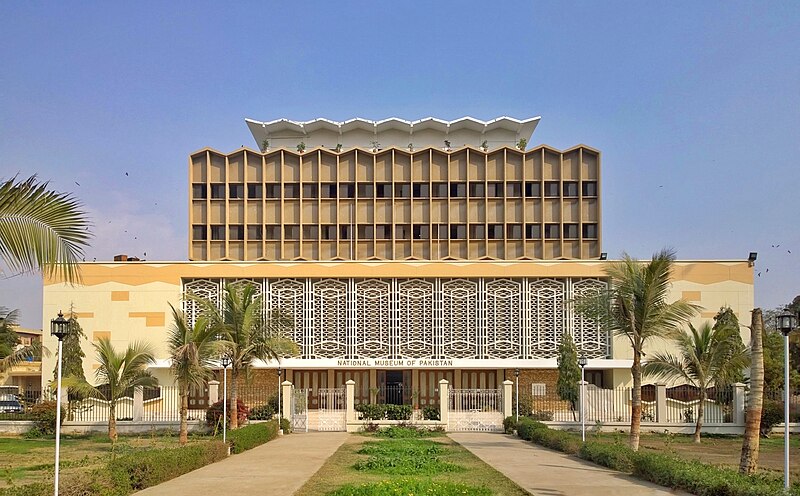
A great view of Museum in sunny day.
Siddiqi

Beautiful gate and park of National Museum of Pakistan in Karachi
Muhammad Lashari
Institutional history
Dated record
Institutional history
The full dated record · 2 entries
1950
National Museum of Pakistan established.
1950
National Museum of Pakistan is recorded from 1950.
Collection
The museum has a collection of 58,000 old coins (some dating from 74 Al-Hijra), and hundreds of well-preserved sculptures. Some 70,000 publications, books and other reading material of the Archeology and Museums Department were also shifted to the National Museum so that the general public could see them. Every year National Museum holds around a dozen exhibitions on National Days and other occasions.
Notes from the source article
Cited by Wikipedia
Notes from the source article
These works are cited by the source article, in its own numbering. They are recorded as its citations, not as sources VALÉORINE has verified.
- 1.Sindh Tourism Development Corporation - National Museum of Pakistan, Karachi. www.stdc.gos.pk.
- 2.KARACHI: Few people visit national museum. DAWN.COM. August 21, 2003.
- 3.Qasmi, A.U. Qaum, Mulk, Sultanat: Citizenship and National Belonging in Pakistan. Stanford University Press. 336-7. 2024. 978-1503637283.
References
Citations
References
Each reference names the institution holding it, so a reader may go to the document itself.
reference work
Partially resolvedreference work
Partially resolved
The Encyclopedia exists whether or not anything is for sale. Corrections are recorded rather than overwritten, and every version of this record is kept. Published 14 August 2026.
Elsewhere in Institutions
3,152 published records in this field, each with its sources named.
- National Museum of Modern ArtOrganisation
- National Museum of Modern Art, KyotoOrganisation
- National Museum of Musical InstrumentsOrganisation
- National Museum of Oriental ArtOrganisation
- National Museum of RavennaOrganisation
- National Museum of Roman ArtOrganisation
- National Museum of San MatteoOrganisation
- National Museum of SculptureOrganisation
Best supported in this field
For owners
Own an object connected with National Museum of Pakistan?
A specialist will read what you send and tell you what the house can establish, what it cannot, and whether the object is suited to sale. There is no charge and no obligation. The object stays with you throughout; nothing is shipped to us unless it is arranged in writing beforehand.