
Mola Ram
Illustration — Self-portrait of the artist Mola Ram, Garhwal, ca.1743–1833 Mola Ram or Maula Ram (1743–1833) was an Indian painter, who originated the Garhwal School of Miniature Painting. He was also a poet, historian and diplomat. Mukandi Lal did research on him.
Mola Ram
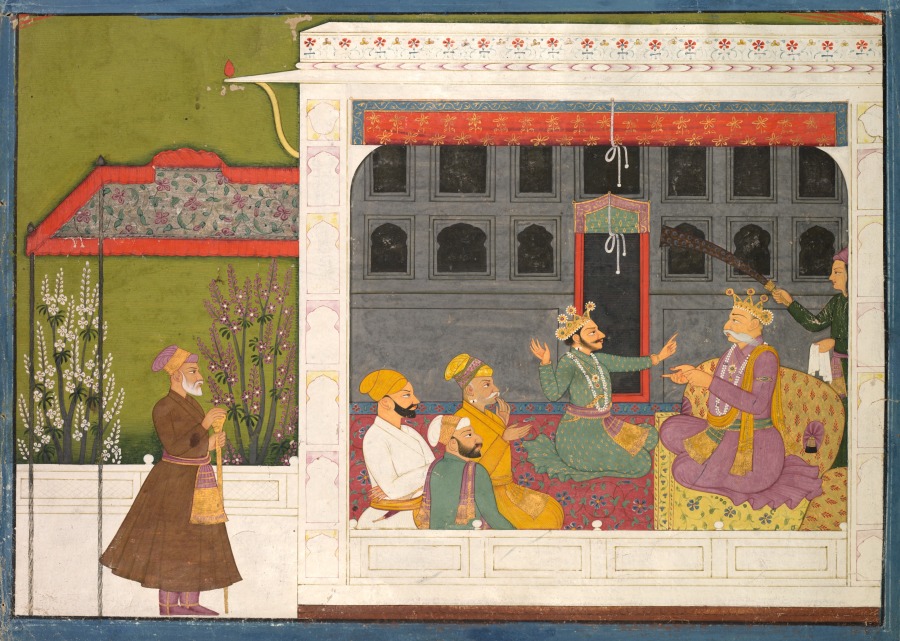
Mola Ram · The Cleveland Museum of Art · Edwin R. and Harriet Pelton Perkins Memorial Fund · CC0
- Born
- Mola Ram was born on 1 January 1743. · Srinagar.
- Died
- Mola Ram died on 1 January 1833. · Srinagar.
- Occupation
- painter
VALÉORINE Encyclopedia
VALÉORINE documentary reading
Documentary summary
Illustration — Self-portrait of the artist Mola Ram, Garhwal, ca.1743–1833 Mola Ram or Maula Ram (1743–1833) was an Indian painter, who originated the Garhwal School of Miniature Painting. He was also a poet, historian and diplomat. Mukandi Lal did research on him.
Admitted source layer · organised and presented by VALÉORINE
Note VALÉORINE
Mola Ram was a painter. The painter was born in Srinagar and died in Srinagar. Works are held at Cleveland Museum of Art, Freer Gallery of Art and Harvard Art Museums.
Composed from admitted, traceable facts · 27 September 2026
VALÉORINE
Reference Check
Propose documentary evidence for Mola Ram. A contribution is never written directly as fact: identity, source, rights and evidence gates still decide.
Sign in to contribute
World of VALÉORINE
Documentary connections
Only confirmed graph relationships appear here. Images are shown only when their identity and reuse rights both pass the documentary gate.
Documentary evidence
Documentary basis
Authority files
wikidata · Q12066832 · wikipedia · Mola Ram
In this article
Life and career
Life and career
He was born in Srinagar (now in Uttarakhand) to Mangat Ram and Rami Devi and worked for the Garhwal Kingdom from 1777 until its annexation first by the Gorkhas in 1803 followed by the British Raj in 1815. It is said that two miniature painters of the Mughal imperial court at Delhi, Sham Das and his son Har Das (or Kehar Das), accompanied Sulaiman Shikoh, the son of Dara Shikoh, when he escaped from his uncle Aurangzeb in 1658 and sought refuge from Prithvi Shah of the Garhwal Kingdom, which had its capital in Srinagar. The painters remained in Srinagar as the royal tasbirdar (picture-makers), and developed the Garhwal style of miniature painting. Mola Ram was one of their descendants. The inception of the Garhwal school of painting is also sometimes credited to him. His son Jwala Ram and grandson Atma Ram continued the tradition, but further descendants suspected a curse and gave up painting. However, one of his descendants, Tulsi (often confused with Tulsi Mistri, another contemporary painter) was also a painter. Mola Ram worked during the times of Garhwal rulers Pradip Shah, Lalit Shah, Jayakrit Shah and Pradyumna Shah from 1777 to 1804. He continued to work for the development of art and literature during the period of the Gorkha rule (1803–15) and the British rule over Garhwal. Mola Ram himself initially painted in the Mughal style until visiting Kangra, e.g. his painting Mastani is in the Mughal idiom, while his later paintings, e.g. Vasakasajja Nayika, are in the Garhwal style, and can be called Garhwali Paintings in true sense. Some of his paintings are signed. He wrote the historical work Garhrajvansh Ka Itihas (History of the Garhwal royal dynasty) which is the source of information about several Garhwal rulers. He starts with Shyam Shah and goes on to describe Dularam Shah, Mahipati Shah, Pritam Shah, Medini Shah, Lalit Shah, and Jayakrit Shah. He also wrote Ganika Natak or Garh Gita Sangram in 1800. Mola Ram himself played a part in politics, helping Jayakrit Shah obtain help from Raja Jagat Prakash of Sirmur to quell a rebellion at the battle of Karparoli. Mola Ram wrote Garhrajvanshkavya, Ran Bahadur Chandrika, Shamsher-e-Jang Chandrika, Bakhtawar Yash Chandrika and others. When Kaji Bakhtawar Singh Basnyat reached Srinagar on 1867 V.S. (i.e. 1810 A.D.), Mola Ram described the Gorkhali administration since 1861 V.S. (i.e. 1804 A.D.). In appreciation of Mola Ram's works, Kaji Bakhtawar gave 61 gold sovereigns, a horse, a robe, some weapons and restored his jagir villages and daily allowances. Mola Ram dedicated Bakhtawar Yash Chandrika in praises of Kaji Bakhtawar Singh Basnyat. He also wrote about the past, present, and future of the Gorkhali administration in Kumaon and Garhwal, which had predicted the possible collapse of Gorkhali rule as mentioned in his another work Garhrajvanshkavya. Mola Ram died in Srinagar in 1833.
Gallery
Gallery
• Illustration — Shiva painted by Ram in the style of the Garhwal School, c. 1800 • Illustration — Poem and portrait of event of death of Kaji Nain Singh Thapa in 1804–06 Gorkha conquest of Garhwal, by Poet Mola Ram • Illustration — Abhisarika Nayika, a painting by Mola Ram
Places
Named by the record
Places
Only places the record itself states, plotted where the house gazetteer settles their coordinates. Nothing is inferred from a name or a nationality.
Mola Ram was born at Srinagar.
Birthplace
Mola Ram died at Srinagar.
Deathplace
Srinagar.
Birth place
Legacy
A large collection of Mola Ram's paintings are preserved at the Hemwati Nandan Bahuguna Garhwal University Museum in Srinagar, Uttarakhand. Some of his paintings can also be viewed at the Boston Museum, USA, at the Bharat Kala Bhawan in Varanasi, and at the Kastur Bhai Lal Bhai Sagrahaalaya, Ahmedabad. Mukandi Lal wrote the book 'Garhwal Paintings' published by the Publications Division of the Government of India in 1968 which traced the history of Garhwal school of painting showcasing Mola Ram's various paintings and sketches. • Illustration — Mural of painter Tulsi Ram, great-grandson of Maula Ram, who painted many murals of the Guru Ram Rai Darbar Sahib complex at Dehradun. Maula Ram's great-grandson, Tulsi Ram (also known as Phattu Sah), was responsible for painting most of the murals found on the walls of the Jhanda Darwaza of the Ram Rai Darbar in Dehradun.
Primary material
Documents and archives
reference work
- “Mola Ram”, English Wikipedia, consulted as further reading
Reputable secondary · Wikipedia
authority record
- Wikidata, structured authority record Q12066832: Mola Ram
General reference · Wikidata
Notes from the source article
Cited by Wikipedia
Notes from the source article
These works are cited by the source article, in its own numbering. They are recorded as its citations, not as sources VALÉORINE has verified.
- 1.Kamboj, 2003 , p.119
- 2.Coomaraswamy, 1969 , pp.75–76
- 3.Bhandari, Dr Mohan. Garhwal School of Painting: Dev Bhumi, Veer Bhumi & Kala Bhumi. newsmeter.in. 2021-08-13.
- 4.Kamboj, 2003 , p.25
- 5.Chaitanya, 1982, p=77
- 6.Mola Ram, Garhwal Paintings, Garhwal School of Painting, Barrister Mukandi Lal. www.srinagargarhwal.com.
- 7.Hāṇḍā, 2002 , p.129
- 8.Kamboj, 2003 , p.28
- 9.Chaitanya, 1982, p=80
- 10.Chaitanya, 1982, p=32
- 11.Hāṇḍā, 2002 , p. 120
- 12.Hāṇḍā, Jain, 2003 , p. 21: "Mola Ram was witness to the collapse of dynastic rule, rise and fall of the tyrannical Gurkha hegemony through which he could steer well, and the British dominance in Garhwal. The upheavals through which the Garhwal kingdom passed during those days are most authentically recorded in his Garhrajvansh Ka Itihas. This work of Mola Ram covers the history of Garhwal from the period of Sham Shah (AD 1550–1569) to the tyrannical days under the Gurkhas and British rule."
- 13.Hāṇḍā, 2002 , pp. 120–144
- 14.Rawat, 2002
- 15.Hāṇḍā, 2002 , p. 144
- 16.Chaitanya, 1982, p=78
- 17.Ohri, Lokesh. Performance Traditions at the Jhanda Saheb Ramlila. Sahapedia.
Bibliography printed in the source article · 7
- Hāṇḍā, Omacanda. History of Uttaranchal. Indus Publishing. 2002. 978-81-7387-134-4.
- Hāṇḍā, Omacanda. Art & architecture of Uttaranchal. Bhavana Books & Prints. 2003. 978-81-86505-65-6.
- Kamboj, B. P. Early wall painting of Garhwal. Indus Publishing. 2003. 978-81-7387-139-9.
- Chaitanya, Krishna. A History of Indian Painting: Pahari Traditions. Abhinav Publications. 1982.
- Rawat, Ajay S. Garhwal Himalayas: A Study in Historical Perspective. Indus Publishing. 2002. 978-81-7387-136-8.
- Coomaraswamy, Ananda K. Introduction to Indian Art. Munshiram Manoharlal, Delhi. 1969.
- Regmi, Mahesh Chandra. Regmi Research Series. Regmi Research Centre. 19. 1987.
References
Citations
References
Each reference names the institution holding it, so a reader may go to the document itself.
reference work
Secondary witnessauthority record
General reference
The Encyclopedia exists whether or not anything is for sale. Corrections are recorded rather than overwritten, and every version of this record is kept. Published 18 August 2026.
Elsewhere in Paintings
18,717 published records in this field, each with its sources named.
- Mojgan ShajarianArtist
- Mokarrameh GhanbariArtist
- Mokuan ReienArtist
- MokujikiArtist
- Molly CramerArtist
- Molly ParkinArtist
- Momo KaporArtist
- Mona FreemanArtist
Best supported in this field
For owners
Own a work by Mola Ram?
A specialist will read what you send and tell you what the house can establish, what it cannot, and whether the object is suited to sale. There is no charge and no obligation. The object stays with you throughout; nothing is shipped to us unless it is arranged in writing beforehand.