
Miraculous Medal
The Miraculous Medal (Médaille miraculeuse), also given the names the Medal of Our Lady of Graces or the Medal of the Immaculate Conception, is a devotional medal originated by Catherine Labouré following apparitions of the Virgin Mary in the Chapel of Our Lady of the Miraculous Medal of Paris, France. The medal, a sacramental, was made by the goldsmith Adrien Vachette. According to the teaching of the Roman Catholic Church, sacramentals, by the Church's prayer, prepare the faithful to receive grace and dispose them to cooperate with it.
Also recorded as miraculous medal
Miraculous Medal
Xhienne · CC BY-SA 3.0
- Name
- Our Lady of the Miraculous Medal
- Field
- religious object · devotional medal
- Period
- 1832
- Region
- France
VALÉORINE Encyclopedia
VALÉORINE documentary reading
Documentary summary
The Miraculous Medal (Médaille miraculeuse), also given the names the Medal of Our Lady of Graces or the Medal of the Immaculate Conception, is a devotional medal originated by Catherine Labouré following apparitions of the Virgin Mary in the Chapel of Our Lady of the Miraculous Medal of Paris, France. The medal, a sacramental, was made by the goldsmith Adrien Vachette. According to the teaching of the Roman Catholic Church, sacramentals, by the Church's prayer, prepare the faithful to receive grace and dispose them to cooperate with it.
Admitted source layer · organised and presented by VALÉORINE
Reference Check
Propose documentary evidence for Miraculous Medal. A contribution is never written directly as fact: identity, source, rights and evidence gates still decide.
Sign in to contribute
World of VALÉORINE
Documentary connections
Only confirmed graph relationships appear here. Images are shown only when their identity and reuse rights both pass the documentary gate.

Documentary evidence
Documentary basis
Authority files
wikidata · Q656895 · wikipedia · Miraculous Medal
In this article
Overview
Overview
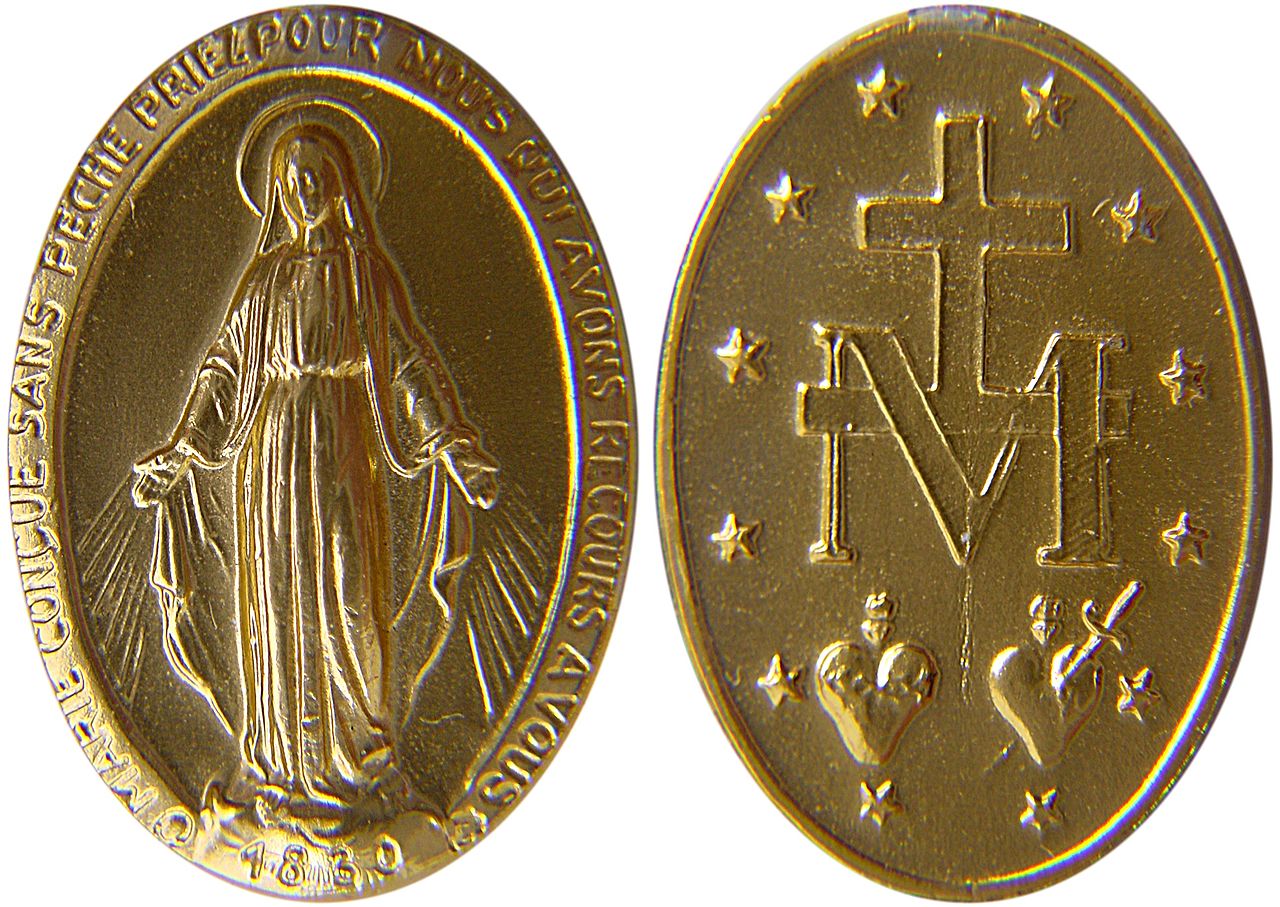
A prayer of petition to Mother Mary is engraved upon the front of the medal, reading "O Mary, conceived without sin, pray for us who have recourse to thee".
Key facts
Key facts
• Name — Our Lady of the Miraculous Medal • Size — 290px • Location — Rue du Bac in Paris, France • Date — 18 July 1830 27 November 1830 • Witness — Saint Catherine Labouré • Type — Marian apparition • Approval — 1836 (Archbishop Hyacinthe-Louis de Quélen, Archdiocese of Paris) • Venerated In — Catholic Church • Shrine — Chapel of Our Lady of the Miraculous Medal, Paris, France • Patronage — Special graces, miracles of healing, conversions, believers • Illustration — The Chapel of Our Lady of the Miraculous Medal is located in Rue du Bac, Paris
Background
Background
Catherine Labouré stated that on July 18, 1830, the eve of the feast of Saint Vincent de Paul, she woke up after hearing the voice of a child calling and leading her to the chapel of her convent. There, the Virgin Mary appeared to her and said that "God wishes to charge you with a mission [...] You will be contradicted, but do not fear, you will have grace [...] Tell your spiritual director all that passes within you [...] Times are evil. Sorrows will come upon France [...] The whole world will be upset by miseries of every kind." On November 27, 1830, Catherine then observed that the Virgin Mary returned during her evening meditations, displaying herself inside an oval frame, standing upon a globe. She wore many rings set with gems that shone rays of light over the globe. Mary said to her that the rays symbolized the graces she is "shedding upon those who ask for them", and that the gems which did not shed light "are the graces for which souls forget to ask". Around the margin of the frame appeared a prayer of petition: Ô Marie, conçue sans péché, priez pour nous qui avons recours à vous ("O Mary, conceived without sin, pray for us who have recourse to thee"). As Catherine watched, the frame seemed to rotate, showing a circle of twelve stars, a large letter 'M' surmounted by a cross, and the stylized Sacred Heart of Jesus crowned with thorns and the Immaculate Heart of Mary pierced with a sword. Catherine heard the Virgin Mary ask her to "have a Medal struck after this model" and to take these images to her confessor, and that "all who wear them will receive great graces". • Illustration — Saint Catherine Labouré After two years of investigation and observation of Catherine's ordinary daily behavior, her priest took the information to the archbishop of Paris, Hyacinthe-Louis de Quélen. The request was approved, and the medal was designed from her visionary descriptions, and eventually produced through the labor of the goldsmith Adrien Vachette. The first 1,500 medals, originally called the "Medal of the Immaculate Conception", were minted on June 30, 1832. During a deadly cholera pandemic, the Daughters of Charity started distributing the medals. After reports of miraculous cures, the demand for the medal rapidly grew in France and other graces were reported, such as conversions, and it became widely known in the following decades as the Miraculous Medal. In 1834, over 500,000 medals had been distributed. By 1835, that number had surpassed 1 million worldwide. By 1839, over 10 million medals had been distributed. And by the time of Catherine Labouré's death in 1876, more than 1 billion Miraculous Medals had been produced. The Chapel of Our Lady of the Miraculous Medal, in which Catherine experienced her visions, is located at the mother house of the Daughters of Charity of Saint Vincent de Paul in rue du Bac, Paris. The incorrupt bodies of Saint Catherine Labouré and Saint Louise de Marillac, a co-founder of the Congregation of the Daughters of Charity of Saint Vincent de Paul, are interred in the chapel.
Symbolism
Symbolism
The elements of the emblem upon the sides of the Miraculous Medal encapsulate major Marian teachings that have since been declared doctrine by the Catholic Church. • Illustration — The Miraculous Medal design was executed by Adrien Vachette based on Saint Catherine Labouré's visions Front: • Mary stands on a globe – Mary bestowing graces upon the Earth and mankind, assumed into Heaven, describing the original vision, Catherine said Mary appeared radiant as a sunrise, "in all her perfect beauty" • Crushes the serpent's head underfoot – reference to Genesis 3:15, Mary is engaged in the spiritual battle against evil and Satan (serpent), she protects from evil • Rays of light shine forth from Mary's hands and rings – symbolizing graces from Mary as a Mediatrix, Mary told Catherine that the rays "symbolize the graces I shed upon those who ask for them" • Words from the vision, originally in French, form an oval frame around the image: "O Mary, conceived without sin, pray for us who have recourse to thee" – the Immaculate Conception of the Virgin Mary • 1830 is marked as the year of the apparitions. Reverse: • A crossbar and a cross surmount a large, bold letter 'M' – Jesus Christ's cross as an act of redemption for mankind, the foot of the Cross, and holiness of the nameplate initial of Mary • Twelve stars mark the perimeter – the Twelve Apostles and the Church, and the vision of John the Apostle in Revelation 12:1: "And a great sign appeared in heaven: A woman clothed with the sun, and the moon under her feet, and on her head a crown of twelve stars", symbolizing the Woman of Apocalypse and Queen of Heaven • Two hearts are depicted underneath the 'M', the left encircled with a crown of thorns, the right pierced by a sword, referencing Simeon's prophecy in Luke 2:35. From each, a flame emanates from the top.
Church approval
Church approval
In 1835, following the success of the Miraculous Medal, the archbishop of Paris, Hyacinthe-Louis de Quélen, initiated a canonical inquiry, which was entrusted to Canon Quentin, the Vicar General. Usually, official recognition of an apparition requires the local bishop to meet personally with the seer. However, in Labouré's case, this was not possible, as she insisted on remaining anonymous and silent. In 1842, Marie-Alphonse Ratisbonne, experienced a sudden conversion from Judaism to the Catholic faith as he was wearing the Miraculous Medal as part of a challenge, upon entering the basilica of Sant'Andrea delle Fratte in Rome. He reportedly had a vision of the Virgin Mary, as depicted on the medal. This event underwent a canonical inquiry, and the Church approved the miracle, granting it ecclesiastical sanction. Alphonse became a Jesuit priest and missionary, and the miracle of his conversion is commemorated in the office of the Feast of the Miraculous Medal. On July 23, 1894, Pope Leo XIII approved the Feast of Our Lady of the Miraculous Medal, composed by the Lazarists. This feast, with a special Office and Mass, was to be celebrated by the priests of the Congregation of the Mission yearly on 27 November. A decree on September 7, 1894, extended the privilege to other religious communities and allowed any priest to celebrate the Mass in chapels attached to the Sisters of Charity. In 1897, Pope Leo XIII granted a canonical coronation of the statue "of the Immaculate Conception, known as the Miraculous Medal". In 1947, after a canonical inquiry, Pope Pius XII canonized Catherine Labouré as a saint, which includes an investigation into the apparitions of the Miraculous Medal. The Miraculous Medal was also granted indulgences by successive Popes; the 2004 Enchiridion Indulgentiarum grants the partial indulgence to the faithfuls of Christ who use a crucifix or cross, a crown, a scapular, a medal blessed by a priest.
Veneration
Veneration
In 1834, the priest John Vianney from Ars acquired a statue of Our Lady of the Miraculous Medal and placed it on a tabernacle with a door featuring the reverse side of the medal. On May 1, 1836, he consecrated his parish to "Mary conceived without sin". After his ordination, the Franciscan priest Maximilian Kolbe wished to celebrate his first Mass at Sant'Andrea delle Fratte, where the Immaculate Virgin had converted Alphonse Ratisbonne. In 1917, he founded the Militia of the Immaculate, under the patronage of the Virgin of the Miraculous Medal. On his way to Japan in 1930, he visited France, including rue du Bac, and distributed Miraculous Medals, referring to them as his "ammunition". Pope John Paul II used a slight variation of the reverse image as his coat of arms, the Marian Cross, a plain cross with an 'M' underneath the right-hand bar (which signified the Blessed Virgin at the foot of the Cross).
Miracles
Miracles
In 1833, the Lazarist priest John Gabriel Perboyre recounts the miraculous healing of a fellow priest through the Miraculous Medal. After arriving in China as a missionary, where he would later die as a martyr in 1839, he distributed many medals and reported numerous miracles in his letters. In 1837, the Miraculous Medal was used by the Archbishop of Paris de Quélen for the conversion and reconciliation with the Church of Dominique-Georges-Frédéric Dufour de Pradt on his deathbed. de Quélen also obtained miraculous healings through the use of the medal and became an advocate of its propagation. In 1842, the most famous conversion through the Miraculous Medal is that of Alphonse Ratisbonne, a Jewish man who was challenged to wear the medal during his trip to Rome. Upon entering the basilica of Sant'Andrea delle Fratte, he experienced a vision of the Virgin Mary as depicted on the medal, leading to his conversion. The miracle was approved by the Church.
Places
Named by the record
Places
Only places the record itself states, plotted where the house gazetteer settles their coordinates. Nothing is inferred from a name or a nationality.
- France
Notes from the source article
Cited by Wikipedia
Notes from the source article
These works are cited by the source article, in its own numbering. They are recorded as its citations, not as sources VALÉORINE has verified.
- 1.Dirvin, Fr. Joseph. Saint Catherine Laboure of the Miraculous Medal. EWTN.
- 2.Ann Ball, 2003 Encyclopedia of Catholic Devotions and Practices p. 356
- 3.AMM - Miraculous Medal Story. www.amm.org.
- 4.Cite CCC 2.1 1674
- 5.Cite CCC 2.1 1670
- 6.The Popes and the Miraculous Medal: A Legacy of Devotion. EWTN Vatican.
- 7.Dirvin, C.M., Joseph I. Saint Catherine Laboure of the Miraculous Medal. Tan Books & Publishers, Inc. 1958. 0-89555-242-6.
- 8."I saw rings on her fingers, three rings to each finger, the largest one near the base of the finger, one of medium size in the middle, the smallest one at the tip. Each ring was set with gems, some more beautiful than others ..." Catherine Labouré, quoted in John Delaney, A Woman Clothed With The Sun, Doubleday, 1960, p. 77.
- 9.St. Catherine Laboure and the Miraculous Medal EWTN. EWTN Global Catholic Television Network.
- 10.CATHOLIC ENCYCLOPEDIA: Miraculous Medal. www.newadvent.org.
- 11.Glass, Joseph. Miraculous Medal. The Catholic Encyclopedia. Robert Appleton Company. 10. 20 December 2012.
- 12.McMenamin, M. 2010. Precisely dated early versions of the Miraculous Medal. Numismatics International Bulletin, v. 45, nos. 3/4, pp. 43-48.
- 13.Mack, John. The museum of the mind: art and memory in world cultures. British Museum. 2003.
- 14.What the Miraculous Medal Has Done for Me. NCR. 2025-01-18.
- 15.Histoire de la Médaille Miraculeuse Chapelle Notre-Dame de la Médaille Miraculeuse. www.chapellenotredamedelamedaillemiraculeuse.com.
- 16.Mauriello, Rev. Matthew R. The Miraculous Medal. Fairfield County Catholic. 1996.
- 17.Callbeck, Cara. "Pilgrims in Paris and a Lesson for Lent", Ignatian Spirituality
- 18.Médaille Miraculeuse Chapelle Notre-Dame de la Médaille Miraculeuse. www.chapellenotredamedelamedaillemiraculeuse.com.
- 19.The Meaning of the Miraculous Medal. The Divine Mercy. 2016-11-25.
- 20.The apparitions and the Miraculous Medal Chapelle Notre-Dame de la Médaille Miraculeuse. www.chapellenotredamedelamedaillemiraculeuse.com.
- 21.Saint Catherine Laboure of the Miraculous Medal EWTN. EWTN Global Catholic Television Network.
- 22.Harrison, Carol E. Conversion in the Age of Mechanical Reproduction: Alphonse Ratisbonne in Rome and Paris. The Journal of Modern History. 92. 1. 116–144. 2020-03-01. 0022-2801.
- 23.Enchiridion Indulgentiarum. quarto editur, Normae de indulgentia, 15
- 24."The Coat of Arms of Pope John Paul II", Liguorian
References
Citations
References
Each reference names the institution holding it, so a reader may go to the document itself.
reference work
Secondary witnessreference work
Secondary witness
The Encyclopedia exists whether or not anything is for sale. Corrections are recorded rather than overwritten, and every version of this record is kept. Published 14 August 2026.
Elsewhere in Medals
1,069 published records in this field, each with its sources named.
- Military Service MedalTerminology
- Military Virtue MedalTerminology
- Militia Long Service MedalTerminology
- Minesweeper War BadgeTerminology
- Mobilisation War CrossTerminology
- Mobilization Cross 1912/13Terminology
- Monte Caseros MedalTerminology
- Monte Cassino Commemorative CrossTerminology
Best supported in this field
For owners
Own an object connected with Miraculous Medal?
A specialist will read what you send and tell you what the house can establish, what it cannot, and whether the object is suited to sale. There is no charge and no obligation. The object stays with you throughout; nothing is shipped to us unless it is arranged in writing beforehand.