
Mino da Fiesole
Illustration — Portrait of Mino da Fiesole, metalpoint with white gouache on blue-grey prepared paper cut to an oval, Chatsworth House. Subject identified based on the similarity to the woodcut illustration in the Lives of Vasari, for which it is a probable source. Alfred Scharf's attribution of the drawing to Filippino Lippi has been generally accepted.
Also recorded as Mino Da Fiesole · Mino da Florentia · Mino da Poppio · Mino di Giovanni Mini da Poppio
Mino da Fiesole
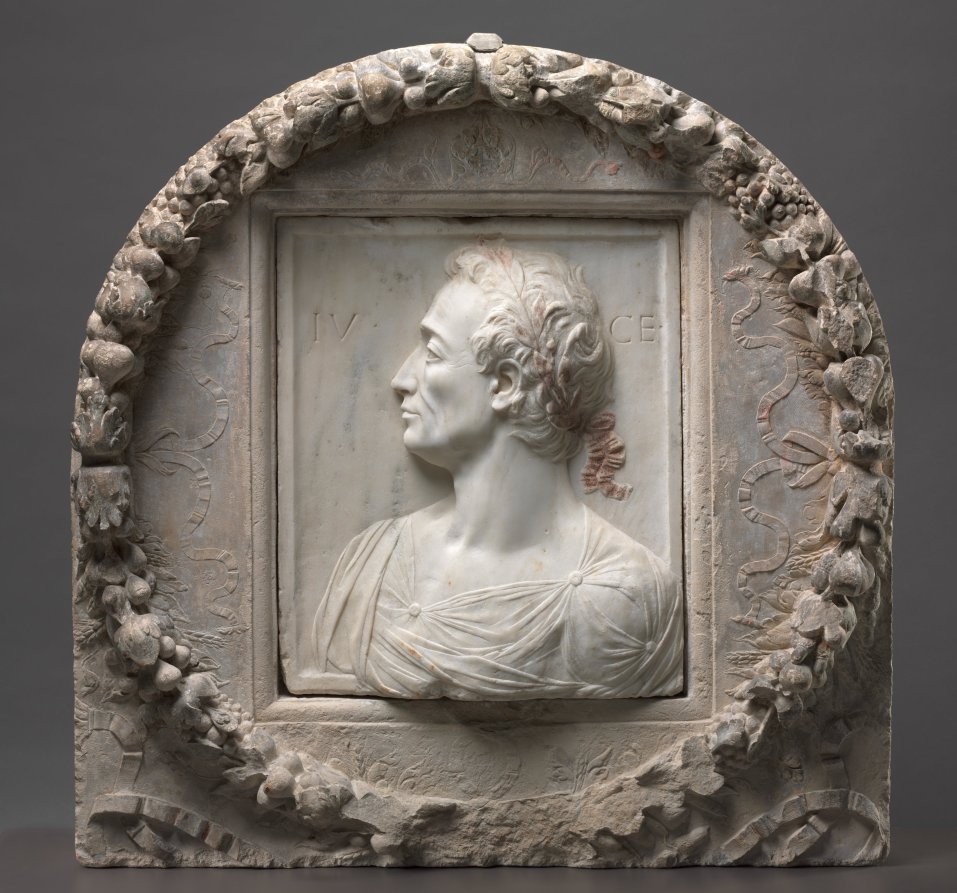
Mino da Fiesole · The Cleveland Museum of Art · John L. Severance Fund · CC0
- Born
- 1429 · Poppi.
- Nationality
- United States
- Occupation
- sculptor
- Known for
- Bust of Alesso of Luca Mini · Bust of Giovanni of Cosimo de' Medici · Portrait of Niccolò Strozzi · Bust of Piero de' Medici · Bust of Pope Paulus II · Bust of Rinaldo of the Luna · Bust of the Cardinal Guillaume d'Estouteville · Madonna and Child
- Languages
- Italian
VALÉORINE Encyclopedia
VALÉORINE documentary reading
Documentary summary
Illustration — Portrait of Mino da Fiesole, metalpoint with white gouache on blue-grey prepared paper cut to an oval, Chatsworth House. Subject identified based on the similarity to the woodcut illustration in the Lives of Vasari, for which it is a probable source. Alfred Scharf's attribution of the drawing to Filippino Lippi has been generally accepted.
Admitted source layer · organised and presented by VALÉORINE
Reference Check
Propose documentary evidence for Mino da Fiesole. A contribution is never written directly as fact: identity, source, rights and evidence gates still decide.
Sign in to contribute
World of VALÉORINE
Documentary connections
Only confirmed graph relationships appear here. Images are shown only when their identity and reuse rights both pass the documentary gate.
Documentary evidence
Documentary basis
Authority files
getty · 500002074 · gnd · 118784153 · wikidata · Q477441 · wikipedia · Mino da Fiesole
In this article
Career
Career
Mino da Fiesole (c. 1429 – July 11, 1484), also known as Mino di Giovanni, was an Italian Renaissance sculptor from Poppi, Tuscany. He is noted for his portrait busts.
The recorded working language is Italian. Works named in the authority record are Bust of Alesso of Luca Mini, Bust of Giovanni of Cosimo de' Medici, Portrait of Niccolò Strozzi, Bust of Piero de' Medici, Bust of Pope Paulus II and Bust of Rinaldo of the Luna. Work by Mino da Fiesole is recorded in the collections of Städel Museum, Bargello National Museum, Cleveland Museum of Art, Bode Museum and Louvre-Lens.
Mino's work was influenced by his master Desiderio da Settignano and by Antonio Rossellino, and is characterized by its sharp, angular treatment of drapery. Unlike most Florentine sculptors of his generation, Mino passed two lengthy sojourns in Rome, from about 1459 to 1464 and again from about 1473/1474 until 1480. Mino was a friend and fellow-worker of Desiderio da Settignano and Matteo Civitali, all three being about the same age. Mino's sculpture is remarkable for its finish and delicacy of details, as well as for its spirituality and strong devotional feeling. Of Mino's earlier works, the finest are in the cathedral of Fiesole, the altarpiece and tomb of Bishop Leonardo Salutati (died 1466) His most arduous and complicated commissions, which define his intellectual and artistic nature, are an altarpiece and tombs for the church of the Benedictine monastery in Florence known as the Badia. (The monuments have been reinstalled in the rebuilt church.) The first, completed about 1468, was essentially a private commission for the Florentine jurist Bernardo Giugni. The second, directly commissioned by the monks and finished in 1481, honored the memory of their founder, the tenth century Ugo, count of Tuscany. The wall monuments exercised Mino's skills: portraits and bas-reliefs are worked into complex tectonic aedicular structures with elaborate highly individualistic decorative moldings. Art historians have revelled in the extraordinary diversity of contemporary and ancient sources that Mino marshaled in these tombs, which distinguish him from other sculptors active in mid quattrocento Florence (Zuraw 1998). • Illustration — The earliest dated Renaissance portrait bust, 1453, by Mino da Fiesole of Piero de' Medici The pulpit in Prato Cathedral, in which he collaborated with Antonio Rossellino, finished in 1473, is very delicately sculpted with bas-reliefs of great minuteness, but somewhat weakly designed. In 1473 he went to Rome where he remained apparently about six years. It is doubtful if all the monuments there attributed to him are of his own hands; there is no question about the tomb of the Florentine Francesco Tornabuoni in the Church of Santa Maria sopra Minerva, the remains of the monument to Pope Paul II in the crypt of St. Peter's, and the beautiful little marble tabernacle for the holy oils in St. Maria in Trastevere bears the inscription Opus Mini. Several monuments in Santa Maria del Popolo have at times been attributed to Mino, for example the marble reredos given by Pope Alexander VI. The monuments there of Archbishop of Salerno Pietro Guglielmo Rocca (d. 1482) and Bishop of Burgos Ortega Gomiel (d. 1514), however, have also been attributed to the school of Andrea Bregno. Some of Mino's portrait busts and profile bas-reliefs are preserved in the Bargello at Florence; they are full of life and expression, though without the extreme realism of Verrocchio and other sculptors of his time. Several museums house Mino's work, some of which include Musée du Louvre in Paris, France, Museum of Fine Arts in Boston, Massachusetts, Birmingham Museum of Art in Birmingham, Alabama, and National Gallery of Art in Washington, D.C. His other works include: • a portrait bust of Piero de Medici (1453), notable as "the oldest authenticated example we have of a post-classical portrait of a living person in the form of a marble bust". • a portrait bust of Niccolò Strozzi (1454) • a bust of Astorgio Manfredi (1455) • the ciborium over the high altar of Santa Maria Maggiore, in Rome • a bust of Diotisalvi Neroni, adviser to Piero de Medici (1464) • companion pieces of Charity and Faith, most probably designed for a wall tomb (1475/1480) Giorgio Vasari's vita of Mino da Fiesole in his Lives of the Artists dismisses him as a mere follower of Desiderio da Settignano, his master. • Illustration — Piazza Mino da Fiesole in Fiesole
Gallery
Gallery
• Illustration — Tomb of Ugo, count of Tuscany, Badia, Florence • Illustration — Alfonso V of Aragon • Illustration — Diotisalvi Neroni • Illustration — Scipio Africanus c. 1460-1465 (Philadelphia Museum of Art) • Illustration — Virgin Annunciate c. 1455-1460 (National Gallery of Art, Washington, D.C.) • Illustration — Julius Caesar c. 1455-1460 (Cleveland Museum of Art) • Illustration — Virgin Annunciate (Louvre) • Illustration — Saint John the Baptist (Museum of Fine Arts of Lyon) • Illustration — Madonna and Child Château de Chenonceau, France. • Illustration — Madonna and Child Louvre, France. • Illustration — Madonna and Child c. 1461 (Cleveland Museum of Art)
Work and production
Work and production
Works recorded as notable number 8: Bust of Alesso of Luca Mini, Bust of Giovanni of Cosimo de' Medici, Portrait of Niccolò Strozzi, Bust of Piero de' Medici, Bust of Pope Paulus II, Bust of Rinaldo of the Luna, Bust of the Cardinal Guillaume d'Estouteville and Madonna and Child.
Identity
Identity
Mino da Fiesole is recorded as sculptor. Identity and origins. The authorities additionally record the headings Mino Da Fiesole, Mino da Florentia, Mino da Poppio, Mino di Giovanni Mini da Poppio and Mino di Giovanni. His recorded language was Italian.
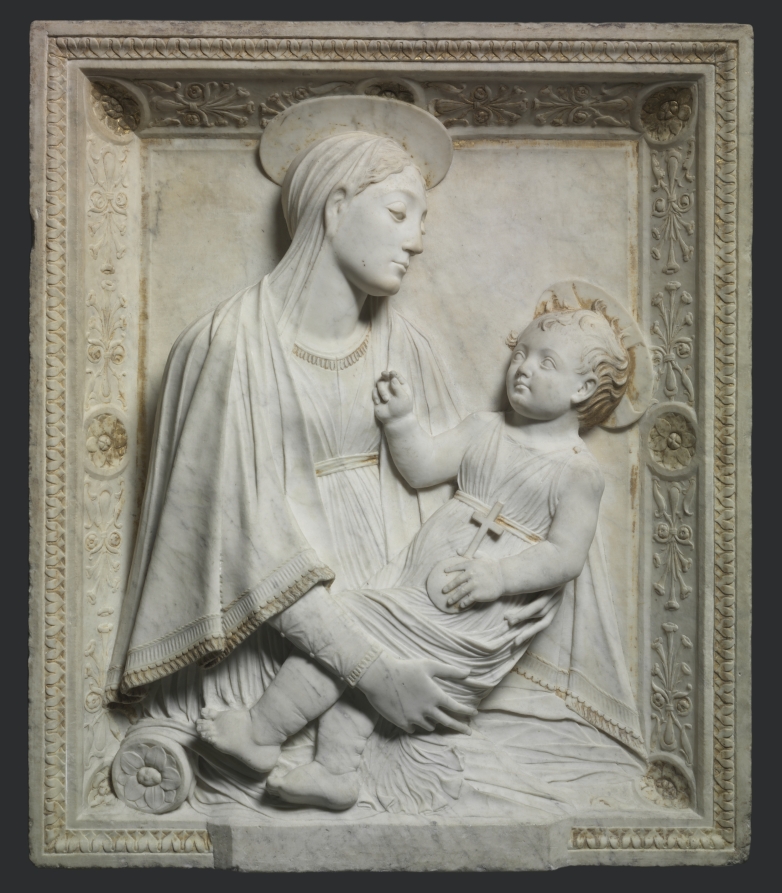
Madonna and Child, by 1461, by Mino da Fiesole
Mino da Fiesole · The Cleveland Museum of Art · Gift of Mrs. Leonard C. Hanna
Life and career
Dated record
Life and career
Explore 1429–1484
The full dated record · 8 entries
1429
Mino da Fiesole was born in 1429 at Poppi.
1450
Palazzo Venezia is dated 1450.
1453
Gesù fanciullo, il Battista e San Girolamo is dated 1453.
1464
Madonna with Child, San Lorenzo and San Leonardo is dated 1464.
1470
Funeral monument for Cristoforo and Domenico Rovere is dated 1470.
1471
tabernacle in the Volterra Cathedral is dated 1471.
1480
tomb of Francesco Tornabuoni is dated 1480.
1484
Mino da Fiesole died in 1484 at Florence.
Places
Named by the record
Places
Only places the record itself states, plotted where the house gazetteer settles their coordinates. Nothing is inferred from a name or a nationality.
Poppi.
Birth place
Florence.
Death place
Primary material
Documents and archives
authority file
- Gemeinsame Normdatei 118784153, Mino, da Fiesole.
General reference · Deutsche Nationalbibliothek
- Getty Union List of Artist Names 500002074, Mino da Fiesole.
General reference · The Getty Research Institute
reference work
- Wikidata, structured authority record Q477441: Mino da Fiesole
Reputable secondary · Wikimedia Foundation
- “Mino da Fiesole”, English Wikipedia, consulted as further reading
Reputable secondary · Wikipedia
Citations
References
Each reference names the institution holding it, so a reader may go to the document itself.
authority file
Gemeinsame Normdatei 118784153, Mino, da Fiesole.Deutsche Nationalbibliothek
Secondary witnessauthority file
Getty Union List of Artist Names 500002074, Mino da Fiesole.The Getty Research Institute
Secondary witnessreference work
Wikidata, structured authority record Q477441: Mino da FiesoleWikimedia Foundation
Secondary witnessreference work
Secondary witness
The Encyclopedia exists whether or not anything is for sale. Corrections are recorded rather than overwritten, and every version of this record is kept. Published 16 August 2026.
Elsewhere in Sculpture
6,174 published records in this field, each with its sources named.
- Mimmo PaladinoArtist
- Mimsy FarmerArtist
- Minca Bosch ReitzArtist
- Ming FayArtist
- Mino del ReameArtist
- Minoru NiizumaArtist
- Miquel Blay i FàbregasArtist
- Mir-Ali Mir-KasimovArtist
Best supported in this field
For owners
Own a work by Mino da Fiesole?
A specialist will read what you send and tell you what the house can establish, what it cannot, and whether the object is suited to sale. There is no charge and no obligation. The object stays with you throughout; nothing is shipped to us unless it is arranged in writing beforehand.