
Merl laVoy
Merl LaVoy (1885–1953) was a photographer and documentary cinematographer who traveled the four corners of the world, earning him the title of “The Modern Marco Polo”.
Merl laVoy

Ron van Dopperen · CC BY-SA 4.0
- Name
- Merl LaVoy
- Born
- 14 December 1885
- Birthplace
- Royalton, Wisconsin, US
- Died
- 7 December 1953
- Place of death
- Johannesburg, South Africa
- Occupation
- Photographer/cinematographer
- Nationality
- United States
VALÉORINE Encyclopedia
VALÉORINE documentary reading
Documentary summary
Merl LaVoy (1885–1953) was a photographer and documentary cinematographer who traveled the four corners of the world, earning him the title of “The Modern Marco Polo”.
Admitted source layer · organised and presented by VALÉORINE
Note VALÉORINE
Merl laVoy was journalist, photographer and photojournalist; nationality: United States. Merl laVoy was born in 1885. Died in 1953.
Composed from admitted, traceable facts · 26 September 2026
VALÉORINE
Reference Check
Propose documentary evidence for Merl laVoy. A contribution is never written directly as fact: identity, source, rights and evidence gates still decide.
Sign in to contribute
World of VALÉORINE
Documentary connections
Only confirmed graph relationships appear here. Images are shown only when their identity and reuse rights both pass the documentary gate.
Documentary evidence
Documentary basis
Authority files
wikidata · Q110281142 · wikipedia · Merl LaVoy
In this article
Key facts
Key facts
• Name — Merl LaVoy • Born — 14 December 1885 • Birthplace — Royalton, Wisconsin, US • Died — 7 December 1953 • Place of death — Johannesburg, South Africa • Occupation — Photographer/cinematographer
Biography
Biography
Merl LaVoy was born to Charles Henry LaVoy and Luella Easton on December 14, 1885, in the small town of Royalton, Wisconsin. LaVoy's father died tragically in a sawmill accident when Merl was 13 months old. His mother married Arthur E. Peck in 1893 and the family moved to Tower in St Louis County, Minnesota. The marriage dissolved and by 1906, LaVoy's mother married William Henry Cole in Seattle. LaVoy rarely discussed his youth but in some accounts he claimed that his parent died while he was young and he lived with an uncle in a log cabin in a heavily forested area of Oregon. In 1907, LaVoy started working for the Great Northern Development Company, which was prospecting for copper at the Kotsina River mine in Alaska. During this time he became a dog sled musher and first started taking photographs. In Spring of 1910, LaVoy travelled to Seattle and met Herschel C. Parker and Belmore Browne and volunteered to help them in their expedition to verify if a previous expedition led by Frederick Alfred Cook who claimed to reach the summit of Denali. The team was unsuccessful. LaVoy also joined the 1912 Parker Browne expedition, in part as a photographer, and transported a ton of gear on dog sleds from Seward to Muldrow Glacier. The team came within a few hundred yards of the summit but had to turn back due to harsh weather. In 1913, LaVoy was assigned by the Chicago Mail to accompany publisher Ben Boyce and take photos on a round-the-world journey. He carried a 40 pound panoramic camera with him and was able to photograph the Taj Mahal with a unique perspective. He later presented a copy of the photo to President Woodrow Wilson. During World War I, LaVoy filmed with the French army during the 1916 Somme offensive where he filmed one of the first tank attacks of the First World War. LaVoy is credited as the only civilian cinematographer from the United States who filmed on the battlefields of the Somme and Verdun with the French army. His film Heroic France was released by the Mutual Film Corporation in June 1917. LaVoy’s second war film Victorious Serbia (1918) was released in the United States at local benefit exhibitions by the Red Cross. In June 1918, LaVoy accompanied lecturer Burton Holmes for his last World War I film project. During the final months of the war, they traveled together extensively across Eastern Europe. Films and photographs were made showing Romanian military operations in Transylvania, daily life in Macedonia and the city of Constantinople (Istanbul) shortly after the Turkish surrender. After the war, LaVoy remained active as a cinematographer for the Red Cross. He filmed in Italy, the Balkans, Turkey and North Africa. During the 1920s, he had photo assignments in Australia, the Solomon Islands, the Philippines, Alaska, and China. From 1927, he made newsreels for Pathé. During the 1930s LaVoy worked on photographic projects in Japan, China, Siberia, and Manuchukuo. In the mid-1930s, LaVoy worked for John W. Hauserman and documented Hauserman's gold mining projects in the Philippines. By 1938, LaVoy was working in South Africa where he embarked on a number of industrial film projects and freelance photography. LaVoy died of a heart attack while staying in Johannesburg, South Africa, on December 7, 1953.
Gallery
Gallery
• Illustration — Children in Constantinople, ca 1918 • Illustration — Serbian soldiers in boats during Balkans Campaign of World War I, 1918 • Illustration — A photo by Merl LaVoy, early 1900s of Trimurti • Illustration — A photo by Merl LaVoy, early 1900s • Illustration — At Serbian front, National Museum of Health and Medicine • Illustration — Balkan owls, National Museum of Health and Medicine • Illustration — Constantinople women, National Museum of Health and Medicine • Illustration — Jewish cemetery, Salonica, National Museum of Health and Medicine • Illustration — LaVoy's camera outfit, National Museum of Health and Medicine • Illustration — Macedonian man, National Museum of Health and Medicine • Illustration — Romanian troops in Transylvania • Illustration — Tin shop, National Museum of Health and Medicine
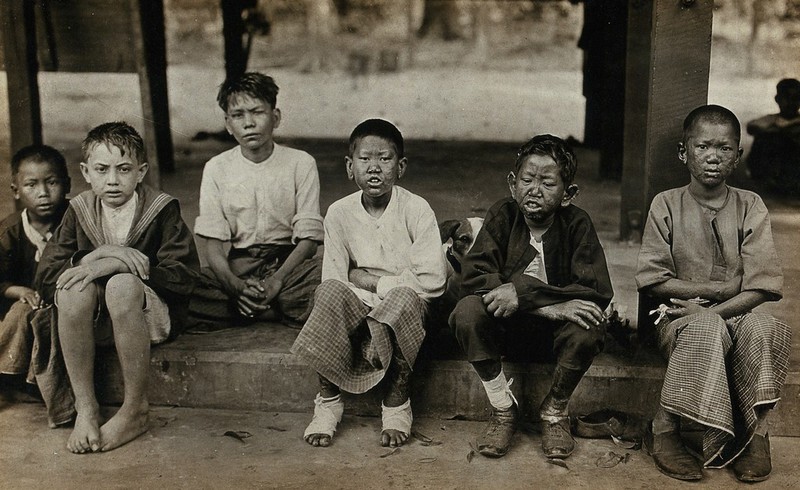
Rangoon Leper Colony,
Merl LaVoy · Wellcome Collection, London · Wellcome Collection
Film work
Long considered a lost film, Heroic France was discovered in 2015 by film historians Ron van Dopperen and Cooper C. Graham. The footage comes from reels 3-6. It has a total playtime of a little over 35 minutes. These scenes were found in a collection of unused footage that had been collected by CBS for their TV documentary series on World War I (1964-1965) and had been donated to the National Archives. • Illustration — "Heroic France" (1917) filmed by Merl LaVoy In 2017, van Dopperen and Graham located the World War I film shot by LaVoy with the British army in Salonika (Thessaloniki, Greece). LaVoy’s life and work during World War I has been described in more detail by authors James W. Castellan, Ron van Dopperen and Cooper C. Graham in their book American Cinematographers in the Great War, 1914-1918
Primary material
Documents and archives
reference work
- “Merl LaVoy”, English Wikipedia, consulted as further reading
Reputable secondary · Wikipedia
authority record
- Wikidata, structured authority record Q110281142: Merl laVoy
General reference · Wikidata
Notes from the source article
Cited by Wikipedia
Notes from the source article
These works are cited by the source article, in its own numbering. They are recorded as its citations, not as sources VALÉORINE has verified.
- 1.Castellan, James W. American Cinematographers in the Great War, 1914-1918. Indiana University Press. 2014. 978-0-86196-717-9.
- 2.Mould, David H. The "Photographer-Adventurers": Forgotten Heroes of the Silent Screen. Journal of Popular Film and Television. 16. 3. 118–129. 1988-07-01. 0195-6051.
- 3.US Passport Applications. National Archives and Records Administration (NARA); Washington D.C.; Roll #: 519; Volume #: Roll 0519 - Certificates: 17750-17999, 16 May 1918-16 May 1918
- 4.Charles LaVoy killed. Montreal River Miner and Iron County Republican. 5. 1887-01-20.
- 5.AAC Publications - Merl Lavoy, 1886-1953. publications.americanalpineclub.org.
- 6.Ramsaye, Terry. A million and one nights : a history of the motion picture through 1925. New York : Simon & Schuster. 1986. 978-0-671-62404-0.
- 7.Merl LaVoy photographs from Alaska National Museum of the American Indian. americanindian.si.edu.
- 8.Davenport, Delbert. Around the World with a Globe-Trotting Cameraman. International Photographer. 18–21. June 1930.
- 9.Plans Long Trip In Aid of Fair. San Francisco Daily NewsJuly 1, 1912. 2. October 17, 1910.
- 10.Browne, Belmore. The conquest of Mt. McKinley. Boston, Houghton Mifflin. 1956.
- 11.Try To Ascend Mount M'Kinley. Spokane Chronicle. 5. 1911-11-25.
- 12.Climbs to Top of the World. The New North. 4. 1911-02-02.
- 13.Peak Scaler Here to See Relatives. Green Bay Press-Gazette. 3. 1913-08-18.
- 14.Birth of the News Reel. American Cinematographer. 288. November 1933.
- 15.Sibley, Hi. The Why of the Tankless Film. Motion Picture Magazine. 60–64. August 1917.
- 16.Dopperen, Ron Van. First World War on Film: Merl laVoy Revisited. First World War on Film. 18 January 2016.
- 17.Dopperen, Ron Van. First World War on Film: Filming Nobel Prize Winner Alexis Carrel (1916). First World War on Film. 8 November 2017.
- 18.Veeder, Gerry K. The Red Cross Bureau of Pictures, 1917–1921: World War I, the Russian Revolution and the Sultan of Turkey's harem. Historical Journal of Film, Radio and Television. 10. 1. 47–70. 1990-01-01. 0143-9685.
- 19.Where Remotest Past Meets Pulsing Present. Visual Education. 140-141, 169-174. June 1924.
- 20.The Lost Archipelago. Visual Education. 230–234. August 1924.
- 21.A Land Without A Typical Climate. Visual Education. 278–282. September 1924.
- 22.Merl LaVoy Appointed Globe Trotting Camera Man by Pathe. Moving Picture World. May 27, 1927.
- 23.Hollywood Cameramen Win Success in the Orient. International Photographer. 18. March 1935.
- 24.Will Our Gold Output Eclipse Alaska's. Philippine Magazine. 531. December 1934.
- 25.Merl LaVoy - ESAT. esat.sun.ac.za.
- 26.Obituaries. Variety. 63. December 16, 1953.
- 27.Dopperen, Ron Van. First World War on Film: Found! Merl laVoy's "Heroic France"(USA, 1917). First World War on Film. 16 November 2015.
- 28.Dopperen, Ron Van. First World War on Film: Merl laVoy with the British Forces in Salonika (1917). First World War on Film. 11 January 2017.
Bibliography printed in the source article · 9
- Terry Ramsaye, A Million and One Nights - A History of the Motion Picture (New York 1926)
- Kevin Brownlow, The War, the West and the Wilderness (London/New York 1979)
- James W. Castellan, Ron van Dopperen, Cooper C. Graham, American Cinematographers in the Great War, 1914-1918 (New Barnet, 2014) https://doi.org/10.2307%2Fj.ctt1bmzn8c
- Weblog on the American Films and Cinematographers of World War I, 2013-2018
- "The Why of the Tankless Film", Motion Picture Magazine (August 1917), 60-61
- Gerry Veeder, "The Red Cross Bureau of Pictures", Historical Journal of Film, Radio and Television 1 (1990), 38-43
- Heroic France (USA, 1917) shot by Merl LaVoy (reconstruction, 2015)
- Movie Trailer "American Cinematographers in the Great War, 1914-1918"
- Stereoscopic photograph showing Merl laVoy in military airplane (Serbia, 1918)
References
Citations
References
Each reference names the institution holding it, so a reader may go to the document itself.
reference work
Secondary witnessauthority record
General reference
The Encyclopedia exists whether or not anything is for sale. Corrections are recorded rather than overwritten, and every version of this record is kept. Published 18 August 2026.
Elsewhere in Photography
11,392 published records in this field, each with its sources named.
- Mercedes DoramePhotographer
- Mercedes JelinekPhotographer
- Meridel RubensteinPhotographer
- Meriem BouderbalaPhotographer
- Merlin BronquesPhotographer
- Merlin MinshallPhotographer
- Merlin TuttlePhotographer
- Merry Moor WinnettPhotographer
Best supported in this field
For owners
Own a work by Merl laVoy?
A specialist will read what you send and tell you what the house can establish, what it cannot, and whether the object is suited to sale. There is no charge and no obligation. The object stays with you throughout; nothing is shipped to us unless it is arranged in writing beforehand.