
Merce Cunningham

Floor · Flickr: Merce Cunningham April 16, 1919- July 26, 2009 · CC BY-SA 2.0
- Name
- Merce Cunningham
- Birth Name
- Mercier Philip Cunningham
- Born
- 16 April 1919
- Birthplace
- Centralia, Washington, U.S.
- Died
- 26 July 2009
- Place of death
- New York City, U.S.
- Occupation
- * Dancer
Reference Check
Propose documentary evidence for Merce Cunningham. A contribution is never written directly as fact: identity, source, rights and evidence gates still decide.
Sign in to contribute
Documentary evidence
Evidence Panel
not yet certified
- Identity
- conflicted
- Independent source families
- 0
- Admitted assertions
- 0
- Open conflicts
- 0
Authority files
gnd · 16333303-8 · wikidata · Q318364 · wikipedia · Merce Cunningham
In this article
Key facts
Key facts
• Name — Merce Cunningham • Birth Name — Mercier Philip Cunningham • Born — 16 April 1919 • Birthplace — Centralia, Washington, U.S. • Died — 26 July 2009 • Place of death — New York City, U.S. • Occupation — * Dancer • choreographer • Years Active — 1938–2009 • Partner — John Cage • Website — mercecunningham.org • Illustration — Merce Cunningham
Biography
Biography
Merce Cunningham was born in Centralia, Washington, in 1919, the second of three sons. Both of his brothers followed their father, Clifford D. Cunningham, into the legal profession. Cunningham first experienced dance while living in Centralia. He took a tap dance class from a local teacher, Mrs Maude Barrett, whose energy and spirit taught him to love dance. Her emphasis on precise musical timing and rhythm provided him with a clear understanding of musicality that he implemented in his later dance pieces. He attended the Cornish College of the Arts in Seattle, headed by Nellie Cornish, from 1937 to 1939 to study acting, but found drama's reliance on text and miming too limiting and concrete. Cunningham preferred the ambiguous nature of dance, which gave him an outlet for exploration of movement. During this time, Martha Graham saw Cunningham dance and invited him to join her company. In 1939, Cunningham moved to New York City and danced as a soloist in the Martha Graham Dance Company for six years. He presented his first solo concert in New York in April 1944 with composer John Cage, who became his lifelong romantic partner and frequent collaborator until Cage's death in 1992. In the summer of 1953, as a teacher in residence at Black Mountain College, Cunningham formed the Merce Cunningham Dance Company. Throughout his career, Cunningham choreographed more than 200 dances and over 800 Events, or site-specific choreographic works. In 1963 he joined with Cage to create the Walker Art Center's first performance, instigating what would be a 25-year collaborative relationship with the Walker. In his performances, he often used the I Ching to determine the sequence of his dances and, often, dancers were not informed of the order until the night of the performance. In addition to his role as choreographer, Cunningham performed as a dancer in his company into the early 1990s. In 1968 Cunningham published his book Changes: Notes on Choreography, edited by Francis Starr, containing various sketches of his choreography. A mural, located in Washington Hall on the campus of Centralia College, was created in honor of Cunningham. Cunningham continued to live in New York City and lead his dance company as Artistic Director until his death. He presented his last work, a new work, Nearly Ninety, in April 2009, at the Brooklyn Academy of Music, New York, to mark his 90th birthday. Later that year he died in his home at the age of 90.
Merce Cunningham Dance Company
Merce Cunningham Dance Company
Cunningham formed Merce Cunningham Dance Company (MCDC) at Black Mountain College in 1953. Guided by its leader's radical approach to space, time and technology, the company has forged a distinctive style, reflecting Cunningham's technique and illuminating the near limitless possibility for human movement. The original company included dancers Carolyn Brown, Viola Farber, Marianne Preger-Simon, Paul Taylor, and Remy Charlip, and musicians John Cage and David Tudor. In 1964 the Cunningham Dance Foundation was established to support his work. MCDC made its first international tour in 1964, visiting Europe and Asia. From 1971 until its dissolution in 2012, the company was based in the Westbeth Artists Community in the West Village; for a time Cunningham himself lived a block away at 107 Bank Street, with John Cage. On July 20, 1999, Merce Cunningham and Mikhail Baryshnikov performed together at the New York State Theater for Cunningham's 80th birthday. In its later years, the company had a two-year residency at Dia Beacon, where MCDC performed Events, Cunningham's site-specific choreographic collages, in the galleries of Richard Serra, Dan Flavin, and Sol LeWitt, among others. In 2007, MCDC premiered XOVER, Cunningham's final collaboration with Rauschenberg, at Dartmouth College in New Hampshire. In 2009, MCDC premiered Cunningham's newest work, Nearly Ninety, at the Brooklyn Academy of Music. The company concluded its farewell tour on December 31, 2011, with a performance at the Park Avenue Armory.
Collaboration
Collaboration
• Illustration — Still frame from Loops, a digital art collaboration with Cunningham and The OpenEnded Group that interprets Cunningham's motion-captured dance for the hands. Merce Cunningham Dance Company frequently collaborated with visual artists, architects, designers, and musicians. Many of Cunningham's most famous innovations were developed in collaboration with composer John Cage, his life partner. Cunningham and Cage used chance procedures to generate material, discarding many artistic traditions of narrative and form. Famously, they asserted that dance and its music should not be intentionally coordinated with one another. John Cage, after his death, was succeeded in the role of music director by David Tudor. After 1995, MCDC's music director was Takehisa Kosugi. MCDC commissioned more work from contemporary composers than any other dance company. Its repertory included works by musicians ranging from Cage and Gordon Mumma to Gavin Bryars, as well as popular bands like Radiohead, Sigur Rós and Sonic Youth. The company also collaborated with an array of visual artists and designers. Robert Rauschenberg, whose famous "Combines" reflect the approach he used to create décor for several MCDC's early works, served as the company's resident designer from 1954 through 1964. Jasper Johns followed as Artistic Advisor from 1967 until 1980, and Mark Lancaster from 1980 through 1984. The last Advisors to be appointed were William Anastasi and Dove Bradshaw in 1984. Other artists who have collaborated with MCDC include Daniel Arsham, Tacita Dean, Liz Phillips, Rei Kawakubo, Roy Lichtenstein, Bruce Nauman, Ernesto Neto, Frank Stella, Benedetta Tagliabue, and Andy Warhol.
Examples in works
Examples in works
In Sixteen Dances for Soloist and Company of Three (1951), Cunningham used Indeterminacy for the first time in this piece; the changing element for each show was the sequence of the sections. In Field Dances (1963), Cunningham experimented with giving the dancer more freedom. Each dancer was given a sequence of movements with which they could do as they pleased. This included exiting and entering at will, executing it in any order and as many times as desired. In Story (1963), Cunningham experimented with the variables of costumes and sets. Before each performance dancers chose an outfit from a pile of second-hand clothes picked out by the designer, Robert Rauschenberg. Rauschenberg was also responsible for creating a new set for every show with items he found in the theatre. Suite by Chance (1953) was his first work made entirely through chance procedures. Charts were created listing elements such as space, time, and positions. A coin was then tossed to determine each of these elements. Canfield (1969) was created by using playing cards. Each movement was assigned a playing card and chosen randomly.
Use of technology
Use of technology
Cunningham's lifelong passion for exploration and innovation made him a leader in applying new technologies to the arts. He began investigating dance on film in the 1970s, and after 1991 choreographed using the computer program LifeForms, a software made by Zella Wolofsky, Tom Calvert, and Thecla Schiphorst. Cunningham explored motion capture technology with digital artists Paul Kaiser and Shelley Eshkar to create Hand-drawn Spaces, a three-screen animation that was commissioned by and premiered at SIGGRAPH in 1998. This led to a live dance for the stage, BIPED, for which Kaiser and Eshkar provided the projected decor. In 2008, Cunningham released his Loops choreography for the hands as motion-capture data under a Creative Commons license; this was the basis for the open-source collaboration of the same name with The OpenEnded Group. Cunningham was one of the first choreographers to begin experimenting with film. He created an original work for the video Westbeth (1974) in collaboration with filmmaker Charles Atlas The computer program later became DanceForms and uses avatars of dancers with color-coded limbs as a platform for choreography. In 2009, Cunningham's interest in new media led to the creation of the behind-the-scenes webcast Mondays with Merce.
Perspective
Perspective
The use of stage space also changed in Cunningham's choreography. The "front and centre" spot traditionally coveted by soloists no longer exists in his works. Dance can take place on any part of the stage; it need not even be frontally oriented, but can be viewed from any angle (at performances in Cunningham's studio, for instance, audiences are seated in an L-shaped configuration). The viewer's focus is never directed to a particular spot; he must often decide among many centres of activity. Merce Cunningham saw randomness and arbitrariness as positive qualities because they exist in real life. Most of Cunningham's choreographic process works to break the boundaries of "putting on a show", the removal of centre stage is an example of this—without a focal point for the audience, no one dancer or step holds the most value and can be seen as arbitrary... or not.
Exhibitions
Exhibitions
There have been numerous exhibitions dedicated to Cunningham's work. Also, his visual art was represented by Margarete Roeder Gallery until her death on December 11, 2023. The major exhibition Invention: Merce Cunningham & Collaborators at the New York Public Library for the Performing Arts closed on October 13, 2007. Merce Cunningham: Dancing on the Cutting Edge, an exhibition of recent design for MCDC, opened at the Museum of Contemporary Art in North Miami in January 2007. A trio of exhibitions devoted to John Cage, Robert Rauschenberg, and Merce Cunningham was curated by Ron Bishop and shown in the spring of 2002 at the Gallery of Fine Art at Edison College in Fort Myers, Florida. A major exhibition about Cunningham and his collaborations, curated by Germano Celant, was first seen at the Fundació Antoni Tàpies in Barcelona in 1999, and subsequently at the Fundação de Serralves in Porto, Portugal in 1999; the Museum Moderner Kunst Stiftung Ludwig in Vienna in 2000; and at the Museo d'Arte Contemporanea, Castello di Rivoli in Turin in 2000. Five Friends: John Cage, Merce Cunningham, Jasper Johns, Robert Rauschenberg, Cy Twombly is an exhibition focused on their friendship and collaboration in different artistic genres. The exhibit was a collaboration between Museum Brandhorst and Museum Ludwig; it was displayed at the Brandhorst from April 10 to August 17, 2025 and at Ludwig from October 3, 2025 to January 11, 2026. The catalog was published in both English and German.
Selected works
Selected works
Cunningham choreographed almost 200 works for his company. • Year(s) — Title — Music — Costumes — Lighting — Decor — Notes — Ref • 1956-1958 — Suite for Five — John Cage's Music for Piano — Robert Rauschenberg — Beverly Emmons • 1960 — Crises — Conlon Nancarrow's Rhythm Studies for Player Piano — Robert Rauschenberg • 1968 — Rainforest — David Tudor — Jasper Johns (uncredited) — Richard Nelson — Andy Warhol's Silver Clouds • 1970 — Second Hand — John Cage's Cheap Imitation — Jasper Johns — Richard Nelson (1970) Christine Shallenberg (2008) — Jasper Johns • 1975 — Sounddance — David Tudor's Toneburst & Untitled (1975/1994) — Mark Lancaster — Mark Lancaster — Mark Lancaster • 1987 — Fabrications — Emanuel Dimas de Melo Pimenta's Short Waves & SBbr — Dove Bradshaw — Josh Johnson — Dove Bradshaw • 1993 — CRWDSPCR — John King's blues 99 — Mark Lancaster — Mark Lancaster — Mark Lancaster • 1994 — Ocean — David Tudor's Soundings: Ocean Diary Andrew Culver's Ocean 1–95 — Marsha Skinner — Marsha Skinner — Marsha Skinner • 1999 — BIPED — Gavin Bryars's Biped — Suzanne Gallo — Aaron Copp — Paul Kaiser, Shelley Eshkar • 2003 — Split Sides — Radiohead & Sigur Rós — James Hall — James F. Ingalls — Robert Heishman, Catherine Yass • 2004 — Views on Stage — John Cage's ASLSP & Music for Two — Josh Johnson — Ernesto Neto, Other Animal • 2006 — eyeSpace — Mikel Rouse's International Cloud Atlas — Henry Samelson — Henry Samelson's Blues Arrive Not Anticipating What Transpires Even Between Themselves • 2007 — David Behrman's Long Throw and/or Annea Lockwood's Jitterbug — Daniel Arsham — Daniel Arsham's ODE/EON • XOVER — John Cage's Aria (1958) & Fontana Mix (1958) — Robert Rauschenberg's Plank — Robert Rauschenberg's Plank • 2009 — Nearly Ninety — John Paul Jones, Takehisa Kosugi, Sonic Youth — Romeo Gigli's io ipse idem — Brian MacDevitt — Benedetta Tagliabue — Video design by Franc Aleu
Chance operations
Merce Cunningham, Merce Cunningham: A Lifetime of Dance, 2000 Cunningham valued the process of a work over the product. Because of his strong interest in the creation of the choreography he used chance procedures in his work. A chance procedure means that the order of the steps or sequence is unknown until the actual performance and is decided by chance. For instance in his work Suite by Chance he used the toss of a coin to determine how to put the choreographed sequences together. Indeterminacy was another part of Cunningham's work. Many of his pieces had sections or sequences that were rehearsed so that they could be put in any order and done at any time. Although the use of chance operations was considered an abrogation of artistic responsibility, Cunningham was thrilled by a process that arrives at works that could never have been created through traditional collaboration. This does not mean, however, that Cunningham considered every piece created in this fashion a masterpiece. Those dances that did not "work" were quickly dropped from the repertory, while those that did were celebrated as serendipitous discoveries. Cunningham used "non-representational" choreography which simply emphasizes movement, and does not necessarily represent any historical narrative, emotional situation, or idea. Such non-representational dance appears in many styles throughout history, but was not commonly used by ballet or Martha Graham, Cunningham's primary influences. In the use of chance procedures, Cunningham abandoned the more traditional structured form of dance. He did not believe that dance needs a beginning, middle or end.
Legacy Plan
The Cunningham Dance Foundation announced the Legacy Plan in June 2009. The Plan provided a roadmap for the future of the Merce Cunningham Dance Company, as envisioned by Cunningham. The first of its kind in the dance world, the plan represented Cunningham's vision for continuing his work in the upcoming years, transitioning his company once he was no longer able to lead it, and preserving his oeuvre. The Legacy Plan included a comprehensive digital documentation and preservation program, which ensures that pieces from his repertory can be studied, performed and enjoyed by future generations with knowledge of how they originally came to life. By other provisions of the plan, the Merce Cunningham Trust, established by Cunningham to serve as the custodian for his works, controls his dances for licensing purposes; Cunningham associates prepared detailed records of the dances so they could be licensed and given authentic productions by other companies. The Legacy Plan also outlined a final international tour for the company, and, ultimately, the closure of the Cunningham Dance Foundation and Merce Cunningham Dance Company and the transfer of all assets to the Merce Cunningham Trust. From Merce's death at age 90 through the Board's last meeting in 2012, the Legacy Plan implemented his wish that the company complete a worldwide legacy tour and then close. The final performance of the Merce Cunningham Dance Company was on December 31, 2011, at the Park Avenue Armory in New York City. The final meeting of the board of directors for the Merce Cunningham Dance Company was held March 15, 2012, in Cunningham's studio at the top of the Westbeth building in the West Village.
Honors and awards
• Year — Award — Issuing body — Ref • 1954 — Guggenheim Fellowship — John Simon Guggenheim Memorial Foundation • 1959 — Guggenheim Fellowship • 1960 — Dance Magazine Award — Dance Magazine • 1964 — Medal — Society for the Advancement of Dancing in Sweden • 1966 — Gold medal for Choreographic Innovation — International Festival of Dance • 1972 — BITEF Award — Belgrade International Theatre Festival • Honorary degree — University of Illinois, Urbana-Champaign • 1975 — New York State Award — New York • 1977 — Capezio Dance Award — Capezio • 1982 — Samuel H. Scripps American Dance Festival Award for Lifetime Achievement in Choreography — American Dance Festival • Commandeur — Ordre des Arts et des Lettres • 1983 — Award of Honor for Arts and Culture — New York • 1984 — Honorary membership — American Academy of Arts and Letters • 1985 — Laurence Olivier Award for Best New Dance Production — Society of London Theatre • Kennedy Center Honors — John F. Kennedy Center for the Performing Arts • MacArthur Fellowship — MacArthur Foundation • 1987 — Algur H. Meadows Award for Excellence in the Arts — Southern Methodist University • 1988 — Dance/USA National Honor • 1989 — Chevalier — Ordre national de la Légion d'honneur • 1990 — National Medal of Arts — United States Congress • Porselli Prize • Digital Dance Premier Award • Award of Merit — Association of Performing Arts Presenters • 1993 — Induction — National Museum of Dance and Hall of Fame • Dance and Performance Award for Best Performance by a Visiting Artist • Medal of Honor — Complutense University of Madrid • Wexner Prize (with John Cage) — Wexner Center for the Arts • Bessie Awards — Dance Theater Workshop • Tiffany Award — International Society of Performing Arts Administrators • 1995 — Honorary degree — Wesleyan University • Carina Ari Award Grand Prix Video Danse with Elliot Caplan • Golden Lion — Venice Biennale • Nellie Cornish Arts Achievement Award — Cornish College of the Arts • 1997 — Medal of Distinction — Barnard College • Grand Prix — Société des Auteurs et Compositeurs Dramatiques • 1998 — Established Artists Award — Bagley Wright Fund • 1999 — Gino Tani Prize for the Art of Dance • Handel Medallion — New York City • Isadora Duncan Dance Award for Lifetime Achievement • Fellow — Hong Kong Academy for Performing Arts • Key to the City — Montpellier, France • 2000 — Nijinsky Special Prize • The Dorothy and Lillian Gish Prize — Dorothy and Lillian Gish Prize Trust • Living Legend — Library of Congress • 2001 — Coat of Arms — Mulhouse, France • Medal of the City of Paris — Mayor of Paris • Award — Career Transition For Dancers • Herald Archangel Award • Village Award — Greenwich Village Society for Historic Preservation • Honorary degree — Edith Cowan University • 2002 — Kitty Carlisle Hart Award for Outstanding Achievement in the Arts — Arts & Business Council • MATA Award — Music at the Anthology • Medal of the city — Dijon, France • 2003 — Edward MacDowell Medal — MacDowell • 2004 — Officier — Ordre national de la Légion d'honneur • 2005 — Honorary doctorate of human letters — University of Minnesota • Praemium Imperiale — Japan Art Association • 2006 — Honorary doctorate of Fine Arts — Cornish College of the Arts • 2007 — Nelson A. Rockefeller Award — Purchase College School of the Arts • Montgomery Fellow — Dartmouth College • 2008 — Honorary doctorate of Fine Arts — Bard College • 2009 — Dance Award — Jacob's Pillow Dance • Skowhegan Medal for Performance
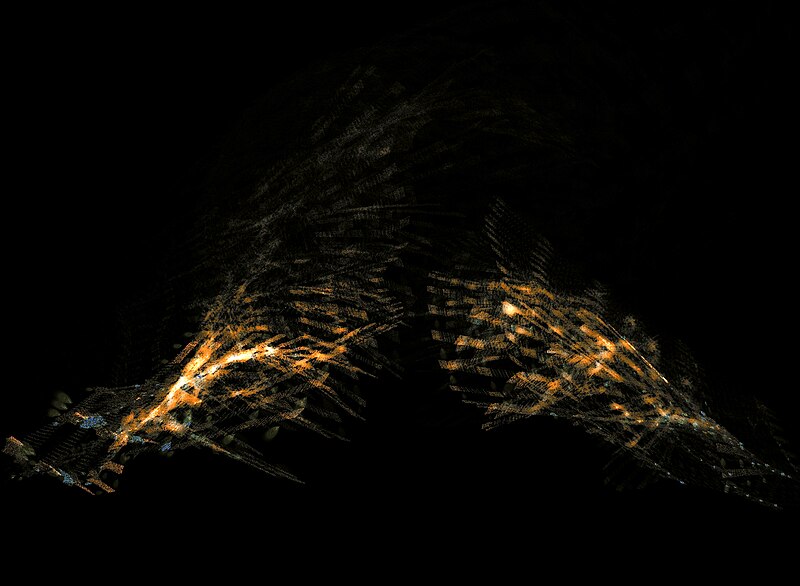
Still frame from Loops, a digital art installation by The OpenEnded Group that interprets Merce Cunningham's motion-captured dance for the hands. Artwork released as open source; motion capture data licensed under a Creative Commons license.
Paulkaiser

SML Reference a href=" https: flickr.com/gregoryhull "
See-ming Lee · Flickr: Jasper Johns: Grey: Reception at the Met / 20080205.SD850IS.2106 / SML
Citations
References
Each reference names the institution holding it, so a reader may go to the document itself.
reference work
Wikidata, structured authority record Q318364: Merce CunninghamWikimedia Foundation
Partially resolvedreference work
Partially resolved
A further 1 witness is held back from this article because the person or object named in it is not yet resolved to this record. They are kept, not discarded, and return once the identity is established.
The Encyclopedia exists whether or not anything is for sale. Corrections are recorded rather than overwritten, and every version of this record is kept. Published 14 August 2026.
Elsewhere in Music memorabilia
42,438 published records in this field, each with its sources named.
- Ment RecordingOrganisation
- Mental TheoPerson
- Merab KostavaPerson
- Mercan DedePerson
- Mercedes SimonePerson
- Mercedes SosaPerson
- Mercer EllingtonPerson
- Merck RecordsOrganisation
Best supported in this field
For owners
Own a work by Merce Cunningham?
A specialist will read what you send and tell you what the house can establish, what it cannot, and whether the object is suited to sale. There is no charge and no obligation. The object stays with you throughout; nothing is shipped to us unless it is arranged in writing beforehand.