
Mengenlehreuhr
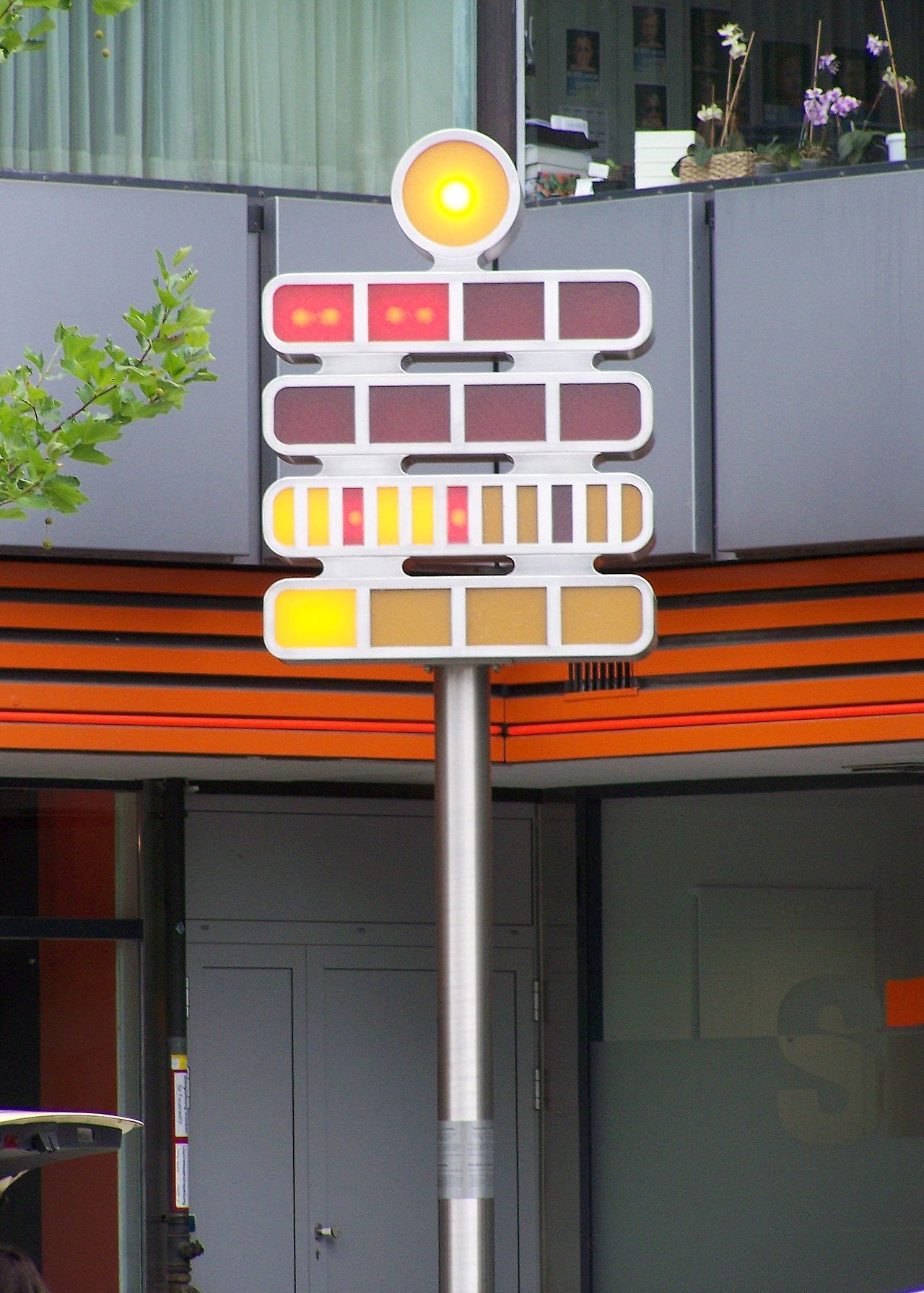
Illustration — The clock at its original location in May 1979, displaying 17:54 (5:54pm). The Mengenlehreuhr (German for "Set Theory Clock") or Berlin-Uhr ("Berlin Clock") is the first public clock in the world that tells the time by means of illuminated, coloured fields, for which it entered the Guinness Book of Records upon its installation on 17 June 1975. Commissioned by the Senate of Berlin and designed by Dieter Binninger, the original full-sized Mengenlehreuhr was originally located at the Kurfürstendamm on the corner with Uhlandstraße in what was then West Berlin.
Also recorded as Berlin-Uhr
Mengenlehreuhr
Muritatis · Public domain
- Period
- 1975
- Region
- Mengenlehreuhr is situated in Germany.
VALÉORINE Encyclopedia
VALÉORINE documentary reading
Documentary summary
Illustration — The clock at its original location in May 1979, displaying 17:54 (5:54pm). The Mengenlehreuhr (German for "Set Theory Clock") or Berlin-Uhr ("Berlin Clock") is the first public clock in the world that tells the time by means of illuminated, coloured fields, for which it entered the Guinness Book of Records upon its installation on 17 June 1975. Commissioned by the Senate of Berlin and designed by Dieter Binninger, the original full-sized Mengenlehreuhr was originally located at the Kurfürstendamm on the corner with Uhlandstraße in what was then West Berlin.
Admitted source layer · organised and presented by VALÉORINE
Reference Check
Propose documentary evidence for Mengenlehreuhr. A contribution is never written directly as fact: identity, source, rights and evidence gates still decide.
Sign in to contribute
World of VALÉORINE
Documentary connections
Only confirmed graph relationships appear here. Images are shown only when their identity and reuse rights both pass the documentary gate.
Documentary evidence
Documentary basis
Authority files
wikidata · Q303363 · wikipedia · Mengenlehreuhr
In this article
Time encoding
Time encoding
After the Senate decommissioned it in 1995, the clock was relocated to a site in Budapester Straße in front of Europa-Center, where it stands today.
• Illustration — Clock displaying time from 16:50 to 17:05 (4:50 pm to 5:05 pm) in time lapse. The Mengenlehreuhr clock face utilizes 24 light fields (1+4+4+11+4=24) to display time in 0–23 hour, 0–59 minute and even/odd second. The clock is read from the top row to the bottom. Second: The top big circular light is the seconds mark. This light switches its state (between ON and OFF) every one second. The light is OFF for even seconds, and ON for odd seconds. On this clock, the precise time in seconds (e.g., 42 in 10:31:42) is not displayed. Rather, this light serves as an indicator that the clock is operating. Second encoder in Source Code Assuming neon[3] holds 1-bit for the 1 second light if(tsec&1){ neon[3]=1; } else{ neon[3]=0; } Hour: The next two rows of 8 red light fields indicate the hour, using a 24-hour format. Each light in the upper row marks 5 full hours, while each light in the lower row marks 1 full hour. Thus, the maximum hour number which can be displayed is 4*5+4=24, and the minimal displayable hour is 0, indicated when all 8 of these lights are OFF. Since a 24-hour clock only uses hour numbers from 0 to 23, an hour number of "24" (the state with all lights ON) is never displayed. Hour encoder in Source Code Assuming neon[0] holds 8-bit for the top 8 lights Hour-top for(uint8_t i=0; i Time decoding - How to Read the Clock== • Illustration — Mengenlehreuhr clock recreation using high voltage neon lamps with clock displaying 12:32:x1 This section demonstrates telling the time, using the accompanying image as an example, in which a time of 12:32 is indicated. Hour (upper row 2 lit, and lower row 2 lit): 2*5+2=12. Each of the 4 upper row lights represents a 5 increment hour: 5, 10, 15, 20. Minute (upper row 6 lit and lower row 2 lit): 6*5+2=32. Each of the 11 upper row lights represents a 5 increment minute: 5,10,15,20,25,30,35,40,45,50,55. Second (top 1): The lamp is lit, indicating an odd number of seconds.
Kryptos
Kryptos
This clock may be referred to in the unsolved section of Kryptos, a sculpture at the Central Intelligence Agency (CIA) headquarters in Langley, Virginia, United States. The sculptor, Jim Sanborn, gave two clues to The New York Times in November 2010 and November 2014, revealing that the portion of the deciphered "K4" sculpture text, in positions 64–74, reads "BERLIN CLOCK". When asked if the clue referred to the Mengenlehreuhr, Sanborn replied, "You'd better delve into that particular clock". However, Sanborn also noted that, "There are several really interesting clocks in Berlin."
Chronology
Dated record
Chronology
The full dated record · 2 entries
1975
Mengenlehreuhr first recorded.
1975
Mengenlehreuhr is recorded from 1975.
Places
Named by the record
Places
Only places the record itself states, plotted where the house gazetteer settles their coordinates. Nothing is inferred from a name or a nationality.
Mengenlehreuhr is situated in Germany.
Country
Mengenlehreuhr is associated with Germany.
Country
Notes from the source article
Cited by Wikipedia
Notes from the source article
These works are cited by the source article, in its own numbering. They are recorded as its citations, not as sources VALÉORINE has verified.
References
Citations
References
Each reference names the institution holding it, so a reader may go to the document itself.
reference work
Secondary witnessreference work
Secondary witness
The Encyclopedia exists whether or not anything is for sale. Corrections are recorded rather than overwritten, and every version of this record is kept. Published 16 August 2026.
Elsewhere in Furniture
924 published records in this field, each with its sources named.
- mattressTerminology
- McClellan saddleTerminology
- McDonald's Cycle CenterTerminology
- memorial benchTerminology
- menorahTerminology
- Mérode AltarpieceTerminology
- Mestre AltarpieceTerminology
- Miho funerary couchTerminology
Best supported in this field
For owners
Own an object connected with Mengenlehreuhr?
A specialist will read what you send and tell you what the house can establish, what it cannot, and whether the object is suited to sale. There is no charge and no obligation. The object stays with you throughout; nothing is shipped to us unless it is arranged in writing beforehand.