
Maximilien Luce
Maximilien Luce (French pronunciation: [maksimiljɛ̃ lys]; 13 March 1858–6 February 1941) was a French Neo-impressionist artist known for his paintings, graphic art, and his anarchist activism. Starting as a wood-engraver, he subsequently concentrated on painting, first as an Impressionist, then as a Pointillist, and finally returning to Impressionism.
Also recorded as Maximillian Luce · Maximilian Luce · Luce
Maximilien Luce
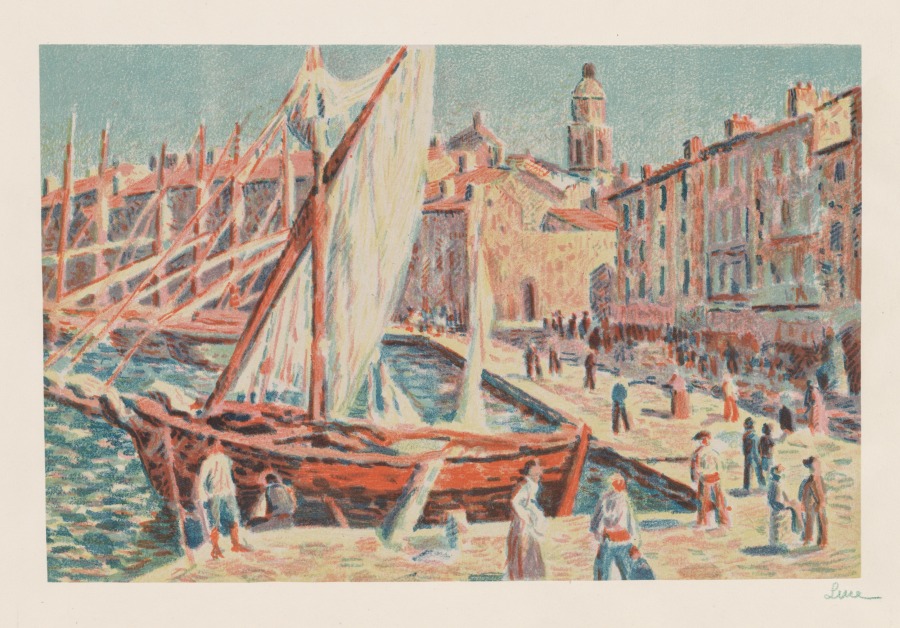
Maximilien Luce · The Cleveland Museum of Art · Alma and Robert D. Milne Fund · CC0
- Born
- 1858.
- Died
- 1941.
- Nationality
- France.
- Fields
- portrait.
- Movements
- pointillism.
- Known for
- Le chantier.
VALÉORINE Encyclopedia
VALÉORINE documentary reading
Documentary summary
Maximilien Luce (French pronunciation: [maksimiljɛ̃ lys]; 13 March 1858–6 February 1941) was a French Neo-impressionist artist known for his paintings, graphic art, and his anarchist activism. Starting as a wood-engraver, he subsequently concentrated on painting, first as an Impressionist, then as a Pointillist, and finally returning to Impressionism.
Admitted source layer · organised and presented by VALÉORINE
Note VALÉORINE
Maximilien Luce (1858–1941) was a draftsperson, lithographer and painter, among other activities, of French nationality. The draftsperson was born and died in Paris.
Maximilien Luce was educated at École nationale supérieure des arts décoratifs. The draftsperson was a member of Société des Artistes Indépendants. Maximilien Luce was associated with pointillism.
Among the works is Le chantier. The work spans portrait. Languages used include French.
Composed from admitted, traceable facts · 26 September 2026
VALÉORINE
Reference Check
Propose documentary evidence for Maximilien Luce. A contribution is never written directly as fact: identity, source, rights and evidence gates still decide.
Sign in to contribute
Documentary evidence
Documentary basis
Authority files
gnd · 1035496585 · wikidata · Q545293 · wikipedia · Maximilien Luce
In this article
Early life and education
Early life and education
Maximilien-Jules-Constant Luce was born on 13 March 1858 in Paris. His parents, of modest means, were Charles-Désiré Luce (1823–1888), a railway clerk, and Louise-Joséphine Dunas (1822–1878). The family lived in the Montparnasse, a working-class district of Paris. Luce attended school at l'Ecole communale, beginning in 1864. In 1872, the 14 year-old Luce became an apprentice with wood-engraver Henri Théophile Hildebrand (1824–1897). During his three-year xylography apprenticeship, he also took night classes in drawing from instructors Truffet and Jules-Ernest Paris (1827–1895). During this period, Luce started painting in oils. He moved with his family to the southern Paris suburb of Montrouge. His art education continued as he attended drawing classes taught by Diogène Maillard (1840–1926) at the Gobelins tapestry factory. Luce began working in the studio of Eugène Froment (1844–1900) in 1876, producing wood-engravings for various publications including L'Illustration and London's The Graphic. He took additional art courses at l'Académie Suisse, as well as in the studio of portrait painter Carolus-Duran (1837–1917). Through Froment's studio, Luce became friends with Léo Gausson and Émile-Gustave Cavallo-Péduzzi. These three artists spent time around Lagny-sur-Marne creating Impressionist landscapes.
Work
Work
Luce spent four years in the military, starting in 1879, serving in Brittany at Guingamp. The next year, he received a promotion to corporal, and he became friends with Alexandre Millerand, who, in 1920, assumed the office of President of France. In 1881 he requested the restoration of his lower rank of soldier, second class. Carolus-Duran used his influence to get a transfer for Luce to Paris barracks. His stint in the military came to a close in 1883. The prevalence of the new zincography printing process rendered xylography nearly obsolete as a profession. When the opportunities for employment as an engraver became scarce, Luce shifted his focus to painting full-time in about 1883. Gausson and Cavallo-Péduzzi introduced Luce in about 1884 to the Divisionist technique developed by Georges Seurat. This influenced Luce to begin painting in the Pointillist style. In contrast to Seurat's detached manner, Luce's paintings were passionate portrayals of contemporary subjects, depicting the "violent effects of light". He moved to Montmartre in 1887. Luce joined the Société des Artistes Indépendants and participated in their third spring exhibition, where Paul Signac purchased one of his pieces, La Toilette. Camille Pissarro and critic Félix Fénéon were also impressed by the seven Luce works displayed in the show. Fénéon characterized Luce as a "coarse, honest man, with a rough and muscular talent." In addition to Pissarro and Signac, he met many of the other Neo-impressionists, including Seurat, Henri-Edmond Cross, Charles Angrand, Armand Guillaumin, Hippolyte Petitjean, Albert Dubois-Pillet, and Pissarro's son, Lucien. A New York Times critic declared this Pointillist period to be the pinnacle of Luce's artistic career, singling out the radiant 1895 painting On the Bank of the Seine at Poissy as an example. He described the skillfully executed painting as "a lyrical celebration of nature." With the exception of the years 1915 to 1919, Luce exhibited in every show at Les Indépendants from 1887 until he died in 1941, including a thirty-year retrospective held in 1926. In 1909, he was elected vice president of the Société des Artistes Indépendants and was elected president in 1935, following the death of Signac, who had held the post since 1908. However, in 1940 he resigned from the position as a protest against the Vichy regime's laws which would have prohibited Jewish artists from participating in the group. Luce had his first solo exhibition, arranged by Fénéon, in July 1888, exhibiting ten paintings at the La Revue indépendante offices. He showed six paintings at the 1889 Les XX exhibition in Brussels. While there, he met Les XX official Octave Maus, as well as Symbolist poet Emile Verhaeren and fellow Neo-impressionist painter Théo van Rysselberghe. Luce's work was also featured in the ninth Les XX exhibition, in 1892. In the spring of 1892 Luce traveled with Pissarro to London. Later that year he visited Saint-Tropez with Signac, and in the summer of 1893 he went to Brittany. In the early part of the twentieth century his identification with the Neo-impressionists began to disappear, as he became less active politically and his artistic style shifted from Neo-impressionism, and he resumed painting in an Impressionist manner. Some of his paintings during this period depicted wounded World War I soldiers arriving from the battlefront to Paris. Luce depicted a diverse range of subjects in his works over a long career. He most frequently created landscapes, but his other works include portraits; still lifes (especially florals); domestic scenes such as bathers; and images of welders, rolling mill operators, and other laborers.
Anarchism
Anarchism
Luce aligned with the Neo-impressionists not only in their artistic techniques, but also in their political philosophy of anarchism. Many of his illustrations were featured in socialist periodicals, notably La Révolte, Jean Grave's magazine which was later called Les Temps nouveaux. Other socialist/anarchist publications which he contributed to include Le Père Peinard, Le Chambard, and La Guerre sociale. On 8 July 1894, Luce, suspected of involvement in the 24 June assassination of President of France Marie François Sadi Carnot, was arrested and was confined to Mazas Prison. He was released forty two days later, on 17 August, following his acquittal at the Procès des trente. He published Mazas, an album consisting of ten lithographs documenting the experiences of himself and other political prisoners incarcerated in Mazas; accompanying the lithographs was text by Jules Vallès. In 1896, while King Alfonso XIII of Spain was visiting Paris, the police detained Luce on the grounds that he was a "dangerous anarchist". Luce's choice of subject matter for his art was often rooted in his political beliefs. Through his paintings, he passionately demonstrated empathy and fellowship with the proletariat.
Family
Family
In 1893, Luce met Ambroisine "Simone" Bouin in Paris. She became his model, companion, common-law wife, and wife. Bouin was usually referred to as "Madame Luce", even before their eventual marriage. She was frequently a model for him, appearing in many of his works, often partially or fully nude, other times depicted in scenes such as on a balcony or combing her hair. The couple's first son, Frédérick, was born on 5 June 1894, but he died fifteen months later, on 2 September 1895. Their second child, whom they also named Frédérick, was born in 1896. In 1903, they adopted Ambroisine's nephew, Georges Édouard Bouin, who had become orphaned. The couple were married on 30 March 1940 in Paris. Ambroisine died in Rolleboise shortly afterward, on 7 June 1940.
Death and assessment
Death and assessment
Luce died at his Paris home on 7 February 1941 at the age of 82. He was buried in Rolleboise. In May 1941, the Bibliothèque nationale de France held a memorial exhibition. Another memorial exhibition was mounted at Les Indépendants from March to April 1942. Luce was among the most productive of the Neo-impressionists, creating over 2,000 oil paintings, a comparably large number of watercolors, gouaches, pastels, and drawings, plus over a hundred prints. The Musée d'Orsay assesses Luce as "one of the best representatives of the neo-impressionist movement". Although he had many solo exhibitions of his work in France, his first in the United States occurred in 1997 with a retrospective at Wildenstein & Company in Manhattan. Notre Dame de Paris, painted in 1900, sold at auction in May 2011 for US$4,200,000, setting a record for a Luce work.
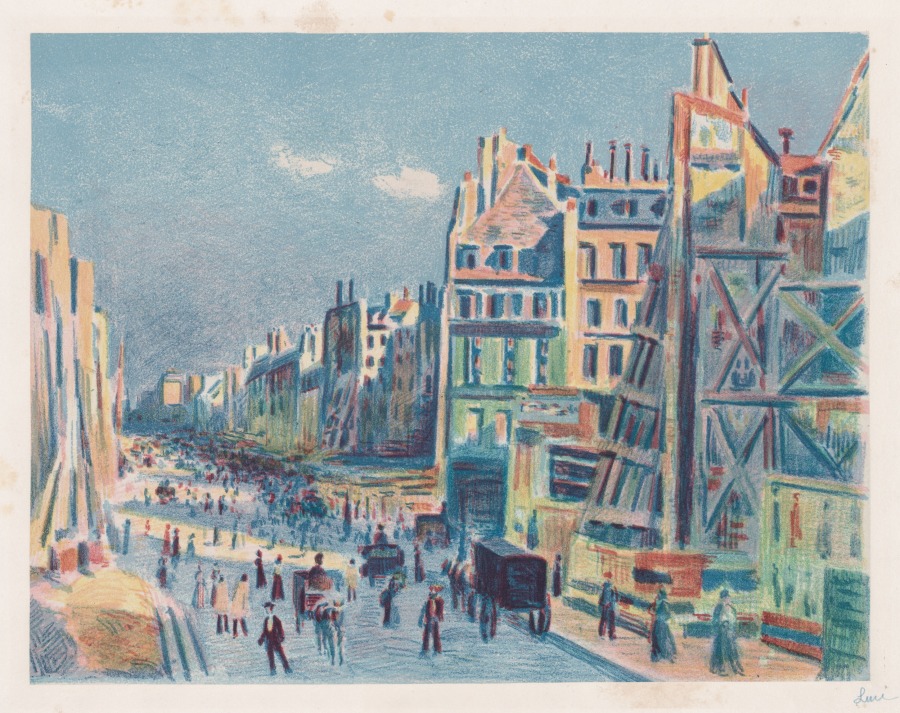
Rue Reamur, 1896, by Maximilien Luce
Maximilien Luce · The Cleveland Museum of Art · Gift of The Print Club of Cleveland
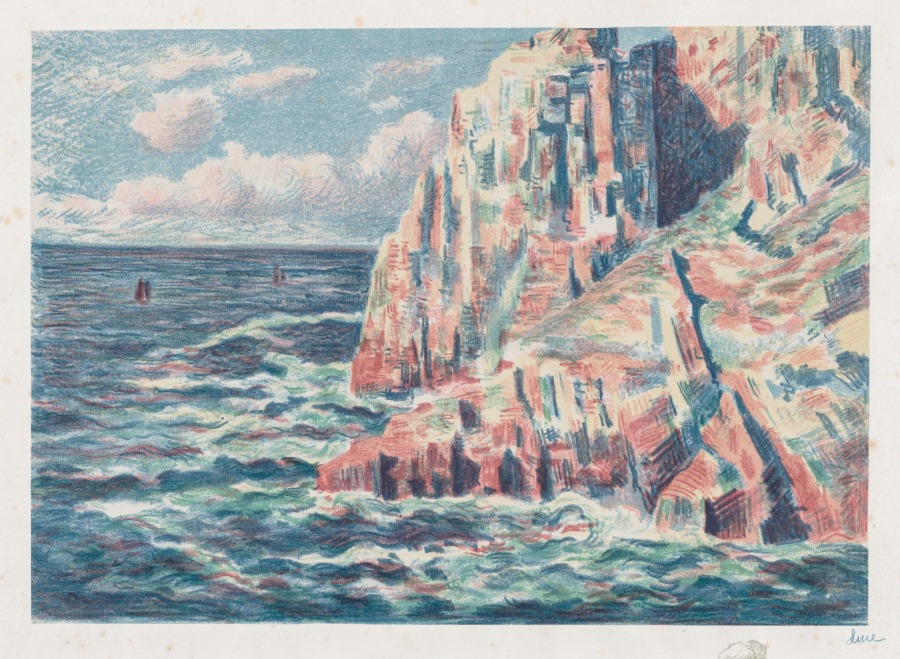
The Sea at Camaret, The Red Rocks, 1895, by Maximilien Luce
Maximilien Luce · The Cleveland Museum of Art · Dudley P. Allen Fund
Life and career
Dated record
Life and career
The full dated record · 2 entries
1858
Maximilien Luce was born in 1858.
1941
Maximilien Luce died at Paris.
Primary material
Documents and archives
reference work
- Wikidata, structured authority record Q545293: Maximilien Luce
Reputable secondary · Wikimedia Foundation
- “Maximilien Luce”, English Wikipedia, consulted as further reading
Reputable secondary · Wikipedia
authority file
- Gemeinsame Normdatei 1035496585, Exhibition Maximilien Luce (2010 : Giverny).
General reference · Deutsche Nationalbibliothek
Notes from the source article
Cited by Wikipedia
Notes from the source article
These works are cited by the source article, in its own numbering. They are recorded as its citations, not as sources VALÉORINE has verified.
- 1.Neo-Impressionist Painters, p. 323.
- 2.Neo-Impressionist Painters, p. 325.
- 3.Neo-Impressionist Painters, p. 326.
- 4.Neo-Impressionist Painters, p. 327.
- 5.Musée d'Orsay. Maximilien Luce, Neo-Impressionist. A Retrospective. 2010.
- 6.Glueck, Grace. Painting His Way From Style To Style. The New York Times. 22. 30 May 1997.
- 7.Neo-Impressionist Painters, p. 331.
- 8.Neo-Impressionist Painters, p. 330.
- 9.Borobia, Mar. Biography and Works: Maximilien Luce. Thyssen-Bornemisza Museum. 2009.
- 10.Recollection Books. Maximilien Luce. Anarchist Encyclopaedia. March 2006.
- 11.Neo-Impressionist Painters, p. 328.
- 12.Neo-Impressionist Painters, p. 329.
- 13.Dictionary of Artists' Models, p. 73.
- 14.Neo-Impressionist Painters, p. 332.
- 15.Dictionary of Artists' Models, p. 74.
- 16.Neo-Impressionist Painters, p. 333.
- 17.Neo-Impressionist Painters, p. 324.
- 18.Kinsella, Eileen. $22 Million Monet Landscape Leads Christie's Imp/Mod Evening Sale. ARTnews. 17 May 2011.
Bibliography printed in the source article · 9
- Clement, Russell T. Neo-Impressionist Painters: a Sourcebook on Georges Seurat, Camille Pissarro, Paul Signac, Théo Van Rysselberghe, Henri Edmond Cross, Charles Angrand, Maximilien Luce, and Albert Dubois-Pillet. Greenwood Press. 1999. 0-313-30382-7.
- Clement, Russell T. Dictionary of Artists' Models. Fitzroy Dearborn. 2001. 9781579582333.
- Bouin-Luce, Jean and Denise Bazetoux, Maximilien Luce, catalogue raisonné de l'œuvre peint, Paris, Editions JBL, 1986–2005.
- Brown, Stephen, "Luce, the artist engage," PhD dissertation, Columbia University, New York, N.Y. 2003
- Cazeau, Philippe, Maximilien Luce, Lausanne, Bibliothèque des arts, 1982.
- Fénéon, Fanny, Correspondance de Fanny & Félix Fénéon avec Maximilien Luce, illustrée par Luce de portraits originaux, Tusson, Charetnte, Du Lérot, 2001.
- Luce, Maximilien, Maximilien Luce, peindre la condition humaine, Paris, Somogy éditions d'art, 2000.
- Luce, Maximilien, Maximilien Luce, Palais des beaux-arts, [Charleroi] 29 octobre-4 decembre 1966, Charleroi, Palais des beaux-arts, 1966.
- Mantes-la-Jolie, Inspirations de bords de Seine, Maximilien Luce et les peintres de son époque, Paris, Somogy, 2004.
References
Citations
References
Each reference names the institution holding it, so a reader may go to the document itself.
authority file
Gemeinsame Normdatei 1035496585, Exhibition Maximilien Luce (2010 : Giverny).Deutsche Nationalbibliothek
Secondary witnessreference work
Wikidata, structured authority record Q545293: Maximilien LuceWikimedia Foundation
Secondary witnessreference work
Secondary witness
The Encyclopedia exists whether or not anything is for sale. Corrections are recorded rather than overwritten, and every version of this record is kept. Published 14 August 2026.
Elsewhere in Prints
4,138 published records in this field, each with its sources named.
- Max ThedyEngraver
- Maxime DethomasEngraver
- Maxime MaufraEngraver
- Maximilian DasioEngraver
- Maximilien VoxEngraver
- Maxwell ArmfieldEngraver
- May AngeliEngraver
- May Oswald GilbertEngraver
Best supported in this field
For owners
Own a work by Maximilien Luce?
A specialist will read what you send and tell you what the house can establish, what it cannot, and whether the object is suited to sale. There is no charge and no obligation. The object stays with you throughout; nothing is shipped to us unless it is arranged in writing beforehand.