
Matthias Claudius
Matthias Claudius (15 August 1740 – 21 January 1815) was a German poet and journalist, otherwise known by the pen name of "Asmus".
Also recorded as Asmus · Mattias Klaudius · Wandsbecker Bote
Matthias Claudius

Friederike Leisching · User DarkScipio on de.wikipedia · Public domain
- Born
- 1740. · Reinfeld.
- Died
- 1815. · Hamburg.
- Nationality
- Duchy of Holstein.
- Occupation
- poet, journalist, writer, independent publisher, translator, lyricist and editing staff.
- Education
- University of Jena.
- Languages
- German.
VALÉORINE Encyclopedia
VALÉORINE documentary reading
Documentary summary
Matthias Claudius (15 August 1740 – 21 January 1815) was a German poet and journalist, otherwise known by the pen name of "Asmus".
Admitted source layer · organised and presented by VALÉORINE
Note VALÉORINE
No house-authored Note is published until its assertions and sources pass the VALÉORINE evidence contract. The documentary article remains available in full while that enrichment is being consolidated.
Documentary enrichment in progress · no unsupported statement published
Reference Check
Propose documentary evidence for Matthias Claudius. A contribution is never written directly as fact: identity, source, rights and evidence gates still decide.
Sign in to contribute
World of VALÉORINE
Documentary connections
Only confirmed graph relationships appear here. Images are shown only when their identity and reuse rights both pass the documentary gate.
Documentary evidence
Evidence Panel
not yet certified
- Identity
- resolved
- Independent source families
- 0
- Admitted assertions
- 0
- Open conflicts
- 0
Authority files
getty · 500505679 · gnd · 116175928X · wikidata · Q77338 · wikipedia · Matthias Claudius
In this article
Life
Life
Claudius was born at Reinfeld, near Lübeck, and studied at Jena. He spent the greater part of his life in the town of Wandsbeck, where he earned his first literary reputation by editing from 1771 to 1775, a newspaper called Der Wandsbecker Bothe (The Wandsbeck Messenger) (Wandsbeck until the year 1879 still written with "ck". Today only with "k".), in which he published a large number of prose essays and poems. They were written in pure and simple German, and appealed to the popular taste; in many there was a vein of extravagant humour or even burlesque, while others were full of quiet meditation and solemn sentiment. In his later days, perhaps through the influence of Klopstock, with whom he had formed an intimate acquaintance, Claudius became strongly pietistic, and the graver side of his nature showed itself. In 1814 he moved to Hamburg, to the house of his son-in-law, the publisher Friedrich Christoph Perthes, where he died on 21 January 1815.
Work
Work
Claudius's poem Death and the Maiden was used by composer Franz Schubert in 1817 for one of his most celebrated songs, which in turn became the basis for the 1824 string quartet of the same name. In Germany, his poem Abendlied (Evening song), also known as "Der Mond ist aufgegangen" remains popular. Claudius's collected works were published under the title of Asmus omnia sua secum portans, oder Sämtliche Werke des Wandsbecker Boten (8 vols., 1775–1812; 13th edition, by C. Redich, 2 vols., 1902). His biography has been written by Wilhelm Herbst (4th ed., 1878). See also M. Schneidereit, M. Claudius, seine Weltanschauung und Lebensweisheit (1898).
Poems
Poems
Abendlied ("Evening Song"), aka "Der Mond ist aufgegangen" ("The moon has risen") "Der Mensch lebt und bestehet", set to music by Max Reger "Christiane" "Die Sternseherin Lise" (Lise the astrologer) "Die Liebe" (Love) "Der Tod (Death) "Ein Wiegenlied bei Mondschein zu singen" (A lullaby to sing in moonlight) "Täglich zu singen" (To be sung every day) "Kriegslied" (Song of war) "Der Frühling. Am ersten Maimorgen" (The Spring. On the first morning in May) "Der Säemann säet den Samen" (The sower sows the seeds), set to music by Ernst Krenek (Drei gemischte a cappella-Chöre, Opus 22) "Der Tod und das Mädchen" (The Death and the maiden), set to music by Schubert "Wir pflügen und wir streuen" ("We plough the fields and scatter" – sung in Germany and England as a harvest festival hymn)
Life and career
Dated record
Life and career
Explore 1740–1815
The full dated record · 3 entries
1740
Matthias Claudius born at Reinfeld.
1802
Asmus Omnia SUA Secum Portans oder sämmtliche Werke des Wandsbecker Bothen (1802) is digitised and catalogued by Internet Archive.
1815
Matthias Claudius died at Hamburg.
Places
Named by the record
Places
Only places the record itself states, plotted where the house gazetteer settles their coordinates. Nothing is inferred from a name or a nationality.
Reinfeld.
Birth place
Hamburg.
Death place
Primary material
Documents and archives
scholarly publication
- Matthias Claudius als Übersetzer von Fénélons religiösen Schriften, Matthias Claudius 1740-1815, 1996
Scholarly · Crossref registry · 1996
- Matthias Claudius und die Gesangbücher im dänischen Gesamtstaat, Matthias Claudius 1740-1815, 1996
Scholarly · Crossref registry · 1996
- Satirische Formen in den Feuilletons und Rezensionen von Matthias Claudius, Matthias Claudius 1740-1815, 1996
Scholarly · Crossref registry · 1996
reference work
- Wikidata, structured authority record Q77338: Matthias Claudius
Reputable secondary · Wikimedia Foundation
- “Matthias Claudius”, English Wikipedia, consulted as further reading
Reputable secondary · Wikipedia
authority file
- Gemeinsame Normdatei 116175928X, Matthias Claudius.
Unverified · Deutsche Nationalbibliothek
Honours
Asteroid 7117 Claudius was named after him.
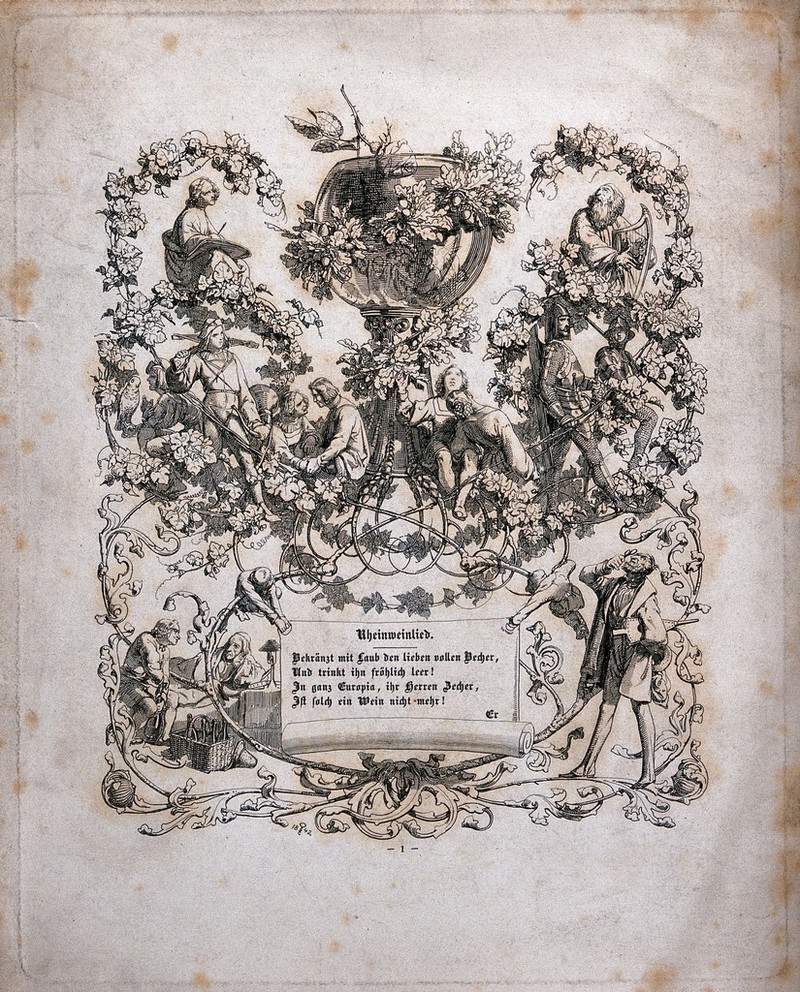
The first verse of a poem entitled, "Rheinweinlied", surrounded by an ornamental design with a large wine glass. Etching, 1842., 1842, by Matthias Claudius
Matthias Claudius · Wellcome Collection, London · Wellcome Collection
Citations
References
Each reference names the institution holding it, so a reader may go to the document itself.
scholarly publication
Matthias Claudius als Übersetzer von Fénélons religiösen Schriften, Matthias Claudius 1740-1815, 1996Crossref registry
Verifiedscholarly publication
Matthias Claudius und die Gesangbücher im dänischen Gesamtstaat, Matthias Claudius 1740-1815, 1996Crossref registry
Verifiedscholarly publication
Satirische Formen in den Feuilletons und Rezensionen von Matthias Claudius, Matthias Claudius 1740-1815, 1996Crossref registry
Verifiedauthority file
Gemeinsame Normdatei 116175928X, Matthias Claudius.Deutsche Nationalbibliothek
Partially resolvedreference work
Wikidata, structured authority record Q77338: Matthias ClaudiusWikimedia Foundation
Partially resolvedreference work
Partially resolved
A further 1 witness is held back from this article because the person or object named in it is not yet resolved to this record. They are kept, not discarded, and return once the identity is established.
The Encyclopedia exists whether or not anything is for sale. Corrections are recorded rather than overwritten, and every version of this record is kept. Published 14 August 2026.
Elsewhere in Books
38,342 published records in this field, each with its sources named.
- Matthias BarrAuthor
- Matthias BlazekAuthor
- Matthias BrandtAuthor
- Matthias BrennerAuthor
- Matthias FlaciusAuthor
- Matthias GarbitiusAuthor
- Matthias HedenstromAuthor
- Matthias Jacob SchleidenAuthor
Best supported in this field
For owners
Own a work by Matthias Claudius?
A specialist will read what you send and tell you what the house can establish, what it cannot, and whether the object is suited to sale. There is no charge and no obligation. The object stays with you throughout; nothing is shipped to us unless it is arranged in writing beforehand.