
Mary Quant
Dame Barbara Mary Quant (11 February 1930 – 13 April 2023) was a British fashion designer and icon. She became an instrumental figure in the 1960s London-based Mod and youth fashion movements, and played a prominent role in London's Swinging Sixties culture. She was one of the designers who took credit for the miniskirt and hotpants.
Also recorded as Mrs Plunket Greene · Dame Barbara Mary Quant
Mary Quant

Jack de Nijs for Anefo / Anefo · Nationaal Archief · CC0
- Born
- 1930.
- Died
- 2023.
- Nationality
- United Kingdom.
- Occupation
- fashion designer.
VALÉORINE Encyclopedia
VALÉORINE documentary reading
Documentary summary
Dame Barbara Mary Quant (11 February 1930 – 13 April 2023) was a British fashion designer and icon. She became an instrumental figure in the 1960s London-based Mod and youth fashion movements, and played a prominent role in London's Swinging Sixties culture. She was one of the designers who took credit for the miniskirt and hotpants.
Admitted source layer · organised and presented by VALÉORINE
Note VALÉORINE
No house-authored Note is published until its assertions and sources pass the VALÉORINE evidence contract. The documentary article remains available in full while that enrichment is being consolidated.
Documentary enrichment in progress · no unsupported statement published
Reference Check
Propose documentary evidence for Mary Quant. A contribution is never written directly as fact: identity, source, rights and evidence gates still decide.
Sign in to contribute
Documentary evidence
Evidence Panel
not yet certified
- Identity
- resolved
- Independent source families
- 0
- Admitted assertions
- 0
- Open conflicts
- 0
Authority files
wikidata · Q234147 · wikipedia · Mary Quant
In this article
Early life
Early life
Ernestine Carter wrote: "It is given to a fortunate few to be born at the right time, in the right place, with the right talents. In recent fashion there are three: Chanel, Dior, and Mary Quant."
Quant was born in Woolwich, London, the daughter of Jack Quant and Mildred Jones. Her parents, who both came from Welsh mining families, had received scholarships to a grammar school and had been awarded first-class honours degrees at Cardiff University before moving to London to work as schoolteachers. She had a younger brother who became a dental officer in the Royal Air Force and with whom she was evacuated to Kent during the Second World War. Quant attended Blackheath High School. For college, her desire had been to study fashion; although her parents dissuaded her from that course of study, and she instead studied illustration and art education at Goldsmiths, University of London for which she received a degree in 1953. In pursuit of her love for fashion, after finishing her degree, she was apprenticed to Erik Braagaard, a high-class Mayfair milliner on Brook Street next door to Claridge's Hotel.
Fashion career
Fashion career
Quant was introduced to Archie McNair, who owned a photography business on the King's Road, through a mutual friend. He and Alexander Plunket worked with Quant to purchase Markham House, the shopfront that would be the location of her clothing boutique, Bazaar. The two men both contributed financially to the project, and Markham House was purchased for £8,000. During the renovation, Quant worked to locate wholesale suppliers, with a salary of £5 per week. Once the shop opened, Quant initially sold clothing sourced from wholesalers in her new boutique in the King's Road. The bolder pieces in her collection started garnering more attention from media like Harper's Bazaar, and an American manufacturer purchased some of her dress designs. Because of this attention and her personal love for these bolder styles, she decided to take designs into her own hands. Initially working solo, she was soon employing a handful of machinists; by 1966 she was working with a total of 18 manufacturers. A self-taught designer inspired by the culture-forward "Chelsea Set" of artists and socialites, Quant's designs were riskier than standard styles of the time. Quant's designs revolutionised fashion from the utilitarian wartime standard of the late 1940s to the energy of the 1950s and 1960s' cultural shifts. She stocked her own original items in an array of colours and patterns, such as colourful tights. Quant's impact did not just come from her unique designs; in her boutique she created a special environment, including music, drinks, and long hours that appealed to young adults. This environment was unique for the industry, as it differentiated from the stale department stores and inaccessible high-class designer store environments that had a hold of the fashion market. Her window displays with models in quirky poses brought a lot of attention to her boutique, where people would often stop to stare at the eccentric displays. She stated that "Within 10 days, we hardly had a piece of the original merchandise left." For a while in the late 1950s and early 1960s, Quant was one of only two London-based high-class designers consistently offering youthful clothes for young people. The other was Kiki Byrne, who opened her boutique on the King's Road in direct competition with Quant. In 1966, Quant was named one of the "fashion revolutionaries" in New York by Women's Wear Daily, alongside Edie Sedgwick, Tiger Morse, Pierre Cardin, Paco Rabanne, Rudi Gernreich, André Courrèges, Emanuel Ungaro, Yves Saint Laurent and Baby Jane Holzer.
Quant and the miniskirt
Quant and the miniskirt
The miniskirt, described as one of the defining fashions of the 1960s, is one of the garments most widely associated with Quant. While she is often cited as the inventor of the style, this claim has been challenged by others. Marit Allen, a contemporary fashion journalist and editor of the influential "Young Ideas" pages for UK Vogue, firmly stated that another British fashion designer, John Bates, rather than Quant or André Courrèges, was the original creator of the miniskirt. Others credit Courrèges with the invention of the style. However, skirts had been getting shorter since the 1950s, and had reached the knee by the early sixties, but "Quant wanted them higher so they would be less restricting—they allowed women to run for a bus... and were much, much sexier". Quant later said: "It was the girls on the King's Road [during the "Swinging London" scene] who invented the miniskirt. I was making easy, youthful, simple clothes, in which you could move, in which you could run and jump and we would make them the length the customer wanted. I wore them very short and the customers would say, 'Shorter, shorter.'" She gave the miniskirt its name, after her favourite make of car, the Mini, and said of its wearers: "They are curiously feminine, but their femininity lies in their attitude rather than in their appearance... She enjoys being noticed, but wittily. She is lively—positive—opinionated." The fashion model Twiggy popularised the miniskirt abroad. In addition to the miniskirt, Quant is often credited with inventing the coloured and patterned tights that tended to accompany the garment, although their creation is also attributed to the Spanish couturier Cristóbal Balenciaga, who offered harlequin-patterned tights in 1962, or to John Bates.
Later career
Later career
In the late 1960s, Quant offered miniskirts that were the forerunner of hotpants and became a British fashion icon. In 1967, she designed berets in twelve colours for British headwear company Kangol. Quant's berets, featuring her daisy logo, are in her collection at the Victoria and Albert Museum. Through the 1970s and 1980s she concentrated on household goods and make-up rather than just her clothing lines, including the duvet, which she claimed to have invented. In 1988, Quant designed the interior of the Mini (1000) Designer (originally dubbed the Mini Quant, the name was changed when popularity charts were set against having Quant's name on the car). It featured black-and-white striped seats with red trimming. The seatbelts were red, and the driving and passenger seats had Quant's signature on the upper left quadrant. The steering-wheel had Quant's signature daisy and the bonnet badge had "Mary Quant" written over the signature name. The headlight housings, wheel arches, door handles and bumpers were all "nimbus grey", rather than the more common chrome or black finishes. Two thousand were released in the UK on 15 June 1988, and a number were also released on to foreign markets; however, the numbers for these are hard to come by. The special edition Mini came in two body colours, jet black and diamond white. In 2000, she resigned as director of Mary Quant Ltd, her cosmetics company, after a Japanese buy-out. There are more than 200 Mary Quant Colour shops in Japan.
Personal life
Personal life
Quant met her future husband and business partner, Alexander Plunket Greene, grandson of the Irish singer Harry Plunket Greene, in 1953. They were married from 1957 until his death in 1990, and had a son. Quant died at home in Surrey on 13 April 2023, aged 93.
Primary material
Documents and archives
reference work
- “Mary Quant”, English Wikipedia, consulted as further reading
Reputable secondary · Wikipedia
authority record
- Wikidata, structured authority record Q234147: Mary Quant
Unverified · Wikidata
Honours and recognition
In 1963, Quant was the first winner of the Dress of the Year award. In the 1966 Birthday Honours she was appointed Officer of the Order of the British Empire (OBE). She arrived at Buckingham Palace to accept the award in a cream wool jersey minidress with blue facings. In 1990, she won the Hall of Fame Award of the British Fashion Council. She was appointed Dame Commander of the Order of the British Empire (DBE) in the 2015 New Year Honours for services to British fashion. She was appointed Member of the Order of the Companions of Honour (CH) in the 2023 New Year Honours for services to fashion. Quant received an honorary doctorate from Heriot-Watt University in 2006. In 2009, the miniskirt designed by Quant was selected by the Royal Mail for their "British Design Classics" commemorative postage stamp issue. In 2012, she was among the British cultural icons selected by artist Sir Peter Blake to appear in a new version of his most famous artwork – the Beatles' Sgt. Pepper's Lonely Hearts Club Band album cover – to celebrate the British cultural figures of his lifetime. Quant was a fellow of the Chartered Society of Designers, and winner of the Minerva Medal, the society's highest award. In the 1966 Donovan song "Sunny South Kensington", Quant and Jean-Paul Belmondo's drug use/abuse is immortalised in the lyric "Jean-Paul Belmondo and-a Mary Quant got stoned, to say the least". Quant is referenced in the musical number "This Is What We Want" in the 2014 stage musical Made in Dagenham, based on the 2010 film of the same name.
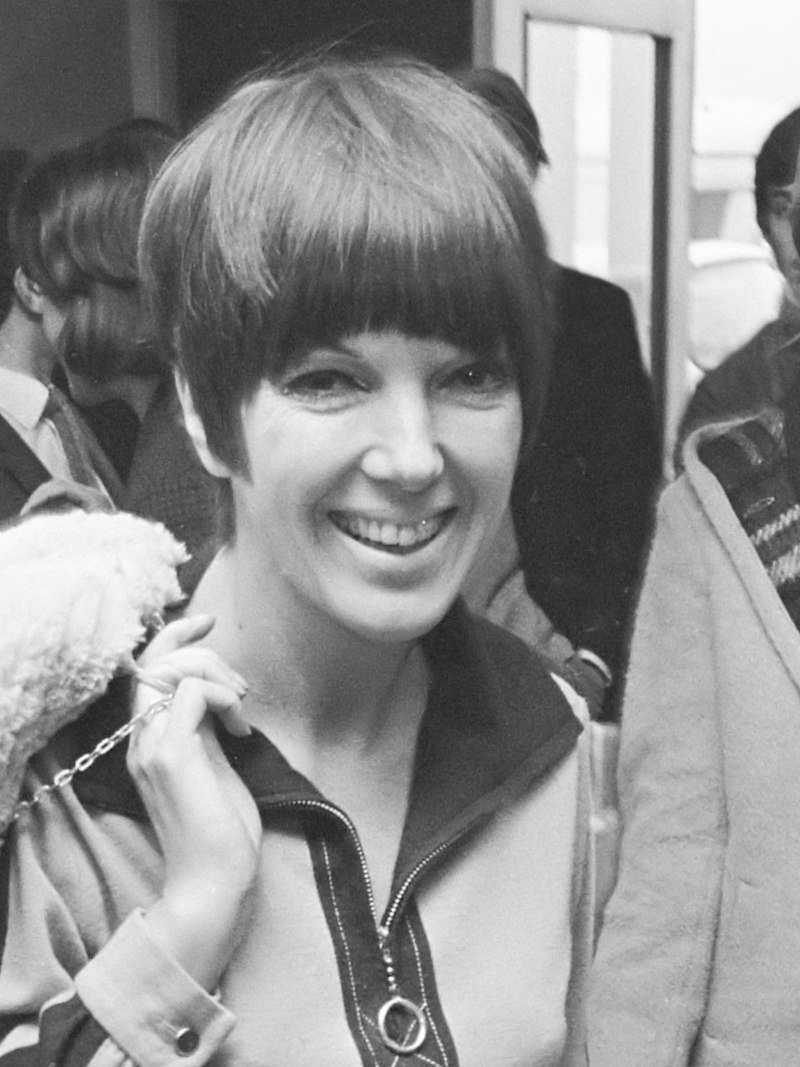
Aankomst Mary Quant (Engelse mode-koningin) op Schiphol 16 december 1966
Jack de Nijs for Anefo / Anefo · Nationaal Archief

Mary Quant plaque Unveiling event 16-Sept-2019 Orlando Plunket Greene. Orlando is Mary Quant's son (and only child). He did the unveiling on behalf of his mother.
Kwh1050
Notes from the source article
Cited by Wikipedia
Notes from the source article
These works are cited by the source article, in its own numbering. They are recorded as its citations, not as sources VALÉORINE has verified.
- 1.Mary Quant – Clothes, Miniskirt & Fashion. 3 June 2020.
- 2.The Mary Quant exhibition at the Victoria and Albert Museum in 2019–20 stated her year of birth as 1930, and that she became a student at Goldsmiths, University of London around 1950. However, the sleeve to her own autobiography (2012) gives the year as 1934, a date that has been widely cited over the years. Obituaries in April 2023 seemed universally to have accepted that she was 93 when she died: in other words, that she was born on 11 February 1930.
- 3.Ho, Karen. The Brit List: Five Great British Fashion Designers. BBC America. 3 July 2012.
- 4.New Year Honours: Designer Mary Quant among Welsh recipients. BBC News. 30 December 2014.
- 5.Do Je-Hae. Mary Quant, British Fashion Icon. The Korea Times. 10 October 2012.
- 6.Muir, Ellie. Mary Quant death: Designer who pioneered Swinging Sixties fashion dies aged 93. The Independent. 13 April 2023.
- 7.McKinnell, Joyce. Beauty. Harper Collins. 93. 2009. 9780007295586.
- 8.Victoria and Albert Museum. 1966 trouser suit by Mary Quant. 18 August 1966.
- 9.Burman, Barbara. Carter [née Fantl], Ernestine Marie (1906–1983), museum curator and writer on fashion. 2004. 10.1093/ref:odnb/48273.
- 10.Connikie, Yvonne. Fashion of a Decade. Infobase Publishing. 17. 2006. 9781438118925.
- 11.Mary Quant: Mother of the miniskirt. The Independent. 2023-04-13.
- 12.Berg. The Great Fashion Designer. 103–04. 2009. 978-1-84788-228-8.
- 13.Victoria and Albert Museum. Mary Quant. Victoria and Albert Museum website. 2011.
- 14.Armstrong, Lisa. Mary Quant: 'You have to work at staying slim – but it's worth it'. The Daily Telegraph. 17 February 2012.
- 15.Quant, Mary. Quant by Quant. V & A Publishing. September 25, 2018. 978-1851779581.
- 16.DelaHaye, Amy. The Berg Companion to Fashion. Berg. 586–588. 2010. 978-1847885630.
- 17.Mary Quant: How She Fought for Women's Rights With Colourful Tights. Bloom.
- 18.Nicolson, Juliet. Mary Quant: Life, love and liberty. Harper's BAZAAR. 11 February 2020.
- 19.Denza, Vanessa. Interview with Vanessa Denza MBE. Victoria and Albert Museum.
- 20.Waddell, Gavin. How fashion works: couture, ready-to-wear, and mass production. Blackwell Science. 130. 2004. 9781118814994.
- 21.O'Byrne, Robert. Style city: how London became a fashion capital. Frances Lincoln. 14. 2009. 9780711228955.
- 22.Revolution In Fashion Reaction In New York: These Were The Revolutionaries. Women's Wear Daily. 112. 74. 4–5. 14 April 1966.
- 23.Horton, Ros. Women Who Changed the World. Quercus. 170. 2007. 9781847240262.
- 24.Victoria and Albert Museum. Garments worn by Marit Allen.
- 25.Cartner-Morley, Jess. Chelsea girl who instigated a new era. The Guardian. 2 December 2000.
- 26.Miles, Barry. The British Invasion: The Music, the Times, the Era. Sterling Publishing Company, Inc. 194. 2009. 9781402769764.
- 27.Miles, Barry. The British Invasion: The Music, the Times, the Era. Sterling Publishing Company, Inc. 203. 2009. 9781402769764.
- 28.Seebohm, Caroline. English Girls in New York: They Don't Go Home Again. New York. 34. 19 July 1971.
- 29.Mary Quant: The designer who launched a fashion revolution. The Courier.
- 30.Carter, Ernestine. The Changing World of Fashion: 1900 to the Present. Weidenfeld and Nicolson. 213. 1977. 9780297773498.
- 31.Lester, Richard. John Bates: Fashion Designer. ACC Editions. 42. 2008. 9781851495702.
- 32.BBC. Mary Quant profile. BBC website. November 2008.
- 33.Hillary Alexander. Fashion designer Mary Quant to have design included on Royal Mail stamps. The Daily Telegraph. 9 January 2009.
- 34.Milford-Cottam, Daniel. Fashion in the 1960s. Shire Publications. 16–17. 2020. 9781784424084.
- 35.Berets: Mary Quant (designer). V&A collections.
- 36.Gillan, Audrey. Mary Quant quits fashion empire. The Guardian. 2 December 2000.
- 37.Horwell, Veronica. Dame Mary Quant obituary. The Guardian. 2023-04-13. 0261-3077.
- 38.Sky News. Fashion designer Mary Quant dies aged 93.
- 39.Dame Mary Quant: Fashion designer dies aged 93. BBC News. 13 April 2023.
- 40.UK list:
- 41.Victoria and Albert Museum. O.B.E. Dress by Mary Quant. 18 August 1966.
- 42.London Gazette issue=61092 supp=y page=N8 date=31 December 2014
- 43.2015 New Year Honours List , Government of the United Kingdom. Retrieved 31 December 2014.
- 44.London Gazette issue=63918 supp=y page=N6 date=31 December 2022
- 45.New Year Honours 2023: Brian May and Lionesses on list. BBC News. 30 December 2022.
- 46.Annual Review 2006 : People, Honours and Awards. www1.hw.ac.uk.
- 47.In pictures: Royal Mail's British design classic stamps. The Guardian. 13 January 2009.
- 48.New faces on Sgt Pepper album cover for artist Peter Blake's 80th birthday. The Guardian. 2016.
- 49.These were the days that shook the world. The Guardian. 5 October 2016.
- 50."Sunny South Kensington", The Little Black Songbook Of Donovan, Wise Publications, 2013, , p. 136.
- 51.EPIC 5-10098, "Mellow Yellow"/"Sunny South Kensington" 45 rpm single, 1966.
- 52.Sophie Isaacs & The "Made in Dagenham" Female Cast – This Is What We Want Lyrics.
- 53.Green, Penelope. Mary Quant, British Fashion Revolutionary, Dies at 93. The New York Times. 13 April 2023. 0362-4331.
Bibliography printed in the source article · 7
- Quant, Mary. Colour by Quant. Treasure. 1984. 978-1-85051-265-3.
- Quant, Mary. Classic Make-up & Beauty. DK Pub. 1996. 978-0-7894-3294-0.
- Quant, Mary. Ultimate Make-up & Beauty. Firefly Books, Limited. 1996. 978-1-55209-080-0.
- Quant, Mary. Mary Quant Autobiography. Headline. 2011. 978-0-7553-6338-4.
- Sandbrook, Dominic. White Heat: A History of Britain in the Swinging Sixties. Little, Brown Book Group. 217–37. 2015. 978-0-349-14128-2.
- Lister, Jenny. Mary Quant. Harry N. Abrams. 2019. 978-1-85177-995-6.
- Felix, Rebecca. Mary Quant: Miniskirt Maker. Abdo Publishing. 2018. 978-1-5321-1075-7.
References
Citations
References
Each reference names the institution holding it, so a reader may go to the document itself.
reference work
Partially resolvedauthority record
Unverified
The Encyclopedia exists whether or not anything is for sale. Corrections are recorded rather than overwritten, and every version of this record is kept. Published 14 August 2026.
Elsewhere in Fashion
2,260 published records in this field, each with its sources named.
- Mary Ann BellDesigner
- Mary Ann DeWeeseDesigner
- Mary McFaddenDesigner
- Mary PingDesigner
- Mary Young PickersgillDesigner
- Mary-Kate OlsenDesigner
- Maryam BoothDesigner
- Maryam ElishaDesigner
Best supported in this field
For owners
Own a work by Mary Quant?
A specialist will read what you send and tell you what the house can establish, what it cannot, and whether the object is suited to sale. There is no charge and no obligation. The object stays with you throughout; nothing is shipped to us unless it is arranged in writing beforehand.