
Mars Orbiter Camera
Illustration — The Mars Orbiter Camera was in orbit around Mars between 1997 and 2006 (narrow-angle camera inside the cylinder, the two wide-angle cameras attached on the front area) The Mars Orbiter Camera and Mars Observer Camera (MOC) were scientific instruments on board the Mars Observer and Mars Global Surveyor spacecraft. The camera was built by Malin Space Science Systems (MSSS) for NASA and the cost of the whole MOC scientific investigation project was about US$44 million, higher than anticipated in the budget.
Also recorded as MOC · Mars Observer Camera
Mars Orbiter Camera
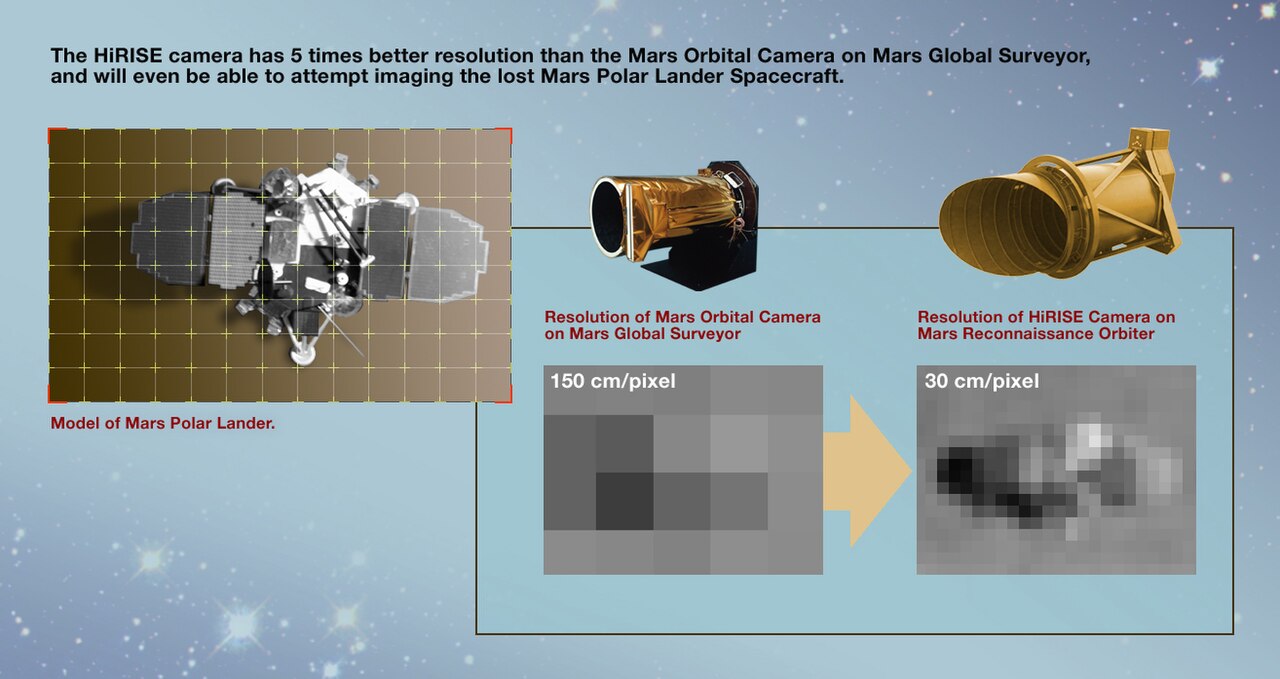
Wikimedia Commons · Public domain
- Field
- still camera
VALÉORINE Encyclopedia
VALÉORINE documentary reading
Documentary summary
Illustration — The Mars Orbiter Camera was in orbit around Mars between 1997 and 2006 (narrow-angle camera inside the cylinder, the two wide-angle cameras attached on the front area) The Mars Orbiter Camera and Mars Observer Camera (MOC) were scientific instruments on board the Mars Observer and Mars Global Surveyor spacecraft. The camera was built by Malin Space Science Systems (MSSS) for NASA and the cost of the whole MOC scientific investigation project was about US$44 million, higher than anticipated in the budget.
Admitted source layer · organised and presented by VALÉORINE
Reference Check
Propose documentary evidence for Mars Orbiter Camera. A contribution is never written directly as fact: identity, source, rights and evidence gates still decide.
Sign in to contribute
Documentary evidence
Documentary basis
Authority files
wikidata · Q6773158 · wikipedia · Mars Orbiter Camera
In this article
Design
Design
• Illustration — Heart-shaped features on Mars (MGS, MOC, February 14, 2004). Originally named Mars Observer Camera, it was selected by NASA in 1986 for the Mars Observer mission, but it returned only three images of planet Mars before the loss of the spacecraft in 1993. A second camera of the same specifications, renamed to Mars Orbiter Camera (MOC), was built (with assistance by California Institute of Technology) and launched on board the Mars Global Surveyor (MGS) spacecraft in 1996. The camera returned 243,668 images while in orbit around Mars, before the loss of the MGS spacecraft in 2006. Mars Orbiter Camera was operated by its manufacturer, Malin Space Science Systems, from its facilities in San Diego, California. The scientific instrument consisted of three elements: a black-and-white narrow-angle camera with a spatial resolution of 1.4 metres per pixel (from an altitude of 378 km), and two pushbroom wide-angle cameras (one red, the other blue) with resolution capabilities spanning 230 m per pixel to 7.5 km/pixel. The narrow-angle camera provided 97,097 (roughly 40%) of the 243,668 images returned by Mars Orbiter Camera. The narrow-angle camera was placed inside an 80 cm-long cylinder with a diameter of 40 cm, and the two wide-angle cameras were attached above the cylinder's front area. All cameras were based on CCD technology and were supported by state-of-the-art 1980s electronics, including a 32-bit radiation-hardened 10 MHz processor (capable of 1 million instructions per second) and 12 MB of DRAM memory buffer. In addition to taking images, the MOC instrument's 12 MB memory buffer serviced the Mars Global Surveyor's Mars Relay antenna as temporary data storage for communications between Earth and landed spacecraft on Mars. For example, more than 7.6 terabits of data were transferred to and from the Mars Exploration Rovers (Spirit and Opportunity). The camera also enabled NASA scientists to choose suitable landing sites for other exploration missions.
Images
Images
• Illustration — Mars Observer Camera view of Mars, before contact was lost • Illustration — Mars Orbiter Camera view of Mars in enhanced color, centered on Arabia Terra (the bright area) • Illustration — Mars Orbiter Camera picture taken on 21 July 1999 showing Mars's polar dunes • Illustration — Gullies in a crater in Eridania, north of the large crater Kepler. Also, features that may be remains of old glaciers are present. One, to the right, has the shape of a tongue. Image taken with Mars Global Surveyor, under the MOC Public Targeting Program. • Illustration — Pattern of large and small tracks made by giant dust devils as seen by Mars Global Surveyor. • Illustration — Group of gullies on north wall of crater that lies west of the crater Newton (41.3047 degrees south latitude, 192.89 east longitide). Image taken with Mars Global Surveyor under the MOC Public Targeting Program. • Illustration — Dark streaks in Diacria quadrangle, as seen by Mars Global Surveyor, under the MOC Public Targeting Program. • Illustration — Layers in the canyon wall in Coprates quadrangle, as seen by Mars Global Surveyor, under MOC Public Targeting Program. • Illustration — Lava flow in Elysium. There are many lava flows in the Elysium quadrangle. In this one, the lava flowed toward the upper right. Image taken by Mars Global Surveyor, under the MOC Public Targeting Program.

Mars Observer Camera (MOC) (renamed Mars Orbiter Camera on Mars Global Surveyor) science investigation used 3 instruments: a narrow angle camera that obtained grayscale (black-and-white) high resolution images (typically 1.5 to 12 m per pixel) and red and blue wide angle cameras for context (240 m per pixel) and daily global imaging (7.5 km per pixel). MOC operated in Mars orbit between September
NASA/JPL
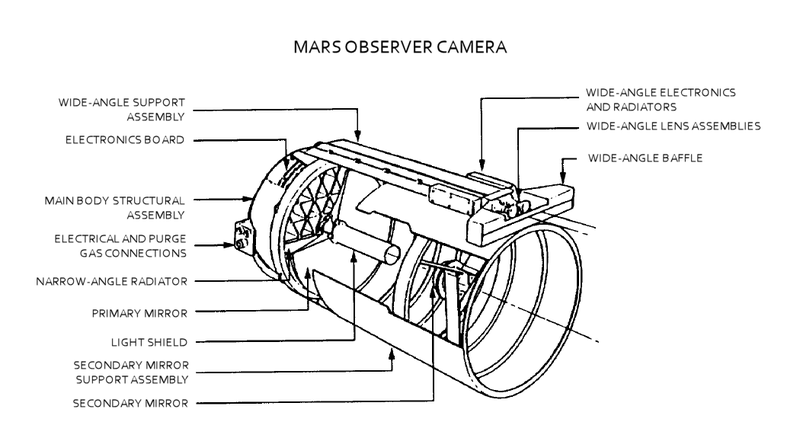
Mars Observer Camera (MOC) diagram. "The Mars Observer Camera (MOC) uses a "push-broom" technique that builds pictures one line at a time as the spacecraft moves around the planet, using the camera's orbital motion to sweep out the desired field of view. The MOC will provide complete low-resolution global coverage of the planet every day, together with medium and high resolution photographs of s
NASA/JPL · "Return to the red planet: The Mars Observer Mission" [1]
Primary material
Documents and archives
authority record
- Wikidata, structured authority record Q6773158: Mars Orbiter Camera
General reference · Wikidata
reference work
- “Mars Orbiter Camera”, English Wikipedia, consulted as further reading
Reputable secondary · Wikipedia
Notes from the source article
Cited by Wikipedia
Notes from the source article
These works are cited by the source article, in its own numbering. They are recorded as its citations, not as sources VALÉORINE has verified.
- 1.Michael C. Malin. An overview of the 1985–2006 Mars Orbiter Camera science investigation. Mars - the International Journal of Mars Science and Exploration. Mars Informatics Inc. 5. 1–60. 6 January 2010. 10.1555/mars.2010.0001.
- 2.Hoekzema, Nick. Planetary & Cometary Exploration Cameras on Orbiters and Landers.
- 3.PIA02004: Syrtis Major and Arabia Terra, Mars. JPL.NASA.gov. 14 June 2000.
- 4.Defrosting Polar Dunes--"They Look Like Bushes!. Malin Space Science Systems. 10 August 1999.
References
Citations
References
Each reference names the institution holding it, so a reader may go to the document itself.
authority record
Secondary witnessreference work
Secondary witness
The Encyclopedia exists whether or not anything is for sale. Corrections are recorded rather than overwritten, and every version of this record is kept. Published 16 August 2026.
Elsewhere in Scientific instruments
736 published records in this field, each with its sources named.
- Mars Advanced Radar for Subsurface and Ionosphere SoundingTerminology
- Mars Climate SounderTerminology
- Mars Color ImagerTerminology
- Mars Multispectral Imager for Subsurface StudiesTerminology
- MarsDialTerminology
- MASCARATerminology
- mathematical instrumentTerminology
- Mauritius Radio TelescopeTerminology
Best supported in this field
For owners
Own an object connected with Mars Orbiter Camera?
A specialist will read what you send and tell you what the house can establish, what it cannot, and whether the object is suited to sale. There is no charge and no obligation. The object stays with you throughout; nothing is shipped to us unless it is arranged in writing beforehand.