
Maria Keil
Maria Keil (9 August 1914 – 10 June 2012) was a Portuguese visual artist. She was part of the second generation of Portuguese modernist painters and produced a vast body of diverse work that included painting, drawing and illustration, azulejo tiles, graphic and furniture design, tapestry and scenography. Particularly noteworthy was her activity as an illustrator, as well as the crucial role she played in the contemporary renewal of traditional tile art in Portugal.
Also recorded as Maria Da Silva Pires Keil Amaral
Maria Keil
Koshelyev · Public domain
- Name
- Maria Keil
- Birth Name
- Maria Pires da Silva
- Born
- 9 August 1914
- Birthplace
- Silves, Portugal
- Died
- 10 June 2012
- Place of death
- Lisbon, Portugal
- Field
- Painting, drawing, tapestry
- Movement
- Modernism
- Full name
- Maria Pires da Silva.
- Nationality
- Portugal.
- Occupation
- painter and photographer.
- Honours
- Commander of the Military Order of Saint James of the Sword.
VALÉORINE Encyclopedia
VALÉORINE documentary reading
Documentary summary
Maria Keil (9 August 1914 – 10 June 2012) was a Portuguese visual artist. She was part of the second generation of Portuguese modernist painters and produced a vast body of diverse work that included painting, drawing and illustration, azulejo tiles, graphic and furniture design, tapestry and scenography. Particularly noteworthy was her activity as an illustrator, as well as the crucial role she played in the contemporary renewal of traditional tile art in Portugal.
Admitted source layer · organised and presented by VALÉORINE
Note VALÉORINE
Maria Keil (1914–2012) was a painter and photographer, of Portuguese nationality. The painter was born Maria Pires da Silva in Silves and died in Lisbon. Languages used include Portuguese.
Composed from admitted, traceable facts · 28 September 2026
VALÉORINE
Reference Check
Propose documentary evidence for Maria Keil. A contribution is never written directly as fact: identity, source, rights and evidence gates still decide.
Sign in to contribute
World of VALÉORINE
Documentary connections
Only confirmed graph relationships appear here. Images are shown only when their identity and reuse rights both pass the documentary gate.
Documentary evidence
Documentary basis
Authority files
wikidata · Q293228 · wikipedia · Maria Keil
In this article
Key facts
Key facts
• Name — Maria Keil • Birth Name — Maria Pires da Silva • Born — 9 August 1914 • Birthplace — Silves, Portugal • Died — 10 June 2012 • Place of death — Lisbon, Portugal • Children — 1 • Field — Painting, drawing, tapestry • Movement — Modernism
Early life and education
Early life and education
Maria Pires da Silva was born in Silves, in the Portuguese region of Algarve, daughter of Francisco da Silva Pires and Maria José Silva. From 1929 she attended the Preparatory Course at the Lisbon School of Fine Arts and then the painting course (which she did not complete), where she was a student of Veloso Salgado. Her art was characterized by the diversity of techniques and means of expression. Throughout her life she engaged in many areas, including painting and drawing, illustration, graphic arts, printmaking, tiles, tapestry, furniture, decoration, scenography and costumes. In 1933 she married the architect Francisco Keil do Amaral and two years later her only son, Francisco Pires Keil do Amaral (or Pitum Keil do Amaral), was born.
Career
Career
In 1936 she became a member of the ETP (Technical Advertising Studio, then run by José Rocha), establishing friendship with Carlos Botelho, Fred Kradolfer, Ofélia Marques and Bernardo Marques. In the following year, she visited Paris during the construction of the Portuguese Pavilion of the Paris International Exhibition of 1937 (of which her husband was the architect). She made a piece for Room IV on the theme of Overseas (Salle IV - Outremer). • Illustration — The Sea, 1958–59, azulejos panel, Av. Infante Santo, Lisbon She exhibited individually for the first time in 1939 (as there were no art galleries, the exhibition took place at Galeria Larbom, a furniture store on Rua do Ouro, Lisbon). The same year she participated in the Secretariado da Propaganda Nacional (SPN) IV Modern Art Exhibition. She also participated in the SPN shows of the next two years, winning the Souza-Cardoso Revelation Prize in 1941 with Self Portrait, 1941. In 1940, she designed sets and costumes for the ballet Lenda das Amendoeiras, presented at the debut show of the Verde Gaio Ballet Company. Between 1946 and 1956 she regularly participated in the exhibitions of the Sociedade Nacional de Belas Artes (SNBA) in Lisbon. She held an individual exhibition in 1945 and, again, in 1955. "This was a historic exhibition, as it marked pioneering levels of innovation in the fields of furniture and, above all, tiles in Portuguese art". In this exhibition she highlighted the work of designing furniture for domestic interiors and for commercial spaces related to restaurants and hotels, to which she dedicated herself from the beginning of the 1940s until the middle of the following decade. There followed a long hiatus in which she dedicated herself to a wide range of activities, before she next exhibited solo in 1983. Keil concentrated on book illustrations during this period. She wrote and illustrated books for both children and adults, with publications of her own text and images, or illustrating works by Matilde Rosa Araújo, Aquilino Ribeiro, Sophia de Mello Breyner Andresen, José Gomes Ferreira, Augusto Abelaira, Mário Dionísio, José Rodrigues Miguéis, Ilse Losa, among others. Another key aspect of her work, where she came to distinguished herself, was the azulejo tile. She began to explore this ouvre in the early 1950s. Keil became one of the main figures in the modernising of this traditional art form. The tile panel O mar, on Avenida Infante Santo, Lisbon, and the extensive collaboration with the Metropolitano de Lisboa (Lisbon Metro) is a highlight of her significant body of work in this genre. Beginning in 1957, her work in the field would continue until c. 1972, with the decoration of the last stations of the first phase of the metro: Arroios, Alameda, Areeiro, Roma and Alvalade. Keil created the panels for all the initial stations with the exception of Avenida. From 1977, some of these panels were totally or partially destroyed, due to the expansion of several stations, including Saldanha, Restauradores and Intendente. In 1978 she participated in the travelling exhibition 5 Centuries of Tiles in Portugal (Rio de Janeiro, São Paulo, Brasília and Caracas). From then on, her work became a part of the main exhibitions (in Portugal and abroad) dedicated to the art of tiles in Portugal. In 1989, the Museu Nacional do Azulejo organized a comprehensive exhibition on this aspect of her work. On 9 April 1981, she was awarded the rank of Commander of the Military Order of Sant'Iago da Espada. Maria Keil died in Lisbon on 10 June 2012, at the age of 97.
Style and works
Style and works
The initial stages of her work were closely linked to the graphic arts and her participation in the Technical Studio of Advertising (formed by José Rocha). It is there that she learnt the about renewing the art Portuguese tiles, initially inspired by the example of Fred Kradolfer. Oscillating between the direct, simple and immediate image, and the fusion of spaces or even the subtle surrealization of the narrative, Maria Keil starts "from a real situation, […] takes from her only what already brings her a touch of unreality. Then, and based on that, she sketches figures of a new reality that is characteristic of her art." This desire for clarification is present in her self-portrait of 1941, dominated by the "architectural presence" of the figure, which functions as the axis of the composition, controlling and dominating "her own presence, through the discreet theatricality of small gestures". Her first experiences in working with azulejo tiles dated back to 1954, working with the TAP Air Portugal delegation in Paris and the Aerogare de Luanda in Angola. Her choice of working with tiles stemmed from the support of the new generation of architects, including her husband, Keil do Amaral, but also had personal motivations. She commented that "after the second exhibition, I came to the conclusion that it was not worth continuing with painting, the world is full of good painting […]. Architecture is a very serious thing, I found it more useful to do things for architecture". Her first major work in this field dates from 1958 to 1959 (with preparatory studies dating from 1956 to 1958) and is entitled O mar (The Sea). Blues and greens predominate with figurative allusions of the fisherman with his son, boats, shells with the entire panel dominated by geometric patterns. Critics considered that "her cultural reference is not located in the pictorial panels, historians or naturalists of erudite production, but in its determinant borders where the possibilities of geometry and colour are transmuted into rhythms". For the vast work for the Metropolitano de Lisboa metro line (1957 – c. 1972), Keil opted for strictly abstract forms.
Azulejos/Lisbon Metro
Azulejos/Lisbon Metro
• Illustration — Martim Moniz (Lisbon Metro) • Illustration — Martim Moniz (Lisbon Metro) • Illustration — Intendente (Lisbon Metro) • Illustration — Intendente (Lisbon Metro) • Illustration — Intendente (Lisbon Metro) • Illustration — Intendente (Lisbon Metro) • Illustration — Anjos (Lisbon Metro) • Illustration — Anjos (Lisbon Metro) • Illustration — Arroios (Lisbon Metro) • Illustration — Arroios (Lisbon Metro) • Illustration — Alameda (Lisbon Metro) • Illustration — Alameda (Lisbon Metro) • Illustration — Restauradores (Lisbon Metro) • Illustration — Areeiro (Lisbon Metro) • Illustration — Roma (Lisbon Metro) • Illustration — Alvalade (Lisbon Metro) • Illustration — Campo Pequeno (Lisbon Metro) • Illustration — Campo Pequeno (Lisbon Metro) • Illustration — Rossio (Lisbon Metro) • Illustration — Metro Lisboa Rossio • Illustration — Marquês de Pombal (Lisbon Metro) • Illustration — Marquês de Pombal (Lisbon Metro) • Illustration — Entre Campos (Lisbon Metro) • Illustration — Entre Campos (Lisbon Metro) • Illustration — Praça de Espanha (Lisbon Metro) • Illustration — Praça de Espanha (Lisbon Metro)
Identity and origins
Identity and origins
Maria Keil was recorded at birth as Maria Pires da Silva. The authorities additionally record the heading Maria Da Silva Pires Keil Amaral. Her recorded language was Portuguese. She married Francisco Keil do Amaral. One child is recorded: Pitum Keil do Amaral. Other recorded relations include Luís Keil.
Identity
Identity
Maria Keil is recorded as having received Commander of the Military Order of Saint James of the Sword.

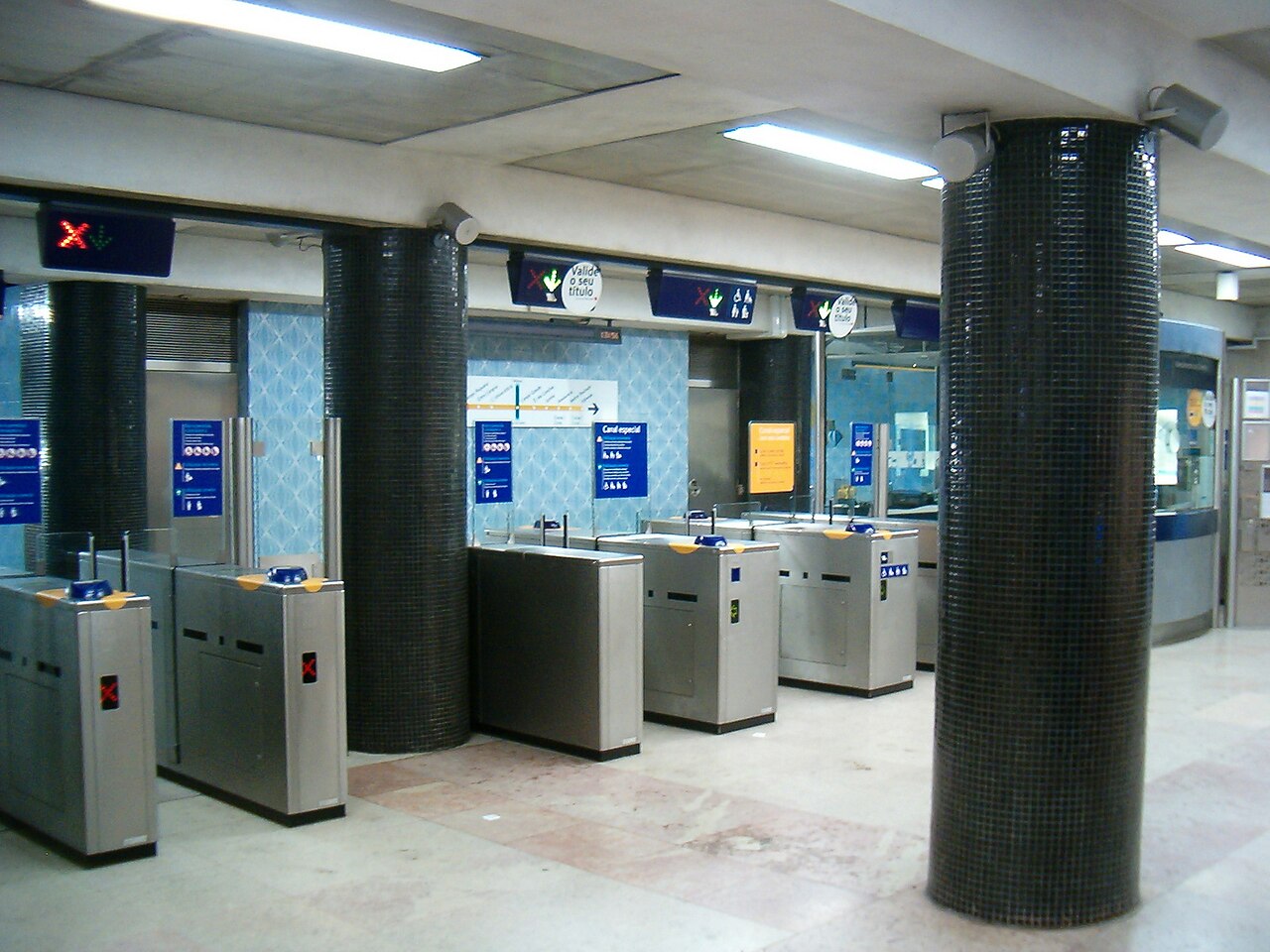
Metro station Anjos (Lisboa)
Koshelyev

Metro station Anjos (Lisboa)
Koshelyev
Life and career
Dated record
Life and career
Explore 1914–2012
The full dated record · 3 entries
1914
Maria Keil born at Silves.
1958
The Sea is dated 1958.
2012
Maria Keil died at Lisbon.
Places
Named by the record
Places
Only places the record itself states, plotted where the house gazetteer settles their coordinates. Nothing is inferred from a name or a nationality.
Silves.
Birth place
Lisbon.
Death place
Awards and recognition
• Souza-Cardoso Award, SPN, 1941. • Acquisition Grand Prix, National Academy of Fine Arts (2009) • In 2020, the Portuguese Ministry of Culture took on the responsibility of inventorying and studying its estate. This agreement, signed with her son Francisco Keil do Amaral known as Pitum, also contemplates the deposition and exhibition of it in one of the museums under the responsibility of the Directorate-General for Cultural Heritage (DGPC). • In 2013, the Museum of the Presidency of the Republic organized the posthumous exhibition On purpose – Maria Keil at the Cascais Citadel Palace, in partnership with the Cascais municipality. It presented a retrospective and comprehensive view of her works. • A library is named after her in Lumiar, Lisbon.
Notes from the source article
Cited by Wikipedia
Notes from the source article
These works are cited by the source article, in its own numbering. They are recorded as its citations, not as sources VALÉORINE has verified.
- 1.Público. Cavaco Silva: Maria Keil foi uma "figura ímpar do século XX". Sonae.com. 2012-06-11.
- 2.Rita Pimenta. Maria Keil: Artista ou operária?. Público. Sonae.com. 2012-06-10.
- 3.KEIL, Maria – Maria Keil: azulejos. Lisboa: Museu Nacional do Azulejo, 1989
- 4.Folheto desdobrável da exposição organizada pelo Museu da Presidência da República: De propósito: Maria Keil, obra artística, Palácio da Cidadela de Cascais, 2013.
- 5.RODRIGUES, António – As construções de Maria Keil. In: KEIL, Maria – Maria Keil: azulejos. Lisboa: Museu Nacional do Azulejo, 1989.
- 6.KEIL, Maria – Maria Keil ilustradora: Mostra bibliográfica. Lisboa: Biblioteca Nacional, 2004. ISBN 972-565-390-4
- 7.Maria Keil de volta ao metro em 2009.
- 8.ENTIDADES NACIONAIS AGRACIADAS COM ORDENS PORTUGUESAS – Página Oficial das Ordens Honoríficas Portuguesas. ordens.presidencia.pt.
- 9.ALMEIDA, Bernardo Pinto de – Maria Keil e a «Escola de Lisboa». In: KEIL, Maria – Roupa a secar no Bairro Alto. Lisboa: Museu Nacional do Traje, 1998, p. 14.
- 10.Maria Keil em entrevista ao Diário de Notícias, 02-10-1985. In: RODRIGUES, António – As construções de Maria Keil. In: KEIL, Maria – Maria Keil: azulejos. Lisboa: Museu Nacional do Azulejo, 1989.
- 11.RODRIGUES, António – As construções de Maria Keil. In: KEIL, Maria – Maria Keil: azulejos. Lisboa: Museu Nacional do Azulejo, 1989.
- 12.SILVA, Raquel Henriques da – Azulejos de Maia Keil. In: KEIL, Maria – Maria Keil: azulejos. Lisboa: Museu Nacional do Azulejo, 1989.
- 13.SILVA, Raquel Henriques da – Azulejos de Maia Keil. In: KEIL, Maria – Maria Keil: azulejos. Lisboa: Museu Nacional do Azulejo, 1989.
- 14.Público. Pintora Maria Keil distinguida com galardão da Academia Nacional de Belas Artes. 29 November 2009.
- 15.Ministério da Cultura assina protocolo para integração do espólio de Maria Keil. portugal.gov.pt.
- 16.PÚBLICO. Espólio de Maria Keil vai ser inventariado e divulgado pela Direcção-Geral do Património Cultural.
- 17.De propósito – Maria Keil, obra artística.
- 18.Portugal, Rádio e Televisão de. Espólio de Maria Keil vai ser inventariado, depositado num museu e mais tarde exposto.
References
Citations
References
Each reference names the institution holding it, so a reader may go to the document itself.
reference work
Wikidata, structured authority record Q293228: Maria KeilWikimedia Foundation
Secondary witnessreference work
Secondary witness
The Encyclopedia exists whether or not anything is for sale. Corrections are recorded rather than overwritten, and every version of this record is kept. Published 16 August 2026.
Elsewhere in Photography
11,392 published records in this field, each with its sources named.
- María GarcíaPhotographer
- María GuðmundsdóttirPhotographer
- Maria JonnPhotographer
- Maria José PallaPhotographer
- Maria LamasPhotographer
- Maria LantzPhotographer
- Maria Lemos de MagalhãesPhotographer
- Maria Martinez-CañasPhotographer
Best supported in this field
For owners
Own a work by Maria Keil?
A specialist will read what you send and tell you what the house can establish, what it cannot, and whether the object is suited to sale. There is no charge and no obligation. The object stays with you throughout; nothing is shipped to us unless it is arranged in writing beforehand.