
mannequin
Illustration — Mannequins in a clothing shop in Canada A mannequin (sometimes spelled as manikin and also called a dummy, lay figure, or dress form) is a doll, often articulated, used by artists, tailors, dressmakers, window dressers and others, especially to display or fit clothing and show off different fabrics and textiles. Alternatively the term refers, or referred to, a live human fashion model. Life-sized mannequins with simulated airways are used in the teaching of first aid, CPR, and advanced airway management skills such as tracheal intubation.
Also recorded as dress form · lay figure · dummy
mannequin

Colin Rose · Flickr · CC BY 2.0
- Field
- doll · statue
VALÉORINE Encyclopedia
VALÉORINE documentary reading
Documentary summary
Illustration — Mannequins in a clothing shop in Canada A mannequin (sometimes spelled as manikin and also called a dummy, lay figure, or dress form) is a doll, often articulated, used by artists, tailors, dressmakers, window dressers and others, especially to display or fit clothing and show off different fabrics and textiles. Alternatively the term refers, or referred to, a live human fashion model. Life-sized mannequins with simulated airways are used in the teaching of first aid, CPR, and advanced airway management skills such as tracheal intubation.
Admitted source layer · organised and presented by VALÉORINE
Note VALÉORINE
No house-authored Note is published until its assertions and sources pass the VALÉORINE evidence contract. The documentary article remains available in full while that enrichment is being consolidated.
Documentary enrichment in progress · no unsupported statement published
Reference Check
Propose documentary evidence for mannequin. A contribution is never written directly as fact: identity, source, rights and evidence gates still decide.
Sign in to contribute
World of VALÉORINE
Documentary connections
Only confirmed graph relationships appear here. Images are shown only when their identity and reuse rights both pass the documentary gate.

Broader Term · incoming
crash test dummy
Term
Own work

Broader Term · incoming
écorché
Term
https://wellcomeimages.org/indexplus/obf_images/a0/a7/ae622bc3d3ed66484908dbb37f32.jpg Gallery: https://wellcomeimages.org/indexplus/image/V0008432EL.html Wellcome Collection gallery (2018-03-23): htt

Broader Term · incoming
manikin
Term
Own work

Broader Term · incoming
Resusci Anne
Term
"Night of the Living Dead" or "The Attack of the Plastic Dummies"

Broader Term · incoming
straw man
Term
Own work ( Original text: selbst erstellt )
Documentary evidence
Evidence Panel
not yet certified
- Identity
- resolved
- Independent source families
- 0
- Admitted assertions
- 0
- Open conflicts
- 0
Authority files
gnd · 4338413-4 · wikidata · Q855680 · wikipedia · Mannequin
In this article
Etymology
Etymology
During the 1950s, mannequins were used in nuclear tests to help show the effects of nuclear weapons on humans. Also referred to as mannequins are the human figures used in computer simulation to model the behavior of the human body.
Mannequin comes from the French word mannequin, which had acquired the meaning "an artist's jointed model", which in turn came from the Flemish word manneken, meaning "little man, figurine", referring to late Middle Ages practice in Flanders whereby public display of even women's clothes was performed by male pages (boys). Fashion shops in Paris ordered dolls in reed from Flemish merchants. Flanders was in terms of logistics the easiest region to import reed dolls from, as the rivers Schelde and Oise provided easy routes from Flanders to Paris. As the Flemish wrote 'manneke(n)' for 'little man' on their invoices, the Parisians pronounced this as 'mannequen', hence shifted to 'mannequin'. A mannequin is thus linguistically masculine, not feminine.
Alternative meaning
Alternative meaning
The Oxford English Dictionary gives two meanings for the term, the first being "a person employed by a dressmaker, costumier, etc., to model clothes," the second being "a model of (part of) a human figure, used for the display of clothes, etc." In the late 1800s and first part of the twentieth century, British and Australian English borrowed 'mannequin' to refer to human, invariably female, fashion models such as Loulou de la Falaise (a meaning still retained in French and other European languages) and the 1926 American Mannequin silent romantic drama film uses that sense, which has become obsolete since in American English. The meaning as a shop dummy dates from the start of World War II. Australian academic Maynard notes the ironic or symbolic potential of the interchangeability of fashion models and mannequins as humans; and of mannikins, dummies, and dolls.
History
History
• Illustration — A lay figure by Albrecht Dürer in the Prado Museum Shop mannequins are derived from dress forms used by fashion houses for dress making. The use of mannequins originated in the 15th century, when miniature "milliners' mannequins" were used to demonstrate fashions for customers. Full-scale, wickerwork mannequins came into use in the mid-18th century. Wirework mannequins were manufactured in Paris from 1835.
Shop display
Shop display
The first female mannequins, made of papier-mâché, were made in France in the mid-19th century. Mannequins were later made of wax to produce a more lifelike appearance. In the 1920s, wax was supplanted by a more durable composite made with plaster. Modern day mannequins are made from a variety of materials, the primary ones being fiberglass and plastic. The fiberglass mannequins are usually more expensive than the plastic ones, tend to be not as durable, but are significantly more realistic. Plastic mannequins, on the other hand, are a relatively new innovation in the mannequin field and are built to withstand the hustle of customer foot traffic usually witnessed in the store they are placed in. Mannequins are used primarily by retail stores as in-store displays or window decoration. However, many online sellers also use them to display their products for their product photos (as opposed to using a live model).
Use by artists
Use by artists
Renaissance artist Fra Bartolomeo invented the full-scale articulated mannequin (more properly known as lay figure) as an aid in drawing and painting draped figures. In 18th-century England, lay-figures are known to have been owned by portrait painters such as Joshua Reynolds, Thomas Gainsborough, and Arthur Devis for the arrangement of conversation pieces.
Medical education
Medical education
In healthcare simulation, the preferred spelling is manikin. Anatomical models such as ivory manikins were used by doctors in the 17th century to study medical anatomy and as a teaching aid for pregnancy and childbirth. Each figure could be opened up to reveal internal organs and sometimes fetuses. There are only 180 known surviving ancient medical manikins worldwide. • Illustration — A medical student performs an eye examination on a manikin in Mauritius Today, medical simulation manikins, models or related artefacts such as SimMan, the Transparent Anatomical Manikin or Harvey are widely used in medical education. The term manikin refers exclusively to these types of models, though mannequin is often also used. In first aid courses, manikins may be used to demonstrate methods of giving first aid (e.g., resuscitation). Fire and coastguard services use manikins to practice life-saving procedures. The manikins have similar weight distribution to a human. Special obese manikins and horse manikins have also been made for similar purposes. Over-reliance on mass-produced manikins has been criticized for teaching medical students a hypothetical "average" that does not help them identify or understand the significant amount of normal variation seen in the real world.
Representation in art and culture
Representation in art and culture
• Illustration — Two mannequins of different types Mannequins were a frequent motif in the works of many early 20th-century artists, notably the metaphysical painters Giorgio de Chirico, Alberto Savinio and Carlo Carrà. Shop windows displaying mannequins were a frequent photographic subject for Eugène Atget. Mannequins have been used in horror and science fiction. The Twilight Zone episode "The After Hours" (1960) involves mannequins taking turns living in the real world as people. In the Doctor Who serial Spearhead from Space (1970), an alien intelligence attempts to take over Earth with killer plastic mannequins called Autons. The romantic comedy film Mannequin (1987) is a story of a window dresser who falls in love with a mannequin that comes to life. The romantic thriller film Bommai (2023) is the story of a person who works in a mannequin factory and falls in love with one of the mannequins, imagining it as his childhood crush.
Military use
Military use
Military use of mannequins is recorded amongst the ancient Chinese, such as at the siege of Yongqiu. The besieged Tang army lowered scarecrows down the walls of their castles to lure the fire of the enemy arrows. In this way, they renewed their supplies of arrows. Dummies were also used in the trenches in World War I to lure enemy snipers away from the soldiers. In the modern era, mannequins have served as targets in shoot houses and target ranges. A Central Intelligence Agency (CIA) report describes the use of a mannequin ("Jack-in-the-Box") as a countersurveillance measure, intended to make it more difficult for the host country's counterintelligence to track the movement of CIA agents posing as diplomats. A "Jack-in-the-Box"mannequin representing the upper half of a humanwould quickly replace a CIA agent after he left the car driven by another agent and walked away, such that any counterintelligence officers monitoring the car would believe, at least briefly, that they were still in it.

zh:上環 永安百貨
Victoriactcal
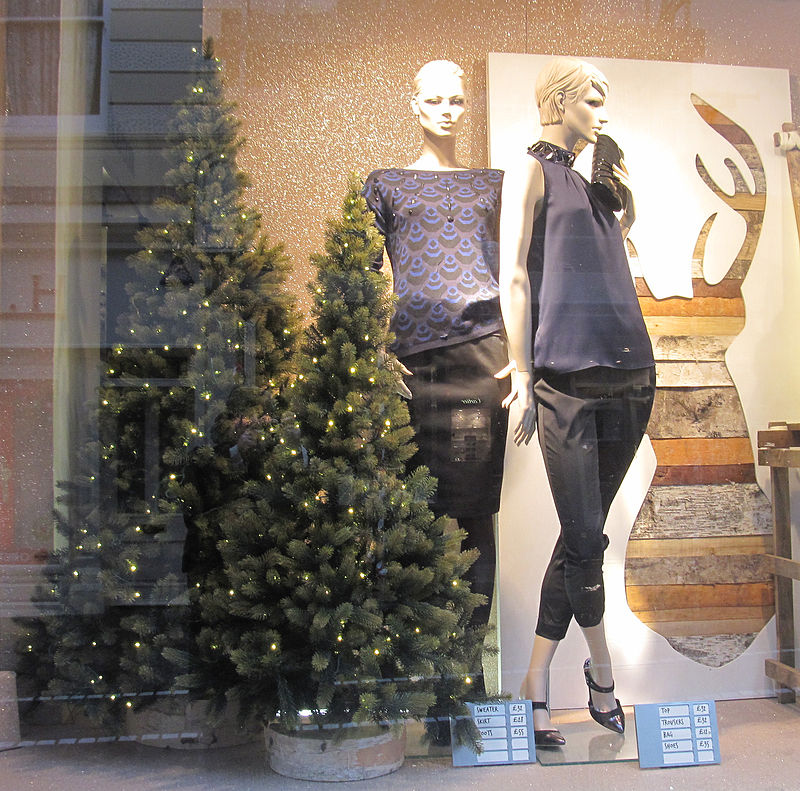
2012 Christmas window display in town shop, Saint Helier, Jersey
Man vyi · Self-photographed
Primary material
Documents and archives
reference work
- “Mannequin”, English Wikipedia, consulted as further reading
Reputable secondary · Wikipedia
- Wikidata, structured authority record Q855680: mannequin
Reputable secondary · Wikidata
authority file
- Gemeinsame Normdatei 4338413-4, Mannequin.
Unverified · Deutsche Nationalbibliothek
Notes from the source article
Cited by Wikipedia
Notes from the source article
These works are cited by the source article, in its own numbering. They are recorded as its citations, not as sources VALÉORINE has verified.
- 1.Seattle Times Company. Nuclear Test Mannequins. Seattle Times Trinity Web. 1995.
- 2.Trivedi, Bijal P. Archaeologists Explore Cold War Nuclear Test Site. National Geographic News. 15 July 2002.
- 3.Houghton Mifflin Company. mannequin. The American Heritage Dictionary of the English Language. 2004.
- 4.Alys Lancaster: Lancashire model who became the face of Blackpool. www.thetimes.com. 2008-09-15.
- 5.Petkanas, Christopher. Loulou & Yves: The Untold Story of Loulou de La Falaise and the House of Saint Laurent. St. Martin's Press. 17 April 2018. 9781250051691.
- 6.1902 Pall Mall Mag. XXVII. 119 Another salon ornamented with tall mirrors in which were reflected the slender elegant figures of several mannequins, most of them exceedingly pretty and all arrayed in magnificent dresses... 1939 M. B. Picken Lang. Fashion 97/2 Mannequin model of human figure for display of garments, hats, furs, etc.
- 7.Should We Be Calling Models 'Mannequins'?. Grazia. 2017-02-21.
- 8.Maynard, Margaret. Living Dolls: The Fashion Model in Australia. The Journal of Popular Culture. 33. 1. 191–205. June 1999. 0022-3840.
- 9.Steele, Valerie (ed.). Encyclopedia of Clothing and Fashion. Vol. 2. Detroit: Charles Scribner's Sons, 2005. p. 377
- 10.Steele, Valerie (ed.). Encyclopedia of Clothing and Fashion. Vol. 2. Detroit: Charles Scribner's Sons, 2005. p. 379
- 11.The Mannequin Guide and The Ultimate Visual Guide to Choosing the Right Mannequin by The Shop Company
- 12.lay figure, n. meanings, etymology and more | Oxford English Dictionary.
- 13.Polite Society by Arthur Devis, Harris Museum and Art Gallery, Preston, 1983, p.67
- 14.lay figure. Oxford Reference.
- 15.Simulation Manikins 101: What They Are, What They’re Called, and Why They Matter. Elevate Healthcare.
- 16.Jennifer Ouellette. CT scans confirm 17th-century medical manikins are mostly made of ivory. ars Technica. 27 Nov 2019.
- 17.SimMan. Laerdal.
- 18.Harvey: Major Changes. Gordon Center for Research in Medical Education.
- 19.Cooper Jeffery B, Taqueti VR. A brief history of the development of mannequin simulators for clinical education and training. Postgrad Med J. 84. 997. 563–570. December 2008. 10.1136/qshc.2004.009886.
- 20.Jacobson, Ella. Too Human. Real Life. 20 May 2019.
- 21.Holzhey, Magdalena. 2005. Giorgio de Chirico 1888–1978 the modern myth. Koln: Taschen. pp. 42–43.
- 22.*Cowling, Elizabeth; Mundy, Jennifer. 1990. On Classic Ground: Picasso, Léger, de Chirico and the New Classicism 1910-1930. London: Tate Gallery. p. 54.
- 23.Spearhead from Space. BBC.
- 24.Mulkern, Patrick. Spearhead from Space. Radio Times. 14 September 2009.
- 25.McQuade, Dan. Why Mannequin Is the Best Movie Ever Made About Philadelphia. Philadelphia. 4 December 2013.
- 26.Bommai Movie Review: Another psycho act by SJ Suryah in a film that's a treasure trove of cliches. India Today. 16 June 2023.
- 27.List of strategies.
- 28.Lopez, C. Todd. Grafenwoehr shoot house: 'Like an action movie set' Article The United States Army. www.army.mil. 31 October 2008.
- 29.Autonomous Robotic Targets Are a Bullseye for Live Fire Training United States Secret Service. www.secretservice.gov. 20 August 2025.
- 30.Royden, Barry G. Tolkachev, A Worthy Successor to Penkovsky. An Exceptional Espionage Operation. Studies in Intelligence. 47. 3. 2003.
Bibliography printed in the source article · 3
- The Recycling and Reuse of Mannequins - See 'Mannakin'
- Gross, Kenneth - The Dream of the Moving Statue (Penn State Press 1992, )
- Verstappen, Stefan. The Thirty-six Strategies of Ancient China. 1999.
References
Citations
References
Each reference names the institution holding it, so a reader may go to the document itself.
authority file
Gemeinsame Normdatei 4338413-4, Mannequin.Deutsche Nationalbibliothek
Partially resolvedreference work
Partially resolvedreference work
Partially resolved
Connections
Knowledge graph
Connections
Each connection was recorded deliberately, with the basis for it kept on the internal record.
Broader subject
2- crash test dummyTerminology
Established from a fact already recorded on a verified source.
- écorchéTerminology
Established from a fact already recorded on a verified source.
The Encyclopedia exists whether or not anything is for sale. Corrections are recorded rather than overwritten, and every version of this record is kept. Published 14 August 2026.
Elsewhere in Collectables
20,755 published records in this field, each with its sources named.
- manikinTerminology
- manjiraTerminology
- MankindWork
- MankyWork
- Manor LordsWork
- Mansion of Hidden SoulsWork
- MansoryOrganisation
- MantronixWork
Best supported in this field
For owners
Own an object connected with mannequin?
A specialist will read what you send and tell you what the house can establish, what it cannot, and whether the object is suited to sale. There is no charge and no obligation. The object stays with you throughout; nothing is shipped to us unless it is arranged in writing beforehand.