
M. G. Ramachandran
Maruthur Gopalan Ramachandran (17 January 1917 – 24 December 1987), popularly known by his initials M. R, was an Indian politician, actor, environmentalist and philanthropist who served as the chief minister of Tamil Nadu from 1977 until his death in 1987. He was the founder and first general secretary of the political party All India Anna Dravida Munnetra Kazhagam (AIADMK).[3] He is regarded as one of the most influential politicians of post-independent India,[4] and was known by the epithets Makkal Thilagam (Jewel of the People) and Puratchi Thalaivar (Revolutionary Leader). In March 1988, he was posthumously awarded the Bharat Ratna, India's highest civilian honour.[130] Born in British Ceylon in 1917, Ramachandran's family later emigrated to India.
Also recorded as M.G.R · Maruthur Gopala Menon Ramachandran · Makkal Thilagam · Puratchi Thalaivar
M. G. Ramachandran

Kumarrajendran at English Wikipedia · Public domain
- Name
- M.
- Birth Name
- Maruthur Gopalan Menon Ramachandran
- Born
- 17 January 1917
- Birthplace
- Nawalapitiya, British Ceylon (present-day Kandy District, Central Province, Sri Lanka)
- Died
- 24 December 1987
- Place of death
- Madras (now Chennai), Tamil Nadu, India
- Occupation
- * Actor
- Nationality
- India, British Raj and Dominion of India.
- Education
- University of Madras.
- Honours
- Filmfare Special Award – South, Bharat Ratna and National Film Award for Best Actor.
- Languages
- Tamil.
VALÉORINE Encyclopedia
VALÉORINE documentary reading
Documentary summary
Maruthur Gopalan Ramachandran (17 January 1917 – 24 December 1987), popularly known by his initials M. R, was an Indian politician, actor, environmentalist and philanthropist who served as the chief minister of Tamil Nadu from 1977 until his death in 1987. He was the founder and first general secretary of the political party All India Anna Dravida Munnetra Kazhagam (AIADMK).[3] He is regarded as one of the most influential politicians of post-independent India,[4] and was known by the epithets Makkal Thilagam (Jewel of the People) and Puratchi Thalaivar (Revolutionary Leader). In March 1988, he was posthumously awarded the Bharat Ratna, India's highest civilian honour.[130] Born in British Ceylon in 1917, Ramachandran's family later emigrated to India.
Admitted source layer · organised and presented by VALÉORINE
Note VALÉORINE
No house-authored Note is published until its assertions and sources pass the VALÉORINE evidence contract. The documentary article remains available in full while that enrichment is being consolidated.
Documentary enrichment in progress · no unsupported statement published
Reference Check
Propose documentary evidence for M. G. Ramachandran. A contribution is never written directly as fact: identity, source, rights and evidence gates still decide.
Sign in to contribute
World of VALÉORINE
Documentary connections
Only confirmed graph relationships appear here. Images are shown only when their identity and reuse rights both pass the documentary gate.
Documentary evidence
Evidence Panel
not yet certified
- Identity
- resolved
- Independent source families
- 0
- Admitted assertions
- 0
- Open conflicts
- 0
Authority files
wikidata · Q127868 · wikipedia · M. G. Ramachandran
In this article
Biography
Biography
In his youth, he joined the drama troupe to support the family. After a few years of acting in plays, he made his debut in the Tamil film industry with Sathi Leelavathi in 1936.[14] In a career spanning more than five decades, he acted in more than 135 films, majority of them in Tamil.[5] He was regarded as one of the three biggest male actors of Tamil cinema during the period alongside Sivaji Ganesan and Gemini Ganesan.[6] He won the National Film Award for Best Actor in 1971, three Tamil Nadu State Film Awards, and three Filmfare Awards South. Ramachandran became part of the Indian National Congress in the late 1930s. In 1953, he became a member of the C. Annadurai-led Dravida Munnetra Kazhagam (DMK). He rose through its ranks based on his popularity as a film star. Despite undergoing a renal transplant and subsequent treatment at the United States, his condition worsened. On 25 December 1987, his remains were buried at the northern end of the Marina beach, where the MGR Memorial was constructed later. In December 2006, a life-size statue of Ramachandran was unveiled in the Indian Parliament. India Post has released several stamps in his honour, and several establishments and places have been named in his honour including the Chennai Central railway station.
Ramachandran studied at University of Madras. The recorded working language is Tamil. Positions recorded include Chief Minister of Tamil Nadu and Member of the 4th Madras Legislative Assembly. Distinctions recorded are Filmfare Special Award – South, Bharat Ratna and National Film Award for Best Actor.
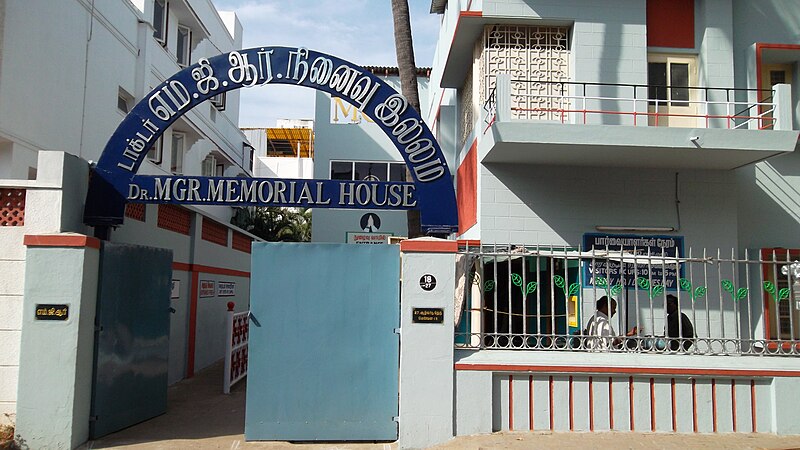
m g.r நினைவு இல்லம் முகப்பு தோற்றம்,ஆற்காடு முதலி தெரு தி.நகர்
Sankar.s

m g.r நினைவு இல்லம் பெயர் பலகை
Sankar.s
Key facts
Key facts
• Name — M. G. Ramachandran • Office — 3rd Chief Minister of Tamil Nadu • Term Start — 9 June 1980 • Term End — 24 December 1987 • Governor — * Prabhudas B. Patwari • S. L. Khurana • Subterm — Cabinet • Suboffice — * Ramachandran II • Ramachandran III • Predecessor — President's rule • Successor — V. N. Janaki Ramachandran • Constituency — * Madurai West • Andipatti • Term Start1 — 30 June 1977 • Term End1 — 17 February 1980 • Governor1 — Prabhudas B. Patwari • Subterm1 — Cabinet • Suboffice1 — Ramachandran I • Predecessor1 — President's rule • Successor1 — President's rule • Constituency1 — Aruppukottai • Office2 — Member of the Tamil Nadu Legislative Assembly • Term Start2 — 24 December 1984 • Term End2 — 24 December 1987 • 1blankname2 — Chief Minister • 1namedata2 — Himself • 2blankname2 — Political Party • 2namedata2 — AIADMK • Predecessor2 — S. S. Rajendran • Successor2 — P. Aasiyan • Constituency2 — Andipatti • Term Start3 — 9 June 1980 • Term End3 — 15 November 1984 • 1blankname3 — Chief Minister • 1namedata3 — Himself • 2blankname3 — Political Party • 2namedata3 — AIADMK • Predecessor3 — T. P. M. Periyaswamy • Successor3 — Pon. Muthuramalingam • Constituency3 — Madurai West • Term Start4 — 30 June 1977 • Term End4 — 17 February 1980 • 1blankname4 — Chief Minister • 1namedata4 — Himself • 2blankname4 — Political Party • 2namedata4 — AIADMK • Predecessor4 — Sowdi Sundara Bharathi • Successor4 — M. Pitchai • Constituency4 — Aruppukottai • Term Start5 — 1 March 1967 • Term End5 — 31 January 1976 • 1blankname5 — Chief Minister • 1namedata5 — * C. N. Annadurai • M. Karunanidhi • 2blankname5 — Political Party • 2namedata5 — * DMK • AIADMK • Predecessor5 — position established • Successor5 — position abolished • Constituency5 — St. Thomas Mount • Office6 — Member of the Tamil Nadu Legislative Council • Term Start6 — 30 March 1962[1] • Term End6 — 7 July 1964 • Successor6 — S. R. P. Ponnuswamy Chettiar • 2blankname6 — Chief Minister • 2namedata6 — * K. Kamaraj • M. Bhaktavatsalam • Office7 — General Secretary of the All India Anna Dravida Munnetra Kazhagam • Term Start7 — 17 October 1986 • Term End7 — 24 December 1987 • Predecessor7 — S. Raghavanandam • Successor7 — J. Jayalalithaa • Term Start8 — 17 October 1972 • Term End8 — 22 June 1978 • Predecessor8 — position established • Successor8 — V. R. Nedunchezhiyan • Office9 — Treasurer of the Dravida Munnetra Kazhagam • Term Start9 — 27 July 1969 • Term End9 — 10 October 1972 • 1blankname9 — President • 1namedata9 — M. Karunanidhi • 2blankname9 — General Secretary • 2namedata9 — V. R. Nedunchezhiyan • Predecessor9 — M. Karunanidhi • Successor9 — K. Anbazhagan • Office10 — President of the South Indian Artistes' Association • Term Start10 — 1961 • Term End10 — 1963 • Predecessor10 — R. Nagendra Rao • Successor10 — S. S. Rajendran • Term Start11 — 1957 • Term End11 — 1959 • Predecessor11 — N. S. Krishnan • Successor11 — Anjali Devi • Birth Name — Maruthur Gopalan Menon Ramachandran • Born — 17 January 1917 • Birthplace — Nawalapitiya, British Ceylon (present-day Kandy District, Central Province, Sri Lanka) • Died — 24 December 1987 • Place of death — Madras (now Chennai), Tamil Nadu, India • Death Cause — Cardiac arrest[2] • Resting Place — M.G.R. and Amma Memorial • Occupation — * Actor • film director • film producer • politician • philanthropist • Party — All India Anna Dravida Munnetra Kazhagam (19721987) • Other Party — * Dravida Munnetra Kazhagam (19531972) • Indian National Congress (19351945) • Nickname — * Makkal Thilagam • Ponmana Chemmal • Puratchi Thalaivar • Vaathiyar
Early life
Early life
Ramachandran was born on 17 January 1917 in Nawalapitiya, Kandy District, British Ceylon (now in Sri Lanka) in a Malayali Nair family to Melakkath Gopalan Menon and Maruthur Satyabhama. His family hailed from Palakkad region in the modern-day Indian state of Kerala.[9][10] His father worked as a magistrate in Kandy, and moved back to India with his family after retirement.[12] He was the youngest of the two sons, and his elder brother was Chakrapani.[13] Ramachandran's father died when he was two and a half years old. Soon after the death of his father, his sister also died due to ill health. After his father's death, their relatives did not support the family, and his mother moved to her brother's house in Kumbakonam. His mother worked as a housemaid to put both her sons through school. During his school days, Ramachandran joined a drama troupe called Boys Company. He trained himself in various aspects, and took on different roles. With help from Kandasamy Mudaliar, he had a brief acting stint overseas in Rangoon and Singapore, where he took up female roles. He returned to India to rejoin Boys Company, and started playing lead roles.
Acting career
Acting career
• Illustration — Ramachandran in his debut film Sathi Leelavathi Ramachandran made his film debut in 1936, in the film Sathi Leelavathi, directed by Ellis R. Dungan, an American-born film director.[15] He followed it with minor appearances and supporting roles in many films.[16] During his early film career, Ramachandran was addressed by his co-stars as "Chinnavar" (the younger one) to distinguish him from his elder brother, Chakrapani, who also worked in the film industry.[17] He worked for over a decade in various films before he played his first lead role in Rajakumari, which was commercially successful.[19] Ramachandran later delivered various hit films such as Manthiri Kumari and Maruthanad Elavarasee in 1950.[20] He established himself as an action hero in Tamil cinema with Manthiri Kumari (1950) and Marmayogi (1951).[22] His popularity rose with the success of En Thangai (1952) and Malaikkallan (1954).[24] • Illustration — Ramachandran with Janaki in Mohini (1948) Ramachandran's 1955 film Alibabavum 40 Thirudargalum was the Tamil film industry's first-ever full-length gevacolor film.[25] He acted further in commercially successful films such as Madurai Veeran (1956), Chakravarthi Thirumagal and Mahadevi (both released in 1957).[26] He also directed few films, and his first film as a director and producer was Nadodi Mannan (1958), which became a blockbuster.[29] He later starred in Kalai Arasi (1963), which featured a storyline of aliens visiting the earth.[31] The following year, he appeared in Thozhilali and Padagotti.[32] After starring in numerous commercially successful films, he held a matinée idol status in Tamil Nadu. In 1960, MGR declined the Padma Shri honour, stating that he could not accept an invitation written in the Devanagari script, consistent with his adherence to Dravidian ideology and advocacy of the Tamil language.[34] Ramachandran was shot in 1967, which permanently changed his voice.[35] His first film to release after his release from the hospital was Arasakattalai, which had been finished earlier. However, he was shooting for the film Kaavalkaaran, when he was shot, and the film had parts featuring his old and new voices across scenes.[36] Ramachandran won the Tamil Nadu State Film Award for Best Actor for the film Kudiyirundha Koyil in 1968 and the National Film Award for Best Actor for Rickshawkaran in 1972.[37] His 1973 film Ulagam Sutrum Valiban was one of the first Tamil films to be filmed abroad, and broke the previous box office records of his films.[38] He later acted in successful films like Netru Indru Naalai (1974), Idhayakkani (1975), and Indru Pol Endrum Vaazhga (1977). His acting career ended in 1978 with his last film being Madhuraiyai Meetta Sundharapandiyan.[39] Ramachandran remarked there was no question of retirement for anyone associated in whichever capacity with the cine field.[40] Kali N. Rathnam, a pioneer of Tamil stage drama, and K. P. Kesavan were mentors of Ramachandran in his acting career.[41] Ramachandran was often paired with actresses B. Saroja Devi, and J. Jayalalithaa.[42] Jayalalithaa, who later followed him into politics, acted with him in 28 films, with the last film being Pattikaattu Ponnaiya in 1973.[43]
Early political career
Early political career
Ramachandran was a member of the Indian National Congress till 1953. In 1953, he joined the Dravida Munnetra Kazhagam (DMK), founded by C. N. Annadurai, and became a prominent member of the party. He became a member of the Madras State Legislative Council in 1962.[44]
1967 assassination attempt
1967 assassination attempt
On 12 January 1967, M. R. Radha, an actor who had appeared in several films alongside Ramachandran, visited him to discuss a future film. During the conversation, Radha stood up, shot Ramachandran near his left ear, and then attempted to shoot himself.[45] The bullet was lodged behind the first vertebra, and Ramachandran underwent a surgery to remove the bullet. However, a piece of the bullet was left behind as the doctors were apprehensive that it would cause further damage if attempted to be removed. As a consequence of the surgery, he lost hearing in his left ear and his voice was altered permanently.[46] The bullet piece left behind got dislodged later, and was removed safely. He was hospitalised for six weeks and was visited by commoners and people from the film industry, polity and bureaucracy. He conducted his campaign for the 1967 assembly elections from the hospital bed, and was elected to the legislative assembly for the first time.[47][48] Radha was later sentenced to five years in prison for the incident, and died in 1979.
Differences with Karunanidhi and birth of AIADMK
Differences with Karunanidhi and birth of AIADMK
• Illustration — Flag of All India Anna Dravida Munnetra Kazhagam After the death of his mentor Annadurai, he became the treasurer of the DMK in 1969 after he helped Karunanidhi became the chief minister of the state and president of the party.[49] However, in the early 1970s, the growing popularity of Ramachandran caused a rift with the DMK president and chief minister Karunanidhi. Ramachandran played a key role in the victory of the DMK in the 1971 assembly elections.[50] Later in the same year, when the DMK government led by Karunanithi wanted to repel the law that was in effect in Tamil Nadu, Ramachandran launched a staunch opposition to it. In 1972, Ramachandran accused that corruption had grown in the DMK after the demise of Annadurai, and demanded the ministers to publicly declare their assets. As a consequence, Ramachandran was expelled from the party temporarily on 10 October 1972, and permanently four days later. On 17 October 1972, Ramachandran became the leader and general secretary of All India Anna Dravida Munnetra Kazhagam (AIADMK), established by Anakaputhur Ramalingam. He continued to act in films and used cinema as a medium to spread his political messages.[51]
First term (1977–1980)
First term (1977–1980)
• Illustration — M. G. Ramachandran collecting the petitions from the public The AIADMK, led by Ramachandran, allied with Congress (I) for the 1977 parliamentary election. Though the combine won 34 of the 39 seats in Tamil Nadu, the Janata party won the election and Morarji Desai became the Prime Minister of India.[52] However, Ramachandran later extended unconditional support to the Janata party government.[53] In the 1977 Tamil Nadu assembly elections, AIADMK allied itself with the Communist Party of India (Marxist), and was part of a four cornered contest against the DMK, the Congress (O) and the Janata Party.[54] The AIADMK-led alliance won the elections by winning 144 seats out of 234 and Ramachandran became the chief minister of Tamil Nadu on 30 June 1977.[56] Indira Gandhi, the leader of Congress (I) leader, sought re-entry into the Parliament after her expulsion from it on 19 December 1978. She considered contesting Thanjavur by-election in Tamil Nadu, scheduled for 17 June 1979, following the resignation of the AIADMK member S. D. Somasundaram, and sought the support of Ramachandran. Ramachandran, who had reportedly agreed to support her during a meeting in New Delhi on 19 May 1979 with Congress leader G. K. Moopanar, later withdrew his backing citing law-and-order concerns.[58] In July 1979, after the fall of the Desai-led government, Ramachandran extended his support to the newly formed Charan Singh-led government at the centre, and Aravinda Bala Pajanor and Satyavani Muthu from the AIADMK became part of the Union Cabinet.[59] Karunanidhi claimed in two separate interviews, in April 2009 and in May 2012, that Ramachandran was ready for the merger of his party, AIADMK, with the DMK in September 1979, with Biju Patnaik acting as the mediator. However, the plan failed to materialise as Panruti S. Ramachandran, a close confidante of Ramachandran, acted as a spoiler and Ramachandran later changed his mind.[61][62] After the fall of the Charan Singh-led government in January 1980, fresh parliamentary elections were called for. The AIADMK–Janata party alliance won only two seats in the elections, with the remaining 37 seats won by the DMK–Congress (I) coalition. Subsequently, the AIADMK-led government was dismissed and the Tamil Nadu assembly was dissolved by the central government led by the Congress in February 1980.
Policies
Policies
In 1978, Ramachandran's government introduced the "one lamp" (oru vilakku) schme which provided free electricity and a government-funded electric lamp for to eligible dwellings measuring up to[66]. In the same year, the state government introduced the 10+2 system of education by abolishing the PUC and moving higher secondary education to school, based on advice from then education minister C. Aranganayagam. His government also improved educational infrastructure with the addition of laboratories in government schools and improved rural access to schools. The rise in demand for college education led the government to encourage private engineering colleges, with further policies enacted to reserving at least half of the seats in such colleges under an open quota and restricting capitation fees.[67] In July 1979, Ramachandran's government introduced a family income ceiling as an economic criterion for availing reservation in educational institutions and later advocated extending reservation to all categories, including the general category, on economic grounds, rather than caste basis. The policy was opposed by Dravidar Kazhagam, with the support of the DMK, and on 21 January 1980, the government withdrew the order and announced an increase in the reservation quota for backward classes to fifty per cent.[68]
Second term (1980–1985)
Second term (1980–1985)
In the 1980 Tamil Nadu assembly elections, the DMK–Congress combined failed to win despite their victory in the earlier 1980 Lok Sabha polls, and the AIADMK, led by Ramachandran, won the election. Ramachandran was sworn in as chief minister for the second time on 9 June 1980. In the by-election held for the Tiruppattur assembly constituency on 29 November 1981, following the death of the incumbent legislator from the Congress, Ramachandran announced that the AIADMK would not contest and would instead offer support to the opposition Congress. While Ramachandran cited a "democratic principle" that the party which originally won the seat should retain it in the event of a vacancy, the decision was criticised by the Communist Party of India as "politics of convenience" and political commentator Cho Ramaswamy viewed it as an attempt to revive ties with then ruling Congress at the centre.[70] • Illustration — Ramachandran with his party colleagues In February 1983, Ramachandran undertook a fast at Marina Beach, alleging that the central government, led by Indira Gandhi, had failed to supply adequate food grains to Tamil Nadu. The move drew criticism from the Congress and the DMK, who alleged it was a political diversion from the case involving the theft of the golden vel at the Tiruchendur Murugan Temple and the subsequent death of a government official, and aimed at influencing the impending by-election to the Tiruchendur constituency. Ramachandran subsequently visited New Delhi to meet the prime minister, after which he ended his fast, as the issue was reportedly sorted out.[71] In the first week of October 1984, Ramachandran fainted while attending a ceremony at the Brihadeeswarar Temple in Thanjavur.[73] On 5 October 1984, he was hospitalised due to respiratory distress and renal impairment. The government released regular health updates, while V. R. Nedunchezhiyan performed the function of the chief minister in the interim.[75] Later, Ramachandran was diagnosed with kidney failure as a result of uncontrolled diabetes, which was soon followed by a heart attack and stroke.[76] He was flown to the United States on 5 November 1984, and underwent a kidney transplant at the Downstate Medical Center in New York City on 19 December 1984, with his niece Leelavathy donating one of her kidneys. While Ramachandran was hospitalised, Indian prime minister Indira Gandhi was assassinated on 31 October 1984,[78] and her son Rajiv Gandhi succeeded her.[79] Rajiv called for fresh elections, and the Ramachandran-led AIADMK allied with Rajiv's Congress for the 1984 Indian general election. Indira Gandhi's assassination, Rajiv Gandhi's visits to the state and Ramachandran's ill health helped create a sympathy wave that helped the AIADMK-Congress alliance sweep the elections with the AIADMK winning 12 seats.[80]
Inter-state water diplomacy
Inter-state water diplomacy
MGR employed personal diplomacy to address inter-state water disputes. During the 1980 Cauvery water shortage, he made an unannounced visit to meet the ailing Karnataka Chief Minister Ramakrishna Hegde in Bengaluru. During the breakfast meeting, when offered a glass of water after a bout of hiccups, MGR remarked that Tamil Nadu too needed water for Kuruvai cultivation, following which Karnataka released Cauvery water to the state before his return to madras. He later secured further releases, including an electricity-for-water arrangement with Karnataka. During another shortage, MGR hosted Karnataka Chief Minister R. Gundu Rao, an admirer of MGR, for breakfast in Chennai and raised the issue. After returning to Bengaluru, Rao directed maintenance work at the Krishnaraja Sagar Dam, facilitating the release of Cauvery water to Tamil Nadu. MGR also persuaded Andhra Pradesh Chief Minister N. T. Rama Rao to launch the Telugu Ganga Project, which supplied Krishna River water to meet Chennai's drinking water needs.[81]
Policies
Policies
In August 1980, the Tamil Nadu Police launched Operation Ajantha, a year-long anti-Naxalite operation, which resulted in the killing of 19 Naxalites, and limited the spread of Naxalism in Tamil Nadu, as their influence was expanding across the region.[83] • Illustration — Ramachandran greeting people and receiving gifts on the Independence day ceremony on 15 August 1982 On 13 November 1980, the state government promulgated an ordinance abolishing the posts of traditional village officers, which were often hereditary roles, and replaced them with village administrative officers, who would be recruited through competitive examinations. The displaced officers were opposed to this and media reports indicated that government records had to be obtained by force from these officers in a few places. Later, revenue minister S. D. Somasundaram announced that would be provided as compensation for the 24,000 village officers affected by the rule.[85] In April 1981, Ramachandran urged the central government to declare Thirukkural as the national scripture of India.[86] Ramachandran allowed the continued sale of liquor in the state, which he had opposed when the ban on which was overturned by his predecessor Karunanidhi in 1971. He rescinded the ban on toddy in 1981, however, the decision was reversed six years later. He later established the Tamil Nadu State Marketing Corporation in 1983 for the import and sale of foreign made liquor.[87] In the early 1980s, there were several instances of clashes between Hindus and Christians in Kanyakumari district, with the tensions escalated on 1 March 1982 during the Mondaicaud Amman Temple festival, which resulted in a police firing, and the deaths of six people and injuries to several others.[88] The unrest soon spread to several areas, resulting in additional casualties, and destruction of property. Ramachandran later visited Mondaicaud and the state government appointed a judicial commission, headed by judge Venugopal, to investigate the incident. The government later issued an order on 29 April 1986 based on the report of the Venugopal commission, to constitute a committee of senior officials to curb antisocial elements that incite violence by creating communal, religious, and political tensions in the state.[89] The Midday Meal Scheme for school students, which had been introduced in 1956 during the tenure of K. Kamaraj, was significantly expanded by Ramachandran in July 1982.[91] It was expanded to cover all government and aided schools for all the days of the year including holidays.[92][93] In 1983, Ramachandran proposed relocating the state capital from Chennai to Tiruchirappalli, citing the drought and drinking water crisis in Chennai. The proposal was later shelved following opposition from various quarters, including within his own party.[94] The government introduced a free electricity scheme for small and marginal farmers in 1984.[96]
Third term (1985–1987)
Third term (1985–1987)
Despite flailing health, Ramachandran contested the 1984 assembly election while still confined to the hospital, and won from Andipatti.[97] During the election, photos of Ramachandran recuperating in hospital were published widely in the media, which helped create a sympathy wave amongst the people.[98] In the elections, the AIADMK–Congress combine won 195 of the 234 seats in the assembly. Following his recovery, Ramachandran returned from the United States on 4 February 1985 and was sworn in as the chief minister, for the third time, on 10 February.[99] He remained in the chief minister's office till 24 December 1987.
Policies and governance
Policies and governance
• Illustration — Ramachandran during a Midday Meal Scheme event Ramachandran was very popular in Tamil Nadu and had high approval from the public.[100][101] He introduced and expanded welfare schemes and enacted several populist measures.[102] His charisma and popularity often trumped policy decisions and led to his eventual success during his tenure as chief minister. The decision-making was often centralised during Ramachandran's tenure. While there was criticism regarding the efficiency of such a system, supporters of Ramachandran countered that this was a result of the party members serving Ramachandran's interests rather than theirs. Ramachandran's charisma and popularity trumped policy decisions that led to his eventual success during his tenure as chief minister.[103] The decade-long rule of Ramachandran was marked by an increase in institutional corruption, tensions between the executive and judiciary, and the proliferation of short-term populist welfare schemes. There was a dilution of the Dravidian rhetoric, including a moderation of anti-Hindi sentiments.[104] As per a study by the Madras Institute of Development Studies in 1988, Ramachandran's tenure saw a lower economic growth than the national average, and limited improvement in essential services, in large due to the shift of government resources to social welfare schemes. Ramachandran's government often used the state machinery against political criticism and censored the media. In April 1987, S. Balasubramanian, the editor of Ananda Vikatan, was sentenced to three months in jail and A.M. Paulraj of Vaniga Otrumai, was ordered to serve a two month jail term by the state legislative assembly, for writing against the government. However, they were later released after cases were filed against the legality of the arrest in the courts[105] Natwar Singh, who served as the minister of state in the external affairs ministry in the mid 1980s, in his autobiography One Life is Not Enough, alleged that Ramachandran covertly supported the cause of independent Tamil Eelam and Liberation Tigers of Tamil Eelam (LTTE), a militant organisation in Sri Lanka. He alleged that the LTTE cadres were given military training in Tamil Nadu, and that Ramachandran had gifted to the group without the knowledge of the Indian government.[107]
Elections results
Elections results
• Tamil Nadu Legislative Assembly • Elections — Assembly — Constituency — Political party — Result — Vote percentage — Opposition • Candidate — Political party — Vote percentage • 1967 — 4th — St. Thomas Mount — DMK — rowspan=2 Dravida Munnetra Kazhagam — rowspan=5 — 66.67% — T. L. Raghupathy — INC — Indian National Congress — 32.57% • 1971 — 5th — 61.11% — INC(O) — Indian National Congress (Organisation) — 38.10% • 1977 — 6th — Aruppukottai — AIADMK — rowspan=3 All India Anna Dravida Munnetra Kazhagam — 56.23% — M. Muthuvel Servai — JP — Janata Party — 17.87% • 1980 — 7th — Madurai West — 59.61% — Pon. Muthuramalingam — DMK — rowspan=2 Dravida Munnetra Kazhagam — 37.59% • 1984 — 8th — Andipatti — 67.40% — Thangaraj — 31.22%
Positions held
Positions held
• Elections — Position — Constituency — Term in office • Assumed office — Left office — Time in office • 1962 — Member of the Legislative Council — 30 March 1962 — 7 July 1964 — 2 years, 99 days • 1967 — Member of the Legislative Assembly — St. Thomas Mount — 15 March 1967 — 5 January 1971 — 3 years, 296 days • 1971 — 22 March 1971 — 31 January 1976 — 4 years, 315 days • 1977 — Chief Minister of Tamil Nadu — Aruppukottai — 30 June 1977 — 17 February 1980 — 2 years, 232 days • 1980 — Madurai West — 9 June 1980 — 9 February 1985 — 4 years, 245 days • 1984 — Andipatti — 10 February 1985 — 24 December 1987 — 2 years, 317 days
Illness and death
Illness and death
• Illustration — MGR Memorial at Marina beach in Chennai From the time of his hospitalisation in October 1984, Ramachandran's health continued to worsen over the next three years, and he had frequent trips to the United States for treatment. He never fully recovered from his health issues and died on 24 December 1987 at 3:30 am in his Ramavaram Garden residence in Manapakkam at the age of 70.[108] His body was kept in state at Rajaji Hall for two days for public viewing. On 25 December 1987, his remains were buried at the northern end of the Marina beach, now called MGR Memorial, adjacent to the Anna Memorial.[109] Around one million people were estimated to have attended his funeral.[110] Ramachandran's death sparked a frenzy of public rioting over the state, and various shops, cinemas, buses and other public and private property became the target of the violence. The police were given shoot-at-sight orders to bring the situation under control. Schools, colleges and various establishments announced holidays due to the situation. The state of affairs continued for almost a month across Tamil Nadu. Some women allegedly shaved their heads bald, and dressed like widows. A few whipped or self immolated themselves. Violence during the funeral alone left 129 people dead and 47 police personnel wounded.[111][112]
Personal life
Personal life
• Illustration — Ramachandran's erstwhile house at T. Nagar in Chennai In 1939, Ramachandran married Chitarikulam Bhargavi, who later died in 1942 due to an illness. In late 1942, he married Sadanandavati, who died later due to tuberculosis in 1962.[114] In 1963, he married actress V. N. Janaki, who later became the chief minister of Tamil Nadu after his death.[116] He had no biological children from any of his marriages.[117] In his early days, Ramachandran was a devout Hindu and a devotee of Murugan and his mother's favourite god, Guruvayurappan.[121] After joining the DMK, he identified himself as a rationalist.[122] He gifted a golden sword weighing half a Kilogram to Mookambika temple in Kollur, Udupi district.[123] Ramachandran was the founder and editor of Thai weekly magazine and Anna daily newspaper in Tamil. He established Sathya Studios and Emgeeyar Pictures.[124] He offered personal financial donations during disasters and calamities, and donated Rs. 75,000 to the war fund during the Sino-Indian War.[125]
In popular culture
In popular culture
Ramachandran's autobiography, "Naan Yaen Piranthen? (Why Was I Born?)", was published in 2003.[145] The 1997 Tamil film Iruvar, by Mani Ratnam, is based on the rivalry and friendship between Ramachandran and Karunanidhi. Mohanlal played Anandan, the character based on Ramachandran.[146] In the 2019 web series Queen, Indrajith Sukumaran portrayed G. M. Ravichandran, the fictional adaptation of Ramachandran.[147] In the Tamil film Thalaivii (2021), Ramachandran was portrayed by Arvind Swamy.[148] The 2026 Tamil feature film Vaa Vaathiyaar is based on his larger-than-life screen persona which inspires events in the film.
Identity and origins
Identity and origins
The authorities additionally record the headings M.G.R, Maruthur Gopala Menon Ramachandran, Makkal Thilagam, Puratchi Thalaivar and Ponamana Chemal. His recorded language was Tamil. His recorded confession was Hinduism. He married V.
Identity
Identity
What the record establishes about M. Ramachandran is recorded with the occupation film producer. Ramachandran is recorded with the occupation screenwriter. Ramachandran is recorded with the occupation politician. Ramachandran is recorded with the occupation actor. Ramachandran is recorded as having received Filmfare Special Award – South, Bharat Ratna and National Film Award for Best Actor. Recognition and collections. Ramachandran received Filmfare Special Award – South, Bharat Ratna and National Film Award for Best Actor.
Life and career
Dated record
Life and career
The full dated record · 2 entries
1917
M. G. Ramachandran was born on 17 January 1917.
1987
M. G. Ramachandran died on 24 December 1987.
Places
Named by the record
Places
Only places the record itself states, plotted where the house gazetteer settles their coordinates. Nothing is inferred from a name or a nationality.
M. G. Ramachandran was born at Kandy.
Birthplace
M. G. Ramachandran died at Chennai.
Deathplace
Kandy.
Birth place
Chennai.
Death place
Film awards
• Year — Event — Category — Film — Conferred by • 1971 — 19th National Film Awards — Best Actor in a Leading Role — Rickshawkaran — Government of India • 1968 — 2nd Tamil Nadu State Film Award — Best Actor — Kudiyirundha Koyil — Government of Tamil Nadu • 1969 — 3rd Tamil Nadu State Film Award — Best Film — Adimai Penn • 1978 — 12th Tamil Nadu State Film Award — Special Award — Madhuraiyai Meetta Sundharapandiyan • 1965 — 13th Filmfare Awards South — Special Award – South — Enga Veettu Pillai — Filmfare • 1969 — 17th Filmfare Awards South — Best Film – Tamil — Adimai Penn • 1973 — 21st Filmfare Awards South — Special Award – South — Ulagam Sutrum Valiban
Legacy and honours
• Illustration — Ramachandran's statue at the MGR Memorial in Chennai Ramachandran generally began all his speeches with the phrase En rathathin rathamana udan pirappukkale ("Blood of my blood, my fellow siblings").[126] He is widely known by the epithets "Makkal Thilagam" (Jewel of the People), "Puratchi Thalaivar" (Revolutionary Leader), and "Ponmana Chemmal" (Generous one) in Tamil Nadu.[127] Ramachandran was awarded honorary doctorates by The World University in 1974 for his contributions to Indian cinema,[128] and the University of Madras in 1987 for his contributions to public affairs.[129] On 19 March 1988, Ramachandran was posthumously honoured with Bharat Ratna, India's highest civilian honour. He became the third chief minister of the state to receive the award after C. Rajagopalachari and K. Kamaraj. The timing of the award was controversial, and his opponents criticised the central government led by Congress under Rajiv Gandhi to have influenced the decision to give the award to help win the upcoming 1989 Lok Sabha election.[131] In 1989, Dr. M. G. R. Home and Higher Secondary School for the Speech and Hearing Impaired was established at his erstwhile residence in Ramapuram, Chennai, in accordance with his last will and testament written in January 1987.[132] His official residence located at 27, Arcot Street, Thyagaraya Nagar was converted into a memorial house and opened for public viewing.[133] The Dr. MGR-Janaki College of Arts and Science for Women was established in a part of the land that housed Sathya Studios.[134] A life-size statue of Ramachandran was unveiled on 7 December 2006 in the Parliament House by then Lok Sabha Speaker Somnath Chatterjee.[135] To commemorate Ramachandran's birth centenary in 2017, the Reserve Bank of India issued Rs. 100 and Rs.5 coins that bore his image as a portrait along with an inscription mentioning the event.[136] Several localities, roads, places, and establishments have been named in his honour. MGR Nagar, a residential neighbourhood in Chennai was named after him.[137] Chennai Mofussil Bus Terminus,[138] Salem Central Bus Stand,[139] Tirunelveli New Bus Stand,[140] and M.G.R. Bus Stand at Madurai are named after him.[141] On 5 April 2019, Government of India renamed the Chennai Central railway station as Puratchi Thalaivar Dr. M.G. Ramachandran Central Railway Station to honour him.[142] On 31 July 2020, Central Metro station of the Chennai Metro was renamed after Ramachandran.[143] On 17 October 2021, the AIADMK headquarters in Royapettah was renamed as Puratchi Thalaivar M.G.R. Maaligai by party leaders in memory of the party's founder.[144]
Primary material
Documents and archives
reference work
- Wikidata, structured authority record Q127868: M. G. Ramachandran
Reputable secondary · Wikidata
- “M. G. Ramachandran”, English Wikipedia, consulted as further reading
Reputable secondary · Wikipedia
authority file
Notes from the source article
Cited by Wikipedia
Notes from the source article
These works are cited by the source article, in its own numbering. They are recorded as its citations, not as sources VALÉORINE has verified.
- 1.Madras Legislative Assembly 1962–67: A Review. Tamil Nadu Legislative Assembly.
- 2.MGR remembered. The Times of India. 24 December 2013.
- 3.Sri Kantha, Sachi. M.G.R. Remembered – Part 26. Sangam.org. 8 April 2015.
- 4.Modi to Mamata, M.G.R. to NTR: Vir Sanghvi lists 70 politicians who changed India. The Hindustan Times. 15 August 2017.
- 5.MGR filmography. Golden Tamil Cinema.
- 6.Events – MGR-Sivaji-Gemini: Trinity Album Launched. Indiaglitz. 9 July 2012.
- 7.Kumaresan, S. From the archives: Why is 1980 Tamil Nadu Assembly election worthy of note?. The New Indian Expressaccess-date=27 April 2021. 27 April 2021.
- 8.Kumaresan, S. From the archives: When MGR sailed on sympathy in 1984 polls. The New Indian Express. 28 April 2021.
- 9.Aiyar, Mani Shankar. A Time of Transition: Rajiv Gandhi to the 21 Century. Penguin Books India. 77. 1 January 2009. 978-0-670-08275-9.
- 10.Gough, Kathleen. Rural Change in Southeast India 1950s to 1980s. Oxford University Press. 161. 1989. 978-0-195-62276-8.
- 11.108th birth anniversary of M.G. Ramachandran celebrated in Jaffna. Tamil Guardian. 21 January 2025.
- 12.MGR's childhood home in Kerala to become a cultural hub. The Times of India. 14 February 2018.
- 13.Veeravalli, Shrikanth. MG Ramachandran's early years: a poor childhood, drama school, and the first big break. Scroll.in.
- 14.M. G. Ramachandran Summary and Analysis Summary. Bookrags. 3 March 2009.
- 15.Americans in Tamil cinema. The Hindu. 6 September 2004.
- 16.Guy, Randor. Meera 1945. The Hindu. 28 March 2008.
- 17.What's in a moniker? Ego, ambition, brand. The Times of India. 28 August 2023.
- 18.This Yesteryear Star Was The Only Actress Who Called MGR By His Name. News18. 13 March 2024.
- 19.Guy, Randor. Rajakumari 1947. The Hindu. 5 September 2008.
- 20.Actor-turned-politician MGR's 108th birth anniversary today: 'His work inspires us,' PM Modi pays homage to superstar of Tamil cinema. Bhaskar English. 17 January 2025.
- 21.MGR Remembered – Part 6. Ilankai Tamil Sangam. 2 February 2013.
- 22.Guy, Randor. Marmayogi 1951. The Hindu. 14 March 2008.
- 23.Phadnis, Aditi. Jayalalithaa: Tamil Nadu's mercurial pharaoh. Business Standard. 6 December 2016.
- 24.Guy, Randor. En Thangai 1952. The Hindu. 28 November 2008.
- 25.Ali Baba and the Forty Thieves: The first colour Tamil film. DT Next. 3 July 2022.
- 26.Mishra, Nivedita. MGR's centenary: The man who dominated Tamil films for 3 decades. The Hindustan Times. 17 January 2017.
- 27.Guy, Randor. Chakravarthi Thirumagal 1957. The Hindu. 9 April 2011.
- 28.Guy, Randor. Mahadevi (1957). The Hindu. 16 January 2016.
- 29.M.G Ramachandran Took Loan From This Producer to Buy Release Prints of Nadodi Mannan. News18. 24 August 2022.
- 30.Two kings: MGR's Nadodi Mannan took Madras by a storm. DT Next. 20 November 2022.
- 31.A Tamil film that had aliens, spaceships, anti-gravity boots half a century ago. The News Minute. 3 June 2016.
- 32.Guy, Randor. Thozhilaali (1964). The Hindu. 30 January 2016.
- 33.Guy, Randor. Padagotti (1964). The Hindu. 28 February 2016.
- 34.The chequered history of our national honours. Refiff. 1 February 2010.
- 35.The gunshot in MGR's ear that changed Tamil Nadu. Asianet News. 4 November 2016.
- 36.Those were the days: A bullet that changed the political career of MGR. DT Next. 28 October 2018.
- 37.MG Ramachandran Awards: Achievements & Honors. The Indian Express.
- 38.Ulagam Sutrum Vaaliban (1973). The Hindu. 30 April 2016.
- 39.MGR-Sivaji-Gemini: Trinity Album Launched. IndiaGlitz. 22 January 2011.
- 40.MGR, man of the masses. The Hindu. 17 January 2018.
- 41.MGR Remembered – Part 2. Ilankai Tamil Sangam. 2 February 2013.
- 42.Saroja Devi: The Kannadathu Payinkili and Abinaya Saraswathi of Tamil cinema. The Hindu. 14 July 2025.
- 43.Pattikatu Ponnaiah: Jayalalitha And M G Ramachandran's Last Film Completes 50 Years. News18. 11 August 2023.
- 44.The Genesis of AIADMK. The New Indian Express. 19 March 2021.
- 45.A. Srivathsan. The day M.R. Radha shot MGR. The Hindu. 23 December 2012.
- 46.When the hero M.G. Ramachandran was shot at by villain M.R. Radha. The Hindu. 26 November 2023.
- 47.Dravidian Chronicles: MGR's first electoral victory was from a hospital bed. The News Minute. 20 April 2016.
- 48.Selvaraj Velayutham. Tamil cinema: the cultural politics of India's other film industry. Routledge. 1967. 2008. 978-0-415-39680-6.
- 49.Kannan, R. Best of friends, worthy rivals. The Hindu. 10 August 2018.
- 50.எம்.ஜி.ஆரை நீக்கியதன் விளைவை தி.மு.க சந்திக்கும்!" அப்போதே எச்சரித்த ராஜாஜி. Vikatan. 20 October 2019.
- 51.The MGR magic: Looking back at how cinema propelled the leader of the AIADMK. The News Minute. 17 January 2018.
- 52.Elections that shaped India: Janata Party wave takes over in 1977. The Hindu. 4 April 2024.
- 53.Indira Gandhi never forgave MGR for 1977. The News Minute. 1 May 2016.
- 54.When a historic election in 1977 turned Tamil Nadu political landscape bipolar. The Hindu. 3 September 2025.
- 55.How the 1977 Assembly election defined the political landscape of Tamil Nadu. The Hindu. 2 July 2024.
- 56.Tamil Nadu polls 2016: A look at past results (1952-2011). OneIndia. 10 May 2016.
- 57.List of Chief Ministers of Tamil Nadu. OneIndia.
- 58.When MGR turned away Indira Gandhi from contesting the Thanjavur Lok Sabha bye-poll. The News Minute. 9 April 2019.
- 59.MGR got equation right with Centre to get State fair share of benefit, influence decisions. The New Indian Express. 24 December 2017.
- 60.Never fight with Delhi. The Hindu. 23 March 2016.
- 61.Tamil Nadu News: AIADMK came close to merging with DMK: Karunanidhi. The Hindu. 1 April 2009.
- 62.How Biju Patnaik nearly pulled off a DMK and AIADMK merger. News Minute. 20 April 2016.
- 63.Tamil Nadu Legislative Assembly. 487. 15 July 1977.
- 64.BBC Tamil. 3 May 2023.
- 65.Ongoing talks with BJP put AIADMK in a fix over Waqf Bill issue. DTNext. 3 April 2025.
- 66.ஒளி விளக்கு!. Dinamani. 29 September 2017.
- 67.MGR's education reforms cemented TN's tech base. The Times of India. 31 March 2016.
- 68.Another look at social justice. The Hindu. 18 September 2021.
- 69.ADMK's surprising stand on EWS verdict. The Hindu. 15 November 2022.
- 70.MGR felt bypolls unnecessary, people's mandate should continue: Report. The New Indian Express. 1 February 2023.
- 71.ஜெயலலிதாவின் அரசியல் ஆளுமைக்கு அடித்தளம்; டெல்லி வரை எதிரொலித்த திருச்செந்தூர் இடைத்தேர்தல் - ஆடுபுலி. Vikatan. 23 March 2026.
- 72.A long march for 'justice'. The Hindu. 9 August 2018.
- 73.Hex fears doom temple gala. Deccan Herald. 19 November 2018.
- 74.There Is A Temple In India That Politicians Are Afraid To Enter! Here's All About It. Times Now. 15 February 2024.
- 75.When MGR fell ill. Frontline. 12 October 2016.
- 76.Venkatramani, S. H. M.G. Ramachandran's kidney ailment remained a well-kept secret. India Today. 15 November 1984.
- 77.MGR dies of heart attack. The Indian Express. 1. 25 December 1987.
- 78.1984: Assassination and revenge. BBC News. 31 October 1984.
- 79.Mollan, Cherylann. A pioneering doctor remembers India leader Indira Gandhi's final moments. BBC News. 28 June 2025.
- 80.AIADMK-Congress combine ride on sympathy wave in '84. The New Indian Express. 4 March 2019.
- 81.When MGR proved Manmohan wrong on a visionary scheme. The hindu. 23 December 2022.
- 82.MGR's 100th birth anniversary: Hero of the poor, manager of talent. timesofindia. 17 January 2017.
- 83.Sundaram, J. Shanmugha. 35 Years on, Cops of Anti-Naxal Operatiob Saluted. The New Indian Express. 7 August 2015.
- 84.36 years later, Operation Ajantha scores with court verdict. The Times of India. 23 February 2016.
- 85.In 1980, MGR regime stunned the State by terminating the services of Village Officers. The Hindu. 14 February 2025.
- 86.MGR fought for Thirukkural as national scripture, Indira Gandhi spiked it. The New Indian Express. 27 September 2017.
- 87.First state to have prohibition, now govt-run liquor shops pervade TN. The New Indian Express. 30 July 2022.
- 88.Kanyakumari communal clashes: Six persons killed, 21 others seriously injured. India Today. 31 March 1982.
- 89.Notice to govt on petition alleging delay in implementing 1986 G.O. The New Indian Express. 16 December 2022.
- 90.Is the RSS appropriating MGR in Tamil Nadu?. thenewsminute. 7 November 2016.
- 91.Subramanian, K. When MGR proved Manmohan wrong on a visionary scheme. The Hindu. 22 December 2022. 0971-751X.
- 92.Book Excerpt: MGR, the Man Who Fed 66 Lakh Children With His Nutritious Mid-Day Meal Scheme. The Better India. 1 July 2017.
- 93.Ramakrishnan, T. How Tamil Nadu created history through mid-day meal scheme. The Hindu. 29 August 2023.
- 94.Fort St George: Ruled by ghosts of parties past. DT Next. 8 June 2022.
- 95.எம்.ஜி.ஆரும். திருச்சியும்.! அ.தி.மு.க பாதையில் மலைக்கோட்டை. Vikatan. 4 February 2018.
- 96.Vivek Das, V. P. Tamil Nadu's unsustainable energy policy. Spontaneous Order. 14 August 2021.
- 97.When MGR fell ill. Frontline. 12 October 2016.
- 98.Where's The Personal Doc?. Outlook. 5 December 2019.
- 99.Sethi, Sunil. Tamil Nadu CM M.G. Ramachandran returns home, health speculations laid to rest. India Today. 28 February 1985.
- 100.M. S. S. Pandian. Culture and Subaltern Consciousness: An Aspect of MGR Phenomenon. Economic and Political Weekly. 24. 30. 62–68. 29 July 1989. 4395134.
- 101.Polls show MGR as the best CM of Tamil Nadu. OneIndia. 20 December 2006.
- 102.The prince of populism. The Hindu. 17 January 2017.
- 103.Ingrid Widlund. A Vote for MGR Transaction and Devotion in South Indian Politics. Statsvetenskaplig Tidskrifts. 96. 3. 225–257. 1993.
- 104.After 10 years of Ramachandran's rule, Tamil Nadu presents a very sorry picture. The Hindu. 31 July 1987.
- 105.S.H. Venkatramani. Arresting affair Arrest of Ananda Vikatan editor another press vs Ramachandran Government battle. India Today. 30 April 1987.
- 106.Ramachandran, K. A trophy to remember. The Hindu. 16 November 2003.
- 107.Natwar exposes Rajiv's dealings with LTTE. The Sunday Times. 3 August 2014.
- 108.M.G. Ramachandrans death marks the passing of an era of stability in Tamil Nadu. India Today. 15 January 1988.
- 109.Tripathi, Ashutosh. Rajaji Hall: A Witness to History and Events in Tamil Nadu. News18. 6 December 2016.
- 110.One Million Indians Mourn Tamil Leader. Charlotte Observer. 26 December 1987.
- 111.Politics and suicides. The Hindu. 2 June 2002.
- 112.PQASB. Popular Tamil Leader Dies in India;Rioting, Suicides Follow Death of Tamil Nadu's Chief Minister. 25 December 1987.
- 113.Tamil leader's death stirs India riots. Chicago Sun-Times. 26 December 1987.
- 114.திருமணமும் தகுதி உயர்வும். Maalaimalar. 19 February 2014.
- 115.Actor-Politician MGR's Marital Life - A Tragic Tale. News18.
- 116.பொன்மனச் செம்மலின் வெற்றி வரலாறு (பகுதி 5): வி.என். ஜானகியை வாழ்க்கைத் துணைவியாக ஏற்றார்!. Maalaimalar. 19 February 2014.
- 117.Thomas, K.M. Family feud over MGR's property turns into public campaign against controlling authority. India Today. 27 April 1998.
- 118.MGR Remembered – Part 41 – Ilankai Tamil Sangam. sangam.org.
- 119.3 chief ministers who rest on the Marina had adopted children. The Times of India. 2016-12-08. 0971-8257.
- 120.Service, Express News. How disputes started between MGR's foster kids?. The New Indian Express. 2016-07-14.
- 121.Linda Woodhead. Religions in Modern World. Fletcher, Kawanam. 39.
- 122.M.S.S. Pandian. The image trap: M G Ramachandran in Film and Politics. SAGE Publications. 131. 1992. 978-0-803-99403-4.
- 123.Jayalalithaa offers prayers at Kollur temple. The Hindu. 31 July 2004.
- 124.AIADMK founder MG Ramachandran's will may hold key to ongoing leadership tussle. The New Indian Express. 4 July 2022.
- 125.1962 India-China war: Why India needed that jolt. The Economic Times. 7 October 2012.
- 126.M.G. Ramachandran is back and back to stay. India Today. 30 June 1985.
- 127.Ponmana Chemmal M G Ramachandran. Kalki. 3 January 1988.
- 128.TN CM to receive honorary doctorate from Dr MGR Educational and Research Institute. News Minute. 16 October 2019.
- 129.M.G.R. biography. MGR home.
- 130.List of Bharat Ratna award winners from 1954 to 2024. The Times of India. 12 August 2024.
- 131.Bharat Ratna- Isn't the arbitrary selection & politics making this highest civilian award controversy prone?. Merinews. 20 November 2013.
- 132.M. G. R. Home and Higher Secondary School for the Speech and Hearing Impaired. Enabled. 16 August 2011.
- 133.MGR Illam gives a glimpse into a charismatic actor-politician's life. The Hindu. 7 January 2024.
- 134.K Subrahmanyam Hall to be opened tomorrow. Deccan Chronicle. 29 August 2018.
- 135.Statues of MGR, Bhupesh Gupta unveiled in Parliament. OneIndia. 7 December 2006.
- 136.Centre to mint ₹5, ₹100 coins to commemorate MGR's birth centenary. The Hindu. 12 September 2017.
- 137.Residents want new street-name boards to be installed at MGR Nagar in Chennai. The Hindu. 10 June 2025.
- 138.CMBT renamed as 'Puratchi Thalaivar Dr. MGR Bus Terminus'. The New Indian Express. 10 October 2018.
- 139.Salem news bus stand renovated at a cost of 24.8 lakhs. The Hindu. 5 October 2024.
- 140.Government of Tamil Nadu, Tirunelveli District Administration. The Hon'ble Chief Minister inaugurated the renewed Bharat Ratna Dr. MGR Bus Stand and Palayamkottai Bus Stand under the Smart City Projects through video conferencing. Tirunelveli district. 8 December 2021.
- 141.It is now MGR bus stand at Mattuthavani. The Hindu. 31 October 2017.
- 142.M, Manikandan. Chennai Central railway station renamed after AIADMK founder MGR. The Hindustan Times. 5 April 2019.
- 143.Tamil Nadu government to rename three metro rail stations in Chennai after late Chief Ministers. The New Indian Express. 31 July 2020.
- 144.எம்ஜிஆர் மாளிகை' ஆனது அதிமுக அலுவலகம்: பொன் விழாவை சிறப்பாக கொண்டாட ஏற்பாடு. Dinamalar. 15 October 2021.
- 145.Janaki's son alone has copyright to M.G.R.'s autobiography: court. The Hindu. 4 July 2012.
- 146.When Mohanlal humanised MGR in Mani Ratnam's Iruvar. The New Indian Express. 20 January 2020.
- 147.Indrajith Sukumaran to play MGR in Gautham Menon's Jayalalithaa web series. Cinema Express. 18 March 2019.
- 148.Team 'Thalaivi' shares new look of Arvind Swami as MGR on his death anniversary. The New Indian Express. 24 December 2020.
- 149.Ramanujam, Srinivasa. Becoming MGR: How Arvind Swami got into shape for 'Thalaivii'. The Hindu. 8 September 2021.
References
Citations
References
Each reference names the institution holding it, so a reader may go to the document itself.
authority file
Partially resolvedreference work
Partially resolvedreference work
Partially resolved
Further particulars
Held on the record
Further particulars
Open the remaining particulars
The identifiers under which M. Ramachandran may be traced in institutional catalogues.
The Encyclopedia exists whether or not anything is for sale. Corrections are recorded rather than overwritten, and every version of this record is kept. Published 14 August 2026.
Elsewhere in Film memorabilia
37,408 published records in this field, each with its sources named.
- M. A. WetherellPerson
- M. BhaskarPerson
- M. E. Clifton JamesPerson
- M. F. HusainPerson
- M. G. SasiPerson
- M. J. BassettPerson
- M. JeevanPerson
- M. K. AsantePerson
Best supported in this field
For owners
Own a work by M. G. Ramachandran?
A specialist will read what you send and tell you what the house can establish, what it cannot, and whether the object is suited to sale. There is no charge and no obligation. The object stays with you throughout; nothing is shipped to us unless it is arranged in writing beforehand.