
Luke Fildes
Sir Samuel Luke Fildes (3 October 1843 – 28 February 1927) was a British painter and illustrator born in Liverpool and trained at the South Kensington and Royal Academy Schools. He was the grandson of the political activist Mary Fildes.
Also recorded as Luke, Sir Fildes · Sir Samuel Luke Fildes · Sir Luke Fildes · Sir Fildes
Luke Fildes

Hayman Seleg Mendelssohn · The story of the House of Cassell · Public domain
- Born
- sources differ (1844 and 1843).
- Nationality
- United Kingdom.
- Occupation
- painter, caricaturist, illustrator and artist.
- Fields
- genre painting and portrait painting.
VALÉORINE Encyclopedia
VALÉORINE documentary reading
Documentary summary
Sir Samuel Luke Fildes (3 October 1843 – 28 February 1927) was a British painter and illustrator born in Liverpool and trained at the South Kensington and Royal Academy Schools. He was the grandson of the political activist Mary Fildes.
Admitted source layer · organised and presented by VALÉORINE
Note VALÉORINE
Luke Fildes (1844–1927) was an artist, caricaturist and illustrator, among other activities, of British nationality. The artist was born Samuel Luke Fildes in Liverpool and died in London.
Luke Fildes was educated at Royal Academy of Arts. The artist was a member of Royal Academy of Arts and worked in London. Activity centred on painting.
The work spans genre painting and portrait painting. Languages used include English. Honours include Knight Bachelor and Knight Commander of the Royal Victorian Order.
Composed from admitted, traceable facts · 27 September 2026
VALÉORINE
Reference Check
Propose documentary evidence for Luke Fildes. A contribution is never written directly as fact: identity, source, rights and evidence gates still decide.
Sign in to contribute
Documentary evidence
Documentary basis
Authority files
wikidata · Q1855648 · wikipedia · Luke Fildes
In this article
Painter
Painter
Fildes soon became a popular artist and by 1870 he had given up working for The Graphic and had turned his full attention to oil painting. He took rank among the ablest English painters, with The Casual Ward (1874), The Widower (1876), The Village Wedding (1883), An Al-fresco Toilette (1889); and The Doctor (1891), now in Tate Britain. He also painted a number of pictures of Venetian life and many notable portraits, among them portraits commemorating the coronation of King Edward VII and Queen Alexandra. He was elected an Associate of the Royal Academy (A.S.A.) in 1879, and a Royal Academician (R.A.) in 1887; and was knighted by King Edward VII in 1906. In 1918, he was appointed as Knight Commander of the Royal Victorian Order (KCVO) by King George V. Fildes produced a large number of caricatures for Vanity Fair under the nom de crayon "ELF". He and Henry Woods were regarded as leaders of the Neo-Venetian school.
Personal life
Personal life
In 1874 Luke Fildes married Fanny Woods, who was also an artist and the sister of Henry Woods. Fildes' first son, Philip, died of typhoid in 1877. The image of the doctor at his son's side during the ordeal left a lasting memory of professional devotion that inspired Fildes' 1891 work The Doctor. Luke Val Fildes was Olympic fencer, solicitor and company secretary. His later son, Sir Paul Fildes, was an eminent scientist. Another son had a distinguished naval career, Lieutenant Commander Denis Quentin Fildes (1889–1975). They also had one more son, Geoffrey, and a daughter, Phyllis. Fildes died in 1927 and is buried in Brookwood Cemetery (Plot 36). A blue plaque marks Fildes's former house, Woodland House, in Melbury Road, Kensington, next to William Burges's Tower House. His home was later owned by film director Michael Winner.
Modern politics
Modern politics
In 1949 Fildes' painting The Doctor (1891) was used by the American Medical Association in a campaign against a proposal for nationalised medical care put forth by President Harry S. Truman. The image was used in posters and brochures along with the slogan, "Keep Politics Out of this Picture" implying that involvement of the government in medical care would negatively affect the quality of care. 65,000 posters of The Doctor were displayed, which helped to raise public scepticism for the nationalised health care campaign.
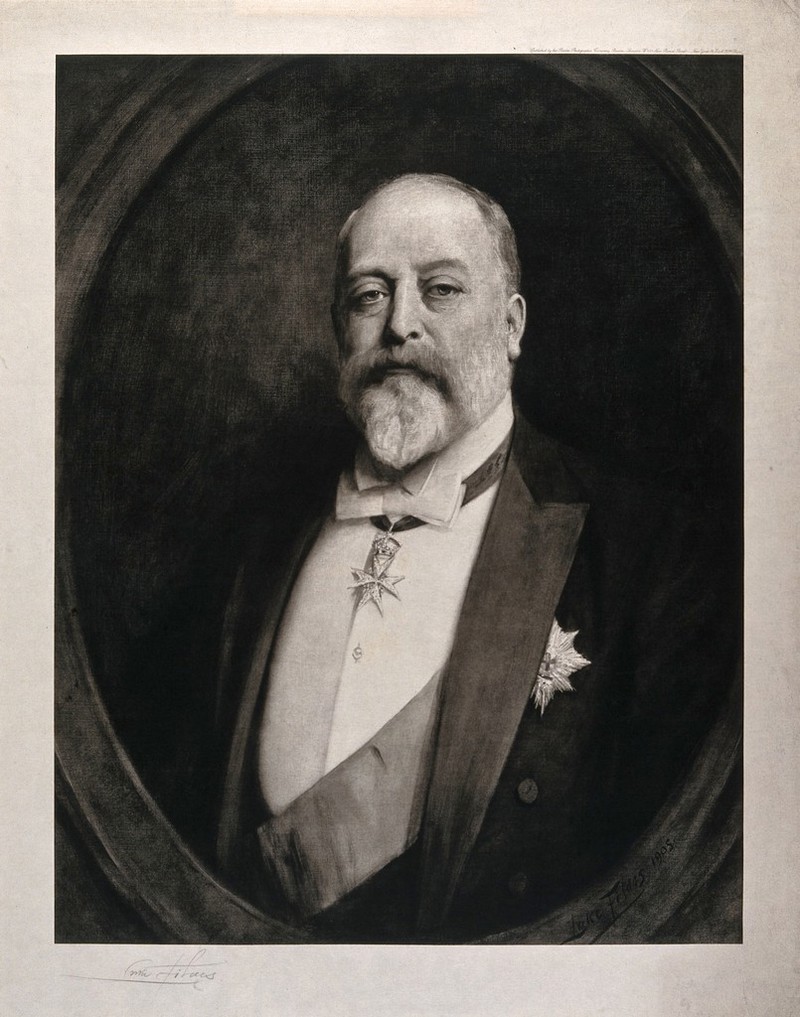
King Edward VII, head and shoulers. Photogravure after Luke Fildes, 1905., 1905, by Luke Fildes
Luke Fildes · Wellcome Collection, London · Wellcome Collection
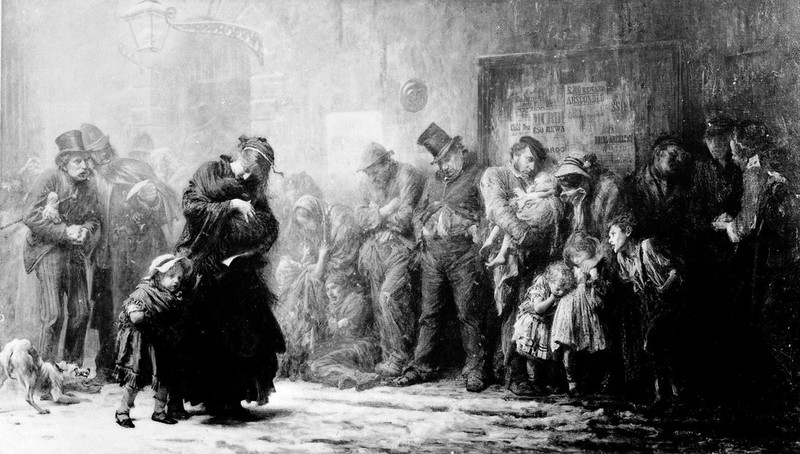
Applicants for admission to a casual ward, Sir Luke Fildes, 1874, by Luke Fildes
Luke Fildes · Wellcome Collection, London · Wellcome Collection
Life and career
Dated record
Life and career
The full dated record · 2 entries
1844
Luke Fildes born at Liverpool.
1927
Luke Fildes died at London.
Illustrator
At the age of 17, Fildes became a student at the Warrington School of Art. Fildes moved to the South Kensington Art School where he met Hubert von Herkomer and Frank Holl. All three men became influenced by the work of Frederick Walker, the leader of the social realist movement in Britain. Fildes shared his grandmother's concern for the poor and in 1869 joined the staff of The Graphic newspaper, an illustrated weekly began and edited by the social reformer, William Luson Thomas. Fildes shared Thomas' belief in the power of visual images to change public opinion on subjects such as poverty and injustice. Thomas hoped that the images in The Graphic would result in individual acts of charity and collective social action. Fildes' illustrations were in the black-and-white style popular in France and Germany during the era. He worked in a social realist style, compatible with the editorial direction of The Graphic, and focused on images depicting the destitute of London. The Graphic published an illustration completed by Fildes the day after Charles Dickens' death, showing Dickens' empty chair in his study; this illustration was widely reprinted worldwide, and inspired Vincent van Gogh's painting The Yellow Chair. In the first edition of The Graphic newspaper that appeared in December 1869, Luke Fildes was asked to provide an illustration to accompany an article on the Houseless Poor Act, a new measure that allowed some of those people out of work to shelter for a night in the casual ward of a workhouse. The picture produced by Fildes showed a line of homeless people applying for tickets to stay overnight in the workhouse. The wood-engraving, entitled Houseless and Hungry, was seen by John Everett Millais, who brought it to the attention of Charles Dickens. Dickens was so impressed that he immediately commissioned Fildes to illustrate his next novel, The Mystery of Edwin Drood; only six of a planned twelve instalments had been published, however, when Dickens' sudden death left the book unfinished. Fildes' illustrations also appeared in other mass-circulation periodicals: Sunday Magazine, The Cornhill Magazine, and The Gentleman's Magazine. He also illustrated a number of books in addition to Dickens' Edwin Drood, such as Thackeray's Catherine (1894).
Primary material
Documents and archives
scholarly publication
- Fildes, Luke (Sir), Benezit Dictionary of Artists, 2011
Scholarly · Crossref registry · 2011
Institutional database
- Wikidata, structured authority record Q1855648: Luke Fildes
Scholarly · Wikimedia Foundation
reference work
- “Luke Fildes”, English Wikipedia, consulted as further reading
Reputable secondary · Wikipedia
Notes from the source article
Cited by Wikipedia
Notes from the source article
These works are cited by the source article, in its own numbering. They are recorded as its citations, not as sources VALÉORINE has verified.
- 1.England & Wales, Civil Registration Birth Index, 1837-1915
- 2.SIR LUKE FILDES : Academic Medicine. LWW.
- 3.Souter, Nick and Tessa. The Illustration Handbook: A guide to the world's greatest illustrators. Oceana. 26. 2012. 978-1-84573-473-2.
- 4.The London Gazette, 3 August 1906.
- 5.Supplement to The London Gazette, 3 June 1918.
- 6.The Tate Collection.
- 7.Pan Macmillan. The London Encyclopaedia. 539–. 9 May 2011. 978-0-230-73878-2.
- 8.The Arts Desk. Interview: Michael Winner on collecting Donald McGill. 8 June 2010.
- 9.Kao, A. C. What Is Represented "Worthily" in Luke Fildes' The Doctor?. AMA Journal of Ethics. 24. 7. E697–713. 2022-07-01. 2376-6980.
Bibliography printed in the source article · 1
- L. V. Fildes, Luke Fildes, R.A., A Victorian Painter (Michael Joseph, 1968)
References
Citations
References
Each reference names the institution holding it, so a reader may go to the document itself.
scholarly publication
Fildes, Luke (Sir), Benezit Dictionary of Artists, 2011Crossref registry
Institutional witnessInstitutional database
Wikidata, structured authority record Q1855648: Luke FildesWikimedia Foundation
Institutional witnessreference work
Secondary witness
The Encyclopedia exists whether or not anything is for sale. Corrections are recorded rather than overwritten, and every version of this record is kept. Published 14 August 2026.
Elsewhere in Illustration
5,224 published records in this field, each with its sources named.
- Luis Fernando RojasIllustrator
- Luis ReyIllustrator
- Luiz Eduardo de OliveiraIllustrator
- Lujaynah AsilIllustrator
- Luther Standing BearIllustrator
- Lüüdia Vallimäe-MarkIllustrator
- Lydia ByamIllustrator
- Lydia GibsonIllustrator
Best supported in this field
For owners
Own a work by Luke Fildes?
A specialist will read what you send and tell you what the house can establish, what it cannot, and whether the object is suited to sale. There is no charge and no obligation. The object stays with you throughout; nothing is shipped to us unless it is arranged in writing beforehand.