
Leṿ Berinsḳi
Illustration — Photo, 2008 Lev Berinski (Russian: Лев Беринский; Căușeni, Soviet Union, April 6, 1939) is an Israeli translator and poet.
Leṿ Berinsḳi

Karl-Heinz Stender, Fockbek, Germany. · Archive of Lev Berinski. · CC BY-SA 3.0
- Born
- 1939 · Căușeni.
- Nationality
- Soviet Union · Israel
- Occupation
- poet · translator · writer · journalist
- Education
- Maxim Gorky Literature Institute
- Languages
- Russian · Yiddish
Reference Check
Propose documentary evidence for Leṿ Berinsḳi. A contribution is never written directly as fact: identity, source, rights and evidence gates still decide.
Sign in to contribute
World of VALÉORINE
Documentary connections
Only confirmed graph relationships appear here. Images are shown only when their identity and reuse rights both pass the documentary gate.
Documentary evidence
Documentary basis
Authority files
wikidata · Q4084900
VALÉORINE Encyclopedia
The documentary record
Statements marked “Documentary record” are set in the article beside the passage they confirm. Each is read from the authority records of the institutions named here; select “Prove” to see the record it was read from, where in that record, and when.
Institutions cited
Deutsche Nationalbibliothek
Not stated by the sources cited: nationality
Complete reading chain (JSON)In this article
Life
He was born into a Jewish family from Bessarabia; his father, Shmuel, was a tailor. During World War II, he was taken to Tajikistan and to Zlatoust, in the Urals. Upon his return to Moldova, he met intellectuals such as Valeriu Gagiu, Alexander Gelman or Alexander Brodsky. From 1954, he lived in Stalino (Donetsk), and after training (1957-1959) at the Stalin Technical School as a cultural employee, he worked as an accordionist and a music teacher. He joined a group of local poets, was a close friend of the Ukrainian poet Vasyl Stus and published in the newspaper Komsomolets Donbassa. Berinsky lived and worked in Moldova in 1960-1961. Afterwards, he returned to Donetsk. From 1963 to 1968 he studied at the Smolensk Pedagogical Institute and translation at the Maxim Gorky Literature Institute. From 1970 to 1974 he taught German at the Moscow Trade Union Technical Institute. He has lived in Israel since 1991.
Documentary record
Leṿ Berinsḳi appears in the authority records of the Deutsche Nationalbibliothek as a writer (born 1939). Leṿ Berinsḳi was born in 1939. The period of activity is recorded as 1989.
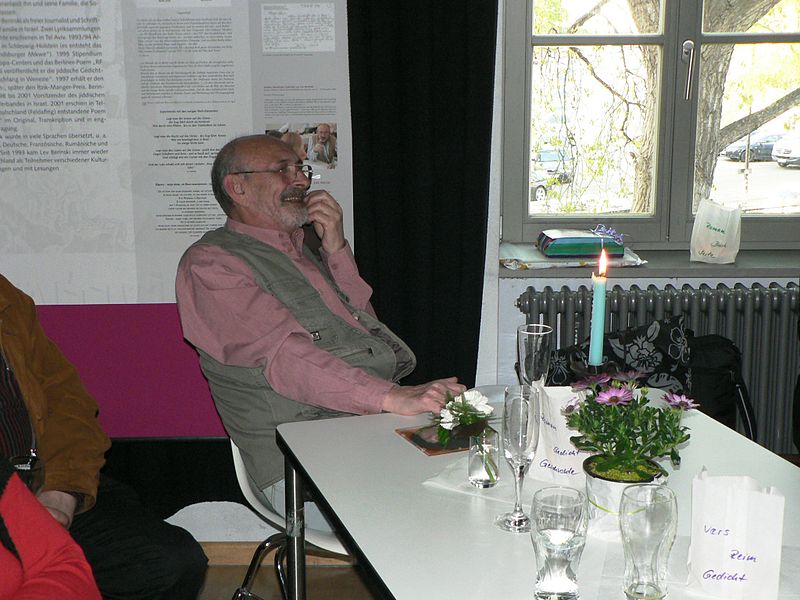
Lev Berinski celebrating his 75th birthday at the district centre Emmers in Dresden.
DusanH
Text attribution
Licensing
Text attribution
Part of the biographical narrative on this page reuses licensed material. Its origin, revision and licence are recorded here.
The biographical narrative on this page is based on the Wikipedia article Lev Berinski, revision 1304600880 (EN edition), by its contributors. VALÉORINE has edited that text and built its own documentary record around it. The reused material is available under CC BY-SA 4.0, and this page's reuse of it is offered under the same licence. Everything else on this page — the chronology, the holdings, the evidence, the plates and the connections — is VALÉORINE's own record. Sources and licences.
Notes from the source article
Cited by Wikipedia
Notes from the source article
These works are cited by the source article, in its own numbering. They are recorded as its citations, not as sources VALÉORINE has verified.
References
Citations
References
Each reference names the institution holding it, so a reader may go to the document itself.
reference work
Secondary witness
The Encyclopedia exists whether or not anything is for sale. Corrections are recorded rather than overwritten, and every version of this record is kept. Published 17 August 2026.
Elsewhere in Books
39,529 published records in this field, each with its sources named.
- LeunclaviusAuthor
- Leung Long ChauAuthor
- Lev AlburtAuthor
- Lev AnninskyAuthor
- Lev BlatnýAuthor
- Lev ChernyiAuthor
- Lev GrossmanAuthor
- Lev GumilevAuthor
Best supported in this field
For owners
Own a work by Leṿ Berinsḳi?
A specialist will read what you send and tell you what the house can establish, what it cannot, and whether the object is suited to sale. There is no charge and no obligation. The object stays with you throughout; nothing is shipped to us unless it is arranged in writing beforehand.