
Kuno von Moltke
Illustration — Kuno von Moltke Lieutenant General Kuno Augustus Friedrich Karl Detlev Graf von Moltke (13 December 1847 – 19 March 1923), adjutant to Kaiser Wilhelm II and military commander of Berlin, was a principal in the homosexual scandal known as the Harden-Eulenburg Affair (1907) that rocked the Kaiser's entourage. Moltke was forced to leave the military service.
Kuno von Moltke

photo: unknown · Goodbye to Berlin? 100 Jahre Schwulenbewegung (Berlin: Verlag rosa Winkel, 1997), p. 46. · Public domain
- Born
- 1847 · Neustrelitz.
- Died
- 1923 · Wrocław.
- Nationality
- Germany
- Occupation
- composer · military personnel
- Languages
- German
VALÉORINE Encyclopedia
VALÉORINE documentary reading
Documentary summary
Illustration — Kuno von Moltke Lieutenant General Kuno Augustus Friedrich Karl Detlev Graf von Moltke (13 December 1847 – 19 March 1923), adjutant to Kaiser Wilhelm II and military commander of Berlin, was a principal in the homosexual scandal known as the Harden-Eulenburg Affair (1907) that rocked the Kaiser's entourage. Moltke was forced to leave the military service.
Admitted source layer · organised and presented by VALÉORINE
Note VALÉORINE
Kuno von Moltke (1847–1923) was a German composer and military personnel. Born in Neustrelitz, the composer died in Wrocław. Languages used include German.
Composed from admitted, traceable facts · 26 September 2026
VALÉORINE
Reference Check
Propose documentary evidence for Kuno von Moltke. A contribution is never written directly as fact: identity, source, rights and evidence gates still decide.
Sign in to contribute
World of VALÉORINE
Documentary connections
Only confirmed graph relationships appear here. Images are shown only when their identity and reuse rights both pass the documentary gate.
Documentary evidence
Documentary basis
Authority files
wikidata · Q66400 · wikipedia · Kuno von Moltke
In this article
Biography
Biography
In 1896 Moltke, a 'confirmed bachelor' in his early 50s, married Nathalie von Hayden ('Lilly'), a woman more than twenty years his junior. The couple soon became estranged, with Moltke's physician later alleging that Lilly had physically attacked Moltke several times. The couple were eventually divorced in 1902 (the formal divorce proceedings took several years to conclude).
The Eulenburg affair
The Eulenburg affair
In 1907, the journalist Maximilian Harden publicly accused Moltke and Philipp, Prince of Eulenburg of a homosexual relationship. At this time, homosexual acts between men were illegal per Paragraph 175 of the German Criminal Code. Accusations and counter-accusations quickly multiplied. Later that year, Moltke sued Harden for libel. His ex-wife Lilly (who had since remarried and was now called Lilly von Elbe) voluntarily testified against him. Magnus Hirschfeld, a physician and sexologist who supported the legalization of homosexuality in Germany, testified that he believed Moltke to be homosexual. The court "sensationally" acquitted Harden, concluding that he had been telling the truth about Moltke's sexuality. However, the verdict was voided due to faulty procedure. In 1908, Harden was retried, and this time he was found guilty of libel against Moltke.
German press reaction
German press reaction
After the first trial, the German press were sympathetic to Moltke. Newspapers condemned the tactics of the defense and expressing condolence with Count von Moltke, who was declared to have presented a dignified figure in court. Berliner Tageblatt condemned Harden for his salacious articles, and argued that they amounted to the unnecessary hunting down of an old soldier.
Later life
Later life
Moltke played little further part in public life after the Harden-Eulenberg affair. He died in Breslau in 1923.
Orders and decorations
Orders and decorations
• German honours • Service Award Cross (Prussia) • Iron Cross, 2nd Class (Prussia) • Knight of the Order of the Red Eagle, 3rd Class with Bow and Crown; 2nd Class with Oak Leaves (Prussia) • Knight of the Royal Order of the Crown, 2nd Class with Star (Prussia) • Knight's Cross of the Royal House Order of Hohenzollern (Prussia) • Commander of the Order of the Zähringer Lion, 2nd Class, 1894; Commander 1st Class, 1904 (Baden) • Knight of the Military Merit Order, 2nd Class with Swords; Commander (Bavaria) • Grand Commander of the House Order of the Wendish Crown (Mecklenburg) • Grand Cross of the Order of the Griffon (Mecklenburg) • Commander of the Order of the White Falcon (Saxe-Weimar-Eisenach) • Commander of the Albert Order, 1st Class (Saxony) • Cross of Honour of the House Order of Schaumburg-Lippe, 2nd Class (Schaumburg-Lippe) • Cross of Honour of the Order of the Württemberg Crown, with Crown, 1893 (Württemberg) • Foreign honours • Knight of the Imperial Order of the Iron Crown, 2nd Class (Austria-Hungary) • Commander of the Imperial Austrian Order of Franz Joseph, with Star (Austria-Hungary) • Commander of the Order of Saints Maurice and Lazarus (Italy) • Commander of the Order of Orange-Nassau (Netherlands) • Order of the Medjidie, 1st Class (Ottoman Empire) • Knight of the Imperial Order of Saint Anna, 2nd Class in Diamonds (Russia) • Knight of the Imperial Order of Saint Stanislaus, 1st Class (Russia) • Commander of the Most Noble Order of the Crown of Siam (Siam) • Commander of the Royal Order of the Sword (Sweden)
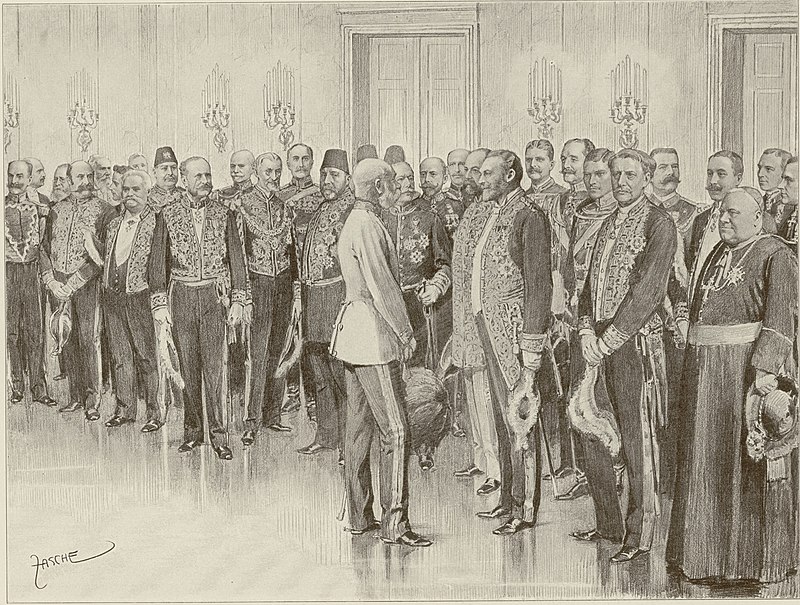
veröffentlicht und abgebildet im Kaiserjubiläumswerk "Viribus Unitis", Wien 1898, S. 45.
Theo Zasche · [1]
Places
Named by the record
Places
Only places the record itself states, plotted where the house gazetteer settles their coordinates. Nothing is inferred from a name or a nationality.
Neustrelitz.
Birth place
Wrocław.
Death place
Notes from the source article
Cited by Wikipedia
Notes from the source article
These works are cited by the source article, in its own numbering. They are recorded as its citations, not as sources VALÉORINE has verified.
- 1.Domeier, Norman. Eulenburg Affair A Cultural History of Politics in the German Empire. Boydell & Brewer. 95–113; 297. 2015. 9781782044581.
- 2.Domeier, Norman. The Homosexual Scare and the Masculinization of German Politics before World War I. Central European History. 47. 4. 737–759. 2014. 0008-9389.
- 3.Dynes, Wayne R. 1934- éd. Donaldson, Stephen, éd. History of homosexuality in Europe and America. Garland. 344. 1992. 0815305508.
- 4.HERR HARDEN ACQUITTED. PRESIDENT'S JUDGMENT. THE SCENE COURT. Manchester Courier and Lancashire General Advertiser. 7 October 1907.
- 5.Death of Count Moltke. The West Australian. 7. 26 April 1923.
- 6.German Court Scandal. Count Cuno von Moltke Dead. Chronicle (Adelaide, South Australia). 35. 21 March 1923.
- 7.In Kommission bei R. v. Decker's Verlag. Handbuch über den Königlich Preußischen Hof und Staat für das Jahr 1906. 41. 1906.
- 8.Hof- und Staats-Handbuch des Großherzogtum Baden. 191. 1902.
- 9.Hof- und Staats-Handbuch des Großherzogtum Baden. 192. 1910.
- 10.Landesamt. Hof- und Staats-Handbuch des Königreich Württemberg. 55. 1907.
Bibliography printed in the source article · 4
- Isabel Hull, The entourage of Kaiser Wilhelm II, Cambridge 1982.
- John Röhl, Des Kaisers bester Freund, in: Kaiser, Hof und Staat. Wilhelm II. und die deutsche Politik, Munich 1988, pp. 35–77, v.a. 64 ff.
- Nicolaus Sombart, Wilhelm II. Sündenbock und Herr der Mitte, Berlin 1996.
- Olaf Jessen: Die Moltkes. Biographie einer Familie, C. H. Beck, Munich 2010,
References
Citations
References
Each reference names the institution holding it, so a reader may go to the document itself.
reference work
Secondary witnessreference work
Secondary witness
The Encyclopedia exists whether or not anything is for sale. Corrections are recorded rather than overwritten, and every version of this record is kept. Published 17 August 2026.
Elsewhere in Music memorabilia
42,832 published records in this field, each with its sources named.
- KungsPerson
- Kuniaki HaishimaPerson
- Kunihiko HashimotoPerson
- Kunle AjayiPerson
- Kurd MaverickPerson
- KuriousPerson
- Kurken AlemshahPerson
- Kurmangazy SagyrbaevPerson
Best supported in this field
For owners
Own a work by Kuno von Moltke?
A specialist will read what you send and tell you what the house can establish, what it cannot, and whether the object is suited to sale. There is no charge and no obligation. The object stays with you throughout; nothing is shipped to us unless it is arranged in writing beforehand.