
kundu
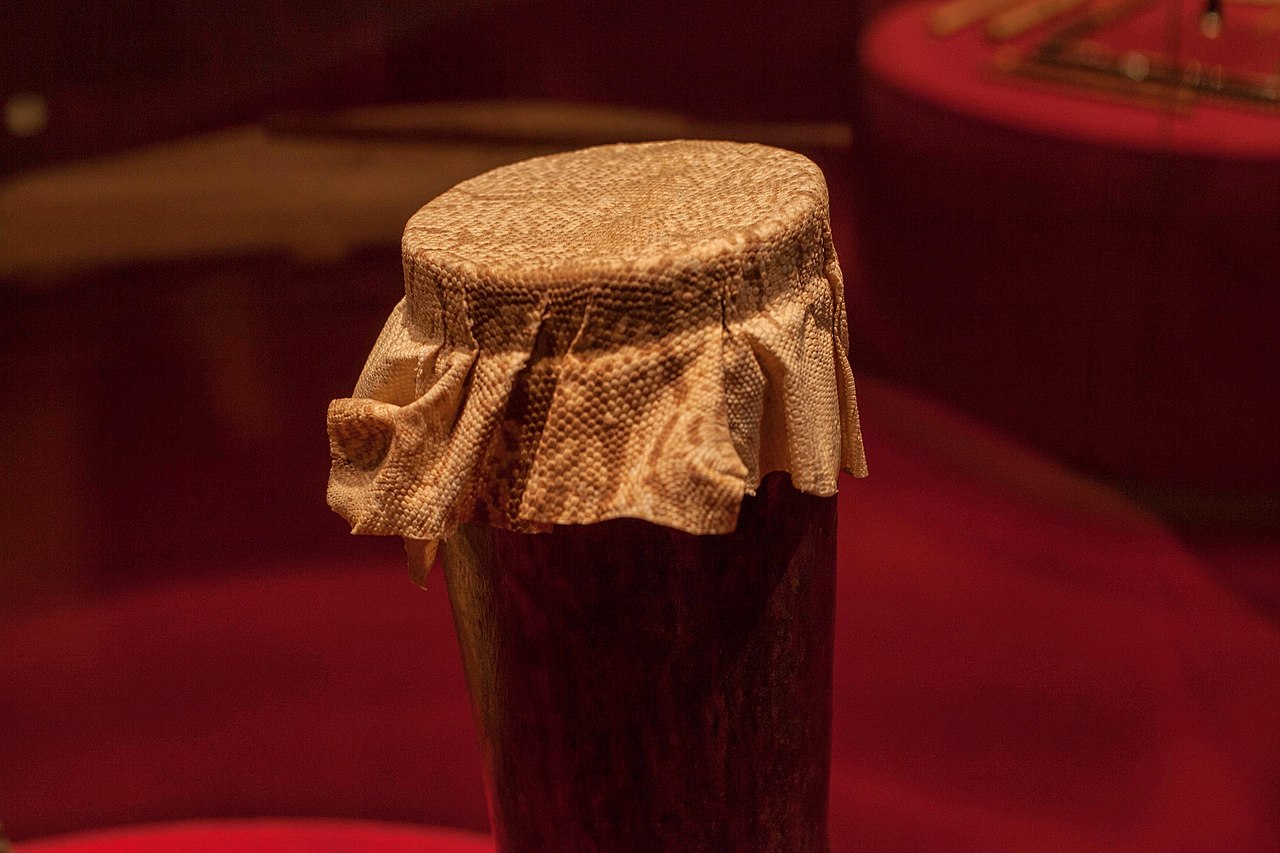
Illustration — Kundu drum, from Papua-New Guinea, Iatmul people, 20th century. The crocodile is symbolic to the Iatmul, who believe they are descended from a giant crocodile, and that the world is the back of that first crocodile. There are three crocodiles on this instrument: the handle and each of the drum openings (seen in the engravings).
kundu
sguastevi · CC BY-SA 3.0
- Field
- hourglass drum
VALÉORINE Encyclopedia
VALÉORINE documentary reading
Documentary summary
Illustration — Kundu drum, from Papua-New Guinea, Iatmul people, 20th century. The crocodile is symbolic to the Iatmul, who believe they are descended from a giant crocodile, and that the world is the back of that first crocodile. There are three crocodiles on this instrument: the handle and each of the drum openings (seen in the engravings).
Admitted source layer · organised and presented by VALÉORINE
Reference Check
Propose documentary evidence for kundu. A contribution is never written directly as fact: identity, source, rights and evidence gates still decide.
Sign in to contribute
World of VALÉORINE
Documentary connections
Only confirmed graph relationships appear here. Images are shown only when their identity and reuse rights both pass the documentary gate.

Documentary evidence
Documentary basis
Authority files
gnd · 4098828-4 · wikidata · Q14640031
In this article
Characteristics
Characteristics
A pidgin name in Papua New Guinea for an hourglass drum used to accompany formal occasions, religious ceremonies and for celebrations (such as the Sing-sing). This drum is emblematic of Papua New Guinea and it appears on the country's coat of arms.
The sizes of a kundu drum vary. A small finger-drum might measure 30 cm (11.81 in), while a large drum might be 200 cm (74.84 in) long. The drum is made of carved wood with a possum or lizard-skin drumhead, with some instruments possessing a handle placed on the narrowest part of the drum. Not all kundus have handles, depending on the instruments' style. Traditionally, the lizard skin was held in place with a layer of human blood (as glue). Depending upon who made it and where it was made, a kundu may be carved plainly, or decorated with "high-relief" carved handles, or relief carvings on the instruments' bodies with open mouthed crocodiles, human faces, dancers, and "spirit figures". Often, the kundu is decorated with animal figures on its edges. On some instruments the handle may have intricate sculpture in (openwork style). For the Papuans, the sound of the Kundu represents the voice of "spirits". Examples of formal religious or civil occasions where one might hear the Kundu include burials, the opening of a new house or the launching of a new boat.
Other names
Other names
The hourglass drum is widespread in New Guinea and many surrounding islands, a land with more than 700 different languages. There is no tradition for the instrument in "New Ireland, Manus, Buka / Bougainville or Rossel Island". While different people's may have the drum, their names and traditions for the instrument vary. Other names include the apa (Elema People, Papua Gulf) and the warup from the Torres Straits.
Tifa
Tifa
In the Indonesian western end of New Guinea, the tradition of making kundu drums has been affected by the drum-making tradition of other Indonesian Islands, especially the Maluku Islands. The Maluku Iskands drums are known under the name tifa. That name has become used for some New Guinean hourglass drums. The Asmat people in the Papua province of Indonesia, make hourglass drums covered with decorative symbolic carvings, including the handle. One thing that is different on the Asmat's drums from the kundu drums is that the Asmat secure the skin with a tightly fitted, slip-on ring of rattan, after the skin is glued down. They use tifa for their carved hourglass drum. Although drums such as the Asmat's and Marind's are now called "tifa", it may not be appropriate to use the word as a synonym for all kundu drums. The Indonesian word has been applied to hourglass drums, but not exclusively. Other drums that tifa applies to include goblet drums, and to the barrel drums played in the Maluku Islands' Tifa totobuang ensemble and in the Papuan Sing-sing.
Gallery
Gallery
• Illustration — Coat of arms for Papua New Guinea, featuring a Kundu drum underneath a Raggiana bird-of-paradise • Illustration — Apa drum, Elema culture, Papuan Gulf, Papua New Guinea, This drum also has crocodile-like art. • Illustration — Musicians playing kundu drums at Port Moresby • Illustration — Skin head on a kundu at Museu de la Música de Barcelona • Illustration — Papua New Guinea, East Sepik Province, Eastern Iatmul People, circa 1909 • Illustration — Wabag, Enga Province, Papua New Guinea. Performers at a Sing-sing. The kundus have rings around the skin head, like those made by the Asmat. • Illustration — Warup people, Papua New Guinea, Torres Strait Islands, circa 1850 • Illustration — Kandara, Marind-Anim ceremonial Dema drum • Illustration — Kandara and Dema costume • Illustration — Large kundu, log drum
Tifa drums
Tifa drums
• Illustration — "Tifa" drum from Manokwari (then called Dorei or Doreh, 1885. The Asmat people are among the inhabitants of Manokwari. • Illustration — Biak. Tifa drum. By putting the narrow part of the hourglass near the bottom, this drum begins to resemble a goblet drum. • Illustration — Tifa drums at a Papuan Sing-sing • Illustration — Maluku Islands, Indonesia. Tifa drum (also tiwa and tiva).

Kundu drum, from Papua-New Guinea, 20th century. In the collection of the Minneapolis Institute of Art.
photographer not named · Minneapolis Institute of Art
Holdings and surviving copies
Where the work is held
Holdings and surviving copies
Where material relating to kundu is held.
Documents and archives
Primary material
Documents and archives
authority file
- Gemeinsame Normdatei 4098828-4, Kundu.
General reference · Deutsche Nationalbibliothek
reference work
- Wikidata, structured authority record Q14640031: kundu
Reputable secondary · Wikidata
Literature
Scholarly footprint
A count of publications is evidence of attention, not of standing, and is given here only as a measure.
Notes from the source article
Cited by Wikipedia
Notes from the source article
These works are cited by the source article, in its own numbering. They are recorded as its citations, not as sources VALÉORINE has verified.
- 1.Minneapolis Institute of Art. Hand drum (kundu), 20th century.
- 2.Wooden sculpture depicting the Papua New Guinea Coat of Arms. July 2025.
- 3.Richard Aldridge. Kundu Drums. new-guinea-tribal-arts.com.
- 4.HolmesMuseumAnthro. Asmat Drum New Guinea (Part 2 of 2).
- 5.Kundu hand drum. 25 November 2008.
- 6.HolmesMuseumAnthro. Asmat Drum New Guinea (Part 1 of 2).
- 7.Metropolitan Museum of Art. Apa, 19th century, Papua New Guiney.
- 8.Stichting Papua Erfgoed. Papua, Asmat, drum tifa (110x19x25).
- 9.Carsten ten Brink. The drum Uwus village, Asmat Region, West Papua, Indonesia.
- 10.Website: new-guinea-tribal-arts.com late 19th century.
References
Citations
References
Each reference names the institution holding it, so a reader may go to the document itself.
authority file
Gemeinsame Normdatei 4098828-4, Kundu.Deutsche Nationalbibliothek
Secondary witnessreference work
Secondary witness
Further particulars
Held on the record
Further particulars
Open the remaining particulars
Naming and authority record. Those registers additionally record the forms Lokundu and Bakundu.
In public collections
The Encyclopedia exists whether or not anything is for sale. Corrections are recorded rather than overwritten, and every version of this record is kept. Published 16 August 2026.
Elsewhere in Collectables
20,755 published records in this field, each with its sources named.
- Kulintang a kayoTerminology
- Kulintang a tiniokTerminology
- Kuma\WarWork
- KumuzTerminology
- Kung Fu ChaosWork
- Kung Fu KidWork
- Kung Fu PandaWork
- Kung Fu Panda 2Work
Best supported in this field
For owners
Own an object connected with kundu?
A specialist will read what you send and tell you what the house can establish, what it cannot, and whether the object is suited to sale. There is no charge and no obligation. The object stays with you throughout; nothing is shipped to us unless it is arranged in writing beforehand.