
Kenyon Cox
Kenyon Cox (October 27, 1856 – March 17, 1919) was an American painter, illustrator, muralist, writer, and teacher. Cox was an influential and important early instructor at the Art Students League of New York. He was the designer of the League's logo, whose motto is Nulla Dies Sine Linea or No Day Without a Line.
Also recorded as Kenyon C. Cox
Kenyon Cox
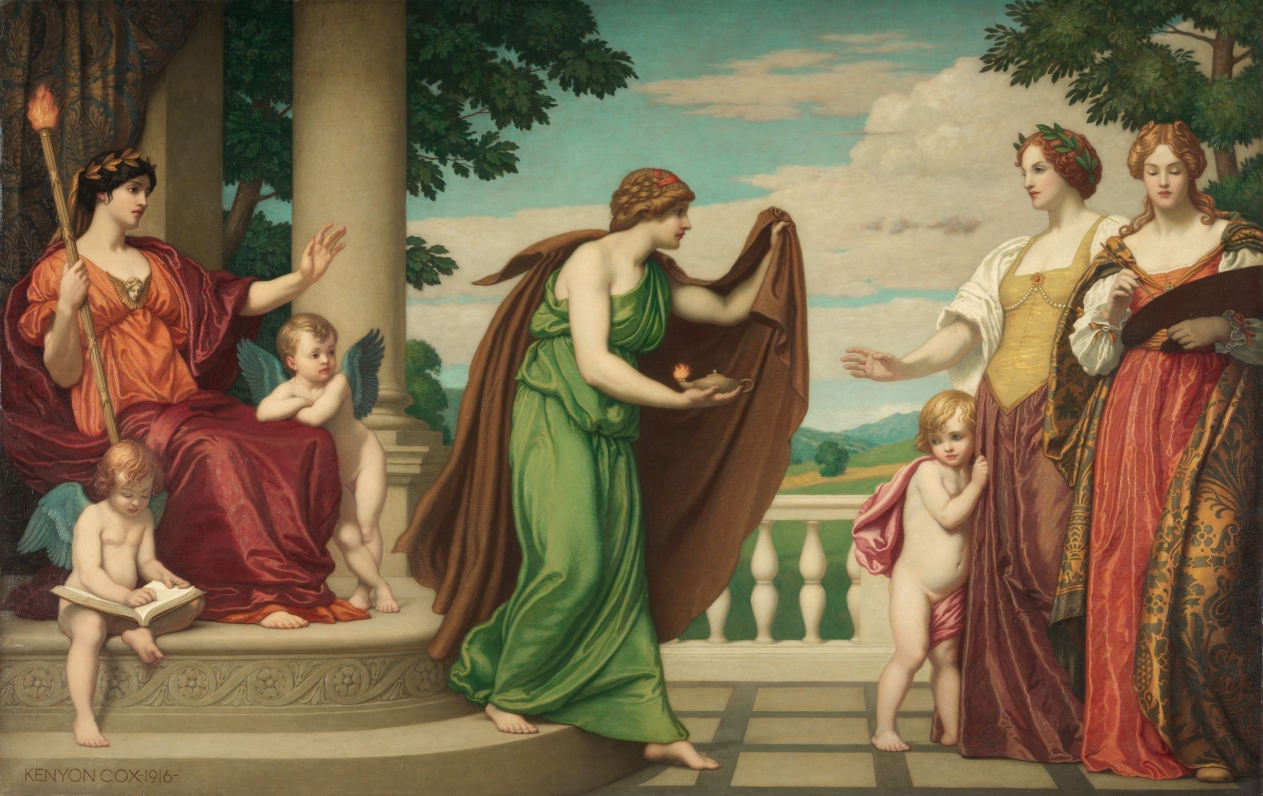
Kenyon Cox · The Cleveland Museum of Art · Gift of J. D. Cox · CC0
- Name
- Kenyon Cox
- Born
- 27 October 1856
- Died
- 17 March 1919
- Spouse
- Louise Howland King (1892–1919, his death)
- Known for
- Painter, Illustrator, Muralist, writer,
- Awards
- Second Hallgarten Prize (1889)
- Nationality
- United States.
- Occupation
- painter, illustrator, writer, art historian, university teacher and art critic.
- Fields
- painting.
- Education
- Beaux-Arts de Paris.
- Teachers
- Jean-Léon Gérôme.
- Honours
- Temple Silver Medal / 2nd Place.
VALÉORINE Encyclopedia
VALÉORINE documentary reading
Documentary summary
Kenyon Cox (October 27, 1856 – March 17, 1919) was an American painter, illustrator, muralist, writer, and teacher. Cox was an influential and important early instructor at the Art Students League of New York. He was the designer of the League's logo, whose motto is Nulla Dies Sine Linea or No Day Without a Line.
Admitted source layer · organised and presented by VALÉORINE
Note VALÉORINE
Kenyon Cox (1856–1919) was an art critic, art historian and illustrator, among other activities, of American nationality. The art critic was born in Warren and died in New York City.
Kenyon Cox was educated at Beaux-Arts de Paris. The art critic worked for Art Students League of New York and was a member of American Academy of Arts and Letters. Activity centred on painting.
The work spans portrait. Languages used include English. Works are held at Cincinnati Art Museum, Cleveland Museum of Art and Cooper Hewitt, Smithsonian Design Museum, among others. Honours include Temple Silver Medal / 2nd Place.
Composed from admitted, traceable facts · 27 September 2026
VALÉORINE
Reference Check
Propose documentary evidence for Kenyon Cox. A contribution is never written directly as fact: identity, source, rights and evidence gates still decide.
Sign in to contribute
World of VALÉORINE
Documentary connections
Only confirmed graph relationships appear here. Images are shown only when their identity and reuse rights both pass the documentary gate.
Documentary evidence
Evidence Panel
not yet certified
- Identity
- resolved
- Independent source families
- 0
- Admitted assertions
- 0
- Open conflicts
- 0
Authority files
wikidata · Q933739 · wikipedia · Kenyon Cox
In this article
Biography
Biography
Kenyon Cox studied at Beaux-Arts de Paris. Training under Jean-Léon Gérôme is recorded. Kenneth Hayes Miller is recorded as having studied under Kenyon Cox. The recorded working language is English. The field of work recorded is painting. Subjects and genres recorded for the work are portrait. Employment is recorded with Art Students League of New York. Works named in the authority record are Study for Central Frieze - Law Reigns - in New York Appellate Courtroom. Work by Kenyon Cox is recorded in the collections of Metropolitan Museum of Art, Cooper Hewitt, Smithsonian Design Museum, Smithsonian American Art Museum, Corcoran Gallery of Art and Cincinnati Art Museum. Distinctions recorded are Temple Silver Medal / 2nd Place.
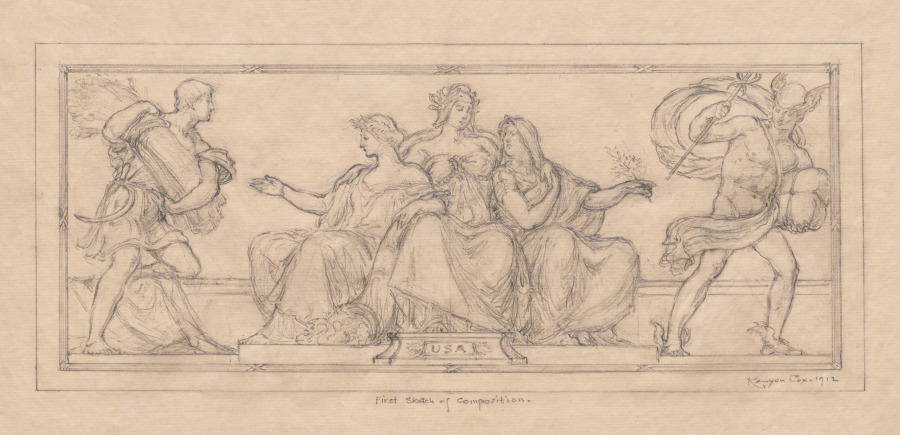
Design for United States Currency, 1912, by Kenyon Cox
Kenyon Cox · The Cleveland Museum of Art · Gift of J. D. Cox
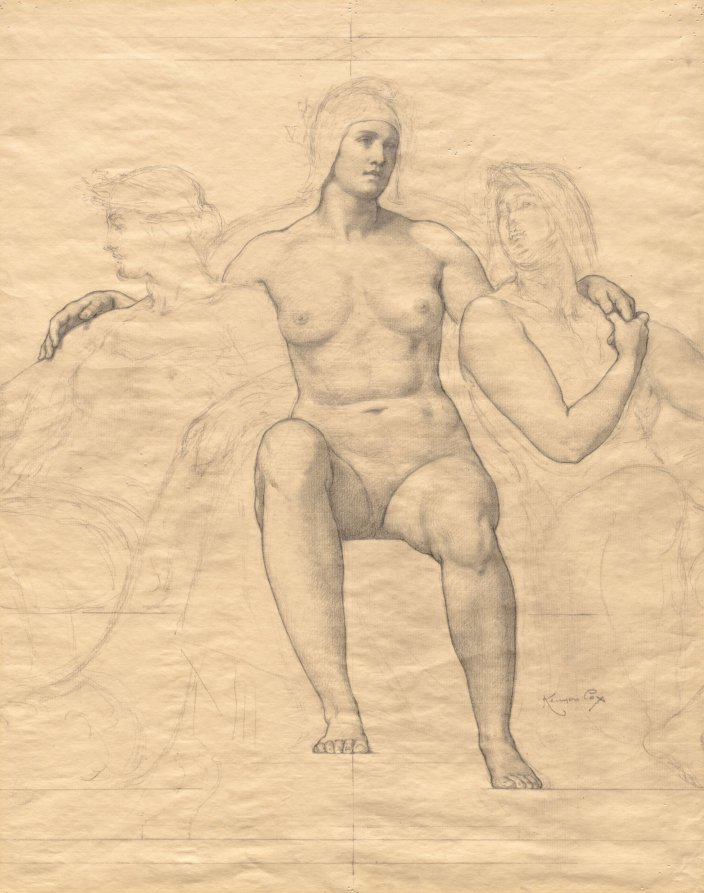
Allegorical Female Figures, 1912, by Kenyon Cox
Kenyon Cox · The Cleveland Museum of Art · Gift of J. D. Cox
Key facts
Key facts
• Name — Kenyon Cox • Born — 27 October 1856 • Died — 17 March 1919 • Spouse — Louise Howland King (1892–1919, his death) • Known for — Painter, Illustrator, Muralist, writer, • Awards — Second Hallgarten Prize (1889) • Illustration — Kenyon Cox, Portrait of Henry L. Fry, 1883, oil on canvas, Cincinnati Art Museum • Illustration — Kenyon Cox, Portrait of Augustus Saint-Gaudens, 1908, oil on canvas, Metropolitan Museum of Art, New York City
Biography
Biography
Cox was born in Warren, Ohio, the son of Jacob Dolson Cox and Helen Finney Cox. As a young adult, he studied art at Cincinnati's Art Academy of Cincinnati (formerly known as the McMicken School of Art), but soon became aware of the lack of opportunity and artistic presence in Cincinnati. After visiting the Centennial Exposition in Philadelphia, he decided that Philadelphia and the art academy there had much more to offer him than Cincinnati did. Cox enrolled in the Pennsylvania Academy of Fine Arts hoping to receive better instruction and eventually secure for himself a way to study in Europe.
Paris and travels
Paris and travels
In 1877 Cox moved to Paris like many American artists of the day to be a part of what he believed to be a sort of second renaissance in art. There he studied at the studio of Carolus-Duran and then under Alexandre Cabanel and Jean-Léon Gérôme at the École des Beaux-Arts. Cox wrote of his initial impression of Paris saying that there was "so much artistic material here that one might almost be content to stay here and paint for years…One can't dive down a crooked street or turn a sharp corner without finding more to paint than he could by hunting months for a subject in America. If Paris is at all like this it must indeed be a paradise for artists." Cox first studied under Carolus-Duran. Soon after, Cox began to get irritated with Duran. During the winter of 1877-78 Cox wrote to his father about Duran stating that, "I appreciate his strong color, breadth, etc., etc. But I thought you would like to know just how he impressed me, and I must say that a predominating vulgarity grates on me." Soon after writing this, Cox left the instruction of Carolus-Duran and enrolled in the École des Beaux-Arts. His painting teachers at the school included Alexandre Cabanel and Jean-Léon Gérôme. While in Europe, Cox took the opportunity to travel throughout France and Italy and see the works of the Renaissance Masters. Later he wrote of his travels saying, "The trip, I think, did more to broaden and define my notions of art than anything that ever happened to me before."
New York
New York
In 1882 Cox left Paris and moved to New York where he continued to paint. He also began to do many illustrations, mostly to pay the bills. Cox became well established as a magazine illustrator. His illustrations reached a much wider audience than did his paintings. Cox also began to write art criticisms (unsigned) for the New York Evening Post. This and other writing jobs took his time away from painting but also helped him make a living. Cox continued to live and work in New York for most of his life. He became an influential and important teacher at the Art Students League of New York. Cox designed the League's logo that reads Nulla Dies Sine Linea or No Day Without a Line. In 1900 he was elected into the National Academy of Design as an Associate Academician, and became a full Academician in 1903. Cox was one of the founders and the secretary of the National Free Arts League, and was a member of the Society of American Artists, the National Academy of Design, and the American Academy of Arts and Letters and served as president of the National Society of Mural Painters from 1915 to 1919.
A Student's Memory
A Student's Memory
Cox made a profound impact on the lives and careers of his students, who included Philadelphia-based painter Margaretta S. Hinchman and artist Jerome Myers, who studied with Cox during his early years of training at the Art Student's League. Though Myers later took a very different path in his own artistic work, he clearly recalled this teacher in his 1940 autobiography, "Artist In Manhattan":
Murals
Murals
• Illustration — Kenyon Cox, Panel of the Sciences, Library of Congress, Washington, D.C. Kenyon Cox began to focus more on mural painting after the 1893 World's Columbian Exposition in Chicago. Cox painted murals in the state capitol buildings of Des Moines, St. Paul and Madison as well as other courthouses, libraries and college buildings. In 1896-97 Cox painted murals in the Library of Congress in Washington, D.C. Cox also made numerous mosaics for places like the Wisconsin State Capitol building. In 1910 Kenyon Cox was awarded the Medal of Honor for mural painting by the Architectural League. He also served as president of the National Society of Mural Painters from 1915 to 1919.
Poetry
Poetry
• Illustration — Kenyon Cox, An Eclogue, 1890, oil on canvas, Smithsonian American Art Museum, Washington, D.C. • Illustration — Kenyon Cox, A Blonde, 1891, oil on canvas, National Academy of Design, New York City Kenyon Cox also began to write more articles and became an art critic for numerous magazines in New York including The Nation, Century and Scribner's. In the summer of 1883 Cox began to write poetry for the public: She lived in Florence centuries ago, • That lady smiling there. What her name or rank I do not know— • I know that she was fair. For some great man — his name, like hers, forgot • And faded from Men's sight— Loved her — he must have loved her — and has wrought • This bust for our delight. Whether he gained her love or had her scorn • Full happy was his fate. He saw her, heard her speak; he was not born • Four hundred years too late. The palace throngs in every room but this — • Here I am left alone. Love, there is none to see — I press a kiss • Upon thy lips of stone. This poem was a big success in New York City art circles and earned Cox a great deal of attention. According to Wayne H. Morgan who wrote the book, Kenyon Cox: a Life in American Art 1856-1919, "The poem and its Unknown Lady symbolized the need among artists, especially those with classical interests, for intense emotion expressed through acceptable forms, and for the idealization of women." Cox himself painted many idealized women mostly in the form of the classic nude. In 1895 Cox published another poem, "The Gospel of Art", that summarized his idealism about the artist's role in the intensifying emotion through sacrifice, and on the function of art in culture: Work thou for pleasure; paint or sing or carve The thing thou lovest, though the body starve. Who works for glory misses oft the goal; Who works for money coins his very soul; Work for the work's sake, then, and it may be That these things shall be added unto thee. In 1904 Cox wrote the book Mixed Beasts where he combined the names of different beasts he believed flowed together to form another name like Bumblebeaver or Kangarooster. He then made up short poems to go with each new beast. In 2005 a new version of Mixed Beasts was released. It still contained most of Cox's original verses but also included input and illustrations by Wallace Edwards.
Marriage
Marriage
• Illustration — Kenyon Cox, Portrait of Louise Howland King Cox, 1892, Smithsonian American Art Museum, Washington, D.C. While working in New York, Cox began to teach at the Art Student League. One of his female students, Louise Howland King from San Francisco, caught Cox's eye and they began to correspond outside of class. In an early letter to Louise, Cox tried to convince her to persist with her art, writing: "We must work for the work's sake. You say you almost forget why you paint at all; well, I have long since satisfied myself that I paint because I cannot help it—because I love the work itself and would rather be a miserably bad painter than a successful man in any other work—because the mere joy of trying and even the excitement of failure are the only true pleasures for me." On June 30, 1892, thirty-six-year-old Cox married twenty-seven-year-old Louise Howland King. The pair executed the murals that decorated the Liberal Arts Building at the 1893 Columbian Exposition in Chicago. They had three children. Leonard, born in 1894 and named after Leonard Opdycke, was a World War I war hero and had a career in city planning and architecture. Son Allyn, born two years later, became an artist, particularly noted for his mural paintings, and an interior decorator. Daughter Caroline born in 1898 was also a talented artist. • Illustration — Louise and Kenyon Cox, 1896 • Illustration — Allyn, Louise, Leonard, Caroline and Kenyon Cox, about 1906
Later years
Later years
Cox continued to paint, teach and write until his death on March 17, 1919. Kenyon Cox died in his New York home from pneumonia. A significant body of Cox's personal and professional papers, including extensive correspondence, is held in the Department of Drawings & Archives at the Avery Architectural and Fine Arts Library at Columbia University in New York City.
Selected works
Selected works
• After Boltraffio, "Sacre Conversazione", (oil on canvas) 1878–1882, owned by the Smithsonian American Art Museum, Washington, D.C. • Study for Mosaic, Wisconsin State Capital, "Justice", (oil on canvas) 1913, owned by the Smithsonian American Art Museum, Washington, D.C. • Mural at Oberlin College, "The Spirit of Self-Sacrificing Love", 1914 • "The Sword is Drawn The Navy Uphold it!" United States Navy recruitment poster, 1917
Life and career
Dated record
Life and career
The full dated record · 2 entries
1856
Kenyon Cox born at Warren.
1919
Kenyon Cox died at New York City.
Places
Named by the record
Places
Only places the record itself states, plotted where the house gazetteer settles their coordinates. Nothing is inferred from a name or a nationality.
Warren.
Birth place
New York City.
Death place
Artistic theory
• Illustration — Nude study in graphite; preparatory drawing for the allegorical figure of Romance in The Arts mural at the Library of Congress Jefferson Building. Drawing created 1896, digitally restored. Cox's art was very different from the cubist, neo-impressionist, fauvist, expressionist and modernist styles that emerged during his lifetime. He advocated careful drawing and modulated color, and he frequently used allegory and symbolism to present his ideas. Kenyon Cox painted in the realistic manner and earned a reputation for landscapes, portraits and genre studies. His idealized nudes and traditional treatment of classical themes had little in common with the popular avant-garde art of the day. Later, in 1912, Cox wrote an article for The Metropolitan Museum of Art Bulletin called "Two Ways of Painting". In this article he describes the difference between the figurative art he was making and the more fashionable abstract art or representational art. In the article he tells of the prejudice he felt as a more traditional figurative artist: The pressure to conformity is upon the other side and it is the older methods that need justification and explanation. The prejudices of the workers and the writers have gradually and naturally become the prejudices of at least a part of the public, and it have become necessary to show that the small minority of artists who still follow the old roads do so, not from ignorance or stupidity or a stolid conservatism, still less from willful caprice, but from necessity; because those roads are the only ones that can lead them where they wish to go. Cox, adamantly loyal to the preservation of the "older methods", set himself in opposition to modern styles. In his 1917 book Concerning Painting: Considerations Theoretical and Historical, Cox restated his earlier feelings about the "Two Ways of Painting" saying: For at least fourteen thousand years, then, from the time of the cavemen to our own day, painting has been an imitative art, and it seems likely that it will continue to be so. That it should, within a few years, entirely reverse its current, and should flow in the opposite direction for thousands of years to come seems highly improbable, not to say incredible. Yet we are gravely told that it is about to do this; that, at the hands of its representative element, reached its final and definite form, and that no further changes are possible. Henceforth, as long as men live in the world they are to be satisfied with a non-representative art — an art fundamentally different from that which they have known and practiced and enjoyed. Cox wrote extensively to persuade the art world and the public to embrace traditional, representational art.
Select writings
• Old Masters and New, 1905 • Painters and Sculptors, 1907 • Concerning Painting: Considerations Theoretical and Historical, 1917
Primary material
Documents and archives
scholarly publication
- An Artist of the American Renaissance: The Letters of Kenyon Cox, 1883-1919, Studies in Art Education, 1997
Scholarly · Crossref registry · 1997
- Cox, Kenyon (1856-1919), artist and critic, American National Biography Online, 2000
Scholarly · Crossref registry · 2000
- Workmanship by Kenyon Cox, The Metropolitan Museum of Art Bulletin, 1917
Scholarly · Crossref registry · 1917
reference work
- “Kenyon Cox”, English Wikipedia, consulted as further reading
Reputable secondary · Wikipedia
authority record
- Wikidata, structured authority record Q933739: Kenyon Cox
Unverified · Wikidata
Notes from the source article
Cited by Wikipedia
Notes from the source article
These works are cited by the source article, in its own numbering. They are recorded as its citations, not as sources VALÉORINE has verified.
- 1.MRS. KENYON COX, PORTRAIT PAINTER: Artist's Widow, Recipient of Many Prizes, Dies--Known for Work with Children. The New York Times. 26. December 12, 1945.
- 2.Cox, Kenyon. An Artist of the American Renaissance: The Letters of Kenyon Cox,1883-1919. Ed. Wayne H. Morgan. Kent, Ohio: Kent State UP, 1995.
- 3.van Hook, Bailey. Angels of Art: Women and Art in American Society, 1876-1914. Pennsylvania State University Press. 28. 1996.
- 4.National Society of Mural Painters.
- 5.Jerome Myers, Artist in Manhattan, New York: American Artists Group, Inc. 1940.
- 6.Cox, Kenyon. "Two Ways of Painting." The Metropolitan Museum of Art Bulletin 7 (1912): 205-207.
- 7.Cox, Kenyon. Concerning Painting: Considerations Theoretical and Historical, 1917
- 8.Moore, Sarah J. "In Search of an American Iconography: Critical Reaction to the Murals At the Library of Congress." Winterthur Portfolio 25 (1990): 231-239.
- 9.Cox, Kenyon, and Wallace Edwards. Mixed Beasts. Kids Can P, Ltd., 2005.
- 10.Smithsonian Archive of American Art. Vers. Series 1: Kenyon and Louise Cox Papers, 1876-1977. Smithsonian Institution. Winter 2008.
- 11.Kenyon Cox. An Artist of the American Renaissance: The Letters of Kenyon Cox, 1883-1919. Kent State University Press; January 1995. . p. 16.
- 12.Ann Lee Morgan Former Visiting Assistant Professor University of Illinois at Chicago. The Oxford Dictionary of American Art and Artists. Oxford University Press; 27 June 2007. . p. 102.
References
Citations
References
Each reference names the institution holding it, so a reader may go to the document itself.
scholarly publication
An Artist of the American Renaissance: The Letters of Kenyon Cox, 1883-1919, Studies in Art Education, 1997Crossref registry
Verifiedscholarly publication
Cox, Kenyon (1856-1919), artist and critic, American National Biography Online, 2000Crossref registry
Verifiedscholarly publication
Verifiedreference work
Partially resolvedauthority record
Unverified
A further 1 witness is held back from this article because the person or object named in it is not yet resolved to this record. They are kept, not discarded, and return once the identity is established.
Further particulars
Held on the record
Further particulars
Open the remaining particulars
Kenyon Cox worked in painting. He was employed by Art Students League of New York. He belonged to American Academy of Arts and Letters.
Career and activity
Recognition and collections
Work by Kenyon Cox is
Metropolitan Museum of Art, Cooper Hewitt, Smithsonian Design Museum, Smithsonian American Art Museum and Corcoran Gallery of Art
The Encyclopedia exists whether or not anything is for sale. Corrections are recorded rather than overwritten, and every version of this record is kept. Published 14 August 2026.
Elsewhere in Illustration
5,224 published records in this field, each with its sources named.
- Kenneth S. FaggIllustrator
- Kenny MeadowsIllustrator
- Kenny YoungbloodIllustrator
- Kenshi YonezuIllustrator
- Keri SmithIllustrator
- Kerry ArgentIllustrator
- Kerstin Abram-NilssonIllustrator
- Kerstin ThorvallIllustrator
Best supported in this field
For owners
Own a work by Kenyon Cox?
A specialist will read what you send and tell you what the house can establish, what it cannot, and whether the object is suited to sale. There is no charge and no obligation. The object stays with you throughout; nothing is shipped to us unless it is arranged in writing beforehand.