
Katsu Kaishū
Katsu Kaishū, was a Japanese statesman, naval engineer and military commander during the late Tokugawa shogunate and early Meiji period. Kaishū was a nickname which he took from a piece of calligraphy (Kaishū Shooku) by Sakuma Shōzan. He went through a series of given names throughout his life; his childhood name was Rintarō.
Also recorded as Katsu Kaishu · Katsu Kaishuu · Yoshikuni
Katsu Kaishū

published by 東洋文化協會 (The Eastern Culture Association) · (1) The Japanese book "幕末・明治・大正 回顧八十年史" (Memories for 80 years, Bakumatsu, Meiji, Taisho). (2) Newton.com.tw [1] · Public domain
- Name
- Katsu Yasuyoshi
- Birth Name
- Katsu Yoshikuni
- Born
- 12 March 1823
- Birthplace
- Honjo, Edo, Japan
- Died
- 21 January 1899
- Place of death
- Akasaka, Tokyo, Japan
- Awards
- See Honours
- Spouse
- Katsu Tamiko, Masuda Ito, 4 other concubines
- Full name
- 義邦.
- Nationality
- Japan.
- Occupation
- politician, university teacher, historian, writer, military personnel and samurai.
- Fields
- history of Japan.
VALÉORINE Encyclopedia
VALÉORINE documentary reading
Documentary summary
Katsu Kaishū, was a Japanese statesman, naval engineer and military commander during the late Tokugawa shogunate and early Meiji period. Kaishū was a nickname which he took from a piece of calligraphy (Kaishū Shooku) by Sakuma Shōzan. He went through a series of given names throughout his life; his childhood name was Rintarō.
Admitted source layer · organised and presented by VALÉORINE
Note VALÉORINE
No house-authored Note is published until its assertions and sources pass the VALÉORINE evidence contract. The documentary article remains available in full while that enrichment is being consolidated.
Documentary enrichment in progress · no unsupported statement published
Reference Check
Propose documentary evidence for Katsu Kaishū. A contribution is never written directly as fact: identity, source, rights and evidence gates still decide.
Sign in to contribute
World of VALÉORINE
Documentary connections
Only confirmed graph relationships appear here. Images are shown only when their identity and reuse rights both pass the documentary gate.

Documentary evidence
Evidence Panel
not yet certified
- Identity
- resolved
- Independent source families
- 0
- Admitted assertions
- 0
- Open conflicts
- 0
Authority files
gnd · 119010364 · wikidata · Q700470 · wikipedia · Katsu Kaishū
In this article
Biography
Biography
He was often called Awa from his ceremonial title Awa-no-kami during the late Tokugawa shogunate and later changed his name to Yasuyoshi after the Meiji Restoration. An advocate of modernization and westernization, Katsu was an influential figure during the end of the Tokugawa Shogunate (Bakumatsu) and subsequent Meiji Restoration. He eventually rose to occupy the position of commissioner (Gunkan-bugyō) in the Tokugawa navy and was a chief negotiator of the bakufu.
Katsu Kaishū studied at Toyo University and Nagasaki Naval Training Center. Training under Otani Nobutomo, Shimada Toranosuke and Wakayama Butsudō is recorded. Sugi Kōji, Satō Masayasu and Sakamoto Ryōma are recorded as having studied under Katsu Kaishū. The recorded working language is Japanese. The field of work recorded is history of Japan. Employment is recorded with Gunkan-sō renjo, Bansho Shirabesho and Kōbusho. Positions recorded include Rikugun sōsai and member of the Genrōin. Distinctions recorded are Order of the Rising Sun, 1st class.
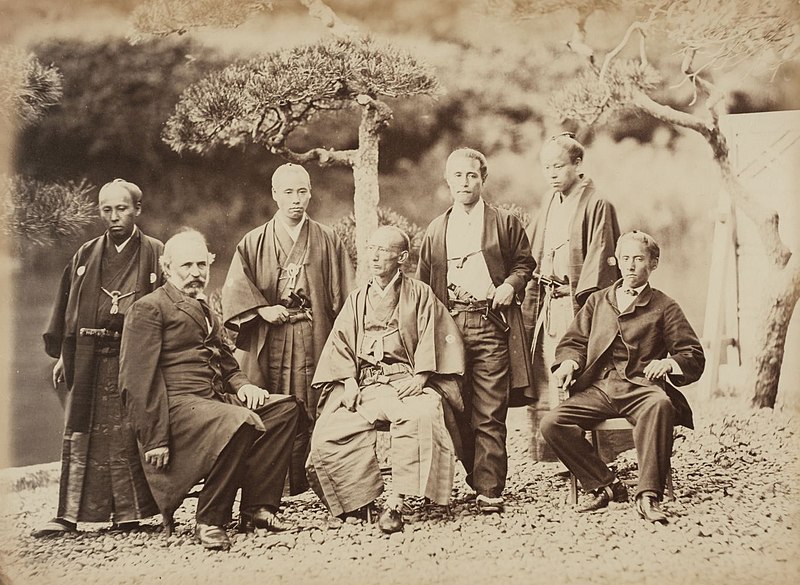
Japanese men. In the center is Inaba Masami (a daimyō of Tateyama Domain during late-Edo period Japan). The other men from the right to the left side are: Ozeki Masuhiro, Matsudaira Tarō, Katsu Kaishu, Ishikawa Jukei, Van Varuken Berg (US envoy), Ezure Akinori (foreign service).
Charles Leander Weed · The Japanese book "幕末・明治・大正 回顧八十年史" (Memories for 80 years, Bakumatsu, Meiji, Taisho), published by 東洋文化協會 (The Eastern Culture Association)

enlightenment aristocracy, Woodblock print (nishiki-e), right part; ink and color on paper Katsu Kaishū, Itō Hirobumi, Kusumoto Masataka, Itagaki Taisuke, Gotō Shōjirō and Prince Komatsu Akihito
Kobayashi Toshimitsu · Waseda University Library
Key facts
Key facts
• Honorific Prefix — Count • Name — Katsu Yasuyoshi • Native Name — 勝 安芳 • Birth Name — Katsu Yoshikuni • Other Name — Katsu Rintarō • Nickname — Katsu Kaishū Awa Katsū • Born — 12 March 1823 • Birthplace — Honjo, Edo, Japan • Died — 21 January 1899 • Place of death — Akasaka, Tokyo, Japan • Burial Place — Senzoku Pond Public Park, Tokyo, Japan • Allegiance — Ensign of Shogunate Ships.svg Tokugawa Shogunate Empire of Japan • Branch — Empire of Japan • Service Years — 1855–1868 (Tokugawa), 1872–1899 (Japanese Empire) • Rank — Gunkan-bugyō (commissioner), Vice Minister, Naval Lord • Commands — Kanrin-maru (warship), Kobe Naval School • Battles — Boshin War • Awards — See Honours • Spouse — Katsu Tamiko, Masuda Ito, 4 other concubines • Children — 9 children • Relations — Katsu Kokichi (father) Katsu Nobuko (mother) • Other Work — Military theorist Count March 12, 1823—January 21, 1899, born Katsu Yoshikuni, best known by his nickname Katsu Kaishū, was a Japanese statesman, naval engineer and military commander during the late Tokugawa shogunate and early Meiji period. Kaishū was a nickname which he took from a piece of calligraphy (Kaishū Shooku) by Sakuma Shōzan. He went through a series of given names throughout his life; his childhood name was Rintarō. He was often called Awa from his ceremonial title Awa-no-kami during the late Tokugawa shogunate and later changed his name to Yasuyoshi after the Meiji Restoration. An advocate of modernization and westernization, Katsu was an influential figure during the end of the Tokugawa Shogunate (Bakumatsu) and subsequent Meiji Restoration. He eventually rose to occupy the position of commissioner (Gunkan-bugyō) in the Tokugawa navy and was a chief negotiator of the bakufu. As a major Tokugawa commander during the Boshin War, he is particularly known for his surrender of Edo to Imperial forces commanded by Saigō Takamori.
Early life
Early life
Born Katsu Yoshikuni on March 12, 1823, in Edo to a low-ranking retainer of the Tokugawa shogunate. His father, Katsu Kokichi, the subject of the autobiography, Musui's Story, was the ill-behaved head of a minor samurai family. As a youth whose given childhood name was Katsu Rintarō (Kaishu was a pseudonym), he studied Dutch and European military science, and was eventually appointed translator by the government when European powers attempted to open contact with Japan. Katsu developed the reputation as an expert in western military technology. Under the advice of Dutch naval officers, Katsu served as head naval cadet at the Nagasaki Naval Academy between 1855 and 1859.
Military service
Military service
In 1860, Katsu served as captain of the warship Kanrin-maru (with assistance from US naval officer Lt. John M. Brooke), to escort the first Japanese delegation to San Francisco, California, en route to Washington, DC, for the formal ratification of the Harris Treaty. The Kanrin Maru, built by the Dutch, was the first Japanese vessel to sail to the Western world. Kaishū remained in San Francisco for nearly two months, observing American society, culture and technology. Following his return to Japan, Katsu held a series of high-ranking posts in the Tokugawa navy, arguing before government councils in favor of a unified Japanese naval force led by professionally trained officers in disregard of promotion and assignment due to hereditary status. During his command as director of the Kobe Naval School, the institute would become a major source of activity for progressive thinking and reformists between 1863 and 1864. In 1862, the then rōnin Sakamoto Ryōma decided to assassinate Katsu due to his support of both modernization and westernization. However, Katsu persuaded Ryōma of the necessity of a long-term plan to increase Japan's military strength in the face of Western influence that led to the Convention of Kanagawa. Instead of killing Katsu, Ryōma started working as his assistant and protégé. In 1866, Katsu was appointed negotiator between the bakufu forces and the anti-shogunal domain of Chōshū, and later served as chief negotiator for the Tokugawa bakufu, ensuring a relatively peaceful and orderly transition of power in the Meiji Restoration. Although sympathetic to the anti-Tokugawa cause, Katsu remained loyal to the Tokugawa bakufu during the Boshin War. After the collapse of the Tokugawa forces in late 1867, Katsu negotiated the surrender of Edo castle to Saigō Takamori on 11 April 1868.
Later years
Later years
Katsu relocated to Shizuoka after the new Imperial government took control of the shogun's former capital, which was renamed Tokyo ("Eastern Capital"). He returned briefly to government service as Vice Minister of the Imperial Japanese Navy in 1872, followed by first Minister of the Navy from 1873 until 1878. As Katsu Yasuyoshi, he was among the most prominent of the former Tokugawa retainers who found employment within the new Meiji government, and was sangi between 1869 and 1885. Although his influence within the navy was minimal, as the Navy was largely dominated by a core of Satsuma officers, Katsu served in a senior advisory capacity on national policy. During the next two decades, Katsu served on the Privy Council and wrote extensively on naval issues. He also made efforts to restore the honor of Tokugawa Yoshinobu and Saigō Takamori. In 1887, he was elevated to the title of hakushaku (count) in the kazoku peerage system. Katsu recorded his memoirs in the book Hikawa Seiwa.
Death
Death
In 1891, through a connection of Tsuda Sen, the father of Tsuda Ume, Katsu Yasuyoshi purchased a plot of land at Senzoku-ike kôen, and built his retirement home there. Following his death in 1899, he was buried with his wife Tami near the site of their home, on the shores of Senzoku Pond, in what is today Senzoku Pond Public Park in Tokyo. The Katsu Kaishu Memorial Museum can also be found near the park.
Order of precedence
Order of precedence
• Fourth rank (15 June 1872) • Senior fourth rank (18 February 1874) • Third rank (December 1887) • Senior third rank (October 1888) • Junior Second rank (30 June 1894) • Senior second rank (20 January 1899; posthumous) * • Illustration — ribbon bar Grand Cordon of the Order of the Sacred Treasure (December 1889) * • Illustration — ribbon bar Grand Cordon of the Order of the Rising Sun (26 February 1898)
In popular culture
In popular culture
Katsu appears in the 2009–2011 TV series Jin, portrayed by actor Fumiyo Kohinata, and is also portrayed by actor Hiroshi Tamaki in the Time Travel comedy film Time Trip App as a young Kaishu fascinated by Western and modern technology but reluctant to take any political action. Katsu appears in the Anime Rurouni Kenshin, where the Protagonist Himura Kenshin who once targeted him as an Imperial assassin, now reencounters him in the Meiji era and defends him from a group of vengeful Tokugawa retainers who blame him for their demise, and for having denied them a Samurai death in battle by surrendering the castle. Katsu appears in the 2024 video game Rise of the Ronin, portrayed in English by actor Earl Baylon and in Japanese by actor Kazuhiro Yamaji. The Filipino novel Revolution: 80 Days (2022) featured Katsu as one of Japan's top officials.
Gallery
Gallery
• Illustration — A young Kaishū Katsu • Illustration — Negotiations between Saigō Takamori (left) and Katsu regarding the surrender of the capital. • Illustration — Katsu (bottom row, third from right) and other major figures of the Meiji era aristocracy. • Illustration — A bust of Katsu Kaishu by Motoyama Hakuun (1871–1952) • Illustration — Grave of Katsu Kaishū at Senzoku Pond Public Park, Tokyo, Japan • Illustration — Memorial on the site of the meeting between Saigō Takamori and Katsu Kaishū, Shiba, Tokyo
Life and career
Dated record
Life and career
Explore 1823–1899
The full dated record · 5 entries
1823
Katsu Kaishū born at Ryōgoku.
1860
Kanagawa Battery is dated 1860.
1863
Maiko Battery Site is dated 1863.
1864
Wadamisaki Battery is dated 1864.
1899
Katsu Kaishū died at Akasaka-ku.
Places
Named by the record
Places
Only places the record itself states, plotted where the house gazetteer settles their coordinates. Nothing is inferred from a name or a nationality.
Ryōgoku.
Birth place
Akasaka-ku.
Death place
Primary material
Documents and archives
scholarly publication
- 3 Katsu Kaishū as a Shadow Founder of the Japanese Ryūgakusei Community in New Brunswick, Rutgers Meets Japan, 2026
Scholarly · Crossref registry · 2026
- Katsu Kaishū:, Rethinking Japan's Modernity, 2024
Scholarly · Crossref registry · 2024
reference work
- Wikidata, structured authority record Q700470: Katsu Kaishū
Reputable secondary · Wikimedia Foundation
- “Katsu Kaishū”, English Wikipedia, consulted as further reading
Reputable secondary · Wikipedia
authority file
- Gemeinsame Normdatei 119010364, Katsu, Kaishū.
Unverified · Deutsche Nationalbibliothek
Honors
• Count (9 May 1887)
Notes from the source article
Cited by Wikipedia
Notes from the source article
These works are cited by the source article, in its own numbering. They are recorded as its citations, not as sources VALÉORINE has verified.
- 1.Sanseidō. 10 March 2025.
- 2.Nussbaum, Louis-Frédéric. (2005). "Katsu Kaishū" in .
- 3.第2回 勝 海舟. Avenue.
- 4.Katsu Kaishu Memorial Museum Unique Ota. Unique Ota the city promotion of ota city.
- 5.Historical novel Revolution: 80 Days offers global, never-before-seen perspective on Gomburza and the 1872 Cavite Mutiny. EIN Presswire. 4 August 2022.
- 6.Raposas, Arius Lauren. Revolution: 80 Days. Ukiyoto. 14 April 2023. 978-9359209821.
- 7.Raposas, Arius Lauren. Revolution: 80 Days. Ukiyoto. 14 April 2023. 978-93-5920-982-1.
References
Citations
References
Each reference names the institution holding it, so a reader may go to the document itself.
scholarly publication
3 Katsu Kaishū as a Shadow Founder of the Japanese Ryūgakusei Community in New Brunswick, Rutgers Meets Japan, 2026Crossref registry
Verifiedscholarly publication
Katsu Kaishū:, Rethinking Japan's Modernity, 2024Crossref registry
Verifiedauthority file
Gemeinsame Normdatei 119010364, Katsu, Kaishū.Deutsche Nationalbibliothek
Partially resolvedreference work
Wikidata, structured authority record Q700470: Katsu KaishūWikimedia Foundation
Partially resolvedreference work
Partially resolved
The Encyclopedia exists whether or not anything is for sale. Corrections are recorded rather than overwritten, and every version of this record is kept. Published 15 August 2026.
Elsewhere in Books
38,960 published records in this field, each with its sources named.
- Katrin OttarsdóttirAuthor
- Katrina LeskanichAuthor
- Katrine Kielos-MarçalAuthor
- Katrya HrynevychevaAuthor
- Katta VaradarajuAuthor
- Kattakayam Cherian MappillaiAuthor
- Katti FrederiksenAuthor
- Katy TurAuthor
Best supported in this field
For owners
Own a work by Katsu Kaishū?
A specialist will read what you send and tell you what the house can establish, what it cannot, and whether the object is suited to sale. There is no charge and no obligation. The object stays with you throughout; nothing is shipped to us unless it is arranged in writing beforehand.