
Kashtan CIWS
The Kortik ("dirk") close-in weapon system (CIWS) is a naval air defence gun-missile system deployed by the Russian Navy. Its export version is known as Kashtan (English: Chestnut), with the NATO designation CADS-N-1. The Kortik is found on the Russian aircraft carrier Admiral Kuznetsov, the, the, as well as the People's Liberation Army Navy Sovremenny-class destroyers, and other designs.
Also recorded as CADS-N-1 · SA-N-11 Grison · Кортик
Kashtan CIWS
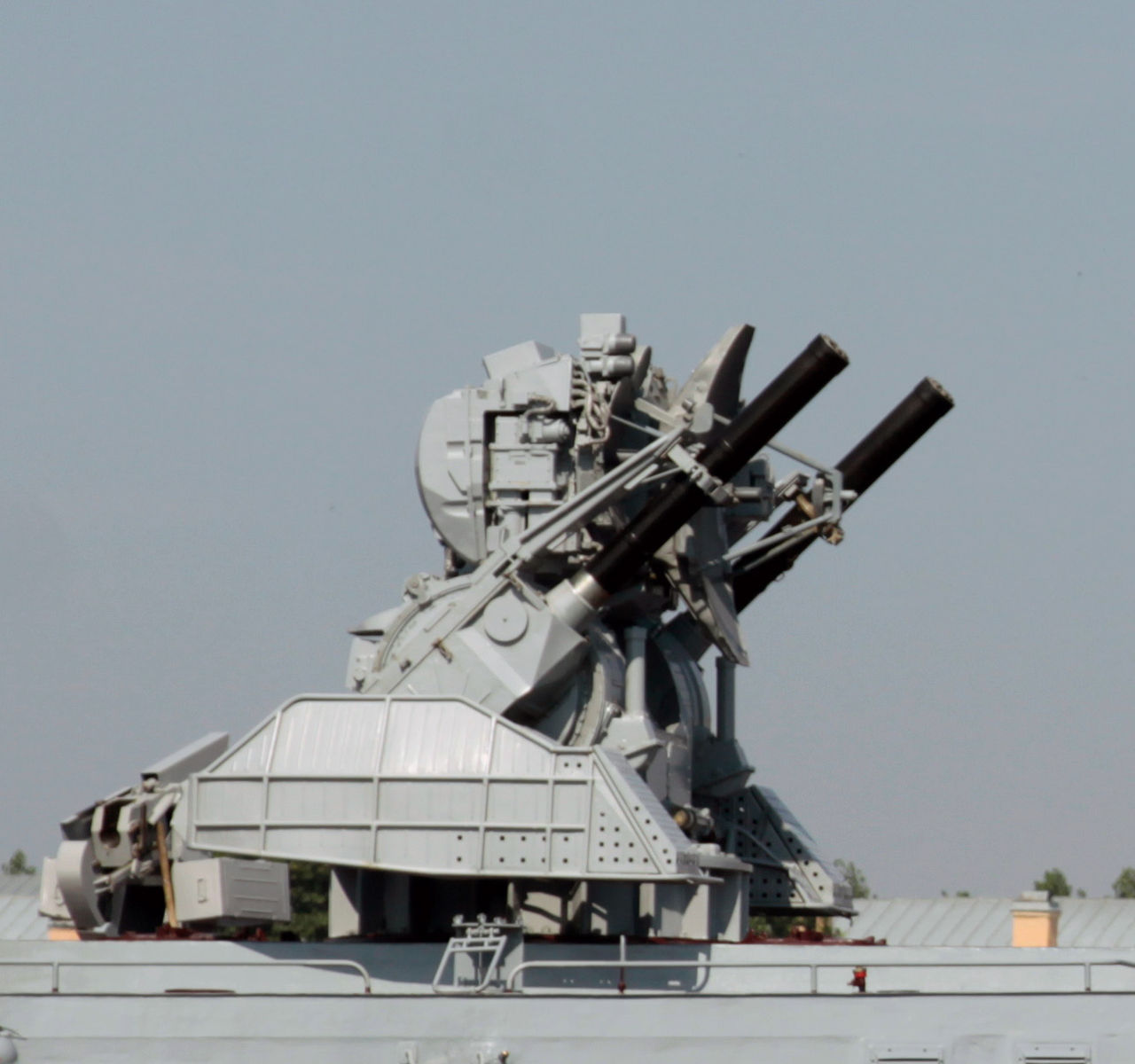
Black leon · CC BY-SA 3.0
- Name
- Kortik / Kashtan
- Field
- close-in weapon system · naval artillery
- Region
- Soviet Union
VALÉORINE Encyclopedia
VALÉORINE documentary reading
Documentary summary
The Kortik ("dirk") close-in weapon system (CIWS) is a naval air defence gun-missile system deployed by the Russian Navy. Its export version is known as Kashtan (English: Chestnut), with the NATO designation CADS-N-1. The Kortik is found on the Russian aircraft carrier Admiral Kuznetsov, the, the, as well as the People's Liberation Army Navy Sovremenny-class destroyers, and other designs.
Admitted source layer · organised and presented by VALÉORINE
Note VALÉORINE
No house-authored Note is published until its assertions and sources pass the VALÉORINE evidence contract. The documentary article remains available in full while that enrichment is being consolidated.
Documentary enrichment in progress · no unsupported statement published
Reference Check
Propose documentary evidence for Kashtan CIWS. A contribution is never written directly as fact: identity, source, rights and evidence gates still decide.
Sign in to contribute
Documentary evidence
Evidence Panel
not yet certified
- Identity
- resolved
- Independent source families
- 0
- Admitted assertions
- 0
- Open conflicts
- 0
Authority files
wikidata · Q367545
In this article
Overview
Overview
Typically deployed as a combined gun and missile system, it provides defence against anti-ship missiles, anti-radar missiles and guided bombs. The system can also be employed against fixed- or rotary-wing aircraft or even surface vessels such as fast attack boats or targets on shore. The Kortik will be replaced in Russian Navy service by the Pantsir-M CIWS, which uses similar rotary cannons but different missile and radar systems.
Key facts
Key facts
• Name — Kortik / Kashtan • Origin — Soviet Union, Russia • Type — Hybrid SAM-Gun based CIWS • Is Ranged — YES • Is Explosive — YES • Is Artillery — YES • Is Vehicle — YES • Is Missile — YES • Service — 1989–present • Used By — See Operators • Designer — Developer: KBP (Arkady Shipunov) Fire control system: RATEP • Design Date — Late 1970s–? • Manufacturer — Tulamashzavod, RATEP • Production Date — 1989–present • Variants — Kortik-M / Kashtan-M • Weight — 15500 kg (Kashtan) 12500 kg (Kashtan-M) • Height — 2250 mm (above deck) • Cartridge — HEI-Frag, Frag-T, APDS-T • Cartridge Weight — 0.39 kg (HEIF, FT) 0.30 kg (APDS-T) • Caliber — 30×165mm AO-18 • Barrels — 2 × 6 (guns); 2 × 4 launch tubes • Action — Gas-operated rotary cannon • Rate — Kashtan: 9,000 rounds/min (guns) Kashtan-M: 1–2 (salvo) missiles per 3–4 sec 10,000 rounds/min (guns) • Velocity — 860 m/s (HEIF, FT) Kashtan-M: 960 m/s (HEIF, FT) 1100 m/s (APDS-T) • Range — By missiles: Kashtan: 1500 – Kashtan-M: 1500 – By guns: Kashtan: (range, altitude) 500 –, 3000 m Kashtan-M: 300 – • Feed — Link-less, helical; 1000 rounds • Sights — Radar / TV-optical: 2–3/1 m (6.6–9.8/3.3 ft) accuracy, tracks 6 targets simultaneously • Filling — Continuous-rod w/ frag layer • Primary Armament — 8 × 9M311K + 32 missiles Kashtan-M: 8 × 9M311-1E + 24 missiles • Secondary Armament — 2 × AO-18K autocannon Kashtan-M: 2 × AO-18KD autocannon • Speed — 910 m/s • Altitude — 3500 m (Kashtan) 6000 m (Kashtan-M)
Design
Design
The weapon is a modular system consisting of a command module and typically two combat modules, as in the case of the two Sovremennyy-class destroyers Taizhou (ex-Vnushitelnyy) and Ningbo (ex-Vechnyy) in Chinese service, although the number can be as many as 8 in the case of Admiral Kuznetsov. The command module detects and tracks threats, distributes targeting data to the combat modules, and interrogates the IFF system of approaching threats. The command module has a 3-D target detection radar, and an all weather multi-band integrated control system. Depending on the number of installed combat modules, the system can engage multiple targets simultaneously. The combat modules automatically track using either radar, an electro-optronic control system (such as FLIRs) or both, and then engages targets with missiles and guns. The combat modules are typically equipped with two GSh-30K (AO-18K) six-barrel 30 mm rotary cannons, with a link-less feeding mechanism, and two 9M311-1 missile launchers equipped with 4 ready-to-fire missiles each and fed by a reloading system storing 32 missiles in ready-to-launch containers. The guns used in the Kortik are the GSh-30K six-barrel 30 mm rotary cannon. Individually, each GSh-30K has a higher rate of fire compared to guns used by other CIWS such as the GAU-8 on the Goalkeeper and the M61 Vulcan on the Phalanx. Along with a high rate of fire, the fairly heavy round (390 g) used by the Kortik is comparable to the DPU rounds of the GAU-8 Avenger (425 g), although the muzzle velocity (and therefore both the kinetic energy and effective range) is slightly lower, partially offsetting the high caliber and rate of fire. The missiles used in the Kortik are the 9M311, which are also used on the 2K22 Tunguska. The 9M311 is an ACLOS guided missile. The warhead weighs 9 kg and is either laser or radio fused. The warhead is a continuous-rod warhead with a steel cube fragmentation layer. The detonation of the warhead will form a complete circle of fragmentation that is 5 meters in radius, and damage or destroy anything in that circle. The combination of the missiles and guns provides more comprehensive protection when compared to other CIWS utilising either missiles or guns only. The system's combined kill probability is allegedly 0.96 to 0.99.
Variants
Variants
• Kashtan-M: improved variant with: • Salvo capability • Dedicated targeting station • Two AO-18KD cannons with higher muzzle velocity (range improved from 4 to 5 km) • Improved missile range and engagement altitude (from 8 to 10 km for range and from 3.5 to 6 km altitude) • Decreased system's reaction time from 6.8 to 5.7 seconds • Sensor modularity • Lower sensitivity • Vulnerable to air to ground missiles and more than 900 pound bombs.
Specifications
Specifications
• Kashtan — Kashtan-M • Weight — 15,500 kg (34,200 lb) — 12,500 kg (27,560 lb) • Armament — 2 x GSh-6-30 — 2 x GSh-6-30KD • Firing Rate — 2 x 4,500 rds/min — 2 x 5,000 rds/min • Target Range — 500-4,000m (1,640-13,120 ft) • Effective Range — 500-1,500m (1,640-4,920 ft) • Ammunition Store — 2 x 500 rounds — 2 x 1500 rounds • Muzzle Velocity — 860 m/s (2,820 ft/s) — 960–1100 m/s (3,150-3,610 ft/s) • Elevation — 3,000 m (9,840 ft)
Operators
Operators
• Illustration — Map of Kashtan operators in blue with former operators in red
Current operators
Current operators
• Russia • Vietnam • Tarantula-class corvette • India • Talwar-class frigates
Former operators
Former operators
• Soviet Union
References
Citations
References
Each reference names the institution holding it, so a reader may go to the document itself.
reference work
Partially resolved
Further particulars
Held on the record
Further particulars
Open the remaining particulars
Kashtan CIWS is classified as a close-in weapon system or naval artillery. Associated with Soviet Union. Connected to 2 other published records in the VALÉORINE Encyclopedia.
Within the Encyclopedia
The Encyclopedia exists whether or not anything is for sale. Corrections are recorded rather than overwritten, and every version of this record is kept. Published 14 August 2026.
Elsewhere in Militaria
6,095 published records in this field, each with its sources named.
- karambitTerminology
- KariofiliTerminology
- Karl-GerätTerminology
- kartouweTerminology
- kaskaraTerminology
- kastaneTerminology
- katanaTerminology
- katarTerminology
Best supported in this field
For owners
Own an object connected with Kashtan CIWS?
A specialist will read what you send and tell you what the house can establish, what it cannot, and whether the object is suited to sale. There is no charge and no obligation. The object stays with you throughout; nothing is shipped to us unless it is arranged in writing beforehand.