
Karl Friedrich Schinkel
Karl Friedrich Schinkel (German pronunciation: [ˈkaʁl ˈfʁiːdʁɪç ˈʃɪŋkl̩]; 13 March 1781 – 9 October 1841) was a Prussian architect, city planner and painter who also designed furniture and stage sets. Schinkel was one of the greatest German architects, a nineteenth century design genius, and a leader in the International Neoclassical and Gothic Revival movements. His most famous buildings are found in and around Berlin, where he influenced the city's design and landscape profoundly.
Also recorded as Carl Friedrich Schinkel · K. F. Schinkel · karl friedrich schinkel · Karl Fr. Schinkel
Karl Friedrich Schinkel
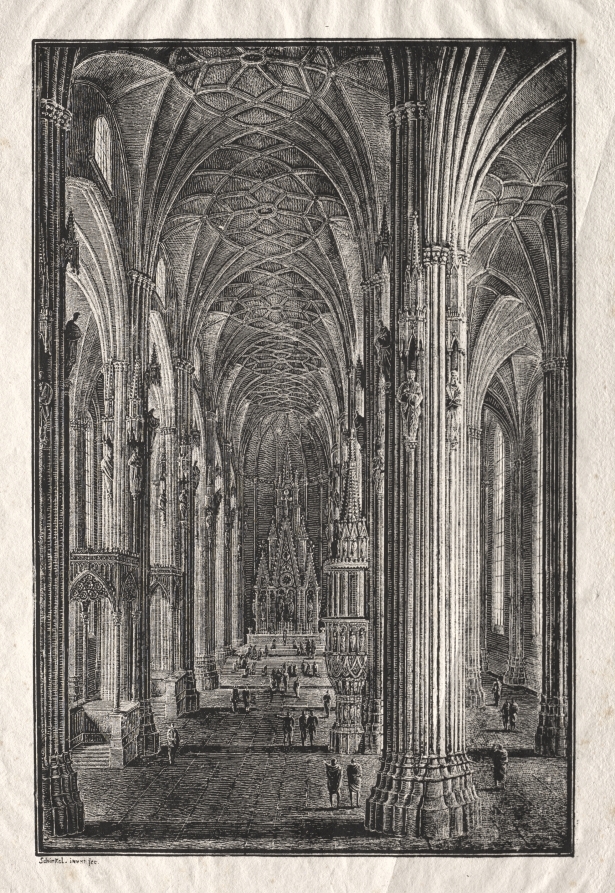
Karl Friedrich Schinkel · The Cleveland Museum of Art · John L. Severance Fund · CC0
- Born
- 1781
- Nationality
- Kingdom of Prussia
- Occupation
- architect · painter · urban planner · university teacher · general contractor · graphic artist · designer · furniture designer · theatre designer
- Movements
- Greek Revival architecture
- Known for
- Glienicke Palace · Alte Nazarethkirche (Berlin-Wedding) · Elisabethkirche and Berlin-Mitte · Schlossbrücke · Charlottenhof Palace · Iron Cross
VALÉORINE Encyclopedia
VALÉORINE documentary reading
Documentary summary
Karl Friedrich Schinkel (German pronunciation: [ˈkaʁl ˈfʁiːdʁɪç ˈʃɪŋkl̩]; 13 March 1781 – 9 October 1841) was a Prussian architect, city planner and painter who also designed furniture and stage sets. Schinkel was one of the greatest German architects, a nineteenth century design genius, and a leader in the International Neoclassical and Gothic Revival movements. His most famous buildings are found in and around Berlin, where he influenced the city's design and landscape profoundly.
Admitted source layer · organised and presented by VALÉORINE
Note VALÉORINE
No house-authored Note is published until its assertions and sources pass the VALÉORINE evidence contract. The documentary article remains available in full while that enrichment is being consolidated.
Documentary enrichment in progress · no unsupported statement published
Reference Check
Propose documentary evidence for Karl Friedrich Schinkel. A contribution is never written directly as fact: identity, source, rights and evidence gates still decide.
Sign in to contribute
Documentary evidence
Evidence Panel
not yet certified
- Identity
- resolved
- Independent source families
- 0
- Admitted assertions
- 0
- Open conflicts
- 0
Authority files
gnd · 10168878-7 · museum · 305468951 · wikidata · Q151759 · wikipedia · Karl Friedrich Schinkel
In this article
Biography
Biography
Schinkel's Bauakademie is considered one of the forerunners of modern architecture. His Altes Museum is one of the most important classical buildings in Europe and a model for future national art museums throughout the world.
Schinkel was born in Neuruppin, Margraviate of Brandenburg. When he was six, his father died in the disastrous Neuruppin fire of 1787. He became a student of architect Friedrich Gilly (1772–1800) (the two became close friends) and his father, David Gilly, in Berlin. At that time, the architectural taste in Prussia was shaped in Neoclassical style, mainly by Carl Gotthard Langhans, the architect of the Brandenburg Gate in Berlin. After returning to Berlin from his first trip to Italy in 1805, he started to earn his living as a painter. When he saw Caspar David Friedrich's painting Wanderer above the Sea of Fog at the 1810 Berlin art exhibition he decided that he would never reach such mastery of painting and turned to architecture. Working for the stage, in 1816 he created a star-spangled backdrop for the appearance of the "Königin der Nacht" in Wolfgang Amadeus Mozart's opera The Magic Flute, which is even quoted in modern productions of this perennial piece. After Napoleon's defeat, Schinkel oversaw the Prussian Building Commission. In this position, he was not only responsible for reshaping the still relatively unspectacular city of Berlin into a representative capital for Prussia, but also oversaw projects in the expanded Prussian territories from the Rhineland in the west to Königsberg in the east, such as New Altstadt Church. From 1808 to 1817 Schinkel renovated and reconstructed Schloss Rosenau, Coburg, in the Gothic Revival style. He also rebuilt the ruins of Chorin Abbey. At age 60, on 9 October 1841, Schinkel died in Berlin, Province of Brandenburg.
Commemoration
Commemoration
His portrait appeared on the 1,000 ℛ︁ℳ︁ banknote issued by the Reichsbank from 1936 until 1945. Printing ceased in 1945 but the note remained in circulation until the issue of the Deutsche Mark on 21 June 1948.
Style
Style
Schinkel's style, in his most productive period, is defined by a turn to Greek rather than Imperial Roman architecture, an attempt to turn away from the style that was linked to the recent French occupiers. (Thus, he is a noted proponent of the Greek Revival.) He believed that in order to avoid sterility and have a soul, a building must contain elements of the poetic and the past, and have a discourse with them. His most famous extant buildings are found in and around Berlin. These include the Neue Wache (1816–1818), the National Monument for the Liberation Wars (1818–1821), the Schauspielhaus (1819–1821) at the Gendarmenmarkt, which replaced the earlier theatre that was destroyed by fire in 1817, and the Altes Museum on Museum Island (1823–1830). He also carried out improvements to the Crown Prince's Palace and to Schloss Charlottenburg. Schinkel was also responsible for the interior decoration of a number of private Berlin residences. Although the buildings themselves have long been destroyed, portions of a stairwell from the Weydinger House were able to be rescued and built into the Nicolaihaus on Brüderstr. and its formal dining hall into the Palais am Festungsgraben. Schinkel was extensively patronised by the Prussian royal family, producing designs for Stolzenfels Castle and completing Charlottenhof Palace for King Frederick William IV and for his brothers, Babelsberg Palace and Glienicke Palace. Between 1825 and 1827, he collaborated with Carl Theodor Ottmer on designs for the Berliner Singakademie for Sing-Akademie zu Berlin. Since 1952, it has been known as the Maxim Gorki Theatre. Later, Schinkel expanded his stylistic range, embracing the Neo-Gothic in his Friedrichswerder Church (1824–1831). Schinkel's Bauakademie (1832–1836), his most important brick masonry building, seemed to point the way to more rationalist architecture, but nonetheless is full of terra cotta ornament, classical details, and extraordinary symbolic sculpture. It is far more similar to H.H. Richardson's Romanesque work than to any modernist building, and was one of the finest architectural school buildings ever built, precisely because it reflected a curriculum created by Schinkel and his colleagues. Schinkel is noted as much for his theoretical work and his unbuilt projects as for the relatively few buildings that were actually executed to his designs. Some of his merits are best shown in his unexecuted plans for the transformation of the Athenian Acropolis into a royal palace for the new Kingdom of Greece and for the erection of the Orianda Palace in the Crimea. These and other designs may be studied in his Sammlung architektonischer Entwürfe (1820–1837) and his Werke der höheren Baukunst (1840–1842; 1845–1846). He also designed the famed Iron Cross medal of Prussia and later Germany. He worked on an unpublished architectural treatise that might well have influenced modern architects, as it looked at construction in various materials and extolled beauty as the highest form of artistic expression.
General source
General source
Jörg Trempler: Schinkels Motive. Matthes & Seitz, Berlin, 2007, ISBN 978-3-88221-866-4. Christoph Werner: Schloss am Strom. Die Geschichte vom Leben und Sterben des Baumeisters Karl Friedrich Schinkel. Bertuch-Verlag, Weimar 2004, ISBN 3-937601-11-2. Christoph Werner: Castle by the River: The Life and Death of Karl Friedrich Schinkel, Painter and Master Builder: A Novel. Tredition, Hamburg, 2020, ISBN 978-3-347-04274-2. Christoph von Wolzogen: Karl Friedrich Schinkel: Unter dem bestirnten Himmel. Biographie. Edition Fichter, Frankfurt, 2016, ISBN 978-3-943856-33-0. John Zukowsky (ed.): Karl Friedrich Schinkel 1781–1841: The Drama of Architecture. With essays by Kurt W. Forster and Wolfgang Pehnt, 2020, ISBN 0-86559-105-9.
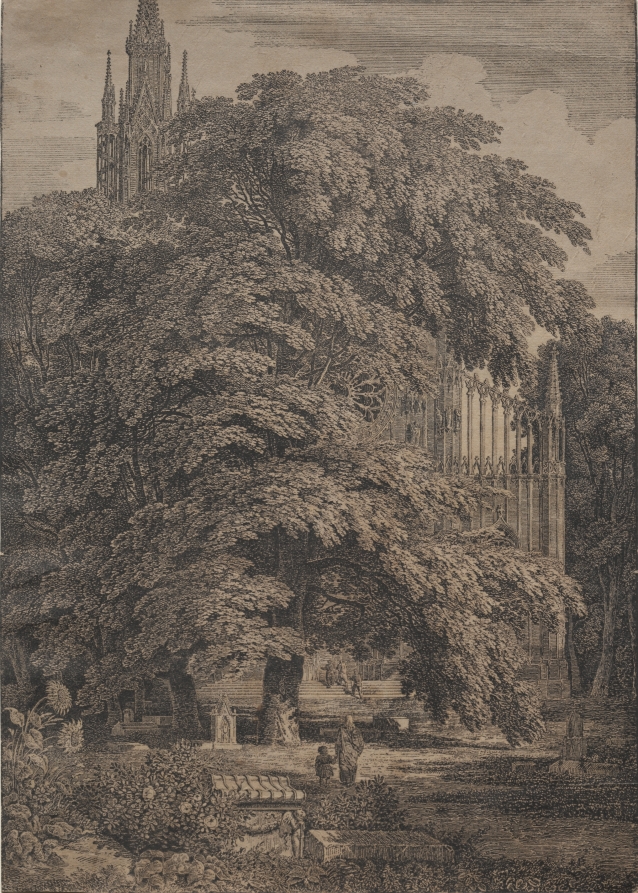
Gothic Church among Oaks, 1810, by Karl Friedrich Schinkel
Karl Friedrich Schinkel · The Cleveland Museum of Art · Mr. and Mrs. Lewis B. Williams Collection
Primary material
Documents and archives
Institutional database
- OpenStreetMap gazetteer entry for Karl Friedrich Schinkel, Schinkelplatz, Nikolaiviertel, Spandauer Vorstadt, Mitte, Berlin, 10117, Deutschland
Scholarly · OpenStreetMap Foundation
- Wikidata, structured authority record Q151759: Karl Friedrich Schinkel
Scholarly · Wikimedia Foundation
reference work
- “Karl Friedrich Schinkel”, English Wikipedia, consulted as further reading
Reputable secondary · Wikipedia
Notes from the source article
Cited by Wikipedia
Notes from the source article
These works are cited by the source article, in its own numbering. They are recorded as its citations, not as sources VALÉORINE has verified.
- 1.Karl Friedrich Schinkel – Facts, information, pictures – Encyclopedia.com
- 2.Karl Friedrich Schinkel. A Universal Man. Yale University Press. 1991. 978-0-300-05165-0.
- 3.Charles Quest-Ritson, "Coburg: Schloß Rosenau", in Gärten in Deutschland, p. 64 online .
- 4.P-184.
- 5.Guratzsch, Dankwart. Wie Bürger für die Schönheit ihrer Städte kämpfen. Welt Online. 13 January 2016.
- 6.Peik, Susan M. Karl Friederich Schinkel: Aspects of His Work. Axel Menges. 7. 2001. 978-3-930698-81-3.
- 7.Malgorzata Omilanowska
References
Citations
References
Each reference names the institution holding it, so a reader may go to the document itself.
Institutional database
OpenStreetMap gazetteer entry for Karl Friedrich Schinkel, Schinkelplatz, Nikolaiviertel, Spandauer Vorstadt, Mitte, Berlin, 10117, DeutschlandOpenStreetMap Foundation
VerifiedInstitutional database
Wikidata, structured authority record Q151759: Karl Friedrich SchinkelWikimedia Foundation
Verifiedreference work
Partially resolved
A further 1 witness is held back from this article because the person or object named in it is not yet resolved to this record. They are kept, not discarded, and return once the identity is established.
The Encyclopedia exists whether or not anything is for sale. Corrections are recorded rather than overwritten, and every version of this record is kept. Published 14 August 2026.
Elsewhere in Modern design
3,254 published records in this field, each with its sources named.
- Karim RashidDesigner
- Karin BjörquistDesigner
- Karl DraisDesigner
- Karl ElsenerDesigner
- Karl GerstnerDesigner
- Karl GölsdorfDesigner
- Karl Gustav HansenDesigner
- Karl HagenauerDesigner
Best supported in this field
For owners
Own a work by Karl Friedrich Schinkel?
A specialist will read what you send and tell you what the house can establish, what it cannot, and whether the object is suited to sale. There is no charge and no obligation. The object stays with you throughout; nothing is shipped to us unless it is arranged in writing beforehand.