
Juste de Juste
Illustration — One of Juste's larger series of "Human Pyramid" etchings • Illustration — The tomb of Louis XII of France and Anne of Brittany, with Juste's Virtues at the corners Juste de Juste (ca. 1505 – ca. 1559) was a Franco-Italian sculptor and printmaker in etching, a member of the Betti family of sculptors from near Florence, who became known as the Juste family in France, where Juste de Juste's father Antonio and his two brothers emigrated and spent most of their careers.
Also recorded as Just de Juste · Justin de Juste · Giusto Betti Juste · Giusto Betti
Juste de Juste
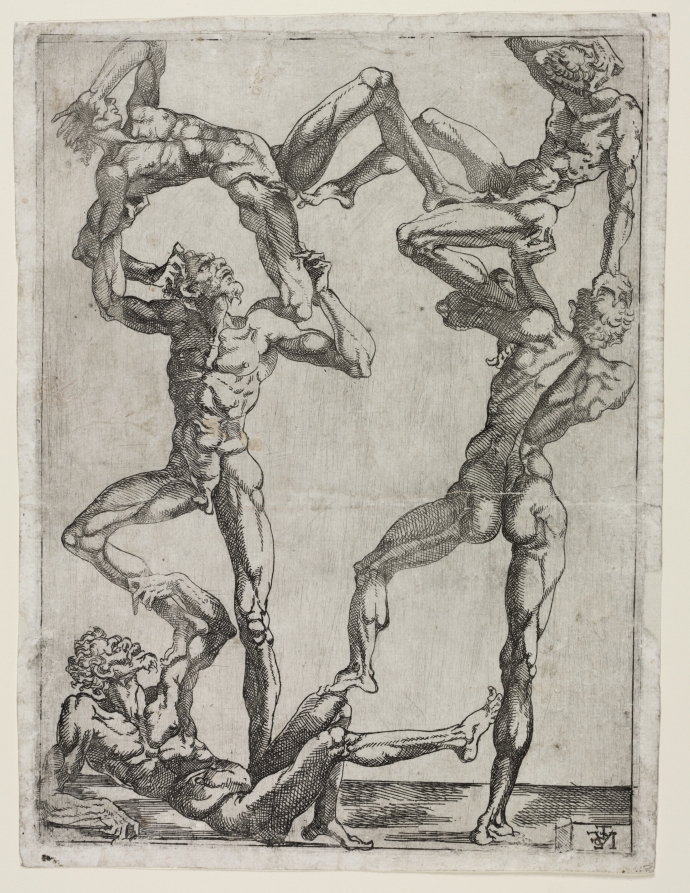
Juste de Juste · The Cleveland Museum of Art · Alma Kroeger Fund · CC0
- Born
- 1505 · Tours.
- Nationality
- France
- Occupation
- sculptor · printmaker
- Languages
- French
VALÉORINE Encyclopedia
VALÉORINE documentary reading
Documentary summary
Illustration — One of Juste's larger series of "Human Pyramid" etchings • Illustration — The tomb of Louis XII of France and Anne of Brittany, with Juste's Virtues at the corners Juste de Juste (ca. 1505 – ca. 1559) was a Franco-Italian sculptor and printmaker in etching, a member of the Betti family of sculptors from near Florence, who became known as the Juste family in France, where Juste de Juste's father Antonio and his two brothers emigrated and spent most of their careers.
Admitted source layer · organised and presented by VALÉORINE
Note VALÉORINE
Juste de Juste (1505–1559) was a printmaker and sculptor, of French nationality. The printmaker was born and died in Tours.
Languages used include French. Works are held at Musée des Beaux-Arts de Rennes, Museum Boijmans Van Beuningen and Nationalmuseum, among others.
Composed from admitted, traceable facts · 01 October 2026
VALÉORINE
Reference Check
Propose documentary evidence for Juste de Juste. A contribution is never written directly as fact: identity, source, rights and evidence gates still decide.
Sign in to contribute
World of VALÉORINE
Documentary connections
Only confirmed graph relationships appear here. Images are shown only when their identity and reuse rights both pass the documentary gate.
Documentary evidence
Documentary basis
Authority files
wikidata · Q6316806 · wikipedia · Juste de Juste
In this article
Identity and origins
Identity and origins
Widely accepted as the author of seventeen etchings of naked or écorché (flayed) male figures signed with a complicated monogram. He also worked as a stuccoist of the School of Fontainebleau under Rosso Fiorentino. Juste de Juste was born in Tours, and trained by his uncle Jean Juste, his father having died in 1519. He worked with Jean on the mausoleum of Louis XII of France at St-Denis, which occupied his uncle for almost fifteen years from 1516–1531, being especially responsible for the four seated Virtues. In 1529 he was still living in Tours when Francis I commissioned him to make marble sculptures of Hercules and Leda, now lost, and in 1533 he was appointed Sculpteur du Roi (a non-exclusive appointment) as his father and uncles had been before him. The year 1531 marked the beginning of the "First School of Fontainebleau", where Juste de Juste spent most of the period 1531-37, before rejoining the family workshop. • Illustration — IVSTE monograms from three different "human piramid" etchings Juste de Juste left a set of twelve small single etched figures (about 195 x 83 mm each; Zerner 6-17) and another set of five larger prints each showing five or six naked male figures forming improbable human pyramids (these about 267 x 205 mm; Zerner 1-5). All the figures are elongated and muscular and many of their faces have anguished grimaces; over much of their bodies the musculature is so exposed they seem flayed, but they have hair and faces. They are usually interpreted as academic exercises in drawing the male figure, perhaps related to the art student's game of marking a number of dots on a piece of paper and then constructing a figure to incorporate them - it is typical of such exercises that the figures touch the frame of the image at several points. The etching technique is personal and direct, but probably not that of a practised printmaker. Like many Fontainbleau prints, the technical finish of the etching is poor, with many unintended marks and variations in the strength of lines, but the images have an intriguing impact. In the case of both sets there is some evidence that there were other members which have not survived. Only the larger set have the monogram, now agreed to read IVSTE-"Juste" (in reverse). An alternative interpretation has been that they refer to an obscure engraver, Jean Viset, about whom little is known except that he worked at Fontainebleau in 1536. All the prints are rare - again like most School of Fontainebleau prints. The larger set is often mentioned in the context of works by Henri Matisse culminating in his The Dance (second version) in the Hermitage in St. He was apparently still living in Tours, where the family workshop continued, at his death about 1559.
The authorities additionally record the headings Just de Juste, Justin de Juste, Giusto Betti Juste and Giusto Betti. His recorded language was French. He was the child of Antonio Giusti.
Identity
Identity
Juste de Juste is recorded as sculptor and printmaker.
Life and career
Dated record
Life and career
The full dated record · 2 entries
1505
Juste de Juste born at Tours.
1559
Juste de Juste died at Tours.
Literature
Scholarly footprint
A count of publications is evidence of attention, not of standing, and is given here only as a measure.
Notes from the source article
Cited by Wikipedia
Notes from the source article
These works are cited by the source article, in its own numbering. They are recorded as its citations, not as sources VALÉORINE has verified.
- 1.British Museum Juste de Juste. Dates from the Getty Union Artist Name List, who have him as "Just de Juste" and variants, but not "Juste de Juste". The British Museum have his dates as 1505-1549. See also Fuhring. There are on line images from Spamula - click on details to see whole image.
- 2.Patricia Wengraf Ltd.
- 3.Fuhring. The Zerner numbers refer to Henri Zerner's catalogue of The School of Fontainebleau, Engravings and Etchings, London 1969. One illustrated above, from Rennes - the other 4 in the series can be found from "External links" below.
- 4.Fuhring.
- 5.Fuhring, op cit
- 6.Fuhring, 284, but especially Suzanne Boorsch, also in Jacobson, pp. 82-84, who tentatively assigns to Viset a different oeuvre, that of the "Master I♀V"
- 7.Musée des Beaux-Arts de Rennes.
References
Citations
References
Each reference names the institution holding it, so a reader may go to the document itself.
reference work
Wikidata, structured authority record Q6316806: Juste de JusteWikimedia Foundation
Secondary witnessreference work
Secondary witness
The Encyclopedia exists whether or not anything is for sale. Corrections are recorded rather than overwritten, and every version of this record is kept. Published 16 August 2026.
Elsewhere in Prints
4,138 published records in this field, each with its sources named.
- Jun HatanakaEngraver
- Jürg KreienbühlEngraver
- Jürgen OvensEngraver
- Jusepe de RiberaEngraver
- Justus DanckertsEngraver
- Justus Erich WalbaumEngraver
- Justus VingboonsEngraver
- Jyoti BhattEngraver
Best supported in this field
For owners
Own a work by Juste de Juste?
A specialist will read what you send and tell you what the house can establish, what it cannot, and whether the object is suited to sale. There is no charge and no obligation. The object stays with you throughout; nothing is shipped to us unless it is arranged in writing beforehand.