
Julius Schnorr von Carolsfeld
Julius Schnorr von Carolsfeld (26 March 1794 – 24 May 1872) was a German painter, chiefly of Biblical subjects. He is remembered for his extensive Picture Bible, and his designs for stained glass windows in cathedrals.
Also recorded as Julius Schnorr Von Carolsfeld · Jul. Schnorr v. Karolsfeld · Julius Schnorr v. Karolsfeld · j. schnorr v. carolsfeld
Julius Schnorr von Carolsfeld
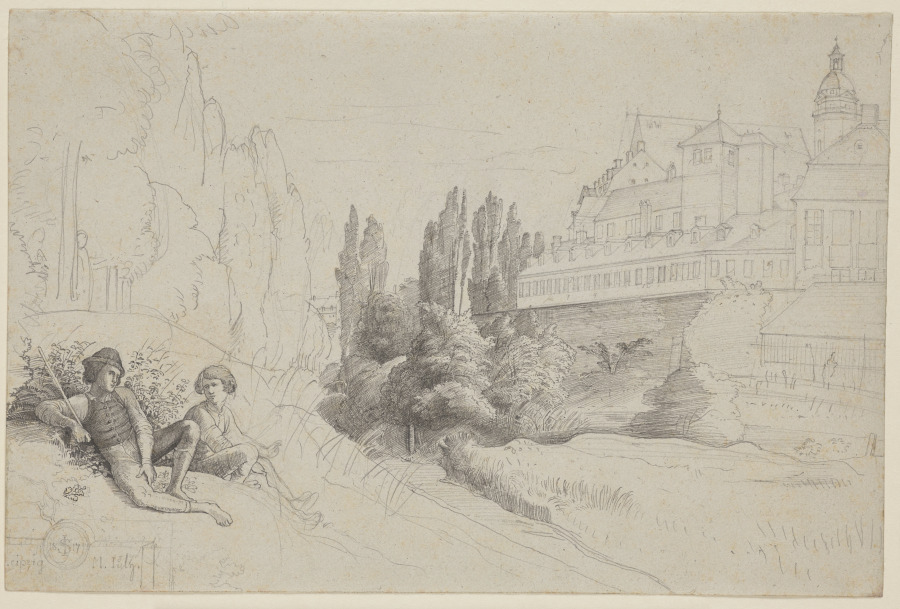
Julius Schnorr von Carolsfeld · The Cleveland Museum of Art · Severance and Greta Millikin Purchase Fund · CC0
- Name
- Julius Schnorr von Carolsfeld
- Born
- 26 March 1794
- Birthplace
- Leipzig, Kingdom of Saxony, Holy Roman Empire
- Died
- 24 May 1872
- Place of death
- Dresden, Kingdom of Saxony, German Empire
- Occupation
- Painter
- Full name
- Julius Veit Hans Schnorr von Carolsfeld.
- Nationality
- Kingdom of Saxony
- Fields
- visual arts
- Education
- Academy of Fine Arts Vienna · Thomasschule zu Leipzig
- Teachers
- Heinrich Füger
- Honours
- Pour le Mérite for Sciences and Arts order · Bavarian Maximilian Order for Science and Art
VALÉORINE Encyclopedia
VALÉORINE documentary reading
Documentary summary
Julius Schnorr von Carolsfeld (26 March 1794 – 24 May 1872) was a German painter, chiefly of Biblical subjects. He is remembered for his extensive Picture Bible, and his designs for stained glass windows in cathedrals.
Admitted source layer · organised and presented by VALÉORINE
Note VALÉORINE
Julius Schnorr von Carolsfeld (1794–1872) was an artist, draftsperson and illustrator, among other activities, a national of the Kingdom of Saxony. The artist was born Julius Veit Hans Schnorr von Carolsfeld in Leipzig and died in Dresden.
Julius Schnorr von Carolsfeld was educated at Academy of Fine Arts Vienna and Thomasschule zu Leipzig. The artist worked for Academy of Fine Arts, Munich and was a member of Académie des beaux-arts. Julius Schnorr von Carolsfeld held the position of museum director. Activity centred on visual arts.
Languages used include German. Works are held at Albertina, Art Institute of Chicago and Metropolitan Museum of Art, among others. Honours include Bavarian Maximilian Order for Science and Art and Pour le Mérite for Sciences and Arts order.
Composed from admitted, traceable facts · 27 September 2026
VALÉORINE
Reference Check
Propose documentary evidence for Julius Schnorr von Carolsfeld. A contribution is never written directly as fact: identity, source, rights and evidence gates still decide.
Sign in to contribute
World of VALÉORINE
Documentary connections
Only confirmed graph relationships appear here. Images are shown only when their identity and reuse rights both pass the documentary gate.

Documentary evidence
Evidence Panel
not yet certified
- Identity
- resolved
- Independent source families
- 0
- Admitted assertions
- 0
- Open conflicts
- 0
Authority files
gnd · 1092013091 · wikidata · Q703458 · wikipedia · Julius Schnorr von Carolsfeld
In this article
Biography
Biography
Julius Schnorr von Carolsfeld studied at Academy of Fine Arts Vienna and Thomasschule zu Leipzig. Training under Heinrich Füger is recorded. Gustav Jäger, Andreas Müller and Alexander Otto Stichart are recorded as having studied under Julius Schnorr von Carolsfeld. The recorded working language is German. The field of work recorded is visual arts. Employment is recorded with Academy of Fine Arts, Munich. Positions recorded include museum director. Work by Julius Schnorr von Carolsfeld is recorded in the collections of Städel Museum, Minneapolis Institute of Art, Art Institute of Chicago, National Gallery of Canada and Metropolitan Museum of Art. Distinctions recorded are Pour le Mérite for Sciences and Arts order and Bavarian Maximilian Order for Science and Art.
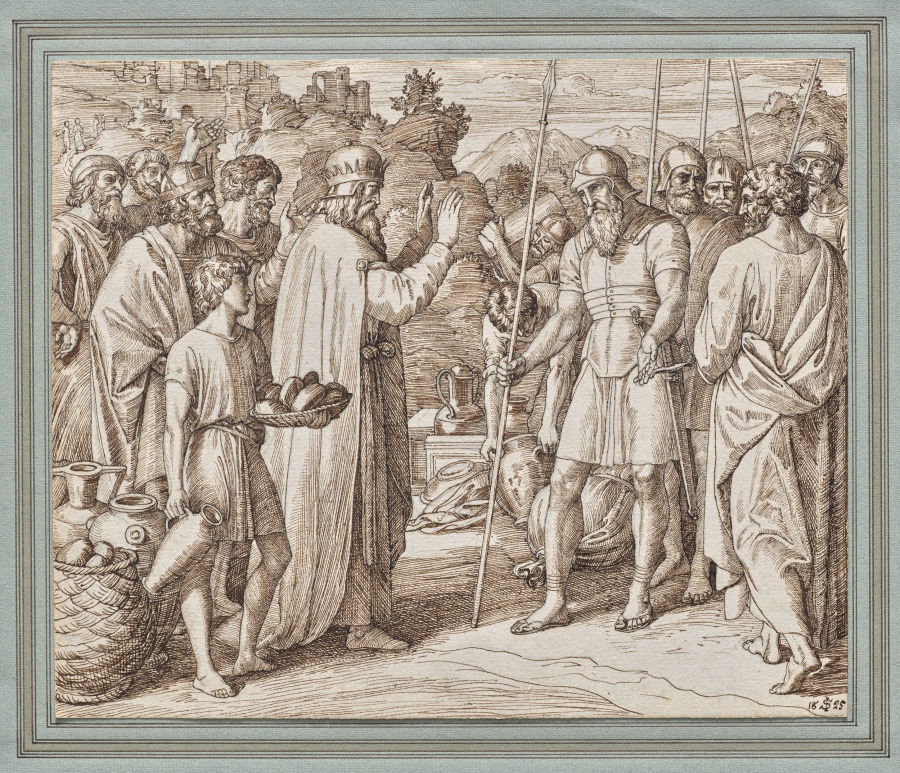
Melchizedek Blessing Abraham, 1825, by Julius Schnorr von Carolsfeld
Julius Schnorr von Carolsfeld · The Cleveland Museum of Art · Alma Kroeger Fund
Key facts
Key facts
• Name — Julius Schnorr von Carolsfeld • Born — 26 March 1794 • Birthplace — Leipzig, Kingdom of Saxony, Holy Roman Empire • Died — 24 May 1872 • Place of death — Dresden, Kingdom of Saxony, German Empire • Occupation — Painter • Illustration — Julius Schnorr von Carolsfeld by Adolf von Donndorf, c.1913, Albertinum gallery, Dresden • Illustration — Julius Schnorr von Carolsfeld by Leonhard Gey
Biography
Biography
Schnorr was born in Leipzig, the son of Veit Hanns Schnorr von Carolsfeld (1764–1841), a draughtsman, engraver, and painter, from whom he received his initial artistic education, his earliest known works being copies of the Neoclassical drawings of John Flaxman. In 1811 he entered the Vienna Academy, from which Johann Friedrich Overbeck and others who rebelled against the old conventional style had been expelled about a year before. There he studied under Friedrich Heinrich Füger, and became friends with Joseph Anton Koch and Heinrich Olivier, both of whom would have an important influence on his style. Schnorr followed Overbeck and the other founders of the Nazarene movement to Rome in 1815, where the colony of artists lived in the abandoned San Isidoro monastery.. This school of religious and romantic art tended to reject modern styles, attempting to revert to and revive the principles and practice of earlier periods. At the beginning of his time in Rome, Schnorr was particularly influenced by his close study of fifteenth-century Italian painting, especially the works of Fra Angelico. Soon however, he abandoned this refined simplicity, and began to look towards more elaborate High Renaissance models. From its outset the Nazarene movement made an effort to recover fresco painting and monumental art, and Schnorr had an opportunity to demonstrate his powers when commissioned to decorate the entrance hall of the Villa Massimo near the Lateran with frescoes illustrating the works of Ariosto. Other cycles in the house were begun by Peter von Cornelius and Johann Friedrich Overbeck. Schnorr married Maria Heller, the stepdaughter of Ferdinand Olivier, in 1827. Their son Ludwig Schnorr von Carolsfeld was an operatic tenor who died at the age of 29. He had just begun to gain renown as the first to sing Wagner's Tristan. Schnorr's brother, Ludwig Ferdinand Schnorr von CarolsfeldLudwig Ferdinand (1788–1853) was also a painter. Schnorr died in Dresden in 1872.
Career
Career
The second period of Schnorr's artistic output began in 1825, when he left Rome, settled in Munich, entered the service of Ludwig I of Bavaria, and transplanted to Germany the art of wall-painting which he had learned in Italy. He showed himself qualified as a sort of poet-painter to the Bavarian court; he organized a staff of trained executants, and covered five halls in the new palace – the "Residenz" – with frescoes illustrating the Nibelungenlied. He also painted a series of scenes from the lives of Charlemagne, Frederick Barbarossa and Rudolph of Habsburg. • Illustration — Illustration from the Picture Bible Schnorr had initially wanted to create a complex symbolic programme in which these German historical subjects were combined with scenes from the Old Testament. This however was rejected by Ludwig, leaving Schnorr to complain that he was left with the task of painting a mere "newspaper report of the Middle Ages" ("Zeitungsartikel des Mittelalters"). Critics considered these compositions to be creative, learned in composition, masterly in drawing, but also exaggerated in thought and extravagant in style. In 1846 Schnorr moved to Dresden to become a professor at the academy there. The next year he was appointed director of the Gemäldegalerie.
Art
Art
Schnorr's third period was marked by his biblical illustrations. He was a Lutheran, and took a broad and unsectarian view. His Picture Bible was published in Leipzig in 30 parts in 1852–60, and an English edition followed in 1861. The Picture Bible illustrations were often complex and cluttered; some critics found them lacking in harmony of line and symmetry, judging them to be inferior to equivalent work produced by Raphael. His style differs from the simplicity and severity of earlier times, exhibiting instead the floridity of the later Renaissance. Schnorr's biblical drawings and cartoons for frescoes formed a natural prelude to designs for church windows, and his renown in Germany secured commissions in Great Britain. Schnorr was one of ten artists who provided designs for a scheme of stained-glass for Glasgow Cathedral, commissioned in 1856–7 and manufactured at the royal factory in Munich, and he later designed windows for St Paul's Cathedral in London. This Munich glass provoked controversy: medievalists objected to its lack of lustre, and stigmatized the windows as mere coloured blinds and picture transparencies. The opposing party, however, claimed for these modern revivals "the union of the severe and excellent drawing of early Florentine oil-paintings with the colouring and arrangement of the glass-paintings of the latter half of the 16th century." Four windows by Schnorr were installed at St Paul's: three in the chancel (removed in 1888) and one at the west end (destroyed in 1941). Most of the Munich glass at Glasgow was removed during the 20th century.
Nazi-looted art
Nazi-looted art
In August 2016, the National Gallery of Art in Washington, D.C., returned a drawing in its collection, A Branch with Shriveled Leaves (1817) by Schnorr, to the heirs of Dr. Marianne Schmidl (1890–1942), an Austrian ethnologist who was murdered in the Holocaust.
Identity and origins
Identity and origins
Julius Schnorr von Carolsfeld was recorded at birth as Julius Veit Hans Schnorr von Carolsfeld. The authorities additionally record the headings Julius Schnorr Von Carolsfeld, Jul. Karolsfeld, j. schnorr v. carolsfeld and J. Schnorr von Karolsfeld. His recorded language was German. He was the child of Veit Hanns Schnorr von Carolsfeld and Christina Juliana Hempel. He married Marie Schnorr von Carolsfeld. One child is recorded: Ludwig Schnorr von Carolsfeld.
Identity
Identity
Julius Schnorr von Carolsfeld is recorded as having studied at Academy of Fine Arts Vienna and Thomasschule zu Leipzig.
Life and career
Dated record
Life and career
The full dated record · 2 entries
1794
Julius Schnorr von Carolsfeld born at Leipzig.
1872
Julius Schnorr von Carolsfeld died at Dresden.
Places
Named by the record
Places
Only places the record itself states, plotted where the house gazetteer settles their coordinates. Nothing is inferred from a name or a nationality.
Leipzig.
Birth place
Dresden.
Death place
Paintings
• Illustration — The Wedding at Cana (1819) • Illustration — Annunciation (1820) • Illustration — Portrait of Klara Bianka von Quandt (1820) • Illustration — Madonna and Child (1820) • Illustration — The Family of St John the Baptist Visiting the Family of Christ (1817) • Illustration — Ruth in Boaz's Field (1828) • Illustration — Flight into Egypt (1828)
Recognition and collections
Where the work is held
Recognition and collections
Julius Schnorr von Carolsfeld received Pour le Mérite for Sciences and Arts order and Bavarian Maximilian Order for Science and Art.
Documents and archives
Primary material
Documents and archives
reference work
- Wikidata, structured authority record Q703458: Julius Schnorr von Carolsfeld
Reputable secondary · Wikimedia Foundation
- “Julius Schnorr von Carolsfeld”, English Wikipedia, consulted as further reading
Reputable secondary · Wikipedia
authority file
- Gemeinsame Normdatei 1092013091, Julius Schnorr von Carolsfeld: 1794-1872 (1994; Leipzig + 1994; Bremen).
Unverified · Deutsche Nationalbibliothek
Notes from the source article
Cited by Wikipedia
Notes from the source article
These works are cited by the source article, in its own numbering. They are recorded as its citations, not as sources VALÉORINE has verified.
- 1.NDB 23 341 343 Schnorr von Carolsfeld, Julius Veit Hans Fastert, Sabine 118609815
- 2.Artist biography in German Masters of the Nineteenth Century, pp.272–3
- 3.Gossman, Lionel. Unwilling Moderns: The Nazarene Painters of the Nineteenth Century. Nineteenth-Century Art Worldwide. 2003.
- 4.Schiff, Gert, "An Epoch of longing" in German Masters of the Nineteenth Century, p.18
- 5.See also The Burlington Magazine, vol. 101, No. 676/677 (July/August 1959) "The Romantic Exhibition" by Kenneth Garlick
- 6.Artist biography in German Masters of the Nineteenth Century, p.273
- 7.Science on Streets. Glasgow Cathedral St Mungo's.
- 8.British Museum. drawing [Christ's Ascension on the Mount of Olives, design for stained glass window].
- 9.National Gallery of Art Returns World War II-Era Duress-Sale Drawing to Heirs. www.nga.gov.
References
Citations
References
Each reference names the institution holding it, so a reader may go to the document itself.
authority file
Gemeinsame Normdatei 1092013091, Julius Schnorr von Carolsfeld: 1794-1872 (1994; Leipzig + 1994; Bremen).Deutsche Nationalbibliothek
Partially resolvedreference work
Wikidata, structured authority record Q703458: Julius Schnorr von CarolsfeldWikimedia Foundation
Partially resolvedreference work
Partially resolved
Further particulars
Held on the record
Further particulars
Open the remaining particulars
Julius Schnorr von Carolsfeld studied at Academy of Fine Arts Vienna and Thomasschule zu Leipzig. He trained under Heinrich Füger. Each of those relationships is stated by the authority record rather than inferred from style.
Julius Schnorr von Carolsfeld worked in visual arts. He was employed by Academy of Fine Arts, Munich. Recorded position is museum director. He belonged to Académie des beaux-arts. Connected to 1 other published record in the VALÉORINE Encyclopedia.
Career and activity
Within the Encyclopedia
The Encyclopedia exists whether or not anything is for sale. Corrections are recorded rather than overwritten, and every version of this record is kept. Published 14 August 2026.
Elsewhere in Paintings
18,717 published records in this field, each with its sources named.
- Julius RolshovenArtist
- Julius Rudolph Ottomar Freiherr von MinutoliArtist
- Julius RungeArtist
- Julius SchmidArtist
- Julius ScholtzArtist
- Julius SchoppeArtist
- Julius SchraderArtist
- Julius Sergius von KleverArtist
Best supported in this field
For owners
Own a work by Julius Schnorr von Carolsfeld?
A specialist will read what you send and tell you what the house can establish, what it cannot, and whether the object is suited to sale. There is no charge and no obligation. The object stays with you throughout; nothing is shipped to us unless it is arranged in writing beforehand.