
Julian Ashton
Julian Rossi Ashton (27 January 185127 April 1942) was an English-born Australian artist and teacher. He is best known for founding the Julian Ashton Art School in Sydney and encouraging Australian painters to capture local life and scenery en plein air, greatly influencing the impressionist Heidelberg School movement. He was a principal organiser of the 1898 Exhibition of Australian Art in London, the first major exhibition of Australian art internationally.
Also recorded as Julian R. Ashton · Julian Rossi Ashton
Julian Ashton

George Washington Lambert · National Gallery of Australia · Public domain
- Born
- 1851. · Addlestone.
- Nationality
- Australia.
- Occupation
- painter, writer, etcher and wood engraver.
- Movements
- Heidelberg School.
- Education
- Totnes Grammar School and West London School of Art.
- Known for
- Il Penseroso, 1894 watercolour, L'Allegro, 1894 watercolour, Le Papillon, 1894 watercolour, Sunset. Dawes Point, Circular Quay, Sydney and 1888 watercolour.
- Honours
- Commander of the Order of the British Empire.
- Languages
- English.
VALÉORINE Encyclopedia
VALÉORINE documentary reading
Documentary summary
Julian Rossi Ashton (27 January 185127 April 1942) was an English-born Australian artist and teacher. He is best known for founding the Julian Ashton Art School in Sydney and encouraging Australian painters to capture local life and scenery en plein air, greatly influencing the impressionist Heidelberg School movement. He was a principal organiser of the 1898 Exhibition of Australian Art in London, the first major exhibition of Australian art internationally.
Admitted source layer · organised and presented by VALÉORINE
Note VALÉORINE
Julian Ashton (1851–1942) was an Australian etcher, painter and wood engraver, among other activities. Born in Addlestone, the etcher died in Bondi.
Julian Ashton studied at Totnes Grammar School and West London School of Art. The etcher worked in Sydney. Julian Ashton was associated with Heidelberg School.
Works include Il Penseroso, 1894 watercolour, L'Allegro, 1894 watercolour and Le Papillon, 1894 watercolour. Languages used include English. Works by the etcher are held at Art Gallery of New South Wales, Art Gallery of South Australia and Australian National Maritime Museum, among others. Julian Ashton received Commander of the Order of the British Empire.
Composed from admitted, traceable facts · 26 September 2026
VALÉORINE
Reference Check
Propose documentary evidence for Julian Ashton. A contribution is never written directly as fact: identity, source, rights and evidence gates still decide.
Sign in to contribute
World of VALÉORINE
Documentary connections
Only confirmed graph relationships appear here. Images are shown only when their identity and reuse rights both pass the documentary gate.

Documentary evidence
Evidence Panel
original value insufficient · checked 25 September 2026
- Identity
- resolved
- Independent source families
- 0
- Admitted assertions
- 0
- Open conflicts
- 0
Authority files
wikidata · Q6306955 · wikipedia · Julian Ashton
In this article
Biography
Biography
Julian Ashton studied at Totnes Grammar School and West London School of Art. The recorded working language is English. Places of work recorded in the authority are Sydney. Works named in the authority record are Il Penseroso, 1894 watercolour, L'Allegro, 1894 watercolour, Le Papillon, 1894 watercolour and "Sunset". Work by Julian Ashton is recorded in the collections of National Gallery of Victoria, Australian National Maritime Museum, Wollongong Art Gallery, Geelong Art Gallery and Art Gallery of South Australia. Distinctions recorded are Commander of the Order of the British Empire.
Ashton was born in Addlestone, Surrey, the son of American amateur painter Thomas Briggs Ashton, and his wife Henrietta, daughter of Count Carlo Rossi, a Sardinian diplomat who married the soprano Henriette Sontag. The family moved to Penzance, Cornwall shortly after, and lived at Burley Grove, Gulval. At the age of 11, the family moved again to Totnes, Devon. His father died in 1864, and around age 15 he began working in the engineers' office of either the Great Western Railway or Great Eastern Railway. There he remained for six years using his entire leisure time painting at South Kensington. During this time he studied at the West London School of Art for three years. He then went to study at the Académie Julian in Paris and began illustrating books. He also had considerable success as a painter, exhibiting at the Royal Academy of Arts and elsewhere. Ashton emigrated to Melbourne in 1878 under contract to David Syme's Illustrated Australian News and lived there for five years before moving to Sydney. He was the elected president of the Art Society of New South Wales from 1886 to 1892. From 1892 to 1895, he taught classes on behalf of the society but was dismissed after choosing to exhibit his works with the newly formed Society of Artists. • Illustration — Ashton's Evening, Merri Creek (1882), held at the Art Gallery of New South Wales, was claimed by the artist to be the first true plein air landscape painted in Australia. He had a background in the contemporary French realism of the Barbizon School, which emphasised painting en plein air (i.e. direct from nature, as opposed to studio-based painting), and which laid the basis for the Impressionist movement. As a trustee of the Art Gallery of New South Wales he championed emerging Australian artists of the Australian Impressionist or Heidelberg School, and the Gallery's decision to collect these works owes much to his influence. Ashton is known for his paintings Evening, Merri Creek (1882), A Solitary Ramble (1888) and others. George Lambert painted a portrait of Ashton which is in the Art Gallery of New South Wales. Lambert showed Ashton, then 77, with white hair and a military-type moustache, dressed in a grey suit and a dapper bow-tie, cigar in hand, sitting beside a table with a mass of objects. The cigar and wine suggest 'good living' and the flowers and fruit may have referred to Ashton's role as a gardener. Behind him there is a deep red curtain draped over a gold picture frame, behind which there is a curtain, creating an abstract arrangement of bold colours, with the frame suggesting Ashton's role as an artist, teacher and patron.
Family
Family
Ashton married twice: to Eliza Ann Pugh (died 15 July 1900) in Hackney, London on 1 August 1876, by whom he had four sons and a daughter. • (J)ulian Howard Ashton (9 August 1877 – 30 April 1964), journalist, artist, and writer and critic. • Rupert Rossi Ashton (c. 1885 – 4 March 1895). • Percy G. Ashton established a plantation in the New Hebrides, before becoming a soldier in World War I. His first wife died in May 1918. He later married jewellery designer Rhoda Wager in March 1920. • Bertha Ashton married W(illiam) Charlton Hubble (1880 – 17 February 1949) in July 1923. He was the (divorced) ex-husband of Georgina Temperley. Their son Tom Hubble went on to become a farmer and artist of no distinction. He married again, on 8 September 1902 to (Constance) Irene Morley (died 11 April 1946). On Monday, 27 April 1942 Ashton died at Bondi, Sydney, aged 91, after a long illness. Until his death he had still been an art teacher to others. The service for the 'Grand Old Man of Australian art' was held at the Northern Suburbs Crematorium on 29 April 1942. Ashton also had a brother, George Rossi Ashton (born 1857), a black-and-white artist who lived in Australia between the years 1878 and 1893 before returning to London. He married Blanche Brooke Coppin, a daughter of George Coppin, in Melbourne on 23 October 1883.
Recognition
Recognition
He was appointed a Commander of the Order of the British Empire (CBE) in 1930.
Life and career
Dated record
Life and career
Explore 1851–1942
The full dated record · 8 entries
1851
Julian Ashton born at Addlestone.
1887
The morn in russet mantle clad, Walks o'er the dew of yon high eastern hill is dated 1887.
1887
A Bush Track, 1887 watercolour is dated 1887.
1888
"Sunset". Dawes Point, Circular Quay, Sydney, 1888 watercolour is dated 1888.
1894
Il Penseroso, 1894 watercolour is dated 1894.
1894
Le Papillon, 1894 watercolour is dated 1894.
1894
L'Allegro, 1894 watercolour is dated 1894.
1942
Julian Ashton died at Bondi.
Places
Named by the record
Places
Only places the record itself states, plotted where the house gazetteer settles their coordinates. Nothing is inferred from a name or a nationality.
Addlestone.
Birth place
Bondi.
Death place
Julian Ashton Art School
• Illustration — Julian Ashton Art School building, George Street, The Rocks • Illustration — Photograph by Henry King showing members of the Society of Artists in 1907, including Ashton (far left) and Norman Lindsay (fifth from left) The Sydney Art School (also known as the Julian Ashton Art School), which Ashton established in 1890 as the "Academy Julian", has been an influential art school in Australia. Julian Ashton students have included William Dobell, John Olsen, Fred Leist, Brett Whiteley, Lola Ridge, Justine Kong Sing, Anne Dangar, and Nora Heysen. (Julian) Howard Ashton's son, J. Richard Ashton, and his wife Wenda ran the School from 1960, when, among many gifted artists, Ian Chapman and Archibald Prize winner Francis Giacco attended, until 1977 when Phillip Ashton (Richard's son) became Principal, this being the time of Hadyn Wilson, political cartoonist Bill Leak and artist Paul Newton. In 1988 the school was incorporated and Paul Delprat, Julian Ashton's great-grandson, himself an ex-student took over the running of the school, becoming the principal. In 1989 the school's antique casts and easels, which date back to 1890, were classified by the National Trust. The school's main campus is in The Rocks, Sydney, located opposite the Museum of Contemporary Art Australia at 117–119 George Street, The Rocks. The building is listed on the New South Wales State Heritage Register. Since 2004 the school has also conducted classes at Headland Park, Georges Heights, Mosman.
Selected paintings
• Illustration — Aboriginal Family Group, 1886, Art Gallery of New South Wales • Illustration — The Corner of the Paddock, 1888, National Gallery of Victoria • Illustration — Circular Quay, Sydney, 1888, private collection • Illustration — A Solitary Ramble, 1888, Art Gallery of New South Wales • Illustration — The Prospector, 1889, Art Gallery of New South Wales • Illustration — Reflections, 1892, private collection • Illustration — The Old Cemetery, Devonshire Street, 1894, State Library of New South Wales • Illustration — Tamarama Beach, forty years ago, a summer morning, 1899, Art Gallery of New South Wales • Illustration — Golden Willows, 1907, New England Regional Art Museum
Primary material
Documents and archives
scholarly index
- OpenAlex author record A5068254000 for Julian Ashton.
Unverified · OpenAlex
authority file
reference work
- “Julian Ashton”, English Wikipedia, consulted as further reading
Reputable secondary · Wikipedia
References ==== Bibliography
• Gray, Anne. George W Lambert Retrospective – Heroes and Icons. Canberra: National Gallery of Australia, 2007.. * *

Julian Ashton - The prospector - Google Art ProjectFXD
Julian Ashton · This file was derived from: Julian Ashton - The prospector - Google Art Project.jpg
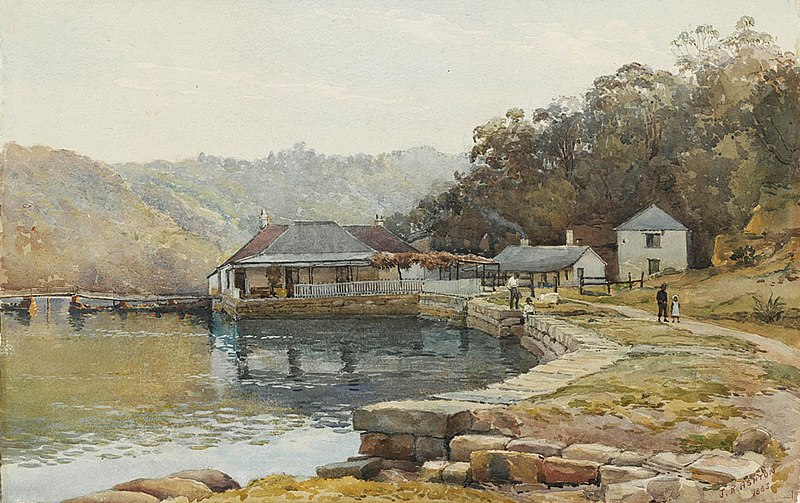
Mosman's Bay, Sydney, Australia, 1883, Julian Rossi Ashton, watercolour, exhibited at the All Australian Art Exhibition, Australia's 150th Anniversary Celebrations, 1938, V1/Har/Mos B/1
Julian Ashton · State Library of New South Wales, V1/Har/Mos
Notes from the source article
Cited by Wikipedia
Notes from the source article
These works are cited by the source article, in its own numbering. They are recorded as its citations, not as sources VALÉORINE has verified.
- 1.Ashton, Thomas Briggs. On the Arno at Florence. artsearch.nga.gov.au.
- 2.Dictionary of Australian Biography Julian Rossi Ashton 0-dict-biogA.html#ashton2
- 3.Adlib Internet Server 5 – Details. acms.sl.nsw.gov.au.
- 4.The Cornishman 28 March 1889
- 5.Fink, Theodore. Julian Ashton's story of his life. The Herald. 16. 21 June 1941.
- 6.National Library of Australia. Julian Ashton Was Artists' Guide & Friend. The Courier-Mail. 4. 29 April 1942.
- 7.Harper, Katherine. 'Ashton, Julian Rossi (1851–1942)', Australian Dictionary of Biography, National Centre of Biography, Australian National University, accessed 30 April 2013
- 8.Mr. J. R. Ashton. Table Talk. 5. 24 April 1891.
- 9.Death of veteran artist. The Advertiser. 7. 29 April 1942.
- 10.Kusko, Julie. The same spot today. The Australian Women's Weekly. 33. 28 January 1970.
- 11.Gray,193.
- 12.Mr Julian Ashton: 80th birthday. The Sydney Morning Herald. 27 January 1931.
- 13.cite NSW SHR 5053171 Julian Ashton Art School hr=01556 access-date=14 October 2018
- 14.Family notices. The Sydney Morning Herald. 1. 6 March 1895.
- 15.Social chat of the day. The Newsletter: An Australian Paper For Australian People. 16. 192. 8. 18 May 1918.
- 16.Sister artists. News. V. 644. 5 (Home addition). 17 August 1925.
- 17.Death of Mr Hubble. The Propeller. XXXIX. 1979. 3. 24 February 1949.
- 18.Men and women. The Sun. 3970. 6. 24 July 1923.
- 19.Artist Group. News. 46. 7,007. 7. 16 January 1946.
- 20.Family Notices. The Sydney Morning Herald. 33,793. 16. 15 April 1946.
- 21.Obituary. The Advocate (Australia). 2. 29 April 1942.
- 22.Funeral Of Julian Ashton. The Sun. 10082. 5 (Late final extra). 29 April 1942.
- 23.It's an Honour – Honours – Search Australian Honours. www.itsanhonour.gov.au.
Bibliography printed in the source article · 2
- Gray, Anne. George W Lambert Retrospective – Heroes and Icons. Canberra: National Gallery of Australia, 2007. .
- Lindsay, Norman. The Julian Ashton book. Art in Australia. 1920.
References
Citations
References
Each reference names the institution holding it, so a reader may go to the document itself.
scholarly index
Partially resolvedauthority file
Partially resolvedreference work
Partially resolvedauthority record
Unverified
The Encyclopedia exists whether or not anything is for sale. Corrections are recorded rather than overwritten, and every version of this record is kept. Published 14 August 2026.
Elsewhere in Paintings
18,452 published records in this field, each with its sources named.
- Julia SchmidtArtist
- Julia SolomonoffArtist
- Julia WernickeArtist
- Juliaan TeniersArtist
- Julian BeeverArtist
- Julian E. LeviArtist
- Julian FałatArtist
- Julian HattonArtist
Best supported in this field
For owners
Own a work by Julian Ashton?
A specialist will read what you send and tell you what the house can establish, what it cannot, and whether the object is suited to sale. There is no charge and no obligation. The object stays with you throughout; nothing is shipped to us unless it is arranged in writing beforehand.