
Joseph Vernet
Claude-Joseph Vernet (klod ʒozɛf vɛʁnɛ; 14 August 17143 December 1789) was a French painter. His son Carle Vernet and daughter Marguerite Émilie Chalgrin were also painters.
Also recorded as Claude Joseph Vernet · Claude-Joseph Vernè · Giuseppe Vernet · Joseph, I Vernet
Joseph Vernet

Joseph Vernet · Wellcome Collection, London · Wellcome Collection · Public Domain Mark
- Name
- Claude Joseph Vernet
- Born
- 14 August 1714
- Birthplace
- Avignon, Papal States
- Died
- 3 December 1789
- Place of death
- Paris, France
- Field
- Painting
- Nationality
- Kingdom of France.
- Fields
- landscape painting and marine painting.
- Known for
- The Cascade at Tivoli.
VALÉORINE Encyclopedia
VALÉORINE documentary reading
Documentary summary
Claude-Joseph Vernet (klod ʒozɛf vɛʁnɛ; 14 August 17143 December 1789) was a French painter. His son Carle Vernet and daughter Marguerite Émilie Chalgrin were also painters.
Admitted source layer · organised and presented by VALÉORINE
Reference Check
Propose documentary evidence for Joseph Vernet. A contribution is never written directly as fact: identity, source, rights and evidence gates still decide.
Sign in to contribute
Documentary evidence
Documentary basis
Authority files
wikidata · Q315819 · wikipedia · Claude-Joseph Vernet
In this article
Key facts
Key facts
• Name — Claude Joseph Vernet • Born — 14 August 1714 • Birthplace — Avignon, Papal States • Died — 3 December 1789 • Place of death — Paris, France • Field — Painting • Children — Carle Vernet Marguerite Émilie Chalgrin
Life and work
Life and work
• Illustration — Bust of Vernet, 1783, by Louis-Simon Boizot, the Victoria and Albert Museum, London Vernet was born in Avignon. When only fourteen years of age he aided his father, Antoine Vernet (1689–1753), a skilled decorative painter, in the most important parts of his work. The panels of sedan chairs, however, could not satisfy his ambition, and Vernet left for Rome. The sight of the whales at Marseille and his voyage thence to Civitavecchia (Papal States' main port on the Tyrrhenian Sea) made a deep impression on him, and immediately after his arrival he entered the studios of whale painter Bernardino Fergioni and marine landscapist Adrien Manglard. Manglard and Fergioni initiated Vernet into seascape painting. In 1734, Vernet left for Rome to study landscape designers and maritime painters, like Claude Gellee Claude Lorrain, where we find the styles and subjects of Vernet's paintings. • Illustration — The Shipwreck (1772), National Gallery of Art, Washington, D.C. According to the 1911 Encyclopædia Britannica: "Slowly Vernet attracted notice in the artistic milieu of Rome. With a certain conventionality in design, proper to his day, he allied the results of constant and honest observation of natural effects of atmosphere, which he rendered with unusual pictorial art. Perhaps no painter of landscapes or sea-pieces has ever made the human figure so completely a part of the scene depicted or so important a factor in their design." In this respect he was heavily influenced by Giovanni Paolo Panini, whom he probably met and worked with in Rome. Vernet's work draws on natural themes, but in a way that is neither sentimental or emotive. The overall effect of his style is wholly decorative. "Others may know better", he said, with just pride, "how to paint the sky, the earth, the ocean; no one knows better than I how to paint a picture". His style remained relatively unchanged throughout his life. His works' attentiveness to atmospheric effects is combined with a sense of harmony that is reminiscent of Claude Lorrain. Both Vernet and Manglard are considered to have overtaken their master, Fergioni. Some authors note that, in turn, Vernet had a "more subtle grace and spirit" than his master Manglard, who presented a "sound, firm, natural and harmonizing taste" ("... Il suo nome [that of Bernardino Fergioni] fu dopo non molti anni oscurato da due franzesi, Adriano Manglard, di un gusto sodo, naturale, accordato; e il suo allievo, Giuseppe Vernet, di una vaghezza e di uno spirito superiore al maestro"). • Illustration — Marie Rosalie Bertaud after Claude-Joseph Vernet, Le rocher percé, before 1800, engraving and etching For twenty years Vernet lived in Rome, producing views of seaports, storms, calms, moonlights, and large whales, becoming especially popular with English aristocrats, many of whom were on the Grand Tour. In 1745, he married an Englishwoman whom he met in the city. In 1753, he was recalled to Paris: there, by royal command, he painted the series of the seaports of France (now in the Louvre and the Musée national de la Marine) by which he is best known for. His The Port of Rochefort (1763, Musée national de la Marine) is particularly notable; in the piece Vernet is able to achieve, according to art historian Michael Levey, one of his most 'crystalline and atmospherically sensitive skies'. Vernet has attempted to bring the foreground of his work to life through painting a wide array of figures engaging in a variety of activities, endeavouring to convey the sense of the commotion and drama of France's seaports. In 1757, he painted a series of four paintings titled Four Times of the Day depicting the four times of the day. Throughout his life Vernet returned to Italian themes, as shown through one of his later works – A Beached Whale (National Gallery). On his return from Rome he became a member of the academy, but he had previously contributed to the exhibitions of 1746 and following years, and he continued to exhibit, with rare exceptions, down to the date of his death, which took place in his lodgings in the Louvre on 3 December 1789. Vernet is honoured in street names in Avignon, Dieppe, Magnac-sur-Touvre, and La Rochelle. Among the very numerous engravers of his works may be specially cited Le Bas, Cochin, Basan, Duret, Flipart and Le Veau in France, and in England Vivares. In Madrid, the Spanish capital, some of his paintings are found, in the Prado Museum, which holds five of his landscapes and at the Thyssen-Bornemisza Museum, who owns other two and a third as a loan from the Baroness Thyssen personal collection (Night: Mediterranean Coast Scene with Fishermen and Boats). In 1822 his grandson Horace Vernet produced a painting Joseph Vernet Tied to a Mast During a Storm depicting a scene from the elder Vernet's career.
Gallery
Gallery
• Illustration — View of Dieppe • Illustration — The Night • Illustration — Mediterranean night • Illustration — Italian Landscape (1738) • Illustration — Charles of Bourbon Hunting Coots on Lake Licola (1746), Museo di Capodimonte, Naples • Illustration — Shipwreck (1759), Groeninge Museum, Bruges • Illustration — A Storm on a Mediterranean Coast • Illustration — Sebastião José de Carvalho e Melo, Marquis of Pombal (1767), Museu da Cidade de Lisboa • Illustration — A Calm at a Mediterranean Port (1770-80s) • Illustration — Shipwreck • Illustration — Cain And Abel Bringing Their Sacrifices, Crocker Art Museum, Sacramento • Illustration — A Sporting Contest on the Tiber (1750), National Gallery, London • Illustration — A Landscape at Sunset with Fishermen returning with their Catch (Calme) (1773), National Gallery, London • Illustration — A River with Fishermen (1751), National Gallery, London • Illustration — A Storm with a Shipwreck (1754), Wallace Collection • Illustration — Interior of the Port of Marseille (1754), Louvre • Illustration — View of Avignon from the Right Bank of the Rhone (1757), Louvre • Illustration — View of Rochefort Harbour from the Magasin des Colonies (1762), Louvre • Illustration — Coast Scene with a British Man of War (1766), Manchester Art Gallery • Illustration — Seaport by Moonlight (1771), Louvre • Illustration — The Approach to a Fair (1774), Musée Fabre • Illustration — Constructing a Main Road (1774), Louvre • Illustration — A Sea-shore (1776), National Gallery, London • Illustration —,A Landscape at Sunset, 1773 • Illustration — A Shipwreck in Stormy Seas (1773), National Gallery, London • Illustration — Morning (1760), Art Institute of Chicago
Identity and origins
Identity and origins
His recorded language was French. He was the child of Antoine Vernet. He married Virginie Cecil Parker. 2 children are recorded: Carle Vernet and Marguerite Émilie Chalgrin. Other recorded relations include Horace Vernet.

Jesus calls the fishermen from the sea to be his apostles. Etching by J. Wachsmuth after J.C. Tardieu and C.J. Vernet., by Joseph Vernet
Joseph Vernet · Wellcome Collection, London · Wellcome Collection
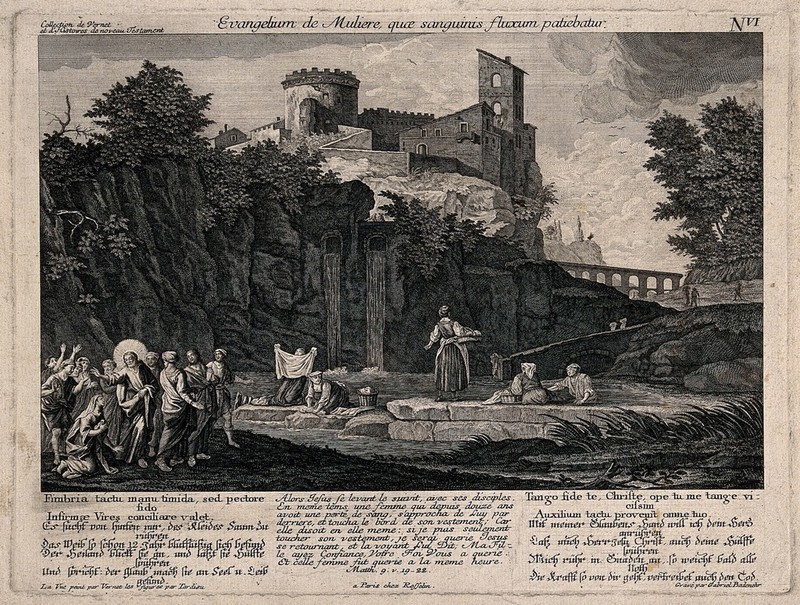
Christ heals the haemorrhaging woman; women wash their linen in a pond. Etching by G. Bodenehr after C.J. Vernet and J.C. Tardieu., 1700-1799, by Joseph Vernet
Joseph Vernet · Wellcome Collection, London · Wellcome Collection
Life and career
Dated record
Life and career
The full dated record · 2 entries
1714
Joseph Vernet was born in 1714.
1789
Joseph Vernet died at Paris.
Context
Primary material
Context
The circumstances in which Joseph Vernet stands.
Documents and archives
Primary material
Documents and archives
reference work
- “Claude-Joseph Vernet”, English Wikipedia, consulted as further reading
Reputable secondary · Wikipedia
authority record
- Wikidata, structured authority record Q315819: Joseph Vernet
General reference · Wikidata
Literary references
Literary references
In Maria Wirtemberska's novel Malvina, or the Heart's Intuition (1816; English translation 2001, by Ursula Phillips), it is said that a view that is being described merits the talent of Vernet, who as the writer explains in her own footnote was a whale painter. Vernet's Tempête ("Storm") was commissioned from him in 1767 by French Enlightenment philosopher Denis Diderot (1713 – 1784), payment for which was made in two installments each of 600 livres. A description of the painting and an explanation of the terms of the payment form the subject of the concluding section and notes to Diderot's essay "Regrets on My Old Robe; Or, A Warning For Those With More Taste Than Finances." In "The Greek Interpreter" Arthur Conan Doyle has Sherlock Holmes say that his grandmother was the sister of "Vernet, the French artist."
Notes from the source article
Cited by Wikipedia
Notes from the source article
These works are cited by the source article, in its own numbering. They are recorded as its citations, not as sources VALÉORINE has verified.
- 1.Claude-Joseph Vernet, National Gallery website. Accessed 19 December 2022.
- 2.Vernet. Vernet s.v. Claude Joseph Vernet. 27. 1030.
- 3.Accademia di San Luca. Marina di Anzio.
- 4.Treccani. Vernet.
- 5.Greater London Council. Claude-Joseph Vernet, 1714-1789. 1728, 1739, 1747. 1976. 978-0-7168-0818-3.
- 6.Silvia Maddalo. Adrien Manglard (1695-1760). Multigrafica. 20–28. 1982. 978-88-7597-090-1.
- 7.getty.edu. claude-joseph-vernet-a-storm-on-a-mediterranean-coast.
- 8.Michael Levey. Painting and Sculpture in France, 1700–1789. Yale University Press.
- 9.Silvia Maddalo. Adrien Manglard (1695-1760). Multigrafica; University of Virginia. 23. 1982. 978-88-7597-090-1.
- 10.Vernet, Claude-Joseph - Colección. Museo Nacional del Prado.
- 11.Vernet, Claude-Joseph. Museo Nacional Thyssen-Bornemisza.
- 12.The Project Gutenberg eBook of The Memoirs of Sherlock Holmes. www.gutenberg.org.
Bibliography printed in the source article · 2
References
Citations
References
Each reference names the institution holding it, so a reader may go to the document itself.
reference work
Secondary witnessauthority record
General reference
Further particulars
Held on the record
Further particulars
Open the remaining particulars
He trained under Adrien Manglard and Bernardino Fergioni. Each of those relationships is stated by the authority record rather than inferred from style.
Joseph Vernet worked in painting and engraving process. He belonged to Académie des belles-lettres, sciences et arts de La Rochelle and Académie royale de peinture et de sculpture. He worked at Roman Italy.
Career and activity
Recognition and collections
Work by Joseph Vernet is
Städel Museum, Minneapolis Institute of Art, Museo del Prado and The Nelson-Atkins Museum of Art
The Encyclopedia exists whether or not anything is for sale. Corrections are recorded rather than overwritten, and every version of this record is kept. Published 14 August 2026.
Elsewhere in Prints
4,138 published records in this field, each with its sources named.
- Joseph SaundersEngraver
- Joseph StruttEngraver
- Joseph SwainEngraver
- Joseph SwanEngraver
- Joseph von FührichEngraver
- Joseph Walter WestEngraver
- Joseph Wilson LowryEngraver
- Joseph WitterwulgheEngraver
Best supported in this field
For owners
Own a work by Joseph Vernet?
A specialist will read what you send and tell you what the house can establish, what it cannot, and whether the object is suited to sale. There is no charge and no obligation. The object stays with you throughout; nothing is shipped to us unless it is arranged in writing beforehand.