
Josef Stránský
Illustration — Stránský in 1916 • Illustration — Stránský in 1911 Josef Stránský (September 9, 1872 – March 6, 1936) was a Czech conductor, composer, and art collector/dealer who moved to the United States and conducted the New York Philharmonic from 1911 to 1923.
Also recorded as Joseph Stránský · Joseph Stransky
Josef Stránský
![Bain News Service, publisher. Hadley Stransky [between ca. 1915 and ca. 1920] 1 negative: glass; 5 x 7 in. or smaller.](https://upload.wikimedia.org/wikipedia/commons/thumb/b/bd/Hadley_%26_Stransky_LOC_23182953861.jpg/706px-Hadley_%26_Stransky_LOC_23182953861.jpg)
The Library of Congress · This image is available from the United States Library of Congress 's Prints and Photographs division under the digital ID ggbain.25509. This tag does not indicate the copyright status of the attache · Public domain
- Born
- 1872. · Humpolec.
- Died
- 1936. · New York City.
- Nationality
- United States.
- Occupation
- art collector, conductor, composer, art dealer and bandleader.
- Fields
- classical and opera.
- Languages
- Czech.
VALÉORINE Encyclopedia
VALÉORINE documentary reading
Documentary summary
Illustration — Stránský in 1916 • Illustration — Stránský in 1911 Josef Stránský (September 9, 1872 – March 6, 1936) was a Czech conductor, composer, and art collector/dealer who moved to the United States and conducted the New York Philharmonic from 1911 to 1923.
Admitted source layer · organised and presented by VALÉORINE
Note VALÉORINE
Josef Stránský (1872–1936) was an art collector, art dealer and bandleader, among other activities, of American nationality. The art collector was born in Humpolec and died in New York City.
The work spans classical, classical music and opera. Languages used include Czech.
Composed from admitted, traceable facts · 27 September 2026
VALÉORINE
Reference Check
Propose documentary evidence for Josef Stránský. A contribution is never written directly as fact: identity, source, rights and evidence gates still decide.
Sign in to contribute
World of VALÉORINE
Documentary connections
Only confirmed graph relationships appear here. Images are shown only when their identity and reuse rights both pass the documentary gate.
Documentary evidence
Evidence Panel
not yet certified
- Identity
- resolved
- Independent source families
- 0
- Admitted assertions
- 0
- Open conflicts
- 0
Authority files
wikidata · Q2347963 · wikipedia · Josef Stránský
In this article
Biography
Biography
He was born on September 9, 1872, in Humpolec in Bohemia. He worked as a conductor in Prague and Berlin before being selected by the New York Philharmonic to replace Gustav Mahler on Mahler's death in 1911. Some commentators did not see Stránský as a worthy successor to Mahler: the periodical Musical America wrote: After much upheaval, search and negotiation, the New York Philharmonic Society... has engaged Josef Stransky... Without disrespect to Mr. Stransky, there are reasons which cause this circumstance to remind one of Aesop's fable of the mountain in labor which finally brought forth a mouse An article in The New York Times about the appointment began: "The financial backers of the New York Philharmonic Orchestra will be interested to learn that the German artistic world is filled with astonishment over the engagement of Josef Stransky of Berlin as the successor to the late Gustav Mahler", before going on to allege that Stránský was chosen over other candidates such as Oskar Fried and Bruno Walter because of his low financial demands. Becoming the Philharmonic's music director at age 39, Stránský was the youngest conductor to assume the post since Carl Bergmann over a half-century earlier. He married Marie Doxrud (1881–1954), a soprano from Norway, in 1912. During his tenure with the Philharmonic, Stránský received praise for his interpretations of Franz Liszt and Richard Strauss by the prominent critic Henry T. Finck of the New York Evening Post. However, Daniel Gregory Mason expressed his dissatisfaction with what he referred to as "the Wagnerian, Lisztian and Tschaikowskian pap ladled out to us by... Stransky of the Phihamonic Society", and went as far as to call the conductor "a total musical incompetent". In an even more biting critique published in H. L. Mencken's American Mercury Magazine, critic D. W. Sinclair wrote Succeeding one of the greatest figures in modern music, the late Gustav Mahler, Stransky maintained himself for so long, not so much by his musical abilities as by his social charm and personal cleverness. • Illustration — The headstone of Josef Stránský at Woodlawn Cemetery in the Bronx, New York Mahler scholar Henry-Louis de La Grange has characterized Stránský as a "conscientious but uninspiring" leader, who allowed the high performing levels achieved by Mahler to fall. Despite these criticisms leveled at him, in fact Stránský accomplished a great deal with the Philharmonic. He had the widest repertoire of any of the Philharmonic's previous conductors, and during the First World War, his programs shifted subtly to favor English, Russian, and French composers. Stránský also included more Americans than all of his predecessors combined, programming George Chadwick, Arthur Foote, Edward MacDowell, John Knowles Paine, and John Philip Sousa. Nor was Stránský averse to "contemporary" music: he played Respighi, Sibelius, and even his immediate Philharmonic predecessor Mahler, and conducted the American premiere of Schoenberg's Pelleas und Melisande. From his installation in 1911 until the end of the 1919–20 season, Stránský conducted every Philharmonic concert. He conducted the orchestra's first recordings, which were made from January 1917 by the Columbia Graphophone Company, although the deal was only announced in March. He was elected an honorary member of Phi Mu Alpha Sinfonia fraternity, the national fraternity for men in music, in 1917 by the fraternity's Alpha chapter at the New England Conservatory of Music in Boston, Massachusetts. In 1921 the Philharmonic merged with the National Symphony, conducted by Willem Mengelberg. For the 1922–23 season, Stránský conducted the first half of the season and Mengelberg the second: Stránský subsequently left the orchestra.
Art dealer
Art dealer
Stránský ultimately left the musical profession to become an art dealer, specializing in Picasso's Rose Period. He was a partner in the art gallery E. Gimpel & Wildenstein in New York City. The gallery became Wildenstein & Company in 1933. Before his death, Stránský amassed a private art collection that included more than 50 major impressionist and post-impressionist paintings by Picasso, Van Gogh, Gauguin, Renoir, Monet, Manet, Degas, Cézanne, Matisse, Seurat, Toulouse-Lautrec, Pissarro, Sisley, Delacroix, Ingres, Corot, Courbet, Daumier, Derain, Boudin, Modigliani, Segonzac, Fantin-Latour, Vuillard, Utrillo, Vlaminck, Guys, Laurencin, Rouault, Gromaire, and others. He also owned a large collection of old master paintings, and was a recognized authority on the old masters. Had this group of works remained intact and in private hands, today it would be one of the most valuable privately held art collections in the world. Recently, Stránský was discovered to have owned for many years a 1785 painting by Nicolas Benjamin Delapierre that may be the earliest known portrait of Thomas Jefferson. It was sold by the estate of his widow (Marie D. Stransky) in October 1954. Stránský died in New York City on March 6, 1936, and is buried at Woodlawn Cemetery in the Bronx, New York City.
Life and career
Dated record
Life and career
The full dated record · 1 entries
1936
Josef Stránský died at New York City.
Places
Named by the record
Places
Only places the record itself states, plotted where the house gazetteer settles their coordinates. Nothing is inferred from a name or a nationality.
Humpolec.
Birth place
New York City.
Death place
Primary material
Documents and archives
reference work
- “Josef Stránský”, English Wikipedia, consulted as further reading
Reputable secondary · Wikipedia
authority record
- Wikidata, structured authority record Q2347963: Josef Stránský
Unverified · Wikidata
References ==== Bibliography
• Horowitz, Joseph. Classical Music in America. A History of Its Rise and Fall, W.W. Norton and Company, New York 2005, • Lyman, Darryl. Great Jews in Music, J. D. Publishers, Middle Viollage, N.Y. 1986. • Sadie, Stanley. The New Grove Dictionary of Music and Musicians. Macmillan, London 1980. • Sendrey, Alfred. Bibliography of Jewish Music, Columbia University Press, New York 1951.
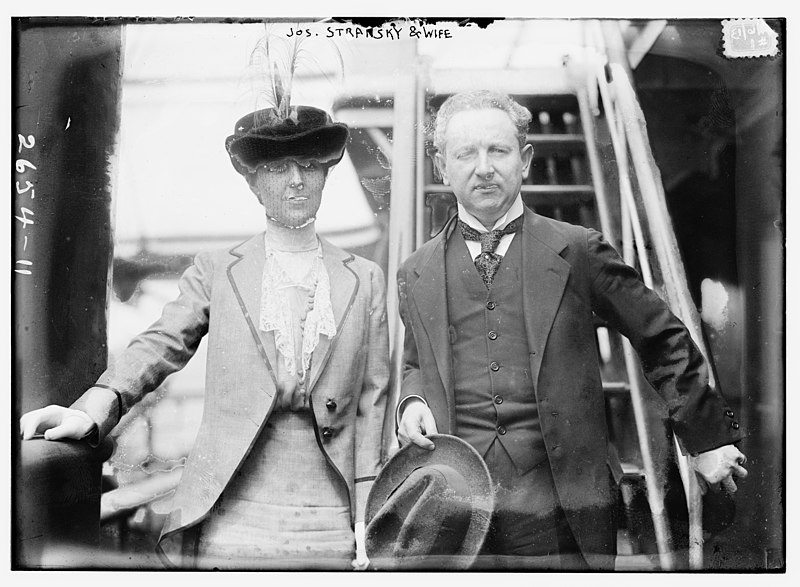
Jos. Stransky wife Abstract/medium: 1 negative: glass; 5 x 7 in. or smaller.
Bain News Service, publisher · Library of Congress Catalog: https: Image download: https: Original url

J. Stransky Abstract/medium: 1 negative: glass; 5 x 7 in. or smaller.
Bain News Service, publisher · Library of Congress Catalog: https: Image download: https: Original url
Notes from the source article
Cited by Wikipedia
Notes from the source article
These works are cited by the source article, in its own numbering. They are recorded as its citations, not as sources VALÉORINE has verified.
- 1.Rottenberg, Dan. Finding Our Fathers: A Guidebook to Jewish Genealogy. Genealogical Pub. Co. 350. 1986. 0-8063-1151-7.
- 2.Huneker, James. Variations. C. Scribner's Sons. 196. 1921. 397819.
- 3.Horowitz (2005), p. 195
- 4.Josef Stransky Attacked. German Review Criticises New Philharmonic Orchestra Conductor. The New York Times. July 4, 1911.
- 5.Finck, Henry Theophilus. Richard Strauss, the Man and His Works. Little, Brown and Co. 130. 1917. 645950.
- 6.Toff, Nancy. Monarch of the Flute: The Life of Georges Barrere. Oxford University Press. 237. 2005. 0-19-517016-4.
- 7.Sinclair, D. W. Six Orchestral Conductors. The American Mercury. Kessinger Publishing. 1. 3. 285. March 1924. 978-0-7661-6475-8.
- 8.de la Grange, Henry-Louis. On Mahler and Britten: Essays in Honour of Donald Mitchell on his Seventieth Birthday. Boydell Press. 77. 1995. 0-85115-614-2.
- 9.Josef Stransky. nyphil.org.
- 10.Horowitz (2005), p. 278
- 11.Important Columbia Deal. The Music Trade Review. LXIV. 9. 48. March 3, 1917.
- 12.Josef Stransky. Discography of American Historical Recordings (DAHR).
- 13.FitzGerald, Michael C. Making Modernism: Picasso and the Creation of the Market for Twentieth Century Art. University of California Press. 224. 1996. 0-520-20653-3.
- 14."The Private Collection of Josef Stransky", The Art News, Volume XXIX, Number 33, New York, May 16, 1931, pp. 86-117.
- 15.From Maud Dale's introduction to "The Private Collection of Josef Stransky," The Art News, Volume XXIX, Number 33, New York, May 16, 1931, pp. 86-117: "Josef Stransky retired at the height of his musical career in order to devote himself entirely to the fine arts. His hobby became his profession and his profession his hobby. A serious student of painting since his early youth, he is now known not only as a collector and fine judge of modern pictures but he has become a recognized authority on the works of the old masters." Then, from Ralph Flint's segment of the introduction: "...long before he ever dreamed of occupying a seat on the New York Art Exchange, Stransky was a collector. Even in his student days when music was his ruling passion the acquisitive urge proved so irresistible that on one occasion he spent his entire holdings for a coveted painting. How many times he has repeated that early performance it would be difficult to say. ...today the Stransky collection stands as one of the finest, most comprehensively selected sequences of French art of the XVIIIth, XIXth, and XXth centuries that is to be met with either here or abroad. Considering the wide range and completeness of the Stransky collection it can only be hoped that it will be kept together in the years to come, for it should stand intact as a fitting memorial to a great collector and art lover."
- 16."Is this Jefferson?" isthisjefferson.org Accessed 4 February 2013.
Bibliography printed in the source article · 4
- Horowitz, Joseph. Classical Music in America. A History of Its Rise and Fall, W.W. Norton and Company, New York 2005,
- Lyman, Darryl. Great Jews in Music, J. D. Publishers, Middle Viollage, N.Y. 1986.
- Sadie, Stanley. The New Grove Dictionary of Music and Musicians. Macmillan, London 1980.
- Sendrey, Alfred. Bibliography of Jewish Music, Columbia University Press, New York 1951.
References
Citations
References
Each reference names the institution holding it, so a reader may go to the document itself.
reference work
Partially resolvedauthority record
Unverified
The Encyclopedia exists whether or not anything is for sale. Corrections are recorded rather than overwritten, and every version of this record is kept. Published 14 August 2026.
Elsewhere in Music memorabilia
42,307 published records in this field, each with its sources named.
- Josef SieberPerson
- Josef SlavíkPerson
- Josef ŠpačekPerson
- Josef StarzerPerson
- Josef SukPerson
- Josef SzulcPerson
- Josef TalPerson
- Josef TriebenseePerson
Best supported in this field
For owners
Own a work by Josef Stránský?
A specialist will read what you send and tell you what the house can establish, what it cannot, and whether the object is suited to sale. There is no charge and no obligation. The object stays with you throughout; nothing is shipped to us unless it is arranged in writing beforehand.