
José Arpa
José Arpa y Perea (1858–1952), was an artist of Spanish birth who worked in Spain, Mexico, and Texas and was noted for his Costumbrista studies and his landscapes of Texas.
Also recorded as Jose Arpa Y Perea · José Arpa Perea · José Arpa y Perea · José Arpa y Pérez
José Arpa

Vogt Auction · Public domain
- Name
- José Arpa y Perea
- Born
- 19 February 1858
- Birthplace
- Carmona, Spain
- Died
- October 1952 (aged 94)
- Place of death
- Seville, Spain
- Known for
- Landscape Painting
- Training
- Academia Real des Bellas Artes, Seville; Eduardo Cano; Academia des Bellas Artes, Rome
- Movement
- Early Texas, Costumbrista
- Nationality
- United States and Spain.
- Occupation
- painter.
- Fields
- landscape painting.
- Education
- Royal Academy of Fine Arts of Saint Isabel of Hungary.
VALÉORINE Encyclopedia
VALÉORINE documentary reading
Documentary summary
José Arpa y Perea (1858–1952), was an artist of Spanish birth who worked in Spain, Mexico, and Texas and was noted for his Costumbrista studies and his landscapes of Texas.
Admitted source layer · organised and presented by VALÉORINE
Note VALÉORINE
José Arpa (1858–1952) was a Spanish and American painter. Born in Carmona, the painter died in Seville. José Arpa was also known as Arpa y Perea, Jose and Arpa, Jose. José Arpa was active in landscape painting.
Languages used include Spanish. Works by the painter are held at Dallas Museum of Art.
Composed from admitted, traceable facts · 26 September 2026
VALÉORINE
Reference Check
Propose documentary evidence for José Arpa. A contribution is never written directly as fact: identity, source, rights and evidence gates still decide.
Sign in to contribute
World of VALÉORINE
Documentary connections
Only confirmed graph relationships appear here. Images are shown only when their identity and reuse rights both pass the documentary gate.
Documentary evidence
Documentary basis
Authority files
wikidata · Q11685731 · wikipedia · José Arpa
In this article
Biography
Biography
José Arpa studied at Royal Academy of Fine Arts of Saint Isabel of Hungary. The recorded working language is Spanish. The field of work recorded is landscape painting. Work by José Arpa is recorded in the collections of Dallas Museum of Art.

Óleo sobre lienzo (1879)
Jl FilpoC
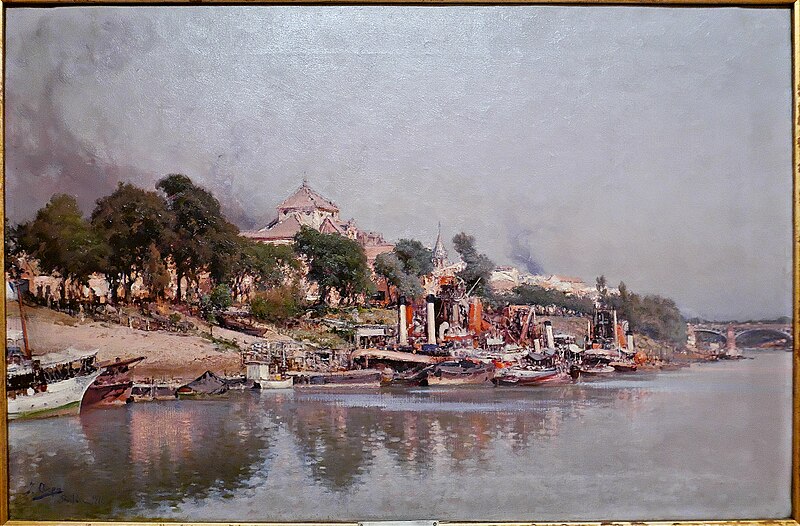
Colección Bellver. Panorámica de Triana, óleo sobre lienzo.
Jl FilpoC
Key facts
Key facts
• Name — José Arpa y Perea • Nocat Wdimage — yes • Born — 19 February 1858 • Birthplace — Carmona, Spain • Died — October 1952 (aged 94) • Place of death — Seville, Spain • Known for — Landscape Painting • Training — Academia Real des Bellas Artes, Seville; Eduardo Cano; Academia des Bellas Artes, Rome • Movement — Early Texas, Costumbrista
Life and career
Life and career
Arpa was born in Carmona, Spain on 19 February 1858, into a very modest family. His father was a cobbler. He displayed a talent for drawing at a young age and was apprenticed to a local painter and decorator. In 1868, he was sent to Seville to study at the Academia Real des Bellas Artes (The Royal Academy of Fine Arts). There, he worked as a house painter during the day, and attended art classes in the evenings. Later, he studied under Eduardo Cano at the Museum of Fine Arts of Seville, where he won the Rome Prize three times, allowing him to study at the Academia des Bellas Artes in Rome. On his return to Seville, he found that the internationally renowned Spanish painter, Marià Fortuny was also working in Seville at the same time. Although the pair probably never met, Fortuny became a major influence on Arpa's work. On account of that influence, he developed a preference for 'plein air' paintings of typical Spanish subjects, which at the time was known in Spain as 'costumbrismo'. He remained in Seville for nine years, where he made many paintings, sketches and also completed a series of ceiling decorations in the Circulo Mercantil Sevilla (Seville Mercantile Building). In late 1895 or early 1896, by which time he had become an established artist, Arpa sailed from Spain to Vera Cruz, Mexico and from there travelled to Texas. During his years in San Antonio, Texas he organized summer painting camps and influenced many painters, most notably Xavier Gonzalez, Octavio Medellín, and Porfirio Salinas. He was a founding member of the "Brass Mug Club", a group of artists that also included Julian Onderdonk, Rolla Taylor, and Ernst Raba. In 1923, Arpa opened a studio and art school in San Antonio, TX teaching landscape and portrait painting. He often took groups of students out into the hill country around the city to paint. Arpa exhibited and sold paintings in each of the places where he lived. In 1932, he returned to Seville where he stayed until his death in 1952, at age ninety-four. Murals by Arpa were hung in the lobby of the San Antonio Express-News building in downtown San Antonio. Some of Arpa's paintings can be found in permanent collections at the San Antonio Museum of Art, the McNay Art Museum, and the Panhandle-Plains Historical Museum in Canyon, Texas.
Work
Work
• Illustration — "Muerte de Miguel de Mañara" (c. 1885) He painted in a realistic style, and was especially noted for his use of brilliant colors and his expertise in capturing the visual effects of sunlight. His work has been widely exhibited; ten of his paintings are in the collection of the San Antonio Museum of Art. He has been described both as an Orientalist and a Spanish impressionist. Select list of works • Puenta de Sevilla en Carmona Spain, Sketch • Carnival De Ichu, [Peruvian Festival], Watercolor • Escena Callejera, [Alley Scene], Watercolor • El Monasterio, [The Monastery], Pencil drawing • Ciudad italiana, [Italian City], Ink drawing • Andalusian Woman with Guitar, Oil on canvas • Cactus Flowers, Oil on canvas • Sevilla, Oil on canvas • Illustration — alt=Jose Arpa, Self Portrait, c. 1927, etching on paper Jose Arpa, Self Portrait, c. 1927, etching on paper • Illustration — alt=Along the Road, oil on board Along the Road, oil on board
Places
Named by the record
Places
Only places the record itself states, plotted where the house gazetteer settles their coordinates. Nothing is inferred from a name or a nationality.
Carmona.
Birth place
Seville.
Death place
Primary material
Documents and archives
reference work
- “José Arpa”, English Wikipedia, consulted as further reading
Reputable secondary · Wikipedia
authority record
- Wikidata, structured authority record Q11685731: José Arpa
General reference · Wikidata
Notes from the source article
Cited by Wikipedia
Notes from the source article
These works are cited by the source article, in its own numbering. They are recorded as its citations, not as sources VALÉORINE has verified.
- 1.Mantle Fielding. 1945. Dictionary of American Painters, Sculptors and Engravers. New York: Struck, 1945; revised in 1983, Glenn B. Opitz, ed. Poughkeepsie, N.Y.: Apollo Books.
- 2.Caroline Remy. 2011. "ARPA, JOSE," Handbook of Texas Online (https://www.tshaonline.org/handbook/online/articles/far17), accessed September 25, 2011. Published by the Texas State Historical Association.
- 3.Jacinto Quirarte. 1973. Mexican American Artists. Austin: University of Texas Press.
- 4.Remy, 2011.
- 5.Caso, E. D., Les Orientalistes de l'Ecole Espagnole, ACR edition, 1997, p. 272
- 6.Allen, Paula. Artist's summer camps drew society painters. San Antonio Express-News. 2016-08-21.
- 7.Ruth Goddard. 1975. Porfirio Salinas. Austin: Rock House Press.
- 8.Texas Artist: José Arpa. Vogt Auction.
- 9.Frances Battaile Fisk. 1928. A History of Texas Artists and Sculptors. Abilene, Tex.: privately printed; reprinted by Morrison Books, Austin, Tex., 1986.
- 10.Texas Artist: Jose Arpa. Vogt Auction Galleries.
References
Citations
References
Each reference names the institution holding it, so a reader may go to the document itself.
reference work
Secondary witnessauthority record
General reference
The Encyclopedia exists whether or not anything is for sale. Corrections are recorded rather than overwritten, and every version of this record is kept. Published 18 August 2026.
Elsewhere in Paintings
18,792 published records in this field, each with its sources named.
- José Antonio BurciagaArtist
- José Antonio Gómez RosasArtist
- José AparicioArtist
- José ArgüellesArtist
- José ArrueArtist
- José BalacaArtist
- José BalmesArtist
- José Bedia ValdésArtist
Best supported in this field
For owners
Own a work by José Arpa?
A specialist will read what you send and tell you what the house can establish, what it cannot, and whether the object is suited to sale. There is no charge and no obligation. The object stays with you throughout; nothing is shipped to us unless it is arranged in writing beforehand.