
Jón Arason
Jón Arason, by Guðmundur Einarsson, in Munkaþverá Jón Arason (1484 – November 7, 1550) was an Icelandic Roman Catholic bishop and poet, who was executed in his struggle against the Reformation in Iceland.
Also recorded as Jon Arason
Jón Arason

Christian Bickel · CC BY-SA 2.0 de
- Name
- Jón Arason
- Born
- 1484
- Birthplace
- Gryta, Iceland
- Died
- 7 November 1550
- Place of death
- Skalholt, Iceland
- Nationality
- Iceland
- Occupation
- poet · translator · writer · catholic priest · bishop
- Languages
- Icelandic
VALÉORINE Encyclopedia
VALÉORINE documentary reading
Documentary summary
Jón Arason, by Guðmundur Einarsson, in Munkaþverá Jón Arason (1484 – November 7, 1550) was an Icelandic Roman Catholic bishop and poet, who was executed in his struggle against the Reformation in Iceland.
Admitted source layer · organised and presented by VALÉORINE
Note VALÉORINE
Jón Arason (1484–1550) was an Icelandic bishop, catholic priest and poet, among other activities. Born in Eyjafjörður, the bishop died in Skálholt. Jón Arason held the position of diocesan bishop. Languages used include Icelandic.
Composed from admitted, traceable facts · 26 September 2026
VALÉORINE
Reference Check
Propose documentary evidence for Jón Arason. A contribution is never written directly as fact: identity, source, rights and evidence gates still decide.
Sign in to contribute
World of VALÉORINE
Documentary connections
Only confirmed graph relationships appear here. Images are shown only when their identity and reuse rights both pass the documentary gate.
Documentary evidence
Documentary basis
Authority files
wikidata · Q382167 · wikipedia · Jón Arason
In this article
Key facts
Key facts
• Type — Bishop • Honorific Prefix — The Right Reverend • Name — Jón Arason • Title — Bishop of Hólar • Church — Roman Catholic • Diocese — Hólar • Appointed — 22 December 1520 • Term — 1524–1550 • Term Start — 1524 • Term End — 7 November 1550 • Predecessor — Gottskálk grimmi Nikulásson • Successor — Ólafur Hjaltason • Ordination — 1504 • Consecration — 1524 • Consecrated By — Olav Engelbrektsson • Born — 1484 • Birthplace — Gryta, Iceland • Died — 7 November 1550 • Place of death — Skalholt, Iceland • Illustration — Statue of Jón Arason, by Guðmundur Einarsson, in Munkaþverá Jón Arason (1484 – November 7, 1550) was an Icelandic Roman Catholic bishop and poet, who was executed in his struggle against the Reformation in Iceland.
Background
Background
Jón Arason was born in Gryta, educated at Munkaþverá, the Benedictine abbey of Iceland, and was ordained a Catholic priest about 1504. Having attracted the notice of Gottskálk Nikulásson bishop of Hólar, he was sent on two missions to Norway. When Gottskálk died in 1520, Jón Arason was chosen as his successor in the episcopal see of Hólar, but he was not officially consecrated until 1524. The other Icelandic bishop, Ögmundur Pálsson of Skálholt, had strongly opposed Jón and even attempted to arrest him in 1522, but Jón managed to escape Iceland on a German ship. The two bishops were eventually reconciled in 1525. Bishop Ögmundur later opposed the imposition of Lutheranism to Iceland, but being old and blind by that time his opposition was ineffective. Clerical celibacy was practiced in medieval Iceland only in the sense that priests did not marry their partners, and Jón Arason had at least nine children by his long-time partner Helga Sigurðardóttir, of whom six lived to adulthood: sons Ari, Björn, Magnús and Sigurður and daughters Þórunn and Helga. Helga Sigurðardóttir brought important allies for Jón through her family connections, as her father Sigurðar Sveinbjarnarson was a powerful priest at Múli in Aðaldalur. In 1522, Jón officially adopted four of his children as his heirs: Ari, Björn, Magnús and Þórunn.
Struggle with the king
Struggle with the king
Bishop Jón became involved in a dispute with his sovereign, King Christian III, because of the bishop's refusal to promote Lutheranism on the island. Although initially he took a defensive rather than an offensive position on the matter, this changed radically in 1548. At that point he and Bishop Ögmundur joined their forces to attack the Lutherans. Bishop Ögmundur's contribution did not last, however, because of his infirmities, and he quickly faced exile to Denmark. Jón's continued resistance is thought to have come from a primitive sense of nationalism and raw ambition as much as religion. He resented the Danes' changing the religious landscape of Iceland and felt the island's culture would be less disrupted by staying Catholic. Jón took encouragement from a letter of support from Pope Paul III in continuing his efforts against the Lutheran cause and fighting for a Catholic Iceland. In this struggle Jón had the help of his illegitimate children, who fought with him in various battles. However, at the Battle of Sauðafell, Jón and two of his sons, Ari and Björn, were captured by his greatest adversary, Daði Guðmundsson. The three were taken prisoner and handed over to the king's bailiff. According to legends, on hearing of Jón's capture, one of his daughters rallied her forces to save him, but her efforts proved unsuccessful. In 1550, Jón, Ari, and Björn were beheaded, ending his campaign for a Catholic Iceland. Christian Skriver, the king's bailiff who pronounced the bishop's death sentence, was later killed by fishermen who favored Jón's cause; they were rumoured to have been persuaded to assassinate him by Jón's powerful and wealthy daughter Þórunn Jónsdóttir. Skriver's death was as much personal revenge for Jón's death as it was born of any sectarian strife between Catholics and Lutherans.
Places
Named by the record
Places
Only places the record itself states, plotted where the house gazetteer settles their coordinates. Nothing is inferred from a name or a nationality.
Eyjafjörður.
Birth place
Skálholt.
Death place
Legacy
• Illustration — Memorial at the place of execution of Jon Arason, in Skálholt, south Iceland Legends claim that as he was about to be beheaded, a priest called Sveinn was by his side to offer him comfort. Sveinn told Jón: Líf er eftir þetta, herra! ("There is a life after this one, Sire!") Jón turned to Sveinn and said: Veit ég það, Sveinki! ("That I know, little Sveinn!") Ever since veit ég það, Sveinki has been a part of the Icelandic treasury of sayings, in this case meaning that something totally obvious has been stated. Gunnar Gunnarsson wrote Jón Arason (Copenhagen: Gyldendal, 1930), a fictionalized account of the life of Jón. Originally written in Danish, the book has been translated into other languages, including English.

Monument, Jón Arason, Skálholt, Iceland
Bromr · Bromr at Dutch Wikipedia
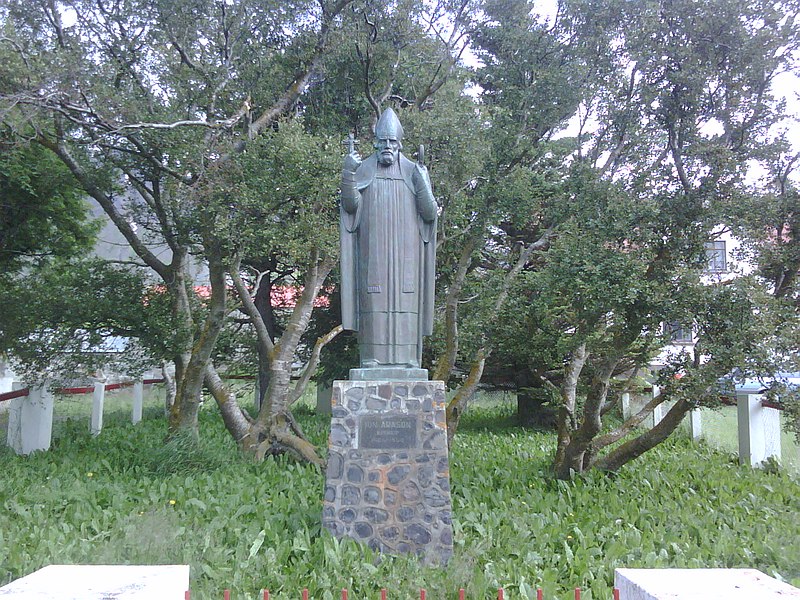
Statue of Jón Arason, by Guðmundur Einarsson, in Munkaþverá
Pietro
Primary material
Documents and archives
reference work
- “Jón Arason”, English Wikipedia, consulted as further reading
Reputable secondary · Wikipedia
authority record
- Wikidata, structured authority record Q382167: Jón Arason
General reference · Wikidata
Notes from the source article
Cited by Wikipedia
Notes from the source article
These works are cited by the source article, in its own numbering. They are recorded as its citations, not as sources VALÉORINE has verified.
- 1.Þjóðminjasafn Íslands. Kórkápa Jóns biskups Arasonar.
- 2.Arason, Jon. 320.
- 3.Aftaka Jóns biskups Arasonar og atburðir á Suðurnesjum. Ferlir. September 2, 2004.
- 4.Ýmsir höfundar. Jón Arason í vitund Íslendinga.
- 5.Saga. Minjar í hættu. 22 September 2013.
- 6.icelandic roots. The Beheading of Jón Arason.
Bibliography printed in the source article · 1
References
Citations
References
Each reference names the institution holding it, so a reader may go to the document itself.
reference work
Secondary witnessauthority record
General reference
The Encyclopedia exists whether or not anything is for sale. Corrections are recorded rather than overwritten, and every version of this record is kept. Published 17 August 2026.
Elsewhere in Books
39,285 published records in this field, each with its sources named.
- Jojo MoyesAuthor
- Joko PinurboAuthor
- Jolanda InsanaAuthor
- Jolanta PytelAuthor
- Jón ÁrnasonAuthor
- Jon FosseAuthor
- Jón GuðmundssonAuthor
- Jón HelgasonAuthor
Best supported in this field
For owners
Own a work by Jón Arason?
A specialist will read what you send and tell you what the house can establish, what it cannot, and whether the object is suited to sale. There is no charge and no obligation. The object stays with you throughout; nothing is shipped to us unless it is arranged in writing beforehand.