
John William North
Illustration — An Old Bowling Green (Halsway Manor, Somerset) (1865). Watercolour, British Museum John William North (London 1 January 1842 – 20 December 1924 Stamborough, Somerset) was a British landscape painter, mainly in watercolour, and illustrator, a prominent member of the Idyllists.
Also recorded as J. W. North
John William North
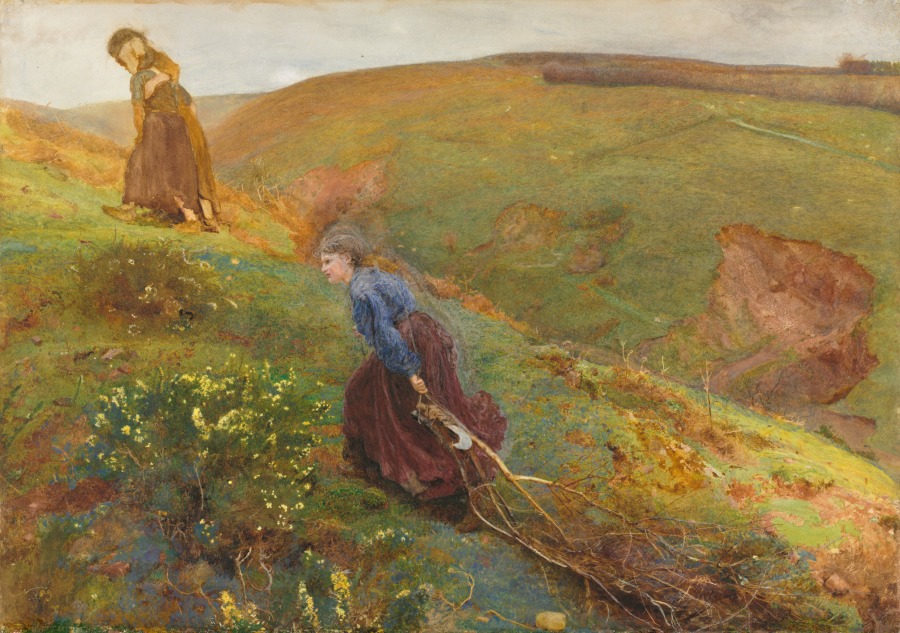
John William North · The Cleveland Museum of Art · Gift in memory of Helen Borowitz · CC0
- Born
- 1842 · London.
- Nationality
- United Kingdom of Great Britain and Ireland
- Occupation
- painter · illustrator · draftsperson · watercolorist · artist
- Fields
- landscape
- Movements
- Idyllic school
- Languages
- English
VALÉORINE Encyclopedia
VALÉORINE documentary reading
Documentary summary
Illustration — An Old Bowling Green (Halsway Manor, Somerset) (1865). Watercolour, British Museum John William North (London 1 January 1842 – 20 December 1924 Stamborough, Somerset) was a British landscape painter, mainly in watercolour, and illustrator, a prominent member of the Idyllists.
Admitted source layer · organised and presented by VALÉORINE
Note VALÉORINE
John William North (1842–1924) was an artist, draftsperson and illustrator, among other activities, of British nationality. The artist was born in London.
John William North was a member of Royal Academy of Arts. The artist was associated with Idyllic school.
The work spans landscape. Languages used include English. Works are held at Manchester Art Gallery, National Gallery and National Gallery of Victoria, among others.
Composed from admitted, traceable facts · 01 October 2026
VALÉORINE
Reference Check
Propose documentary evidence for John William North. A contribution is never written directly as fact: identity, source, rights and evidence gates still decide.
Sign in to contribute
World of VALÉORINE
Documentary connections
Only confirmed graph relationships appear here. Images are shown only when their identity and reuse rights both pass the documentary gate.

Documentary evidence
Documentary basis
Authority files
wikidata · Q6264235 · wikipedia · John William North
In this article
Biography
Biography
The recorded working language is English. Subjects and genres recorded for the work are landscape. Work by John William North is recorded in the collections of National Gallery of Victoria, Tate, National Gallery, Yale Center for British Art and Walker Art Gallery.
• Illustration — The Wood Gatherers, watercolour, 1869, Cleveland Museum of Art • Illustration — Spring, watercolour, Metropolitan Museum of Art, New York. North was born in Walham Green in London, England. His father Charles North was a draper who together with his wife Fanny kept a shop in the area. They had three children apart from John – Charles, Fanny and Alfred. Little is known of John's early schooling, although he claimed to have been an avid reader from the age of 6 years. He left school at the age of 12. Due to a downturn in business, John's father was forced to shut up shop and relocate the business to Worthing (on the Sussex coast). After the business failed again, John's parents decided to emigrate with the youngest son Alfred to Canada. It is thought that John (then 14) and his two siblings, Charles and Fanny, were looked after by various relatives including an uncle in Walham Green, and a great uncle who owned a farm near Kimpton in Hertfordshire. He showed artistic ability at a young age and received some training at art school as well as instruction from a local artist called Hackman. At the age of 10 he completed his first watercolour, The Thames from Wandsworth, which was subsequently exhibited by the Royal Watercolour Society in 1919. A number of other watercolours and sketches were also completed in his teens. At the age of 16, he was apprenticed to produce illustrations for the notable London-based wood engraver Josiah Whymper. There North became friends with Frederick Walker, Arthur Boyd Houghton and George John Pinwell, who would later become associated with the Idyllic school. He worked – using a brush and pencil – on black and white illustrations for various publications, gaining a reputation for the quality of his landscapes. In 1868 he moved to Somerset, renting a room at Halsway Manor near Crowcombe – his friend and fellow artist Frederick Walker also lived there. North's vivid watercolour of Halsway Manor, from 1865, is in the British Museum, London. In 1866 North's parents returned from Canada and he became the main provider for the whole family. North moved to the village of Woolston in 1869. The period 1860–67 brought both artistic success as an illustrator and financial security. North was also developing his skill as a watercolourist, so much so that in 1867 he decided to pursue his painting full-time and abandon his illustration work. He made his debut at the Royal Academy in 1869 with four watercolours, including The Wood Gatherers (1869; Cleveland Museum of Art). In the subsequent years up to 1887, he divided his time painting between Somerset, a studio in London, and a house in Algeria. North exhibited at the Grosvenor Gallery and the New Gallery and was a member of Arts Club. He was eventually accepted as a member of the Royal Watercolour Society (RWS) and an associate of the Royal Academy (ARA). In 1884 North married the 21-year-old Selina Weetch at Bicknoller Church in Somerset, setting up home in Beggearn Huish House in Nettlecombe. They went on to have six children, including Roland Arthur Charles North. Selina died in 1898. North became friends with the essayist Richard Jefferies in 1883 until the latter's death in 1887. Subsequently, North was involved in setting up a fund for Jefferies' widow and family, and invited them to stay at his home in Somerset, even arranging for the education of Jefferies' son Harold. In 1895, North started the O.W. Paper & Arts Co. featuring fine papers for art printing and watercolor. In personality and politics North was a liberal, publicly championing the cause of social justice for the agricultural labouring class. He opposed the enclosure of common lands, campaigned for decent rural sanitation and for social housing. North died at Stamborough, Somerset in 1924, and is buried in the New Cemetery at Nettlecombe.
Art
Art
• Illustration — The house of roses, Tripoli The term "idyllist" is more properly applied to North's earlier black and white landscapes, which were driven by the necessity to illustrate a particular literary narrative. His later watercolour work was certainly not idyllist in the nostalgic, "chocolate-box art" sense of the word, but attempted to evoke a sense of spiritual communion with nature. In this North owed a lot to his friend Richard Jefferies, and biographer Herbert Alexander noted that North had to be in the right state of mind before he would start a painting. In 1895, North helped to develop a new, kind of linen-based art paper that was extraordinarily durable and ideally suited to the demands of the watercolourist. He experimented with this paper for the rest of his life and was able to develop a very detailed painting style using ordinary watercolor paint and no gouache. He built up his forms by applying the paints in very small dots and touches of pure colour – a technique predating pointillism by a decade.
Life and career
Dated record
Life and career
The full dated record · 2 entries
1842
John William North was born on 1 January 1842.
1924
John William North died on 20 December 1924.
Primary material
Documents and archives
reference work
- “John William North”, English Wikipedia, consulted as further reading
Reputable secondary · Wikipedia
authority record
- Wikidata, structured authority record Q6264235: John William North
General reference · Wikidata
Notes from the source article
Cited by Wikipedia
Notes from the source article
These works are cited by the source article, in its own numbering. They are recorded as its citations, not as sources VALÉORINE has verified.
- 1.B/w illustrations by North (southwilts.com).
- 2.OWP Paper (baph.org.uk).
- 3.J W North Working Notes (southwilts.com)
- 4.J W North (Victorian web)
- 5.Victorian watercour painters (handprint.com)
Bibliography printed in the source article · 4
- Herbert Alexander, John William North, A.R.A., R.W.S. (Old Watercolour Society's Club Fifth Annual Volume, 1927-8)
- Hubert von Herkomer, 'J. W. North, A.R.A., R.W.S., Painter-Poet', Magazine of Art, July–August 1893, pp. 297–300, 342–48.
- Marcus B. Huish, British Watercolour art (London: Fine Art Society; Adam & Charles Black, 1904), p157 ff.
- Donato Esposito, 'John William North (1842–1924)', in Frederick Walker and the Idyllists (London: Lund Humphries, 2017), pp. 91–111.
References
Citations
References
Each reference names the institution holding it, so a reader may go to the document itself.
reference work
Secondary witnessauthority record
General reference
Further particulars
Held on the record
Further particulars
Open the remaining particulars
John William North is recorded as painter, illustrator, draftsperson, watercolorist and artist.
Recognition and collections
Work by John William North is
National Gallery of Victoria, Tate, National Gallery and Yale Center for British Art
The Encyclopedia exists whether or not anything is for sale. Corrections are recorded rather than overwritten, and every version of this record is kept. Published 18 August 2026.
Elsewhere in Paintings
19,126 published records in this field, each with its sources named.
- John William BeattyArtist
- John William GodwardArtist
- John William InchboldArtist
- John William LewinArtist
- John William WaterhouseArtist
- John Wollaston the YoungerArtist
- John Wood DodgeArtist
- John Young JohnstoneArtist
Best supported in this field
For owners
Own a work by John William North?
A specialist will read what you send and tell you what the house can establish, what it cannot, and whether the object is suited to sale. There is no charge and no obligation. The object stays with you throughout; nothing is shipped to us unless it is arranged in writing beforehand.