
John Sartain
John Sartain (October 24, 1808 – October 25, 1897) was an English-born American artist who pioneered mezzotint engraving in the United States.
Also recorded as J. Sartain · Sartain
John Sartain
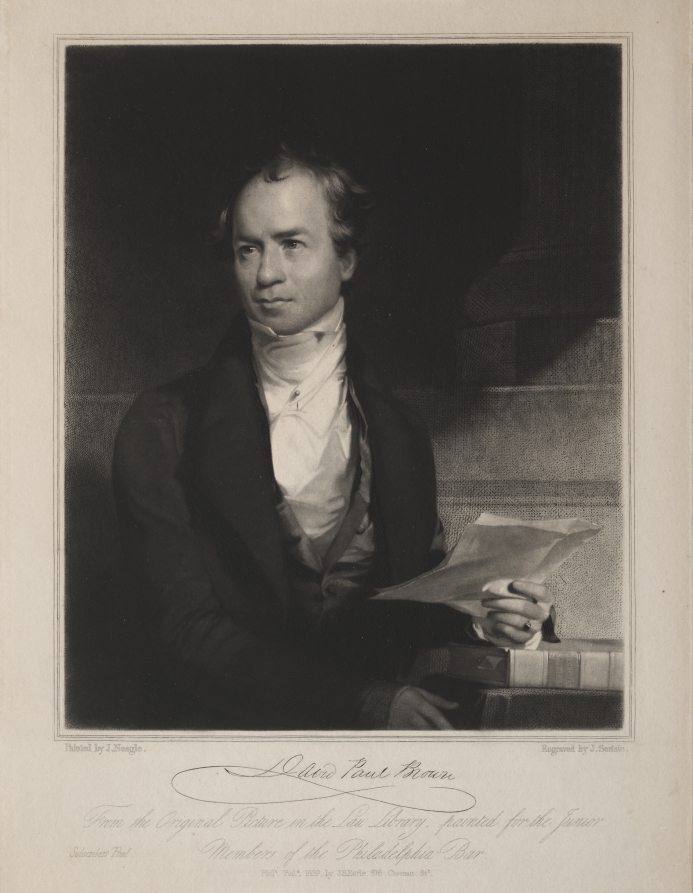
John Sartain · The Cleveland Museum of Art · Gift of William C. Keough · CC0
- Name
- John Sartain
- Born
- 24 October 1808
- Birthplace
- London, England
- Died
- 25 October 1897
- Place of death
- Philadelphia, Pennsylvania
- Nationality
- United Kingdom of Great Britain and Ireland.
- Occupation
- engraver.
- Fields
- portrait.
VALÉORINE Encyclopedia
VALÉORINE documentary reading
Documentary summary
John Sartain (October 24, 1808 – October 25, 1897) was an English-born American artist who pioneered mezzotint engraving in the United States.
Admitted source layer · organised and presented by VALÉORINE
Note VALÉORINE
John Sartain (1808–1897) was an engraver, of British nationality. The engraver was born in London and died in Philadelphia. John Sartain was a member of American Philosophical Society.
The work spans portrait. Works are held at National Library of Wales, National Portrait Gallery and Print Collection, among others.
Composed from admitted, traceable facts · 26 September 2026
VALÉORINE
Reference Check
Propose documentary evidence for John Sartain. A contribution is never written directly as fact: identity, source, rights and evidence gates still decide.
Sign in to contribute
World of VALÉORINE
Documentary connections
Only confirmed graph relationships appear here. Images are shown only when their identity and reuse rights both pass the documentary gate.

Documentary evidence
Documentary basis
Authority files
wikidata · Q3182429 · wikipedia · John Sartain
In this article
Biography
Biography
The field of work recorded is mezzotint technique. Subjects and genres recorded for the work are portrait. Work by John Sartain is recorded in the collections of The Nelson-Atkins Museum of Art, National Portrait Gallery, National Library of Wales, Smithsonian American Art Museum and Yale Center for British Art.
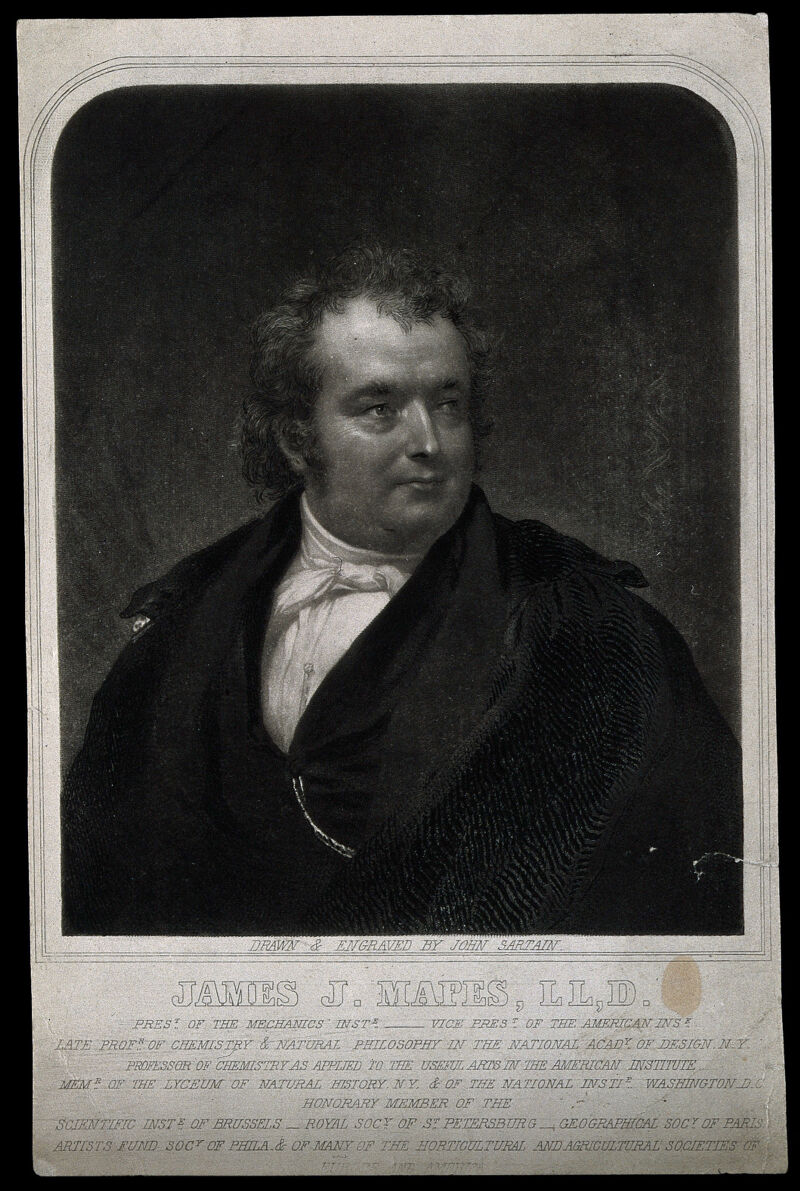
James Jay Mapes. Stipple engraving by J. Sartain after himself., by John Sartain
John Sartain · Wellcome Collection, London · Wellcome Collection
Key facts
Key facts
• Name — John Sartain • Born — 24 October 1808 • Birthplace — London, England • Died — 25 October 1897 • Place of death — Philadelphia, Pennsylvania
Biography
Biography
John Sartain was born in London, England. He learned line engraving, and produced several of the plates in William Young Ottley's Early Florentine School (1826). In 1828, he began to make mezzotints. He studied painting under John Varley and Henry James Richter. In 1830, at the age of 22, he emigrated to the United States and settled in Philadelphia. There he studied with Joshua Shaw and Manuel J. de Franca. For about ten years after his arrival in the United States, he painted portraits in oil and miniatures on ivory. During the same time, he found employment in making designs for banknote vignettes, and also in drawing on wood for book illustrations. He was a 33 degree Mason. He pioneered mezzotint engraving in the United States. He engraved plates in 1841–48 for Graham's Magazine, published by George Rex Graham, and believed his work was responsible for the publication's sudden success. Sartain became editor and proprietor of Campbell's Foreign Semi-Monthly Magazine in 1843. He had an interest at the same time in the Eclectic Museum, for which, later, when John H. Agnew was alone in charge, he simply engraved the plates. • Illustration — Pennsylvania Hall burning, 1838. Sartain was an eyewitness. • Illustration — John Sartain, Mary, Queen of Scots, The Evening Before Her Execution • Illustration — John Sartain, Zachary Taylor
Sartain's Magazine
Sartain's Magazine
In 1848, he purchased a half interest in the Union Magazine, a New York-based periodical. He transferred it to Philadelphia, where it was renamed Sartain's Union Magazine, and from 1849 to 1852 he published it with Graham. It became very well known during those four years. During this time, besides his editorial work and the engravings that had to be made regularly for the periodicals with which he was connected, Sartain produced an enormous quantity of plates for book-illustration. • Illustration — John Sartain • Illustration — John Sartain, Edgar Allan Poe Sartain was a colleague and friend of Edgar Allan Poe. Around July 2, 1849, shortly before Poe's death, the author unexpectedly visited Sartain's house in Philadelphia. Looking "pale and haggard" with "a wild and frightened expression in his eyes", Poe told Sartain that he was being pursued and needed protection; Poe asked for a razor so that he could shave off his mustache to become less recognizable. Sartain offered to cut it off himself using scissors. Poe had said he had overheard people while on the train who were conspiring to murder him. Sartain asked why anyone would want to kill him, and Poe answered it was "a woman trouble". However, later when Sartain let Poe stay the night with him at his house, Poe informed him that he may have been hallucinating. This incident was four months before Poe's death. Poe gave Sartain a new poem, "The Bells", which was published in Sartain's Union Magazine in November 1849, a month after Poe's death. Sartain's also published the first authorized printing of "Annabel Lee", also posthumously.
Years in Philadelphia
Years in Philadelphia
After his arrival in Philadelphia, Sartain took an active interest in art matters there. He held various offices in the Artists' Fund Society, the School of Design for Women, and the Pennsylvania Academy of Fine Arts, and was actively connected with other educational institutions in the city. He had visited Europe several times, and on the occasion of his second visit in 1862 he was elected a member of the society "Artis et Amicitiæ" in Amsterdam. Sartain had charge of the art department of the Centennial Exposition in Philadelphia, in 1876. In recognition of his services there, the king of Italy conferred on him the title of cavaliere of the Order of the Crown of Italy. His architectural knowledge was frequently requisitioned: he took a prominent part in the work of the committee on the Washington Memorial by Rudolf Siemering in Fairmount Park, Philadelphia, and he designed medallions for the monument to George Washington and Lafayette erected in 1869 in Monument Cemetery, Philadelphia. His Reminiscences of a Very Old Man (New York, 1899) are of unusual interest. • Illustration — John Sartain, William Henry Harrison • Illustration — John Sartain, Alexander Pope • Illustration — John Sartain, Cinque (The Amistad Case) Several small Philadelphia streets between 11th and 12th streets were renamed in honor of Sartain in 1895. Sartain was elected to the American Philosophical Society in 1897. Upon his death later that year, the 89-year-old Sartain was buried in Monument Cemetery. Shortly before his death, The Philadelphia School of Design for Women created the John Sartain Fellowship in recognition of his 28 year tenure as Director. In 1956 the cemetery was condemned by the city and given to Temple University which cleared it for a parking lot. Sartain's body was not claimed and he and approximately 20,000 other unclaimed bodies were re-interred in a large mass grave at Lawnview Cemetery. The tombstones, including the cemetery's 70 feet high central monument to George Washington and General Lafayette and his family monument (all designed by Sartain) were dumped into the Delaware River to serve as the foundations for the Betsy Ross Bridge.
Family
Family
John Sartain married Susannah Longmate Swaine and they had eight children. Samuel (1830-1906), who was an engraver; Henry (1833-1895); William (1843-1925); and Emily Sartain pursued careers as artists. Emily Sartain first practised art as an engraver under her father. She studied at the Pennsylvania Academy under Christian Schussele, and then, until 1875, with Évariste Vital Luminais in Paris. In 1886, she became principal of the Philadelphia School of Design for Women. William Sartain engraved under his father's supervision until he was about 24. From 1867 to 1868, he studied under Christian Schussele and at the Pennsylvania Academy. He then went to Paris, where he studied with Léon Bonnat. In 1877, he returned to the United States, settling in New York, where he was elected an associate of the National Academy of Design in 1880. He was one of the founders of the Society of American Artists. He painted both landscape and figure subjects. • Illustration — Emily Sartain, 1876 plate • Illustration — William Sartain in his studio, circa 1900
Identity
Identity
John Sartain is recorded as engraver.
Life and career
Dated record
Life and career
Explore 1808–1897
The full dated record · 3 entries
1808
John Sartain born at London.
1847
Sartain's union magazine of literature and art (1847) is digitised and catalogued by Internet Archive.
1897
John Sartain died at Philadelphia.
Places
Named by the record
Places
Only places the record itself states, plotted where the house gazetteer settles their coordinates. Nothing is inferred from a name or a nationality.
London.
Birth place
Philadelphia.
Death place
Primary material
Documents and archives
reference work
- “John Sartain”, English Wikipedia, consulted as further reading
Reputable secondary · Wikipedia
authority record
- Wikidata, structured authority record Q3182429: John Sartain
General reference · Wikidata
Notes from the source article
Cited by Wikipedia
Notes from the source article
These works are cited by the source article, in its own numbering. They are recorded as its citations, not as sources VALÉORINE has verified.
- 1.Quinn, Arthur Hobson. Edgar Allan Poe: A Critical Biography. Baltimore: The Johns Hopkins University Press, 1998: 330. .
- 2.Silverman, Kenneth. Edgar A. Poe: Mournful and Never-ending Remembrance. New York: Harper Perennial, 1991: 416. .
- 3.Meyers, Jeffrey. Edgar Allan Poe: His Life and Legacy. New York: Cooper Square Press, 1992: 246. .
- 4.Sova, Dawn B. Edgar Allan Poe: A to Z. New York: Checkmark Books, 2001: 25. .
- 5.Meyers, Jeffrey. Edgar Allan Poe: His Life and Legacy. New York: Cooper Square Press, 1992: 244.
- 6.Alotta, Robert I. Mermaids, Monasteries, Cherokees, and Custer. Bonus Books, Inc. 204–205. 1990. 0-933893-90-6.
- 7.APS Member History. search.amphilsoc.org.
- 8.Binghamton Republican Printers. Abstract of Proceedings of the Supreme Council of Sovereign Grand Inspectors-General of the Thirty-Third and Last Degree Ancient Accepted Scottish Rite. 137. 1898.
- 9.An experiment in training for the useful and the beautiful; Training for the useful and the beautiful; a history. Women Working, 1800-1930 - CURIOSity Digital Collections.
- 10.Campbell, Tad D. Charles M. Appleton Biography. www.suvpac.org.
- 11.Stone Angels, 6 May 2011, "How Monument Cemetery Was Destroyed". Accessed 25 July 2011.
- 12.Dowd, M. Jane. Biographical Dictionary of American Educators. Greenwood Press. 3. 1148–1149. 1978.
- 13.Martinez, Katharine. Philadelphia's Cultural Landscape: The Sartain Family Legacy. Temple University Press. 120. 2000. 978-1-56639-791-9.
- 14.Pennsylvania Academy of the Fine Arts. The Sartain family: PAFA's most famous artistic dynasty.
- 15.Morgan, Ann Lee (Former Visiting Assistant Professor University of Illinois at Chicago). The Oxford Dictionary of American Art and Artists. Oxford University Press. 432–433. 27 June 2007. 978-0-19-802955-7.
- 16.Clement, Russell T. The Women Impressionists: A Sourcebook. Greenwood Press. 32. 2000.
- 17.Ricci, Patricia Likos. Philadelphia's Cultural Landscape: The Sartain Family Legacy. Temple University Press. 120–137. 2000. 978-1566397919.
- 18.Hoffmann, Mott. Moore College of Art & Design. Arcadia Publishing. 2008. 978-0-7385-5659-8.
References
Citations
References
Each reference names the institution holding it, so a reader may go to the document itself.
reference work
Secondary witnessauthority record
General reference
Further particulars
Held on the record
Further particulars
Open the remaining particulars
A count of publications is evidence of attention, not of standing, and is given here only as a measure.
Recognition and collections
Work by John Sartain is
The Nelson-Atkins Museum of Art, National Portrait Gallery, National Library of Wales and Smithsonian American Art Museum
The Encyclopedia exists whether or not anything is for sale. Corrections are recorded rather than overwritten, and every version of this record is kept. Published 16 August 2026.
Elsewhere in Prints
4,138 published records in this field, each with its sources named.
- John Robert CozensEngraver
- John Rubens SmithEngraver
- John SaltEngraver
- John Samuel AgarEngraver
- John ScottEngraver
- John Sigismund TannerEngraver
- John Singleton CopleyEngraver
- John StorrsEngraver
Best supported in this field
For owners
Own a work by John Sartain?
A specialist will read what you send and tell you what the house can establish, what it cannot, and whether the object is suited to sale. There is no charge and no obligation. The object stays with you throughout; nothing is shipped to us unless it is arranged in writing beforehand.