
John Newbery
John Newbery (9 July 1713 – 22 December 1767), considered "The Father of Children's Literature", was an English publisher of books who first made children's literature a sustainable and profitable part of the literary market. He also supported and published the works of Christopher Smart, Oliver Goldsmith and Samuel Johnson. In recognition of his achievements the Newbery Medal was named after him in 1922.
John Newbery
John Newbery (1713-1767) · Eighteenth Century Collections Online and history.org · Public domain
- Name
- John Newbery
- Born
- 9 July 1713
- Birthplace
- Waltham St Lawrence, Berkshire, England
- Died
- 22 December 1767
- Place of death
- London, England
- Occupation
- Publisher
- Nationality
- Kingdom of Great Britain
- Known for
- The History of Little Goody Two-Shoes · A Little Pretty Pocket-Book · MOTHER GOOSE'S MELODY
- Languages
- English
VALÉORINE Encyclopedia
VALÉORINE documentary reading
Documentary summary
John Newbery (9 July 1713 – 22 December 1767), considered "The Father of Children's Literature", was an English publisher of books who first made children's literature a sustainable and profitable part of the literary market. He also supported and published the works of Christopher Smart, Oliver Goldsmith and Samuel Johnson. In recognition of his achievements the Newbery Medal was named after him in 1922.
Admitted source layer · organised and presented by VALÉORINE
Note VALÉORINE
No house-authored Note is published until its assertions and sources pass the VALÉORINE evidence contract. The documentary article remains available in full while that enrichment is being consolidated.
Documentary enrichment in progress · no unsupported statement published
Reference Check
Propose documentary evidence for John Newbery. A contribution is never written directly as fact: identity, source, rights and evidence gates still decide.
Sign in to contribute
World of VALÉORINE
Documentary connections
Only confirmed graph relationships appear here. Images are shown only when their identity and reuse rights both pass the documentary gate.
Documentary evidence
Evidence Panel
not yet certified
- Identity
- resolved
- Independent source families
- 0
- Admitted assertions
- 0
- Open conflicts
- 0
Authority files
wikidata · Q266330 · wikipedia · John Newbery
In this article
Biography
Biography
The recorded working language is English. Places of work recorded in the authority are Reading. Employment is recorded with William Carnan. Works named in the authority record are The History of Little Goody Two-Shoes, A Little Pretty Pocket-Book and MOTHER GOOSE'S MELODY.
Key facts
Key facts
• Name — John Newbery • Born — 9 July 1713 • Birthplace — Waltham St Lawrence, Berkshire, England • Died — 22 December 1767 • Place of death — London, England • Resting Place — Waltham Saint Lawrence • Occupation — Publisher • Language — English • Genre — Children's literature • Notable Works — The History of Little Goody Two-Shoes • Children — 6 • Relatives — Elizabeth Anne Le Noir (adoptive granddaughter)
Early life
Early life
Newbery was born in 1713 to Robert Newbery, a farmer, in Waltham St Lawrence, Berkshire, England, and an unknown mother. When he was younger he gave himself an education. He was apprenticed to a local printer, William Ayers, at the age of sixteen. The business was later sold to William Carnan. In 1737 Carnan died, leaving the business to his brother, Charles Carnan, and Newbery. Two years later, Newbery married William Carnan's widow, Jordan Mary. He adopted Mary's three children, John, Thomas and Anna-Maria. In 1740 their daughter Mary was born. John, born in 1741, died at age 11. Their son Francis was born in 1743.
Publishing career
Publishing career
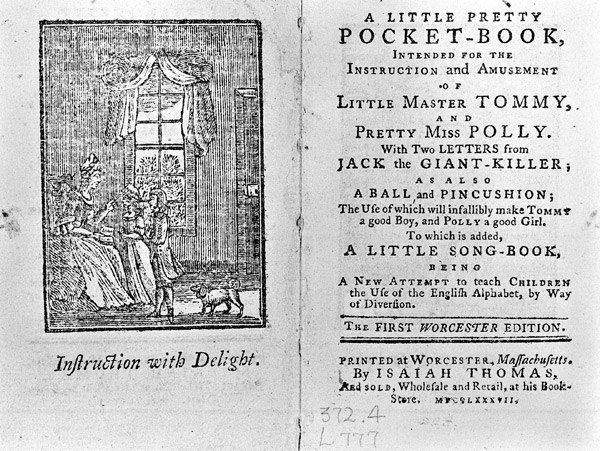
• Illustration — Newbery's A Little Pretty Pocket-Book, originally published in 1744 By 1740 Newbery had started his publishing business in Reading. His first two publications were an edition of Richard Allestree's The Whole Duty of Man and Miscellaneous Works Serious and Humerous [sic] In Verse and Prose. In 1743, Newbery left Reading, putting his stepson John Carnan in charge of his business there, and established a shop in London, first at the sign of the Bible and Crown near Devereux Court. He published several adult books, but he became interested in expanding his business to children's books. His first children's book, A Little Pretty Pocket-Book, appeared 18 July 1744. A Little Pretty Pocket-Book is the first in Newbery's successful line of children's books. The book cost six pence but for an extra two the purchaser received a red and black ball or pincushion. Newbery, like John Locke, believed that play was a better enticement to children's good behaviour than physical discipline, and the child was to record their behaviour by either sticking a pin in the red side for good behaviour or the black side if they were bad. A Little Pretty Pocket-Book, though it would seem didactic today, was well received. Promising to "infallibly make Tommy a good boy and Polly a good girl", it had poems, proverbs and an alphabet song. The book was child sized with a brightly coloured cover that appealed to children—something new in the publishing industry. Known as gift books, these early books became the precursor to the toy books popular in the nineteenth century. In developing his particular brand of children's literature, Newbery borrowed techniques from other publishers, such as binding his books in Dutch floral paper and advertising his other products and books within the stories he wrote or commissioned. This improvement in the quality of books for children, as well as the diversity of topics he published, helped make Newbery the leading producer of children's books in his time. In 1745 Newbery moved his firm to a more upmarket address at 65 St. Paul's Churchyard and named it the Bible and Sun, continuing to publish a mix of adult and children's titles. This new shop did so well he eventually sold the Reading business. His success allowed his son Francis to attend both Cambridge and Oxford Universities. Jan Susina, writing in The Lion and the Unicorn says "Newbery's genius was in developing the fairly new product category, children's books, through his frequent advertisements... and his clever ploy of introducing additional titles and products into the body of his children's books." About one-fifth of the five hundred books Newbery produced were children's stories, including ABC books, children's novels and children's magazines. He published his own books as well as those by authors like Samuel Johnson and Oliver Goldsmith. Scholars have speculated that Goldsmith or Giles and Griffith Jones wrote The History of Little Goody Two-Shoes, Newbery's most popular book. It had 29 editions between 1765 and 1800. Some sources credit Newbery with publishing the first edition of Mother Goose in England, but others now say the book may have been planned, but was never actually produced. Newbery also published a series of books written by "Tom Telescope" that were wildly popular, going through seven editions between 1761 and 1787 alone. These were based on the emerging science of the day and consisted of a series of lectures given by a boy, Tom Telescope. The most famous is The Newtonian System of Philosophy Adapted to the Capacities of Young Gentlemen and Ladies. John Newbery died 22 December 1767, at his house in St. Paul's Churchyard. He is buried in his birthplace of Waltham Saint Lawrence.
Patent medicine
Patent medicine
Newbery's prosperity did not just come from publishing; he was one of the most successful merchants in England at the time. Some of his fortunes came from the patent and sales of Dr Robert James's Fever Powder, a medicine which claimed to cure gout, rheumatism, scrofula, scurvy, leprosy, and distemper in cattle. This product became successful due in part to Newbery's advertisements for it in his literature. In Goody Two-Shoes, the heroine's father dies because he was "seized with a violent fever in a place where Dr. James Fever Powder was not to be had." Newbery used his fortune to help writers through financial difficulties. Those he is known to have assisted include Johnson, who called him "Jack Whirler" for his constant activity and inability to sit still; and Goldsmith, who portrayed Newbery in The Vicar of Wakefield as Dr Primrose, "the friend of all mankind".
Newbery's themes
Newbery's themes
Locke had written that "children may be cozened [tricked] into a knowledge of the letters; be taught to read, without perceiving it to be anything but a sport, and play themselves into that which others are whipped for." He also suggested that picture books be created for children. Locke also argued that children should be considered "reasoning beings." Newbery acted upon these suggestions. A Pretty Little Pocket-Book was a hodge-podge of information and games, including riddles and advice on a proper diet, but its primary message was "learn your lessons... and one day you will ride in a coach and six." "In Newbery's universe work is always rewarded and altruism pays dividends as reliably as Isaac Newton's laws of motion." Newbery's tales seem didactic today, but were popular and enjoyed by children of the 18th and 19th centuries. They draw the world as a meritocracy where a child rises or falls on his or her character. Most of his stories concern a virtuous orphan who works hard (or is "industrious"), and therefore eventually becomes prosperous. They tell the life of the orphan from childhood to adulthood, to illustrate rewards and punishments associated with "good" and "bad" behaviour.
Life and career
Dated record
Life and career
Explore 1713–1767
The full dated record · 3 entries
1713
John Newbery born at Berkshire.
1760
The Original Mother Goose's Melody: As First Issued by John Newbery, of London, about A.D., 1760 (1889) is digitised and catalogued by Internet Archive.
1767
John Newbery died at London.
Bestselling Newbery books
According to the New Cambridge Bibliography of English Literature (NCBEL 2.120), Newbery "wrote, wholly or partly" and "edited or materially influenced" the following works: • Mother Goose's Melody • A Little Pretty Pocket-Book (1744) by M. F. Thwaite and John Newbery • The Newtonian System of Philosophy (1761) by Tom Telescope, John Newbery, and Oliver Goldsmith • The Renowned History of Giles Gingerbread (1764) • The History of Little Goody Two-Shoes (1765) by John Newbery (perhaps written with Oliver Goldsmith) • The entertaining history of Tommy Gingerbread: a little boy, who lived upon learning
Legacy
His son Francis, his stepson Thomas Carnan, his nephew Francis and Francis's wife Elizabeth and his grandson Francis Power continued the business after his death, though with less cooperation than John Newbery had anticipated; the son and stepson frequently differentiated themselves from the nephew through their imprints, and had a less than cordial relationship between each other as well. Francis (nephew) struck out on his own without legally inheriting any of John Newbery's publications, only a share of his newspaper interests. Nevertheless, he persevered, and upon his death in 1780, his widow Elizabeth inherited the firm through his will. Elizabeth carried on a successful, independent twenty-two year career, retiring in 1802 by selling the business to her successor, John Harris. In 1922, the John Newbery Medal was created by the American Library Association in his honour; it is awarded each year to the "most distinguished contribution to American literature for children".
Primary material
Documents and archives
reference work
- Wikidata, structured authority record Q266330: John Newbery
Reputable secondary · Wikimedia Foundation
- “John Newbery”, English Wikipedia, consulted as further reading
Reputable secondary · Wikipedia
authority file
Citations
References
Each reference names the institution holding it, so a reader may go to the document itself.
authority file
Partially resolvedreference work
Wikidata, structured authority record Q266330: John NewberyWikimedia Foundation
Partially resolvedreference work
Partially resolved
The Encyclopedia exists whether or not anything is for sale. Corrections are recorded rather than overwritten, and every version of this record is kept. Published 14 August 2026.
Elsewhere in Books
38,988 published records in this field, each with its sources named.
- John NealAuthor
- John NeihardtAuthor
- John Nelson DarbyAuthor
- John NettlesAuthor
- John NewtonAuthor
- John Nkemngong NkengasongAuthor
- John NormanAuthor
- John NorrisAuthor
Best supported in this field
For owners
Own a work by John Newbery?
A specialist will read what you send and tell you what the house can establish, what it cannot, and whether the object is suited to sale. There is no charge and no obligation. The object stays with you throughout; nothing is shipped to us unless it is arranged in writing beforehand.