
John Francis Rigaud
Illustration — John Francis Rigaud by George Dance (1793) John Francis Rigaud (18 May 1742 – 6 December 1810) was a British painter who specialised in history painting and portrait painting.
Also recorded as R. A. John Francis Rigaud · Rigoud · R.A. Rigaud · R. A. J.F. Rigaud
John Francis Rigaud

John Francis Rigaud · Wellcome Collection, London · Wellcome Collection · Public Domain Mark
- Born
- 1742. · Turin.
- Nationality
- United Kingdom of Great Britain and Ireland and Kingdom of Great Britain.
- Occupation
- painter and translator.
- Fields
- history and portrait.
- Languages
- English.
VALÉORINE Encyclopedia
VALÉORINE documentary reading
Documentary summary
Illustration — John Francis Rigaud by George Dance (1793) John Francis Rigaud (18 May 1742 – 6 December 1810) was a British painter who specialised in history painting and portrait painting.
Admitted source layer · organised and presented by VALÉORINE
Note VALÉORINE
John Francis Rigaud (1742–1810) was a British and British painter and translator. Born in Turin, the painter died in Great Packington. John Francis Rigaud was a member of Royal Academy of Arts and worked in Great Britain.
Genres include history, history painting and portrait. Languages used include English. Works by the painter are held at Auckland Art Gallery, John and Mable Ringling Museum of Art and Museo del Prado, among others.
Composed from admitted, traceable facts · 26 September 2026
VALÉORINE
Reference Check
Propose documentary evidence for John Francis Rigaud. A contribution is never written directly as fact: identity, source, rights and evidence gates still decide.
Sign in to contribute
World of VALÉORINE
Documentary connections
Only confirmed graph relationships appear here. Images are shown only when their identity and reuse rights both pass the documentary gate.
Documentary evidence
Documentary basis
Authority files
wikidata · Q3181529 · wikipedia · John Francis Rigaud
In this article
Early life
Early life
The recorded working language is English. Subjects and genres recorded for the work are history and portrait. Places of work recorded in the authority are Great Britain. Work by John Francis Rigaud is recorded in the collections of Museo del Prado, Auckland Art Gallery, Royal Museums Greenwich, John and Mable Ringling Museum of Art and National Portrait Gallery.
Rigaud was born in Turin on 18 May 1742 and baptised on 9 September. He was the second son of James Dutilh or Rigaud and Jeanne Françoise Guiraudet. His father came from a family of Protestant merchants; his grandfather Jacques Dutilh had fled from Lyon to Geneva with his family after the revocation of the Edict of Nantes. Jacques died on the journey, and his widow assumed her maiden nameRigaudby which the family became known. John had a brother Jacques Etienne Rigaud born 16 Jan 1741 and died 7 Mar 1767 at Turin. Having demonstrated an artistic ability, Rigaud studied with Claudio Francesco Beaumont of Turin, a historical painter to the king of Sardinia. He left Beaumont to travel to Italy and study painting in Florence and Bologna, where he was made a member of the Accademia Clementina in 1766. He then travelled to Rome, but had to return home due to family considerations. In January 1768, he set off once again, this time to Piacenza, Parma, Bologna, and then, once again, to Rome. He settled there and studied the city's art, particularly the old masters, and participated in life-drawing schools. There, he produced what the Dictionary of National Biography describes as "one of his most important works": Hercules Resting from his Labours. While in Rome, Rigaud became friends with the Swedish sculptor Johan Tobias Sergel and the Irish painter James Barry.
London
London
In April 1770, he and Barry travelled together to Florence, Bologna, and Turin. Rigaud then spent a short time in Paris before leaving for London in December 1771. He exhibited his Hercules at the Royal Academy in 1772 and was elected an associate of the Academy in the same year. Also in 1772 he lodged at Mr. Luther's, 20 Frith Street (now no. 25), Soho. While Rigaud consistently exhibited paintings at the Royal Academyshowing a total of 155 works there between 1772 and 1815 – "his most lucrative and engrossing employment was decorative painting for the town and country houses of the nobility, including Lord Gower, Lord Sefton, and the Earl of Aylesford". Some of his exhibits at the Academy were studies for ceiling paintings, and in 1797 he showed three works described as "specimen[s] of fresco painting on Portland stone. The architect William Chambers offered him work in London at Melbourne House in Piccadilly (1772 and 1774) and at Somerset House (1780). He also helped decorate the Common Council Chamber of the Guildhall in London (1794) and Trinity House (1796). According to the Dictionary of National Biography, all these works were "executed in the fashionable Italian style of G. B. Cipriani and Biagio Rebecca, being mostly classical figures and imitations of bas-reliefs". His works at the Guildhall, representing "Providence", "Innocence", "Wisdom" and "Happiness" were painted at the expense of Alderman John Boydell. They did not last: a guidebook to the building, published in 1819, recorded that "these Paintings never dried perfectly and turned black. They exist no longer..." • Illustration — Johann Reinhold Forster and Georg Forster in Tahiti, by John Francis Rigaud 1780. Rigaud also produced history paintings, such as Entry of the Black Prince into London with his Royal Prisoner (1775), and several works for the galleries of Thomas Macklin and Robert Bowyer, and for the Shakespeare Gallery of John Boydell in the late 1780s. According to the Dictionary of National Biography, "his historical paintings were not well received". He was also commissioned to paint two religious works: a Descent from the Cross for the Roman Catholic Sardinian Embassy Chapel in London in 1780 and a fresco of the Ascension for the newly rebuilt church of St Martin Outwich in 1797. This last painting soon fell into poor condition and was destroyed during alterations to the building in 1827. His "descent from the Cross," painted in 1780 is now visible in the Church of St Anselm and St Cecilia which was built after the destruction of the Sardinian Embassy Chapel during the Gordon riots. • Illustration — Samson Breaking his Bands (1784) Rigaud was also a portrait painter, and painted a group portrait of the artists Francesco Bartolozzi, Agostino Carlini, and Giovanni Battista Cipriani in 1777 and another of Sir Joshua Reynolds, Sir William Chambers, and Joseph Wilton in 1782. He also painted a series of naval heroes, including Lord Nelson. According to the Dictionary of National Biography, his portraits "tend to be strongly characterized and boldly conceived, even occasionally eccentric". On 10 February 1784 Rigaud was formally elected to the Royal Society, with Samson Breaking his Bands as his diploma work. In 1795, he was appointed historical painter to Gustavus IV of Sweden and was made a member of the Royal Academy of Stockholm. However, after 1800, according to the Dictionary of National Biography, his career as a painter seems to have declined. He translated Leonardo da Vinci's A Treatise on Painting (1802) and he restored painted decorations such as those in Greenwich Hospital and Montague House.
Family
Family
• Illustration — Portrait of the artist with his wife Mary Williams and children (Mary, Stephen and Betsy), in his studio, 1782. Rigaud married Mary Williams (1740? – 1808) on 21 July 1774. They had three daughters and one son, Stephen Francis Dutilh Rigaud, who also became a painter. After his wife's death, Rigaud lived with his son.
Death
Death
He died from apoplexy on 6 December 1810 at Packington Hall in Warwickshire and was buried in St James' Church, Great Packington.
Gallery
Gallery
• Illustration — Portrait of Horatio Nelson, 1781
Identity and origins
Identity and origins
The authorities additionally record the headings R. John Francis Rigaud, Rigoud, R.A. Rigaud and Rigaud. His recorded language was English. One child is recorded: Stephen Francis Dutilh Rigaud.
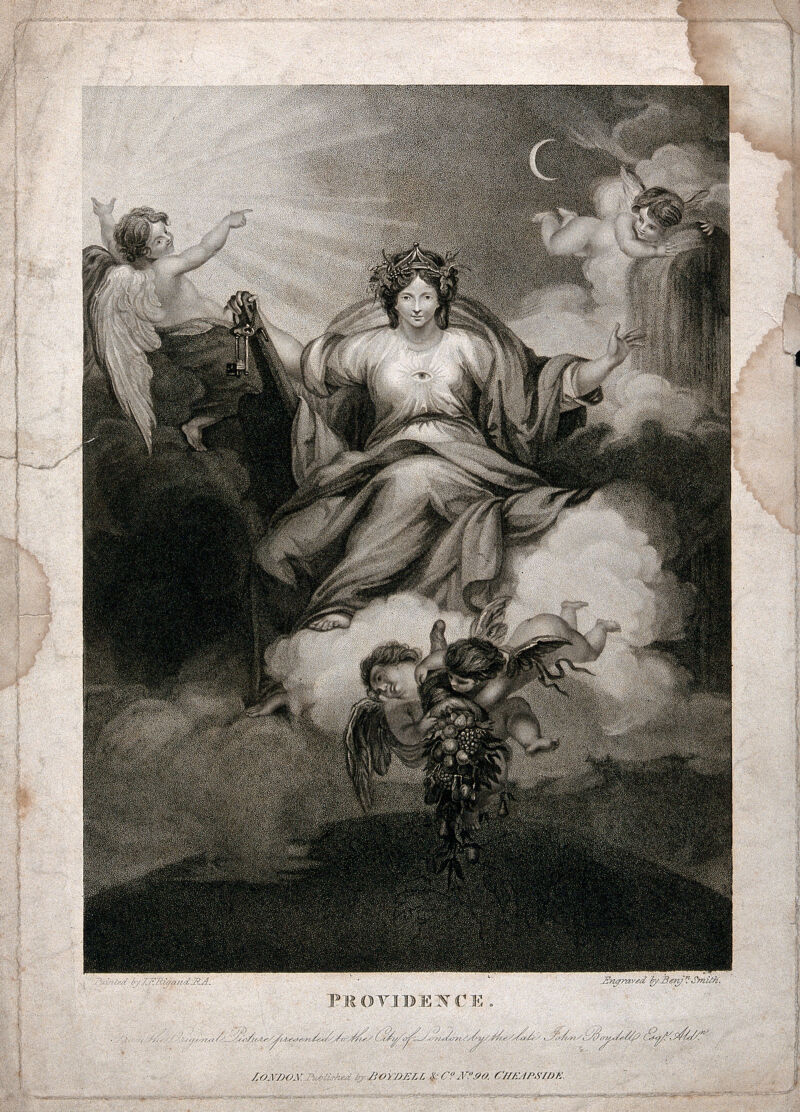
A woman enthroned on clouds is holding a rudder and keys, she is surrounded by four angels, two of which are holding a cornucopia; representing Providence. Stipple engraving by B. Smith after J.F. Rigaud., by John Francis Rigaud
John Francis Rigaud · Wellcome Collection, London · Wellcome Collection
Life and career
Dated record
Life and career
The full dated record · 2 entries
1742
John Francis Rigaud was born in 1742 at Turin.
1810
John Francis Rigaud died in 1810 at Great Packington.
Places
Named by the record
Places
Only places the record itself states, plotted where the house gazetteer settles their coordinates. Nothing is inferred from a name or a nationality.
Turin.
Birth place
Great Packington.
Death place
Literature
Literature
Literature
Rigaud, John Francis, Oxford Art Online, 2003
Rigaud, John Francis, Benezit Dictionary of Artists, 2011
Rigaud, John Francis (1742–1810), Oxford Dictionary of National Biography, 2017
7962, 1811-04-03, RIGAUD (John Francis), R
Scholarly footprint
Literature
Scholarly footprint
A count of publications is evidence of attention, not of standing, and is given here only as a measure.
Notes from the source article
Cited by Wikipedia
Notes from the source article
These works are cited by the source article, in its own numbering. They are recorded as its citations, not as sources VALÉORINE has verified.
- 1.Cust and Myrone, "John Francis Rigaud".
- 2.Rigaud, Stephen Francis Duthil. Facts and Recollections of the XVIIIth Century in a Memoir for John Francis Rigaud Esq. R.A. The Volume of the Walpole Society. 50. 1984.
- 3.Rimbault, Edward Francis. Soho and its Associations : Historical, Literary & Artistic. Dulau & Co., 27 Bateman's Buildings, Soho. 106–107. 1895.
- 4.Graves, Algernon. A Dictionary of Artists who have Exhibited Works in the Principal London Exhibitions of Oil Paintings from 1760 to 1880. George Bell and Sons. 53. 1884.
- 5.Graves, Algernon. The Royal Academy: A Complete Dictionary of Contributors from its Foundations in 1769 to 1904. Henry Graves. 6. 300. 1905.
- 6.John Nichols and Son. A Brief Account of the Guildhall of the City of London. 39. 1819.
- 7.Godwin, George. The Churches of London: A History and Description of the Ecclesiastical Edifices of the Metropolis. C. Tilt. 1839.
- 8.Malcolm, James Peller. Londinium Redivivium, or, an Ancient History and Modern Description of London. 4. 411. 1807.
- 9.Taylor, Lyrica. A rediscovered Self-portrait by JF Rigaud (1742–1810): The art of family affection in 18th-century England. The British Art Journal. 16. 2. 50–55. 2015. 1467-2006.
Bibliography printed in the source article · 2
- Cust, L. H. and Martin Myrone. "John Francis Rigaud" DNB. Oxford Dictionary of National Biography. Oxford University Press. 2004. Retrieved on 2 February 2008.
- Rigaud, John Francis.
References
Citations
References
Each reference names the institution holding it, so a reader may go to the document itself.
reference work
Wikidata, structured authority record Q3181529: John Francis RigaudWikimedia Foundation
Secondary witnessreference work
Secondary witness
The Encyclopedia exists whether or not anything is for sale. Corrections are recorded rather than overwritten, and every version of this record is kept. Published 18 August 2026.
Elsewhere in Paintings
18,623 published records in this field, each with its sources named.
- John FeryArtist
- John FinnieArtist
- John FischerArtist
- John Francis MurphyArtist
- John Frederick KensettArtist
- John GastArtist
- John George BrownArtist
- John GibbArtist
Best supported in this field
For owners
Own a work by John Francis Rigaud?
A specialist will read what you send and tell you what the house can establish, what it cannot, and whether the object is suited to sale. There is no charge and no obligation. The object stays with you throughout; nothing is shipped to us unless it is arranged in writing beforehand.