
John Callcott Horsley
John Callcott Horsley (29 January 1817 – 18 October 1903) was an English academic painter of genre and historical scenes, illustrator, and designer of the first Christmas card. He was a member of the artists' colony in Cranbrook.
Also recorded as John Calcott Horsley · Horsley · J. C. Horsley · J.C. Horsley
John Callcott Horsley
![Men and women are gathered outside a prison in Cairo as prisoners look out from behind the bars, and a child stands on ledge to look through the window. Wood engraving after J.C. Horsley, 1876., [1876], by John Callcott Horsley](https://iiif.wellcomecollection.org/image/V0041229/full/1280,/0/default.jpg)
John Callcott Horsley · Wellcome Collection, London · Wellcome Collection · Public Domain Mark
- Born
- 1817. · London.
- Nationality
- United Kingdom of Great Britain and Ireland.
- Occupation
- painter and illustrator.
- Fields
- genre painting and history painting.
- Movements
- Cranbrook Colony.
- Languages
- English.
VALÉORINE Encyclopedia
VALÉORINE documentary reading
Documentary summary
John Callcott Horsley (29 January 1817 – 18 October 1903) was an English academic painter of genre and historical scenes, illustrator, and designer of the first Christmas card. He was a member of the artists' colony in Cranbrook.
Admitted source layer · organised and presented by VALÉORINE
Reference Check
Propose documentary evidence for John Callcott Horsley. A contribution is never written directly as fact: identity, source, rights and evidence gates still decide.
Sign in to contribute
World of VALÉORINE
Documentary connections
Only confirmed graph relationships appear here. Images are shown only when their identity and reuse rights both pass the documentary gate.

Documentary evidence
Documentary basis
Authority files
wikidata · Q1699529 · wikipedia · John Callcott Horsley
In this article
Childhood and education
Childhood and education
The recorded working language is English. The field of work recorded is genre painting and history painting. Subjects and genres recorded for the work are genre. Places of work recorded in the authority are London. Work by John Callcott Horsley is recorded in the collections of J. Paul Getty Museum, Tate, National Gallery of Canada, Philadelphia Museum of Art and National Gallery.
Horsley was born in London, the son of William Horsley, the musician, and grand-nephew of Sir Augustus Callcott. His sister Mary Elizabeth Horsley wed the famous British engineer Isambard Kingdom Brunel in 1836. Horsley was mentored by William Mulready and Augustus Wall Callcot who sent him at age thirteen to study at Dr Henry Sass's academy where he met D.G Rossetti, J. Millais and W.P. Frith; in his biography Horsley recalls Dr Sass as being vain and untalented. Following preparatory school Horsley studied painting at the Royal Academy schools where he met Thomas Webster. He exhibited The Pride of the Village at the Royal Academy Exhibition of 1839. It was later part of the Vernon Gift to the nation.
Family life
Family life
Horsley married Elvira Walter in 1846 with whom he had three sons: Edward (1848), Frank (1849), and Harry (1850). Elvira died of consumption in 1852 followed by the deaths of Edward and Harry in 1854 and Frank in 1857 due to scarlet fever. Horsley remarried, to Rosamund Haden, who came from a family of distinguished surgeons—her father Charles Haden had a practice in Sloan Street and her brother Francis Seymour Haden was a surgeon and etcher, who founded the Royal Society of Painters, Etchers and Engravers in 1880. Rosamund gave birth to Walter Charles (1855–1934), Hugh (1856), Victor (1857-1916), Emma (1858), Fanny (1859-1949), Gerald (1862) and Rosamund Brunel (1864-1949). Gerald grew up to be an architect, Walter an artist also studying at the RA Schools. Sir Victor Horsley became famous as a surgeon and neuropathologist, and a prominent supporter of the cause of experimental research. Fanny (Frances) became Lady Whitelegge. Hugh and Emma died of scarlet fever. After his wedding to Rosamund in 1854 Horsley and his new wife toured the Midlands for five months to establish contacts with wealthy industrialists for portrait commissions. Horsley moved into 'Willesley', his house in Cranbrook in 1861, joining the Cranbrook Colony; while maintaining a home in London. The architect Richard Shaw adds "...tall chimneys and cosy 'inglenooks.'" in the Jacobean style to 'Willesley'.
Career
Career
Horsley's paintings were largely of historical subjects set in the seventeenth and eighteenth centuries, influenced by the Dutch masters Pieter de Hooch and Vermeer. Examples are "Malvolio", "L'Allegro and il Penseroso" (painted for the Prince Consort), "Le Jour des Morts" and "A Scene from Don Quixote". As a young artist Horsley was patronised by the collector John Sheepshanks, who bought two of Horsley's paintings: The Rival Performers (1839) and Youth and Age (1839), both of which are now part of the V&A collection. Callcott Horsley exhibited a second painting entitled 'Youth and Age' at the Royal Academy in 1851. In 1843 his cartoon (preliminary drawing) of "St Augustine Preaching" won a prize in the competition to provide interior decorations for Palace of Westminster. This led to his being selected in 1844 as one of the six painters commissioned to execute frescoes there. He painted Religion (1847) in the House of Lords, and Satan touched by Ithuriel's Spear while whispering evil dreams to Eve (1848). He also produced three of the four full-page plates illustrating the Main Sacraments for the 1845 illuminated Book of Common Prayer designed by Owen Jones. In 1864 he became a Royal Academician (RA). Horsley had much to do with organizing the winter exhibitions of "Old Masters" at Burlington House after 1870. Horsley was rector and treasurer of the Royal Academy from 1875 to 1890 and 1882 to 1897 respectively. He earned the nickname 'Clothes-Horsley' for his opposition to the use of nude life models. When, during the 1880s, the example of the French Salon began to affect the Academy exhibitors, and paintings of the nude became the fashion, he protested against the innovation, and his attitude caused Punch to give him the sobriquet of "Mr J. C(lothes) Horsley" (a pun on clothes horse). Protests against the nude in 1885 assumed a variety of forms: Moore's White Hydrangea was damaged by a 'scratching fiend' during the summer exhibition and life studies executed by Academy students were stolen. However, it was a letter printed in The Times on 20 May which proved the catalyst for igniting a national controversy around the exhibition of the nude. The letter was titled 'A Woman's Plea' and signed 'British Matron'. In fact it was penned by J. C. Horsley... He resigned from the academy in 1897, and became a "retired Academician". In 1843 Horsley designed the first ever Christmas card, commissioned by Henry Cole. It caused some controversy because it depicted a small child drinking wine. He also designed the Horsley envelope, a pre-paid envelope that was the precursor to the postage stamp. In 1856 Horsley was photographed at "The Photographed Institute" by Robert Howlett, as part of a series of portraits of "fine artists". The picture was among a group exhibited at the Art Treasures Exhibition in Manchester in 1857. Horsley was a member of the London-based Etching Club contributing illustrations to editions of "The Deserted Village" (Oliver Goldsmith) and "Songs of Shakespeare". He also illustrated a number of other books including "Little Princes" by Eliza Slater (London: Henry G. Bohn, 1890).
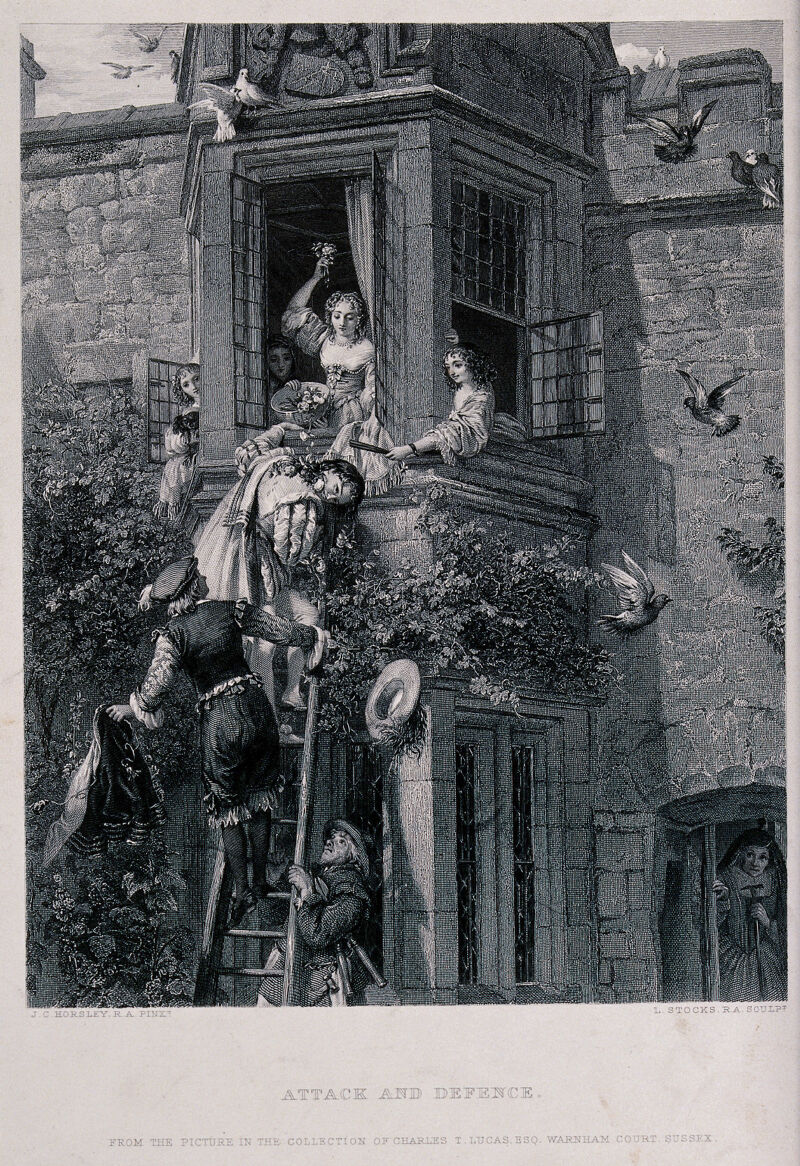
A young man on a ladder leading to an upstairs window from where young women pelt him with flowers. Engraving by L. Stocks after J. C. Horsley., 1800-1899, by John Callcott Horsley
John Callcott Horsley · Wellcome Collection, London · Wellcome Collection
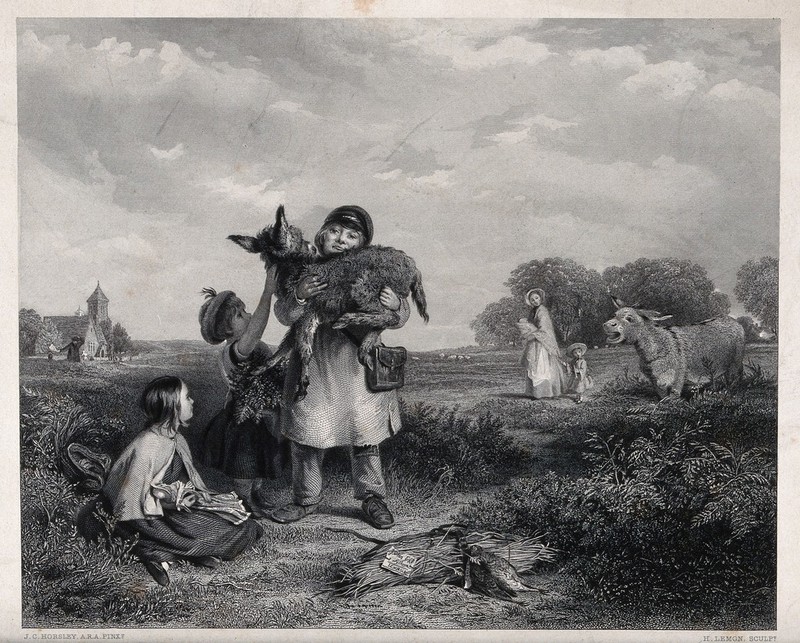
A man picking up a donkey foal with the aid of two girls with the mare crying out for its foal in the background. Line engraving with etching by H. Lemon after J. C. Horsley., by John Callcott Horsley
John Callcott Horsley · Wellcome Collection, London · Wellcome Collection
Life and career
Dated record
Life and career
The full dated record · 2 entries
1817
John Callcott Horsley born at London.
1903
John Callcott Horsley died at London.
Notes from the source article
Cited by Wikipedia
Notes from the source article
These works are cited by the source article, in its own numbering. They are recorded as its citations, not as sources VALÉORINE has verified.
- 1.EB1911 y Horsley, John Callcott 13 739
- 2.The Cranbrook Colony: Fresh Perspectives, Wolverhampton Art Gallery, 2010
- 3.The Rival Performers (1839)
- 4.Youth and Age (1839)
- 5.The complex history surrounding the decoration is best summarized by T. S. R. Boase, The Decorations of the New Palace of Westminster 1841-1863, in: Journal of the Warburg and Courtauld Institutes 17:1954, pp. 319–358.
- 6.Religion
- 7."Satan touched by Ithuriel's Spear while whispering evil dreams to Eve"
- 8.John Callcott Horsley, R.A., Royal Academy of Arts Collections
- 9.See Lucinda Hawksley (2013) The Mystery of Princess Louise: Queen Victoria's Rebellious Daughter
- 10.Smith, Alison. The Victorian Nude. Manchester University Press. 227. 1996. 9780719044038.
- 11.Robert Howlett.
Bibliography printed in the source article · 1
References
Citations
References
Each reference names the institution holding it, so a reader may go to the document itself.
reference work
Wikidata, structured authority record Q1699529: John Callcott HorsleyWikimedia Foundation
Secondary witnessreference work
Secondary witness
The Encyclopedia exists whether or not anything is for sale. Corrections are recorded rather than overwritten, and every version of this record is kept. Published 14 August 2026.
Elsewhere in Illustration
5,224 published records in this field, each with its sources named.
- John Bulloch SouterIllustrator
- John BurninghamIllustrator
- John ButtonIllustrator
- John Byam Liston ShawIllustrator
- John Caruthers LittleIllustrator
- John Cecil ClayIllustrator
- John CelardoIllustrator
- John Coleman BurroughsIllustrator
Best supported in this field
For owners
Own a work by John Callcott Horsley?
A specialist will read what you send and tell you what the house can establish, what it cannot, and whether the object is suited to sale. There is no charge and no obligation. The object stays with you throughout; nothing is shipped to us unless it is arranged in writing beforehand.