
Johann König
Johann König (21 October 1586 – 4 March 1642) was a German painter. He was a follower of Adam Elsheimer. He is known primarily for his painted copper panels.
Also recorded as Hans Konig · Johann Konig · Hans König · Jakob Konig
Johann König
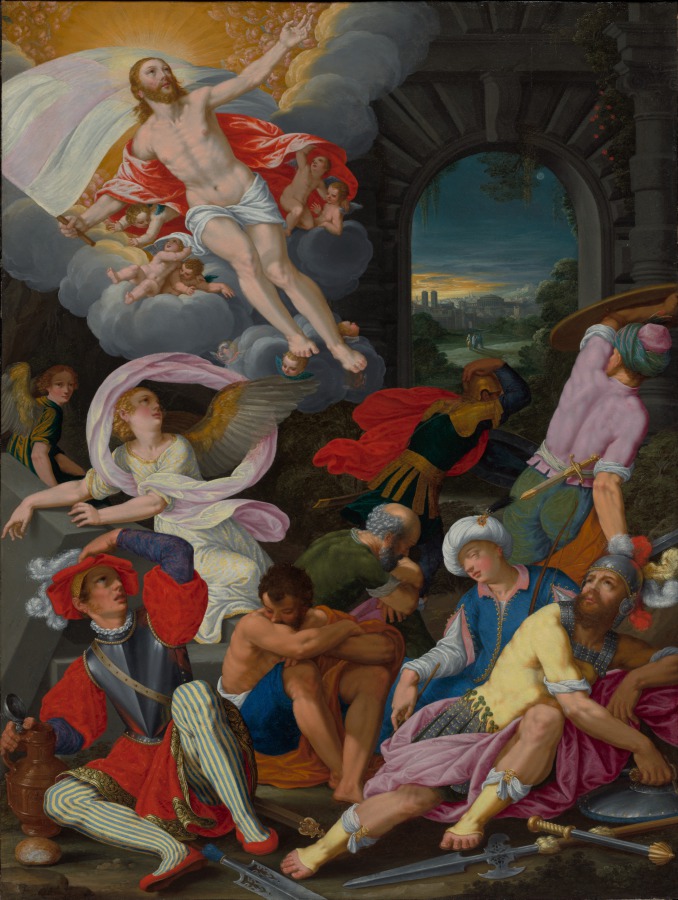
Johann König · The Cleveland Museum of Art · Leonard C. Hanna Jr. Fund · CC0
- Name
- Johann König
- Born
- 21 October 1586
- Birthplace
- Nuremberg, Holy Roman Empire
- Died
- 4 March 1642
- Place of death
- Augsburg
- Known for
- Painting, Miniature painting
- Training
- Johannes Rottenhammer
- Nationality
- Germany
- Occupation
- painter
- Languages
- German
VALÉORINE Encyclopedia
VALÉORINE documentary reading
Documentary summary
Johann König (21 October 1586 – 4 March 1642) was a German painter. He was a follower of Adam Elsheimer. He is known primarily for his painted copper panels.
Admitted source layer · organised and presented by VALÉORINE
Reference Check
Propose documentary evidence for Johann König. A contribution is never written directly as fact: identity, source, rights and evidence gates still decide.
Sign in to contribute
World of VALÉORINE
Documentary connections
Only confirmed graph relationships appear here. Images are shown only when their identity and reuse rights both pass the documentary gate.
Documentary evidence
Documentary basis
Authority files
wikidata · Q439439
In this article
Biography
Biography
The recorded working language is German. Places of work recorded in the authority are Augsburg, Venice and Rome. Work by Johann König is recorded in the collections of Ashmolean Museum, Städel Museum, Statens Museum for Kunst, Kunsthistorisches Museum and Bavarian State Painting Collections.
Key facts
Key facts
• Name — Johann König • Born — 21 October 1586 • Birthplace — Nuremberg, Holy Roman Empire • Died — 4 March 1642 • Place of death — Augsburg • Known for — Painting, Miniature painting • Training — Johannes Rottenhammer • Patrons — Philipp Hainhofer
Life
Life
König was born in Nuremberg in 1586, the son of goldsmith Arnold König. His knowledge of the works of Johannes Rottenhammer suggests that he might have apprenticed in Augsburg (possibly with Rottenhammer). He spent a year in Venice and Rome from 1610 to 1614. There he possibly made contact in December 1610 with Elsheimer before the latter died. His works directly influenced even König's early works. Paul Bril also exerted a strong influence on the painter. In Rome, he came into contact with the early works of Carlo Saraceni. In 1614 he returned to Augsburg, married and received painter rights from the local guild. In 1622 he became a member of the Painters' Guild and a year later, he became a member of the Great Council. After 1620 he worked with Matthias Gundelach and Johann Matthias Kager on decorations of Augsburg Town Hall created by Elias Holl. Following the Edict of Restitution, by 1631 he returned to Nuremberg, where he further worked and died in March 1642.
Overview
Overview
König was known as a painter of small-format images on copper and colorful miniatures and Kunstkammer pieces on marble. They are now on display along with five drawings in municipal art collections in the Schaezlerpalais in Augsburg. His other works are displayed in the Louvre, the Kunsthistorisches Museum in Vienna, the art gallery in Berlin, the Hessian State Museum in Darmstadt, the Staatliche Kunsthalle in Karlsruhe, in the National Museum of Germanic in Nuremberg and the Ashmolean Museum in Oxford. Pieces of medium-large format on canvas, such as the painting of Saint Peter, in the Herzog Anton Ulrich Museum in Braunschweig and a painting of the stoning of St. Stephen.
Gallery
Gallery
• Illustration — The cross-bearing Jesus • Illustration — Adoration with Angels and Putti carrying the tools of the Passion • Illustration — Ascension of Christ
Life and career
Dated record
Life and career
The full dated record · 2 entries
1586
Johann König was born on 21 October 1586.
1642
Johann König died on 4 March 1642.
Places
Named by the record
Places
Only places the record itself states, plotted where the house gazetteer settles their coordinates. Nothing is inferred from a name or a nationality.
Johann König was born in Nuremberg.
Birthplace
Johann König died in Nuremberg.
Deathplace
Nuremberg.
Birth place
Notes from the source article
Cited by Wikipedia
Notes from the source article
These works are cited by the source article, in its own numbering. They are recorded as its citations, not as sources VALÉORINE has verified.
- 1.Master Paintings Week. Master Paintings Week Returns to Centre Stage This Summer.
- 2.Art Fund. Angels Escourting Lot and His Family from Sodom.
- 3.Kern, Margit (2008). Geschichte der bildenden Kunst in Deutschland: Barock und Rokoko, Hrsg.: Stefan Grohé. Band 5 von Geschichte der bildenden Kunst in Deutschland, Prestel, München, , 9783791336305
- 4.richard-green.com
- 5.richard-green.com
- 6.Home. stadtlexikon-augsburg.de.
Bibliography printed in the source article · 2
- Gode/Krämer. Augsburger Stadtlexikon (Stand: 2. Auflage Druckausgabe)
- Baumgartl/Lauterbach/Otto. Maler in Franken – Leben und Werk von Künstlern aus fünf Jahrhunderten, Nürnberg
References
Citations
References
Each reference names the institution holding it, so a reader may go to the document itself.
authority record
General reference
Further particulars
Held on the record
Further particulars
Open the remaining particulars
Identity and origins. The authorities additionally record the headings Hans Konig, Johann Konig, Hans König, Jakob Konig and Johann Koenig. His recorded language was German.
The Encyclopedia exists whether or not anything is for sale. Corrections are recorded rather than overwritten, and every version of this record is kept. Published 17 August 2026.
Elsewhere in Paintings
19,183 published records in this field, each with its sources named.
- Johann Kaspar FüssliArtist
- Johann KautskyArtist
- Johann KoerbeckeArtist
- Johann KölerArtist
- Johann Ludwig AberliArtist
- Johann Ludwig BleulerArtist
- Johann Martin BernatzArtist
- Johann Martin UsteriArtist
Best supported in this field
For owners
Own a work by Johann König?
A specialist will read what you send and tell you what the house can establish, what it cannot, and whether the object is suited to sale. There is no charge and no obligation. The object stays with you throughout; nothing is shipped to us unless it is arranged in writing beforehand.