
Johann Eleazar Zeissig
Illustration — Portrait of Schenau by Christian Friedrich Stölzel (1787) Johann Eleazar Zeissig, also known as Schenau (7 November 1737 – 23 August 1806), was a German genre, portrait and porcelain painter, and engraver; director of the Royal Academy of Arts in Dresden.
Also recorded as Zeissig Schenau · Johann Eleasar Zeizig Schenau · Johann Eleazar Zeisig · Johann Eleazar Schenau
Johann Eleazar Zeissig

Christian Friedrich Stölzel · Self-scanned · Public domain
- Born
- 1737. · Großschönau.
- Died
- 1806. · Dresden.
- Nationality
- Germany.
- Occupation
- painter and university teacher.
- Fields
- painting.
- Languages
- German.
VALÉORINE Encyclopedia
VALÉORINE documentary reading
Documentary summary
Illustration — Portrait of Schenau by Christian Friedrich Stölzel (1787) Johann Eleazar Zeissig, also known as Schenau (7 November 1737 – 23 August 1806), was a German genre, portrait and porcelain painter, and engraver; director of the Royal Academy of Arts in Dresden.
Admitted source layer · organised and presented by VALÉORINE
Note VALÉORINE
Johann Eleazar Zeissig (1737–1806) was a painter and university teacher, of German nationality. The painter was born in Großschönau and died in Dresden.
Johann Eleazar Zeissig worked for Dresden Academy of Fine Arts and worked in Dresden and Paris. Activity centred on painting.
The work spans portrait. Languages used include German. Works are held at Auckland Art Gallery, Führermuseum and Gemäldegalerie Alte Meister, among others.
Composed from admitted, traceable facts · 26 September 2026
VALÉORINE
Reference Check
Propose documentary evidence for Johann Eleazar Zeissig. A contribution is never written directly as fact: identity, source, rights and evidence gates still decide.
Sign in to contribute
World of VALÉORINE
Documentary connections
Only confirmed graph relationships appear here. Images are shown only when their identity and reuse rights both pass the documentary gate.
Documentary evidence
Documentary basis
Authority files
wikidata · Q556102 · wikipedia · Johann Eleazar Zeissig
In this article
Life
Life
Christian Leberecht Vogel is recorded as having studied under Johann Eleazar Zeissig. The recorded working language is German. The field of work recorded is painting. Subjects and genres recorded for the work are portrait. Places of work recorded in the authority are Dresden and Paris. Employment is recorded with Dresden Academy of Fine Arts. Work by Johann Eleazar Zeissig is recorded in the collections of Städel Museum, Auckland Art Gallery, Philadelphia Museum of Art, Staatliche Kunstsammlungen Dresden and Gemäldegalerie Alte Meister.
Schenau was born in 1737, the son of Elias Zeissig and Anna Elisabeth (née Paul), poor Damask weavers, of Großschönau, near Zittau in Saxony. Together with his five sisters, he was tutored by his father in arithmetic, writing, reading and also learnt the trade of Damask weaving. He showed an early talent for painting and drawing, and was sent away at the age of twelve to study art in Dresden, where he was also employed as a lawyer's clerk. Through the help of a pupil of Anton Raphael Mengs, he was accepted at the Dresden art school. • Illustration — The origin of painting: A family making "chinese shadows" • Illustration — Schenau's grave in Großschönau Here, Schenau was taught by Charles-François de Silvestre, the son of the director of the school, Louis de Silvestre. In 1756, after the outbreak of the Seven Years' War, he accompanied the Sylvestre brothers to Paris, where he stayed until 1770, working at the Royal Academy of Painting and Sculpture with, amongst others, Johann Georg Wille. He became acquainted with leading French artists of the day, such as François Boucher, Gabriel François Doyen, Maurice Quentin de La Tour and Edmé Bouchardon; he was particularly influenced by the work of Jean-Baptiste Greuze. Schenau copied the works of the old masters such as Antonio da Correggio, Guido Reni and Titian, and acquired the patronage of the Saxon ambassador, General Fontenay. He also became a china painter, working at the porcelain factory in Sèvres, taking on, in addition, the roles of goldsmith, engraver and sculptor. Through the influence of his mentor, Charles-François de Silvestre, or his wife, the teacher and confidante of the Dauphine Maria Josepha, Schenau was introduced to the French court; he received many commissions from the Crown Princess of France and was soon the most respected genre painter in Paris. He painted portraits of, amongst others, Maria Josepha and Madame de Pompadour. In 1770, at the end of the Seven Years' War, Schenau went back to Dresden. In that year he became a member of the Dresden Academy of Fine Arts and, three years later, the Director of the drawing school of the porcelain factory in Meissen. In Meissen, he taught students not only drawing on china, but also created new designs. In 1774, he became professor of genre and portrait painting at the Dresden Art Academy. After the death of Charles François Hutin, in 1776, he was made, together with Giovanni Battista Casanova, alternate director of the academy and on Casanova's death in 1795, the sole director. Among his students were Christian Henry Becke, Friedrich Rehberg and Christian Leberecht Vogel; amongst his admirers was the writer August Gottlieb Meissner, who dedicated his book Alcibiades (1781) to the artist. In 1796 Schenau returned from the Meissen porcelain factory and devoted the following years to teaching at the Art Academy. Schenau died in 1806 in Dresden. His grave was originally located in St. John's churchyard (Johanniskirchhof) but, during the secularization of the cemetery, was moved 1854 to the cemetery in Großschönau.
Artistic style
Artistic style
• Illustration — The kurfürstlich-sächsische family (1772) Schenau began his artistic career as a copyist of old masters. In Paris he became acquainted with contemporary painters, but also through his studies at the Académie royale was influenced by French art theory of the time. His work also reveals the influence of the Dutch Fijnschilders, such as Gerard Dou and Caspar Netscher. His work was also influenced by his French friends, such as Jean Siméon Chardin, and, especially, Jean-Baptiste Greuze. Many of his drawings and paintings were reproduced as copper engraving reproductions for mass sale. Under the name Daniel Heimlich, Schenau also published etchings of views from the area around Paris. Many of his works are now lost or destroyed, such as the altarpiece of the Holy Cross Church in Dresden, which he had worked on from 1788 to 1792; a fire in 1897 destroyed the nave and the altar which was replaced by a work by Anton Dietrich (1833-1904). Most of his surviving works are now in museums in Saxony. A few of his works, such as "Elector of Saxony's Family" (1772) and "The Art Discussion" (1777), can be found in the Dresden State Art Collections. Many works are in the "Deutsches Damast-und Frottiermuseum" in his hometown of Großschönau.
Example: Das Kunstgespräch (The Art Discussion)
Example: Das Kunstgespräch (The Art Discussion)
• Illustration — The Art Discussion (1777) This important work of 1777 shows, in the foreground on the right, the Saxon statesman, Thomas Fritsch (1700-1775), together with Christian Ludwig von Hagedorn, art theorist and collector. Both are engrossed in a conversation about art. On the table between them, allegorical figures representing painting, sculpture and poetry can be seen. Amongst those listening in the background are painters Adrian Zingg (left), Schenau himself and Anton Graff.
Other works
Other works
• Der doppelte Verlust (1770) • Die kurfürstlich-sächsische Familie (1772) • Priamus bittet Achilles um die Leiche Hektors (1775) • Das Kunstgespräch (1777) • Ehepaar in der Laube (1785) • Selbstportrait (1785) • Auferstehung Christi (1786) • Kreuzigung Christi (1788–1792) • Christus am Ölberg (1795) • Familienszene (1800) • Unterzeichnung des Ehevertrages (1802)
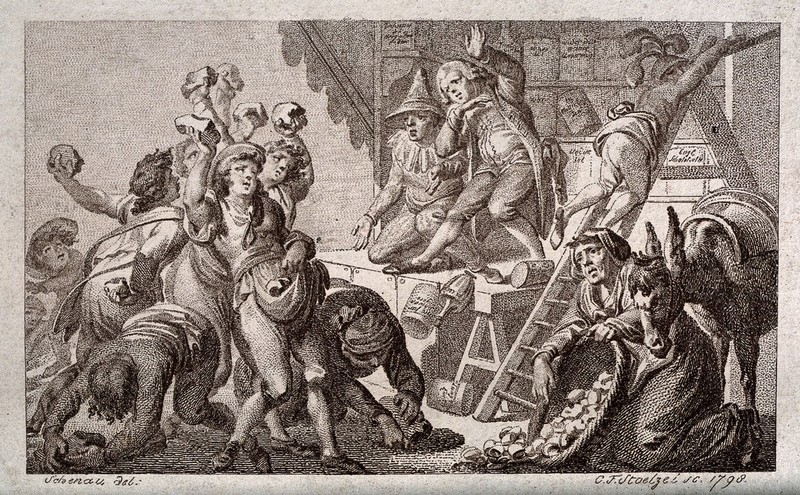
An itinerant medicine vendor and his assistants being pelted off stage with stones from an angry audience. Engraving by C.F. Stoelzel, 1798, after J. Schenau., 1798, by Johann Eleazar Zeissig
Johann Eleazar Zeissig · Wellcome Collection, London · Wellcome Collection
![A philosopher and virtuoso seated in an armchair: dissatisfied with his accomplishments, he points to the need for charity to the poor. Engraving by C.F. Stoelzel, 1774, after J.E. Schenau, 1773., [ca. 1774], by Johann Eleazar Zeissig](https://iiif.wellcomecollection.org/image/L0086038/full/800,/0/default.jpg)
A philosopher and virtuoso seated in an armchair: dissatisfied with his accomplishments, he points to the need for charity to the poor. Engraving by C.F. Stoelzel, 1774, after J.E. Schenau, 1773., [ca. 1774], by Johann Eleazar Zeissig
Johann Eleazar Zeissig · Wellcome Collection, London · Wellcome Collection
Life and career
Dated record
Life and career
The full dated record · 2 entries
1737
Johann Eleazar Zeissig was born in 1737 at Großschönau.
1806
Johann Eleazar Zeissig died in 1806 at Dresden.
Places
Named by the record
Places
Only places the record itself states, plotted where the house gazetteer settles their coordinates. Nothing is inferred from a name or a nationality.
Großschönau.
Birth place
Dresden.
Death place
Notes from the source article
Cited by Wikipedia
Notes from the source article
These works are cited by the source article, in its own numbering. They are recorded as its citations, not as sources VALÉORINE has verified.
- 1.August Gottlieb Meissner. Alcibiades, volume 1 (J. G. I. Breitkopf, 1781).
- 2.Thomas Fritsch.
- 3.Christian Ludwig von Hagedorn.
Bibliography printed in the source article · 11
- Schenau. In: Heinrich Keller (Hrsg.): Nachrichten von allen in Dresden lebenden Künstlern. Dyk, Leipzig 1789, S. 143–155.
- G. F. Otto: Lexikon der Oberlausitzischen Schriftsteller und Künstler. Band 3, Abt. 1. Görlitz 1803, S. 192–197.
- Schenau, Johann Eleazar. In: Georg Kaspar Nagler (Hrsg.): Neues allgemeines Künstler-Lexicon. Band 15. Fleischmann, München 1845, S. 181–184.
- Moritz Wießner: Die Akademie der bildenen Künste zu Dresden. Dresden 1864, S. 56f.
- David Goldberg: Catalog zur Illustration der öffentlichen Vorträge über Johann Eleazar Schenau (Zeißig). Richard Menzel, Zittau 1878.
- Fr. August Czischkowsky (Hrsg.): Zeit- und Ortsgeschichte von Großschönau. Großschönau 1887, S. 643ff.
- L. W. Schmidt: Johann Eleazar Zeissig, genannt Schenau. Diss., Heidelberg 1926.
- H. Marx: ...den guten Geschmack einzuführen.“ Zum 250. Geburtstag von Johann Eleazar Zeissig, genannt Schenau. In: Dresdner Kunstblätter. 32, 1988, S. 10–18.
- Der Brockhaus Kunst. 2. Auflage. Brockhaus, Leipzig 2001, S. 1034.
- Anke Fröhlich: ...Grazie und erhaben“. Die Werke des Oberlausitzer Malers Johann Eleazar Zeissig, gen. Schenau (1737–1806) im Kulturhistorischen Museum zu Görlitz. In: Görlitzer Magazin. 19, 2006, S. 12–31.
- Anke Fröhlich: ...mit seinen schönen Ideen und sanften Pinseln“. Der Dresdner Genremaler und Akademiedirektor Johann Eleazar Zeissig, gen. Schenau. In: Dresdner Kunstblätter. 51, 2007, S. 180–196.
References
Citations
References
Each reference names the institution holding it, so a reader may go to the document itself.
reference work
Wikidata, structured authority record Q556102: Johann Eleazar ZeissigWikimedia Foundation
Secondary witnessreference work
Secondary witness
The Encyclopedia exists whether or not anything is for sale. Corrections are recorded rather than overwritten, and every version of this record is kept. Published 16 August 2026.
Elsewhere in Paintings
18,623 published records in this field, each with its sources named.
- Johann Daniel Wilhelm HartmannArtist
- Johann David PassavantArtist
- Johann Dominicus FiorilloArtist
- Johann Dominik BossiArtist
- Johann EnderArtist
- Johann Ernst HeinsiusArtist
- Johann FischbachArtist
- Johann Franz ErmelsArtist
Best supported in this field
For owners
Own a work by Johann Eleazar Zeissig?
A specialist will read what you send and tell you what the house can establish, what it cannot, and whether the object is suited to sale. There is no charge and no obligation. The object stays with you throughout; nothing is shipped to us unless it is arranged in writing beforehand.