
Jo van den Broek
Illustration — J.H. van den Broek, 1968 Johannes Hendrik van den Broek (ˈjoː vɑn də(m) ˈbruk; 4 October 1898 – 6 September 1978) was a Dutch architect influential in the rebuilding of Rotterdam after World War II. He is known for his work with Jaap Bakema, in their practice as Van den Broek en Bakema, and as one of the founders of Nieuwe Bouwen, the modernist movement in Dutch architecture.
Also recorded as Johannes Hendrik van den Broek · J.H. van den Broek · J. H. van den Broek
Jo van den Broek

Vervaardiger: Ary (A.) Groeneveld · This image has been extracted from another file · CC0
- Born
- 1898 · Rotterdam.
- Died
- 1978 · The Hague.
- Nationality
- Kingdom of the Netherlands
- Occupation
- architect · university teacher
- Education
- Delft University of Technology
VALÉORINE Encyclopedia
VALÉORINE documentary reading
Documentary summary
Illustration — J.H. van den Broek, 1968 Johannes Hendrik van den Broek (ˈjoː vɑn də(m) ˈbruk; 4 October 1898 – 6 September 1978) was a Dutch architect influential in the rebuilding of Rotterdam after World War II. He is known for his work with Jaap Bakema, in their practice as Van den Broek en Bakema, and as one of the founders of Nieuwe Bouwen, the modernist movement in Dutch architecture.
Admitted source layer · organised and presented by VALÉORINE
Reference Check
Propose documentary evidence for Jo van den Broek. A contribution is never written directly as fact: identity, source, rights and evidence gates still decide.
Sign in to contribute
World of VALÉORINE
Documentary connections
Only confirmed graph relationships appear here. Images are shown only when their identity and reuse rights both pass the documentary gate.
Documentary evidence
Documentary basis
Authority files
wikidata · Q2258655 · wikipedia · Jo van den Broek
In this article
Early life and education
Early life and education
Johannes Hendrik van den Broek was born in Rotterdam on 4 October 1898.
Career
Career
Van den Broek joined Johannes Brinkman in 1936, after the death of Brinkman's partner Leendert van der Vlugt. The new firm was named Brinkman and Van den Broek Architects. Their work during this time including a new terminal building for the Holland-America cruise line. • Illustration — "Bakema Tower" housing in Berlin's Hansaviertel, designed in 1957 for Interbau and built 1959 From 1948 onward, van den Broek worked with Jacob Bakema. After Brinkman's death, the architectural firm was known as Van den Broek en Bakema (Van den Broek & Bakema). The practice played a leading role in Dutch post-war reconstruction rebuilding and expanding the housing in the Netherlands. The two architects collaborated to design landmarks and neighborhoods in Rotterdam and around the Netherlands. Van den Broek and Bakema participated in the 1957 Interbau project in Berlin, a post-war building project in which 13 prominent international architects designed buildings for the Hansaviertel. Although their building, known as the Bakema Tower, was not constructed until two years after the exhibition of the project opened in July 1957, the plans and models were included in the catalogue. This was regarded as one of the firm's most significant projects. They achieved international fame with some of their projects, including the Lijnbaan shopping centre (1949-53) and buildings for retailers Ter Meulen, Wassen and Van Vorst (1948-51) in Rotterdam. • Illustration — Pampus Expansion Plan (1965) Van den Broek en Bakema was commissioned to design buildings for Delft University of Technology, including the Faculty of Architecture (1959-64) and the Auditorium (1959-66). Other major projects for which they are known are Marl civic centre in Germany (1958-62); Terneuzen town hall in Zeeland, Netherlands (1963-72); the Kennemerland regional plan (1957-59); and the plan for a city on the artificial island Pampus (1965). The practice became known for its large-scale building projects and its problem-solving ability, and it generated new ideas about architecture, urbanism, and society. Bakema stayed on after Van den Broek left the practice in the early 1970s.
Life and career
Dated record
Life and career
Explore 1898–1978
The full dated record · 14 entries
1898
Jo van den Broek born at Rotterdam.
1925
Van Nelle Factory is dated 1925.
1931
Parklaanflat is dated 1931.
1931
Schiekade 49-53 is dated 1931.
1932
Complex Ungerplein: building blocks is dated 1932.
1934
De Eendracht is dated 1934.
1936
Complex Ungerplein is dated 1936.
1939
C.N.A. Looslaan 15, Rotterdam is dated 1939.
1940
Tollens factory is dated 1940.
1948
Lijnbaan is dated 1948.
1948
Ypenhof is dated 1948.
1949
Rotterdam Cruise Terminal is dated 1949.
1961
Offenbachlaan 5, Rotterdam is dated 1961.
1978
Jo van den Broek died at The Hague.
Places
Named by the record
Places
Only places the record itself states, plotted where the house gazetteer settles their coordinates. Nothing is inferred from a name or a nationality.
Rotterdam.
Birth place
The Hague.
Death place
Death and legacy
Van den Broek died on 6 September 1978 in The Hague, aged 79. He was one of the founders of Nieuwe Bouwen, the modernist movement in Dutch architecture and construction after 1930. The firm still exists to this day and is now known as Broekbakema.
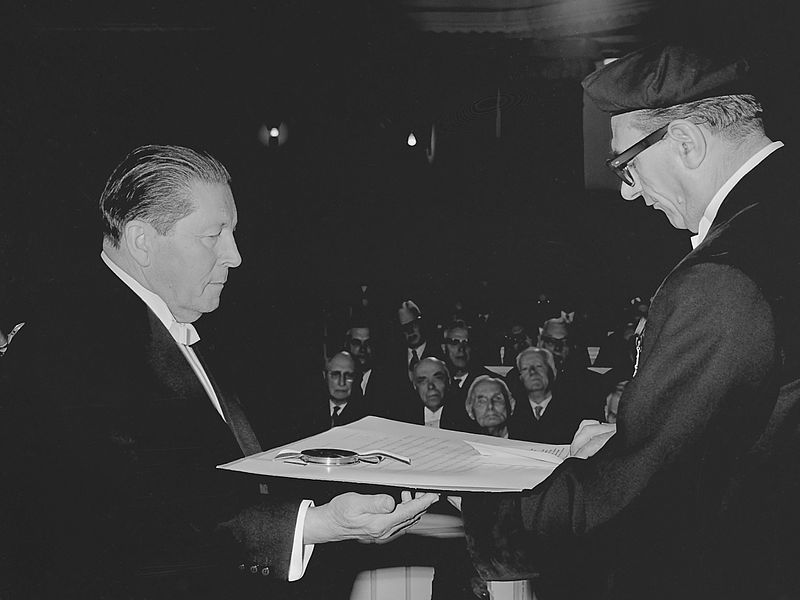
Architect G.Th. Rietveld benoemd tot eredoctor aan de Delftse Technische Hogeschool. De promotor prof. J. H. van den Broek (r) reikt de heer G.Th. Rietveld
Eric Koch for Anefo · Nationaal Archief

Collectie / Archief: Fotocollectie Anefo Reportage / Serie: Architect G.Th. Rietveld benoemd tot eredoctor aan de Delftse Technische Hogeschool Beschrijving: Prof. J.H. van de Broek (l) feliciteert architect Gerrit Rietveld Datum: 11 januari 1964 Locatie: Delft, Zuid-Holland Trefwoorden: architecten Persoonsnaam: Broek, J.H. van den, Rietveld, Gerrit Fotograaf: Koch, Eric / Anefo Auteursre
Eric Koch for Anefo
Context
Primary material
Context
The circumstances in which Jo van den Broek stands.
Documents and archives
Primary material
Documents and archives
Institutional database
- Wikidata, structured authority record Q2258655: Jo van den Broek
Scholarly · Wikimedia Foundation
reference work
- “Jo van den Broek”, English Wikipedia, consulted as further reading
Reputable secondary · Wikipedia
Notes from the source article
Cited by Wikipedia
Notes from the source article
These works are cited by the source article, in its own numbering. They are recorded as its citations, not as sources VALÉORINE has verified.
- 1.Broekbakema.nl. History of Broekbakema.
- 2.Jaap Bakema (1914-1981). Team 10.
- 3.ArchitectureGuide.nl. Aankomsthal Holland-Amerika Lijn (Cruise Terminal).
- 4.van Es, Evelien. Van den Broek & Bakema: Vigorous protagonists of a functionalist architecture at the TH Delft. TU Delft. 12 February 2019. 978-94-6366-118-8.
- 5.Buildings of jaap bakema. NL Architecture Guide.
- 6.Bakema Tower. Architectuul. 1 November 2019.
- 7.Expo 1957 Berlin. Bureau International des Expositions (BIE). 16 January 2025.
- 8.H Klopma and JB Bakema, architectural firm Van den Broek and Bakema, City on Pampus, drawing, 1964. Flickr. 5 February 2025.
- 9.Jaap Bakema and the Open Society. Archis. 31 May 2017.
References
Citations
References
Each reference names the institution holding it, so a reader may go to the document itself.
Institutional database
Wikidata, structured authority record Q2258655: Jo van den BroekWikimedia Foundation
Institutional witnessreference work
Secondary witness
The Encyclopedia exists whether or not anything is for sale. Corrections are recorded rather than overwritten, and every version of this record is kept. Published 17 August 2026.
Elsewhere in Design
11,558 published records in this field, each with its sources named.
- Jiří SvobodaDesigner
- Jo CoenenDesigner
- Jo NagasakaDesigner
- Jo PalmaDesigner
- Jô VasconcellosDesigner
- Joachim Daniel von JauchDesigner
- Joachim Gotsche GiæverDesigner
- Joachim GrassiDesigner
Best supported in this field
For owners
Own a work by Jo van den Broek?
A specialist will read what you send and tell you what the house can establish, what it cannot, and whether the object is suited to sale. There is no charge and no obligation. The object stays with you throughout; nothing is shipped to us unless it is arranged in writing beforehand.