
Jean Sylvain Bailly
Jean Sylvain Bailly (15 September 1736 – 12 November 1793) was a French astronomer, mathematician, freemason, and political leader of the early part of the French Revolution. He presided over the Tennis Court Oath, served as the mayor of Paris from 1789 to 1791, and was ultimately guillotined during the Reign of Terror.
Jean Sylvain Bailly

Jean-Laurent Mosnier · Public domain
- Born
- 15 September 1736
- Birthplace
- Paris, France
- Died
- 12 November 1793
- Education
- *Academy of Sciences
- Occupation
- * Astronomer
- Nationality
- France
- Fields
- mathematics · astronomy · politics · French Revolution
- Languages
- French
VALÉORINE Encyclopedia
VALÉORINE documentary reading
Documentary summary
Jean Sylvain Bailly (15 September 1736 – 12 November 1793) was a French astronomer, mathematician, freemason, and political leader of the early part of the French Revolution. He presided over the Tennis Court Oath, served as the mayor of Paris from 1789 to 1791, and was ultimately guillotined during the Reign of Terror.
Admitted source layer · organised and presented by VALÉORINE
Note VALÉORINE
Jean Sylvain Bailly (1736–1793) was a French astronomer, mathematician and mayor, among other activities. The astronomer was born and died in Paris.
Jean Sylvain Bailly studied at Académie des sciences and French Academy of Sciences. The astronomer was a member of Académie des Inscriptions et Belles-Lettres, Académie des sciences and Académie Française, among others and held the positions of mayor of Paris and member of the French National Assembly, among others. Jean Sylvain Bailly worked in Paris. The astronomer was active in astronomy, French Revolution and mathematics. Languages used include French.
Composed from admitted, traceable facts · 30 September 2026
VALÉORINE
Reference Check
Propose documentary evidence for Jean Sylvain Bailly. A contribution is never written directly as fact: identity, source, rights and evidence gates still decide.
Sign in to contribute
World of VALÉORINE
Documentary connections
Only confirmed graph relationships appear here. Images are shown only when their identity and reuse rights both pass the documentary gate.
Documentary evidence
Evidence Panel
not yet certified
- Identity
- resolved
- Independent source families
- 0
- Admitted assertions
- 0
- Open conflicts
- 0
Authority files
wikidata · Q1685301 · wikipedia · Jean Sylvain Bailly
In this article
Biography
Biography
Jean Sylvain Bailly studied at French Academy of Sciences. The recorded working language is French. The field of work recorded is mathematics, astronomy and politics. Places of work recorded in the authority are Paris. Positions recorded include member of the French National Assembly and mayor of Paris.
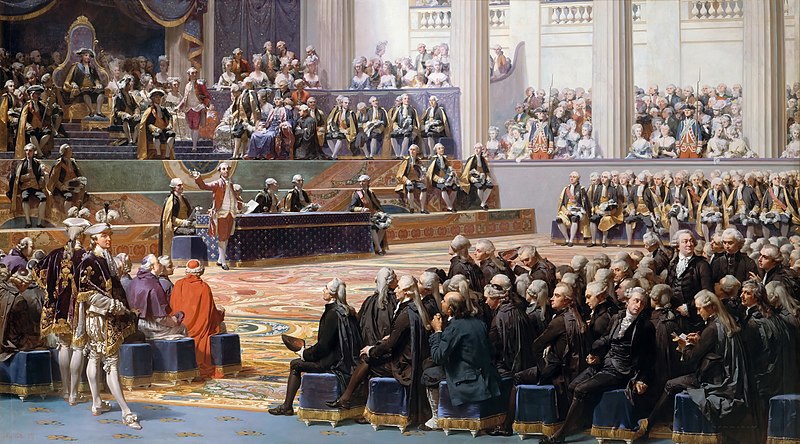
Inaugurazione degli Stati Generali, 5 maggio 1789, olio su tela, 400 x 715 cm, Versailles, Musée national du château et des Trianons
Auguste Couder · Joconde database: entry 000PE005448

Buste de Jean-Sylvain Bailly conservé au musée de la Révolution française, Vizille.
Nicolas Dessaux
Key facts
Key facts
• Office — 1st Mayor of Paris • Term Start — 15 July 1789 • Term End — 12 November 1791 • Predecessor — Jacques de Flesselles (Provost of the Merchants) • Successor — Jérôme Pétion de Villeneuve • Office2 — 1st President of the National Constituent Assembly • Term Start2 — 17 June 1789 • Term End2 — 3 July 1789 • Predecessor2 — Office established • Successor2 — Jean Georges Lefranc de Pompignan • Office3 — Deputy of the Estates-General • Constituency3 — Paris • Term Start3 — 5 May 1789 • Term End3 — 9 July 1789 • Born — 15 September 1736 • Birthplace — Paris, France • Died — 12 November 1793 • Place of death — Paris, France • Death Cause — Guillotined • Party — Patriotic (1790–1791) • Education — *Academy of Sciences • French Academy • Occupation — * Astronomer • mathematician • politician
Scientific career
Scientific career
Born in Paris, Bailly was the son of Jacques Bailly, an artist and supervisor of the Louvre Palace, and the grandson of Nicolas Bailly, also an artist and court painter. As a child he originally intended to follow in his family's footsteps and pursue a career in the arts. He became deeply attracted to science, however, particularly astronomy, by the influence of Nicolas de Lacaille. An excellent student with a "particularly retentive memory and inexhaustible patience", he calculated an orbit for the next appearance of Halley's Comet (in 1759), and correctly reduced Lacaille's observations of 515 stars. He participated in the construction of an observatory at the Louvre. These achievements along with others got him elected to the French Academy of Sciences in 1763. In the years prior to the French Revolution, Bailly's distinctive reputation as a French astronomer led to his recognition and admiration by the European scientific community. Due to his popularity amongst the scientific groups, in 1777, Bailly received Benjamin Franklin as a guest in his house in Chaillot.
Scientific and other writing
Scientific and other writing
Bailly published his Essay on The Theory of the Satellites of Jupiter in 1766. The essay was an expansion of a presentation he had made to the academy in 1763. He later released the noteworthy dissertation On the Inequalities of Light of the Satellites of Jupiter in 1771. In 1778, he was elected a foreign member of the Royal Swedish Academy of Sciences. • Illustration — Front page of the 1777 copy of "Discourse on the Origin of the Sciences and the Peoples of Asia" Bailly gained a high literary reputation thanks to his Eulogies for King Charles V of France, Lacaille, Molière, Pierre Corneille and Gottfried Leibniz, which were issued in collected form in 1770 and 1790. He was admitted to the Académie française on 26 February 1784 and to the Académie des Inscriptions in 1785. From then on, Bailly devoted himself to the history of science. He published A History of Ancient Astronomy in 1775, followed by A History of Modern Astronomy (3 vols., 1782). Other works include Discourse on the Origin of the Sciences and the Peoples of Asia (1777), Discourse on Plato's 'Atlantide (1779), and A Treatise on Indian and Oriental Astronomy (1787). Though his works were "universally admired" by contemporaries, later commentators have remarked that "their erudition was... marred by speculative extravagances."
During the French Revolution
During the French Revolution
In a short period of time, Bailly made his way up the judicial ranks. From being the deputy of Paris, he was elected Estates-General on 20 May 1789. Soon after he was elected inaugural president of the National Assembly (3 June 1789) and led the famous proceedings in the Tennis Court on 20 June, being the first to take the Tennis Court Oath. In the National Assembly (French Revolution) Bailly was one of the deputies who secured the passage of a decree that declared Jews to be French citizens on 17 September 1791. He was met with threats and ridicule for this action. This decree repealed the special taxes that had been imposed on the Jews, as well as all the ordinances existing against them. Bailly was a member of the Club de 1789, one of the best-known societies at the time. Though calls on his time from his mayoral duties restricted his involvement in the group, by May 1790, Bailly had risen to presiding officer of the club. In 1791, Jean Sylvain Bailly joined the Jacobin Club, but took no active role in it. Shortly after the storming of the Bastille on 14 July 1789, he became the first mayor of Paris under the newly adopted system of the Commune. • Illustration — Sketch by Jacques-Louis David of the Tennis Court Oath. Bailly is pictured in the centre, facing the viewer, his right hand raised. • Illustration — J.S.Bailly, by Garneray and Alix, after David scene above
Mayor of Paris
Mayor of Paris
On 15 July 1789, Bailly took office as the mayor of Paris. Two days later he was met by Louis XVI at the Hôtel de Ville who was there to endorse the Revolution. Bailly presented him with the new symbol of the revolution: the cockade of France. In his function as mayor, he was attacked by Camille Desmoulins and Jean-Paul Marat as too conservative. Bailly continuously sought to promote the authority of the mayor while limiting the power of the General Assembly of the Commune.
Maintaining order
Maintaining order
Jean Sylvain Bailly sought to be in full control of his administration as the mayor of Paris. He envisioned being in a position where all answered to him, and only his orders were to be followed. Creating a centralized government within Paris was his plan, however Parisians were not keen with this vision. His views are depicted in the following passage of his Mémoires:... in the executive assembly, the mayor who presides over it is a specific officer of the commune. This Assembly possesses the totality of power, but its chief is its agent, its executive authority, who should be charged with the execution of its orders and the maintenance of its regulations. Moreover, since he is at the head of the administration, he understands all of its branches and has all of its strings in his hands. He is in a better position to detect the difficulties and the dangers than the other members who do not have the same information. If the law does not demand it, reason dictates that no important step be taken and no important questions be decided in his absence, unless he be allowed at least to make observations...
Food crisis
Food crisis
During the early years of the French Revolution, Paris was going through a major food shortage. Bailly's actions to circumvent the situation were of great importance in keeping the revolution alive. Bailly had deputies gather grain that was being hoarded, made the sale of wheat mandatory by farmers, and helped the bakers by making them first in line in the village markets. Convoys that transported grain obtained by deputies were often attacked. To deter these attacks, Bailly signed a decree imposing a fine of five hundred livres on anyone found obstructing such convoys. Not only did the mayor control the supply of grain in the city, but he also imported grain from Africa to increase the city's reserve. A provisional regime was established in October, 1789, in order to stabilize the administration of the government. Doing so led to order being established within the different jurisdictions, allowing The Communal Assembly, with the help of Bailly, to gain control of the food crisis. By February, 1790, the situation in Paris had improved.
National Guard
National Guard
The National Guard, formed during the revolution by The Communal Assembly, was weak and underfunded. Lafayette, chief of the militia, could only do so much to strengthen this newly formed military. It took persuading to get funding from the Assembly to cover the cost and wages brought on by the troops. Bailly saw the importance of having a military that was well-equipped. In the fall of 1789, Bailly was able to acquire ammunition for the troops. In October 1789, Bailly was involved in the establishment of the National Guard department, whose purpose was to arm the military. The mayor not only played a role in strengthening the National Guard, but also issued orders to Lafayette when trying to maintain civility within the city. Bailly's use of troops was to secure the prisons, certify the droits d'entrée would be collected, and to ensure that beggars would not congregate in the city.
Church property
Church property
In an unsuccessful attempt at financial reconstruction, the National Assembly had taken control of church property, making it available to buyers through the issue of non-negotiable bonds known as "assignats". Bailly, along with the Municipal Bureau, then came up with a proposition on 10 March 1790, asking the government to give the city of Paris 200,000,000 livres worth of church land for it to sell to private investors in a period of three years. For their work in selling the land, Bailly and his administration would retain 50,000,000 livres. The National Assembly agreed to this deal. On 2 August 1790, Bailly was reelected as mayor. He allowed investors to begin the purchasing of church property. Before a year had passed, 28,000,000 livres worth of land had already been sold. Bailly's proposal proved successful in generating revenue for Paris and the French state.
Fall from favour
Fall from favour
After a failed attempt by the royal family to flee the country, Bailly tried to contain the growing republican crowds asking for the King to step down. On the morning of 17 July 1791, tensions were rising as suspicion of treason grew. Citizens suspected of criticising the government or National Guard were being interrogated and detained. Bailly soon heard of a gathering at the Champ de Mars, where citizens were meeting to sign petitions calling for the overthrow of the King. Imposing martial law, he ordered the National Guard to disperse the large riotous assembly that had gathered. A violent response ensued and many people died, for which Bailly, along with Lafayette, was considered responsible. What was to become known as the Champ de Mars Massacre was taken by the revolutionaries as an exemplar for oppression by the government. Having thereby become extremely unpopular, Bailly resigned on 12 November and was replaced four days later by Jerôme Pétion. Bailly moved to Nantes, where he composed his Mémoires d'un Témoin (published in 3 volumes by MM. Berville and Barrière, 1821–1822), an incomplete narrative of the extraordinary events of his public life.
Execution
Execution
• Illustration — Bailly on the guillotine In July 1793, Bailly left Nantes to join his friend Pierre-Simon Laplace at Melun, but was recognized there and arrested. On 14 October, he was pressed to testify against Marie Antoinette but refused. On 10 November 1793, he was brought before the Revolutionary Tribunal in Paris, speedily tried, and sentenced to death the next day. On 12 November 1793, he was guillotined at the Champ de Mars, a site selected symbolically as the location of his betrayal of the republican movement. The little red flag he had used to give the order to fire on the crowds on the Champ de Mars was tied to the cart that took him to his death, and burned in front of him before he was executed. It was the revival of this event as a part of republican heritage after 10 August 1792, as well as a campaign of municipal persecution led by Marat, that ultimately resulted in Bailly's execution, as well as that of "many of his colleagues". Before his death, he was forced to endure the freezing rain and the insults of a howling mob. When a scoffer shouted, "Tu trembles, Bailly?" ("Do you tremble, Bailly?"), he responded, "Oui, mais c'est seulement de froid" ("Yes, but it is only the cold").
Works
Works
• Essai sur la théorie des satellites de Jupiter, 1766 • Sur les inégalités de la lumière des satellites de Jupiter, 1771 • Histoire de l'astronomie ancienne, 1775 • Histoire de l'astronomie moderne, 1782 • Lettres sur l'origine des sciences et sur celle des peuples de l'Asie, 1777 • Lettres sur l'Atlantide de Platon et sur l'ancienne histoire de l'Asie, 1779 (archive.org) • Traite de l'astronomie indienne et orientale, 1787 • Mémoires de Bailly, tome premier (1821) • Mémoires de Bailly, tome second • Mémoires de Bailly: avec une notice sur sa vie, des notes et des éclaircissements historiques, 3ème tome (1822)
Career and activity
Career and activity
Jean Sylvain Bailly worked in mathematics, astronomy, politics and French Revolution. Recorded positions include member of the French National Assembly, mayor of Paris and seat 31 of the Académie française. He belonged to Académie Française, French Academy of Sciences, Royal Swedish Academy of Sciences, Académie des Inscriptions et Belles-Lettres and Accademia Nazionale delle Scienze detta dei XL. He worked at Paris. Recorded as astronomer, politician, mathematician, writer and mayor.
Life and career
Dated record
Life and career
The full dated record · 2 entries
1736
Jean Sylvain Bailly born at Paris.
1793
Jean Sylvain Bailly died at Paris.
Notes from the source article
Cited by Wikipedia
Notes from the source article
These works are cited by the source article, in its own numbering. They are recorded as its citations, not as sources VALÉORINE has verified.
- 1.Cara, Monique. Dictionnaire universel de la Franc-Maçonnerie. Larousse. 2011. 9782035861368.
- 2.Pierrat, Emmanuel. Le Paris des Francs-Maçons. Le Cherche Midi. 2013. 9782749131429.
- 3.Stephens, p. 51.
- 4.Smith, Edwin Burrows. Jean-Sylvain Bailly: Astronomer, Mystic, Revolutionary 1736–1793. Transactions of the American Philosophical Society. 44. 4. 430. September 1954. 10.2307/1005705.
- 5.Brucker, Gene A. Jean-Sylvain Bailly: Revolutionary Mayor of Paris. University of Illinois Press. 1950.
- 6.Longman. Chronicle of the French Revolution. 1989.
- 7.Schama, Simon. Citizens. Penguin. 1989.
- 8.Bailly, Jean-Sylvain. 1906. 455–456.
- 9.Bailly, Jean Sylvain. Mémoires D'un Témoin de la Révolution, ou Journal. Baudouin frères. 106–107. 1821.
- 10.Petites et Grandes Révolutions de la Famille de Milly: Recherches sur et ... by Alexandre Blondet, p. 181, 185
- 11.Les lundis révolutionnaires: 1790 by Jean-Bernard, pp. 250–251
- 12.Andress, David. Massacre at the Champ de Mars: popular dissent and political culture in the French Revolution. Royal Historical Society: Boydell Press. 2000.
- 13.W. R. Aykroyd. Three Philosophers: Lavoisier, Priestley and Cavendish. Elsevier Science. 159. 2014. 978-1-4831-9445-5.
Bibliography printed in the source article · 9
- Chapin, Seymour L. Bailly, Jean-Sylvain. Dictionary of Scientific Biography. Charles Scribner's Sons. 1. 400–402. 1970. 978-0-684-10114-9.
- 3. 220.
- Stephens, Henry Morse. A History of the French Revolution. C. Scribner's Sons. 51. 1886.
- Bailly, J.-S., "Secret Report on Mesmerism or Animal Magnetism", International Journal of Clinical and Experimental Hypnosis, Vol.50, No.4, (October 2002), pp. 364–368. doi=10.1080/00207140208410110
- Franklin, B., Majault, M.J., Le Roy, J.B., Sallin, C.L., Bailly, J.-S., d'Arcet, J., de Bory, G., Guillotin, J.-I. & Lavoisier, A., "Report of The Commissioners charged by the King with the Examination of Animal Magnetism", International Journal of Clinical and Experimental Hypnosis, Vol.50, No.4, (October 2002), pp. 332–363. doi=10.1080/00207140208410109
- Eloges by Merard de Saint Just, Delisle de Salles, Jérôme Lalande and Lacretelle
- A memoir by François Arago, read on 26 February 1844 before the Académie des Sciences, and published in Notices biographiques, t. ii. (1852)
- Delambre, Histoire de l'astronomie au 18 me siecle, p. 735
- Jérôme Lalande, Bibliographie astronomique, p. 730.
References
Citations
References
Each reference names the institution holding it, so a reader may go to the document itself.
reference work
Wikidata, structured authority record Q1685301: Jean Sylvain BaillyWikimedia Foundation
Partially resolvedreference work
Partially resolved
The Encyclopedia exists whether or not anything is for sale. Corrections are recorded rather than overwritten, and every version of this record is kept. Published 15 August 2026.
Elsewhere in Books
38,960 published records in this field, each with its sources named.
- Jean SteinAuthor
- Jean SternAuthor
- Jean StevoAuthor
- Jean SulivanAuthor
- Jean TardieuAuthor
- Jean TerrassonAuthor
- Jean TharaudAuthor
- Jean Thompson SsipsisAuthor
Best supported in this field
For owners
Own a work by Jean Sylvain Bailly?
A specialist will read what you send and tell you what the house can establish, what it cannot, and whether the object is suited to sale. There is no charge and no obligation. The object stays with you throughout; nothing is shipped to us unless it is arranged in writing beforehand.