
Jean-Michel Moreau
Jean-Michel Moreau (26 March 1741 – 30 November 1814), also called Moreau le Jeune ("the younger"), was a French draughtsman, illustrator and engraver. • Illustration — Portrait of Jean-Michel Moreau le Jeune by François-Louis Gounod
Also recorded as Jean Michel, the younger Moreau · Jean-Michel, le jeune Moreau · Jean Michel, II Moreau · Jean Michel, the Younger Moreau
Jean-Michel Moreau
Jean-Michel Moreau · Wellcome Collection, London · Wellcome Collection · Public Domain Mark
- Born
- 1741
- Died
- 1814
- Nationality
- France
- Occupation
- painter · illustrator · encyclopédistes · engraver · copper engraver · etcher · draftsperson · artist
VALÉORINE Encyclopedia
VALÉORINE documentary reading
Documentary summary
Jean-Michel Moreau (26 March 1741 – 30 November 1814), also called Moreau le Jeune ("the younger"), was a French draughtsman, illustrator and engraver. • Illustration — Portrait of Jean-Michel Moreau le Jeune by François-Louis Gounod
Admitted source layer · organised and presented by VALÉORINE
Reference Check
Propose documentary evidence for Jean-Michel Moreau. A contribution is never written directly as fact: identity, source, rights and evidence gates still decide.
Sign in to contribute
Documentary evidence
Documentary basis
Authority files
wikidata · Q321972 · wikipedia · Jean-Michel Moreau
In this article
Biography
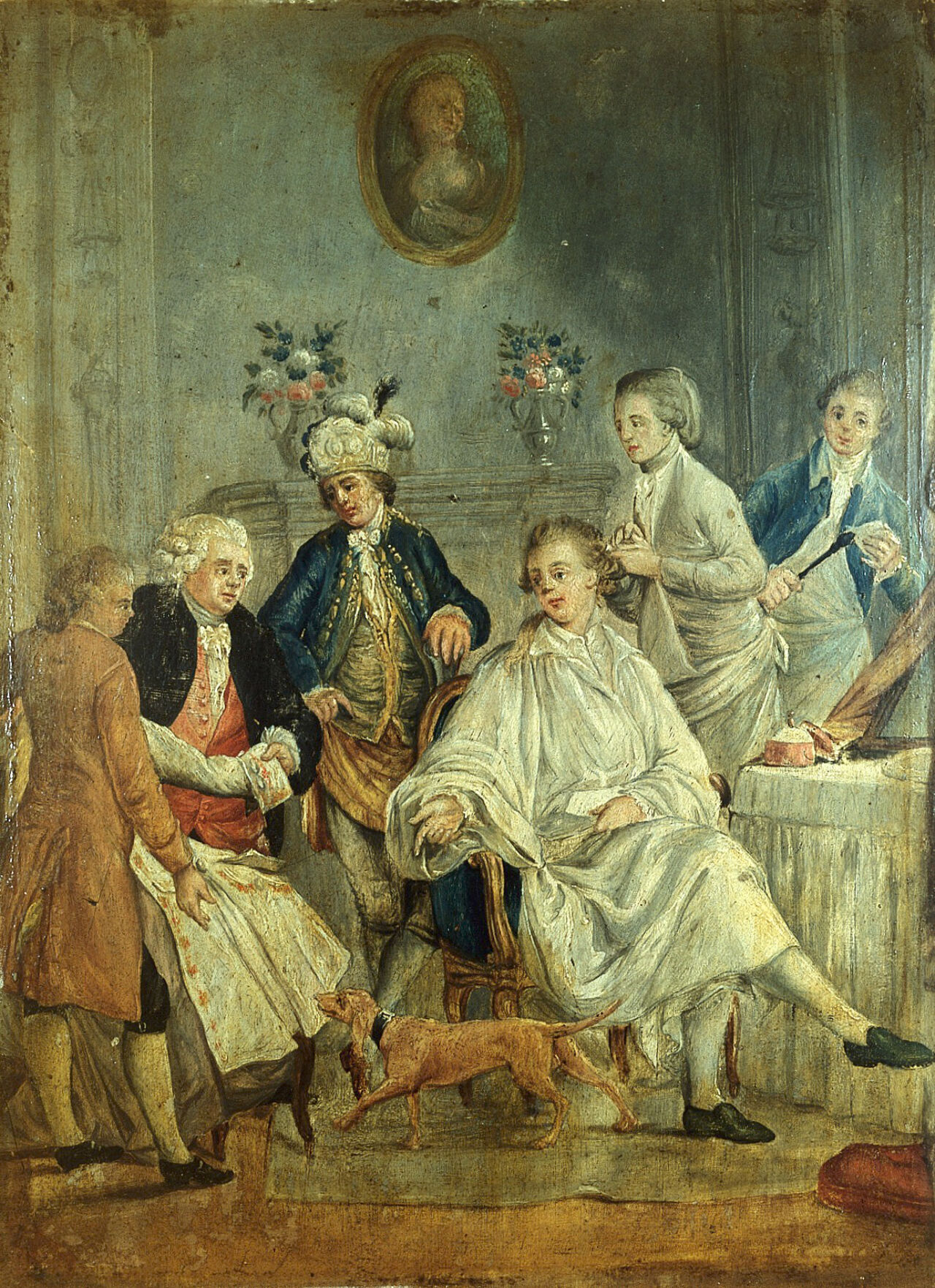
Moreau le Jeune, as he is usually called, was born in Paris. He was the pupil of the painter Louis-Joseph Le Lorrain who accompanied his master to St Petersburg in 1758 when Le Lorrain went to be the first director of the Saint Petersburg Academy of Fine Arts established the previous year, where Moreau briefly taught drawing before returning to Paris in 1759, after Le Lorrain's unexpected death. • Illustration — Jean-Michel Moreau the Younger, Fête donnée à Louveciennes le 2 septembre 1771 (Musée du Louvre) He worked for the engraver Jacques-Philippe Lebas, producing reproductive drawings of contemporary paintings and those of Old Masters for engravers to work from and learning etching During the 1760s he also provided drawings to be engraved for the Recueil d’antiquités of the comte de Caylus, who kept a benevolent watch over him. For Diderot and Alembert's Encyclopédie he provided pen and wash drawings for the engravers, illustrating artisanal processes. As an engraver he collaborated with François Boucher, Hubert Gravelot and others on illustrations for an edition of Ovid's Metamorphoses. In 1765 Moreau married Françoise-Nicole Pineau, daughter of François Pineau, master sculptor, and Jeanne-Marie Prault - whose father was Pierre Prault, patriarch of a family of publishers, privilègiés du Roi. In 1770 he succeeded Charles-Nicolas Cochin as chief Dessinateur des Menus Plaisirs du Roi, on Cochin's recommendation, which occasioned his prints celebrating the marriage of the Dauphin and his coronation in 1781, in part on the strength of these productions he was appointed Dessinateur et Graveur du Cabinet du Roi, which brought an annual pension and lodgings in the galleries of the Palais du Louvre. Now he found that he required the services of other engravers to reproduce his own designs, which included illustrations for the Chansons of Jean-Benjamin de La Borde (1773), the collected works of Rousseau (1773–82) and of Voltaire (printed at Brussels, 1782–9). For the Menus Plaisirs, the office that produced and executed all the designs for settings of court festivities and recorded them in presentation drawings, he recorded many occasions such as his famous pen-and-wash record of the inauguration in September 1771 of Mme du Barry's Pavillon de Louveciennes (illustration, right). He still found time for intimate portrait drawings in charcoal and chalks • Illustration — Noël Le Mire from Jean-Michel Moreau the Younger, Le gâteau des rois (The Troelfth Cake), an allegory of the First Partition of Poland Moreau's name appears in the 1778 roster of Les Neuf Soeurs, the masonic lodge named for the Muses that had been founded two years previously by the astronomer Jérôme Lalande, and which served as a forum for progressive ideas. He traveled to Italy for six months in 1785 and wasagrée at the Académie Royale de Peinture et de Sculpture in 1780 and received there as a full member in 1789. The French Revolution, with which Moreau was in sympathy, did not hinder his success as an illustrator, providing engravers with pen and wash drawings to replicate, as for a French translation of the Aeneid published in 1804 In 1793 Moreau was appointed to the commission temporaire des arts and in 1797 was made a professor at the newly reformed écoles centrales. With the Bourbon restoration in 1814 Louis XVIII appointed him once again to a royal office. He died in Paris. In his prolific career his best-known works are those twenty-four illustrations that record fashionable dress and interiors of the last years of the Ancien Régime, his contributions to the Monument du costume physique et morale, twelve as a Suite d'estampes pour servir à l'histoire dews mœurs des François au dix-huitième siècle, 1776 and 1777, and twelve more in the Troisième Suite d'éstampes pour servir a l'Histoire des Moeurs et du Costume..., 1783, published by his uncle by marriage, L.-F. Prault, and many times re-issued in varying formats, notably in a collection in 1789 with text by Restif de la Bretonne. Each of the first dozen of these vignettes of stylish contemporary life has an element of anecdote, reporting in a cohesive and unified manner "a highly idealized vision of an aristocratic family's approach to childbearing and motherhood based on the philosophy of Rousseau" (Heller-Greenman). In the second suite, a hint of criticism of aristocratic duplicity in affairs of the heart can be discerned and some rural vignettes vertueuses (sentimental and virtuous) provide a contrasting social world in the manner of Greuze. Moreau le Jeune's reputation was resuscitated from oblivion in the later nineteenth century by the connoisseurs of the dix-huitième Edmond and Jules de Goncourt.
![A young man and a young woman embrace each other at a table piled with books. Engraving by N. Le Mire, 1795, after J.M. Moreau le Jeune, 1794., An 3e [1795], by Jean-Michel Moreau](https://iiif.wellcomecollection.org/image/V0039313/full/800,/0/default.jpg)
A young man and a young woman embrace each other at a table piled with books. Engraving by N. Le Mire, 1795, after J.M. Moreau le Jeune, 1794., An 3e [1795], by Jean-Michel Moreau
Jean-Michel Moreau · Wellcome Collection, London · Wellcome Collection
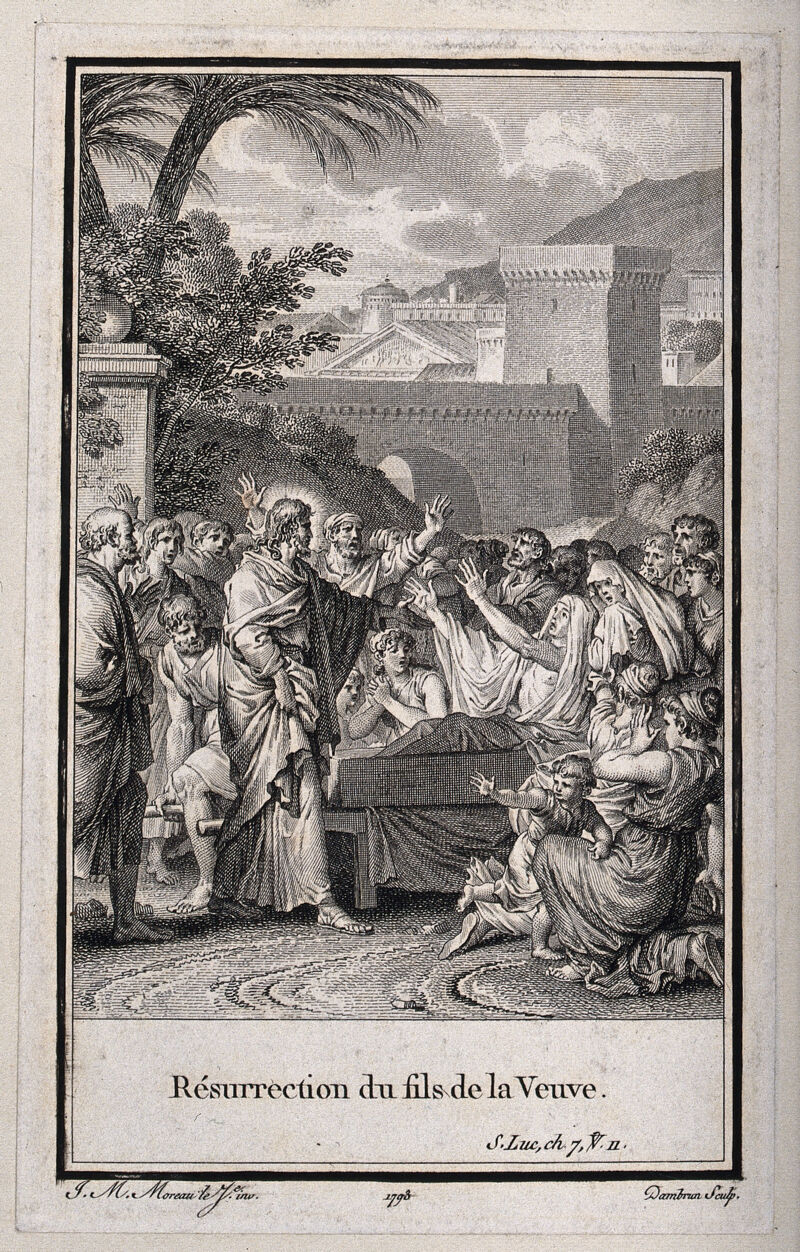
Christ raises the widow's son from the dead. Engraving by J. Dambrun, 1793, after J.M. Moreau., 1793, by Jean-Michel Moreau
Jean-Michel Moreau · Wellcome Collection, London · Wellcome Collection
Primary material
Documents and archives
Institutional database
- Wikidata, structured authority record Q321972: Jean-Michel Moreau
Scholarly · Wikimedia Foundation
reference work
- “Jean-Michel Moreau”, English Wikipedia, consulted as further reading
Reputable secondary · Wikipedia
Notes from the source article
Cited by Wikipedia
Notes from the source article
These works are cited by the source article, in its own numbering. They are recorded as its citations, not as sources VALÉORINE has verified.
- 1."Moreau the Elder" refers to his older brother Louis-Gabriel Moreau (1740-1806).
- 2.Les Metamorphoses d’Ovide, en Latin et en François, de la traduction de M. l’Abbé Banier, ..., printed by Laurent-François Prault, Paris 1767- 1771. About thirty artists and engravers contributed to the 139 illustration plates. http://www.asherbooks.com/Classical-antiquity_21_2_subject.html
- 3.A portrait of the artist's infant daughter Fanny is at the Fine Arts Museums of San Francisco. She married the artist Carle Vernet, son of Joseph Vernet.
- 4.Received in a probationary position.
- 5.His membership in various progressive societies during the Revoilution is "well documented" (Heller-Greenman)
- 6.A preparatory drawing is at the J. Paul Getty Museum.
- 7.The project was sponsored by the Strasbourg financier and amateur engraver Jean-Henri Eberts.
Bibliography printed in the source article · 5
- Adrien Moureau. Les Moreaus (Librairie de L'Art, 1893).
- Marie-Joseph-François Mahérault, 1979. L'œuvre gravé de Jean-Michel Moreau le jeune (1741–1814) : catalogue raisonné et descriptif avec notes iconographiques et bibliographiques, suivi d'un catalogue raisonné de gravures d'après Moreau et d'un supplément contenant un catalogue des dessins de Moreau (Amsterdam)
- Edmond et Jules de Goncourt L'art du dix-huitème siècle Tome II, (Paris: Rapilly, 1874) - chapter devoted to Moreau, pages 151 to 232
- Jean Chrétien Ferdinand Hoefer, Nouvelle Biographie générale, t. 36, Paris, Firmin-Didot, 1861, p.495-7
- Dorothy P. Arthur et David Smith, Sur un collaborateur énigmatique de l'Encyclopédie : Jean-Michel Moreau dit le Jeune, , 2008, no°43, p.145-157
References
Citations
References
Each reference names the institution holding it, so a reader may go to the document itself.
Institutional database
Wikidata, structured authority record Q321972: Jean-Michel MoreauWikimedia Foundation
Institutional witnessreference work
Secondary witness
The Encyclopedia exists whether or not anything is for sale. Corrections are recorded rather than overwritten, and every version of this record is kept. Published 14 August 2026.
Elsewhere in Prints
4,138 published records in this field, each with its sources named.
- Jean-Joseph-François TassaertEngraver
- Jean-Julien LemordantEngraver
- Jean-Louis ForainEngraver
- Jean-Michel CelsEngraver
- Jean-Pierre CeytaireEngraver
- Jean-Pierre Norblin de La GourdaineEngraver
- Jean-Pierre VellyEngraver
- Jean-Robert IpoustéguyEngraver
Best supported in this field
For owners
Own a work by Jean-Michel Moreau?
A specialist will read what you send and tell you what the house can establish, what it cannot, and whether the object is suited to sale. There is no charge and no obligation. The object stays with you throughout; nothing is shipped to us unless it is arranged in writing beforehand.