
Jean-Honoré Fragonard
Jean-Honoré Fragonard (lang; 5 April 1732 – 22 August 1806) was a French painter and printmaker whose late Rococo manner was distinguished by remarkable facility, exuberance, and hedonism. One of the most prolific artists active in the last decades of the Ancien Régime, Fragonard produced more than 550 paintings (not counting drawings and etchings), of which only five are dated. Among his most popular works are genre paintings conveying an atmosphere of intimacy and veiled eroticism.
Also recorded as Jean Honoré Fragonard · Zhan-Onore Fragonar · Honoré Fragonard · Frago
Jean-Honoré Fragonard
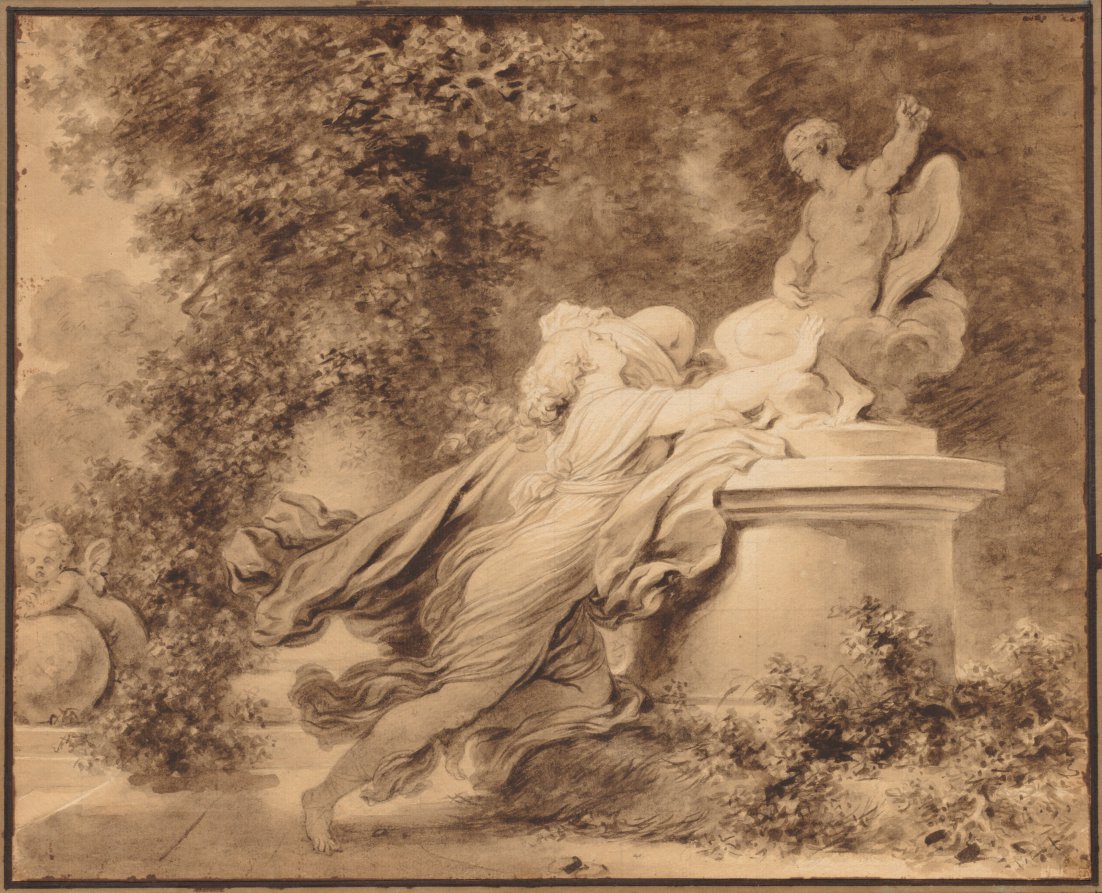
Jean-Honoré Fragonard · The Cleveland Museum of Art · Grace Rainey Rogers Fund · CC0
- Name
- Jean-Honoré Fragonard
- Born
- 5 April 1732
- Birthplace
- Grasse, France
- Died
- 22 August 1806
- Place of death
- Paris, France
- Movement
- Rococo
- Awards
- Prix de Rome
- Field
- Painting, drawing, etching
- Training
- * Jean-Siméon Chardin
- Nationality
- France · French constitutional monarchy
- Occupation
- painter · printmaker · draftsperson · illustrator
- Fields
- portrait · landscape painting
VALÉORINE Encyclopedia
VALÉORINE documentary reading
Documentary summary
Jean-Honoré Fragonard (lang; 5 April 1732 – 22 August 1806) was a French painter and printmaker whose late Rococo manner was distinguished by remarkable facility, exuberance, and hedonism. One of the most prolific artists active in the last decades of the Ancien Régime, Fragonard produced more than 550 paintings (not counting drawings and etchings), of which only five are dated. Among his most popular works are genre paintings conveying an atmosphere of intimacy and veiled eroticism.
Admitted source layer · organised and presented by VALÉORINE
Note VALÉORINE
Jean-Honoré Fragonard (1732–1806) was a draftsperson, illustrator and painter, among other activities, a national of France and French constitutional monarchy. The draftsperson was born in Grasse and died in former 2nd arrondissement of Paris.
Jean-Honoré Fragonard was educated at Beaux-Arts de Paris, École royale des élèves protégés and French Academy in Rome. The draftsperson worked in Dresden, Frankfurt and Grasse, among others. Activity centred on painting. The draftsperson was associated with Rococo.
Among the works are A Young Girl Reading, The Lock and The Swing. The work spans landscape painting and portrait. Languages used include French. Honours include Prix de Rome.
Composed from admitted, traceable facts · 26 September 2026
VALÉORINE
Reference Check
Propose documentary evidence for Jean-Honoré Fragonard. A contribution is never written directly as fact: identity, source, rights and evidence gates still decide.
Sign in to contribute
Documentary evidence
Documentary basis
Authority files
gnd · 10158660-7 · wikidata · Q127171 · wikipedia · Jean-Honoré Fragonard
In this article
Key facts
Key facts
• Name — Jean-Honoré Fragonard • Born — 5 April 1732 • Birthplace — Grasse, France • Died — 22 August 1806 • Place of death — Paris, France • Children — 2, including Alexandre-Évariste Fragonard • Movement — Rococo • Awards — Prix de Rome • Field — Painting, drawing, etching • Training — * Jean-Siméon Chardin • François Boucher • Charles-André van Loo French Academy in Rome • Works — The Swing, A Young Girl Reading, The Bolt
Biography
Biography
• Illustration — Statue of Fragonard in Grasse, his birthplace • Illustration — Jean-Honoré Fragonard, Blindman's Buff, 1775–1780, Timken Museum of Art, San Diego Jean-Honoré Fragonard was born in Grasse, Alpes-Maritimes, France the only child of François Fragonard, a glover, and Françoise Petit. In 1738 the family relocated to Paris. The young Fragonard showed an inclination for art, which was recognized by François Boucher, who recommended him to the atelier of Chardin. Fragonard studied for a short time with Chardin then returned ca. 1749 to Boucher, whose style he soon acquired so completely that the master entrusted him with the execution of replicas of his paintings. Though not yet a student of the Academy, Fragonard gained the Prix de Rome in 1752 with a painting of Jeroboam Sacrificing to Idols, but before proceeding to Rome he continued to study for three years under Charles-André van Loo. In the year preceding his departure he painted the Christ washing the Feet of the Apostles now at Grasse Cathedral. In December 1756, he took up his abode at the French Academy in Rome, then presided over by Charles-Joseph Natoire. While at Rome, Fragonard contracted a friendship with a fellow painter Hubert Robert. In 1760, they toured Italy together, executing numerous sketches of local scenery. It was in these romantic gardens, with their fountains, grottoes, temples and terraces, that Fragonard conceived the dreams which he was subsequently to render in his art. He also learned to admire the masters of the Dutch and Flemish schools (Rubens, Hals, Rembrandt, Ruisdael), imitating their loose and vigorous brushstrokes. Added to this influence was the deep impression made upon his mind by the florid sumptuousness of Giovanni Battista Tiepolo, whose works he had an opportunity to study in Venice before he returned to Paris in 1761. In 1765 his Coresus Sacrificing Himself to Save Callirhoe secured his admission to the Academy. It was made the subject of a pompous (though not wholly serious) eulogy by Denis Diderot, and was bought by the king, who had it reproduced at the Gobelins factory. Until this time Fragonard had hesitated between religious, classic and other subjects, but he did not aspire to become a history painter and he had difficulty completing official commissions. As a consequence, he painted mostly for private patrons or for himself. The demand of the wealthy art patrons of Louis XV's pleasure-loving and licentious court turned him definitely towards those scenes of love and voluptuousness, which are only made acceptable by the tender beauty of his color and the virtuosity of his facile brushwork; such works include the Blind Man's Bluff (Le collin maillard), Serment d'amour (Love Vow), Le Verrou (The Bolt), La Culbute (The Tumble), La Chemise enlevée (The Raised Chemise), and L'escarpolette (The Swing, Wallace Collection), and his decorations for the apartments of Mme du Barry and the dancer Madeleine Guimard. • Illustration — Early engraving after Jean-Honoré Fragonard titled Chaumiére Italienne A lukewarm response to these series of ambitious works induced Fragonard to abandon the Rococo style and to experiment with Neoclassicism. He married Marie-Anne Gérard (1745–1823), herself a painter of miniatures, on 17 June 1769 and had a daughter, Rosalie Fragonard (1769–1788), who became one of his favourite models. In October 1773, he again went to Italy with Pierre-Jacques Onézyme Bergeret de Grancourt and his son, Pierre-Jacques Bergeret de Grancourt. In September 1774, he returned through Vienna, Prague, Dresden, Frankfurt and Strasbourg. Back in Paris Marguerite Gérard, his wife's 14-year-old sister, became his student and assistant in 1778. In 1780, he had a son, Alexandre-Évariste Fragonard (1780–1850), who eventually became a talented painter and sculptor. The French Revolution deprived Fragonard of his private patrons: they were either guillotined or exiled. The neglected painter deemed it prudent to leave Paris in 1790 and found shelter in the house of his cousin Alexandre Maubert at Grasse, which he decorated with the series of decorative panels known as the Les progrès de l'amour dans le cœur d'une jeune fille, originally painted for Château du Barry. • Illustration — The Swing (French: L'escarpolette), 1767, Wallace Collection, London
Work
Work
• Illustration — Jeroboam Offering Sacrifice for the Idol, 1752, Beaux-Arts de Paris, Paris • Illustration — Blind Man's Bluff, 1750–1752, Toledo Museum of Art, Toledo, Ohio • Illustration — The See-Saw, 1750–1752, Thyssen-Bornemisza Museum, Madrid • Illustration — The Birth of Venus, 1753–1755, Musée Grobet-Labadié, Marseille • Illustration — The Grape Gatherer, 1754–1755, Detroit Institute of Art, Detroit, Michigan • Illustration — The Musical Contest, 1754–55, Wallace Collection, London • Illustration — Aurora Triumphing over Night, c. 1755–56, Museum of Fine Arts, Boston • Illustration — The Little Park, 1763, Wallace Collection, London • Illustration — Coresus Sacrificing himself to Save Callirhoe, 1765, Louvre, Paris • Illustration — Callirhoe's Sacrifice. Real Academia de Bellas Artes de San Fernando, Madrid. (ricordo from the large Coresus and Callirhoë) • Illustration — The Bathers, c. 1765, Louvre, Paris • Illustration — Inspiration, 1769, Louvre, Paris • Illustration — Portrait of a Man, the so-called Denis Diderot, 1769, Louvre, Paris • Illustration — Portrait of François-Henri d'Harcourt, c. 1769, Accademia Carrara di Belle Arti di Bergamo, Bergamo • Illustration — The Love Letter, 1770, Metropolitan Museum of Art, New York • Illustration — La Gimblette, c. 1770, Alte Pinakothek, Munich • Illustration — The Secret Meeting, 1771, (former collection of Madame Du Barry), Frick Collection, New York • Illustration — The Visit to the Nursery, c. 1775, National Gallery of Art, Washington, D.C. • Illustration — A Young Girl Reading, c. 1776, National Gallery of Art, Washington, D.C. • Illustration — The Two Sisters, after 1778, Metropolitan Museum of Art. New York • Illustration — The Stolen Kiss, late 1780s, Hermitage Museum, Saint Petersburg • Illustration — The Beautiful Servant, Nationalmuseum, Stockholm • Illustration — The Woman With A Dog, after 1760, found in The Metropolitan Museum of Art • Illustration — Les Débuts du Modèle Or Model's First Lesson, 1770, found in Musée Jacquemart-André • Illustration — Le Chat angora (c. 1783–1785), Wallraf-Richartz Museum.
Recent exhibitions
Recent exhibitions
• Consuming Passion: Fragonard's Allegories of Love – Sterling and Francine Clark Art Institute, Williamstown, MA, from 28 October 2007 to 21 January 2008. • Fragonard – Jacquemart-André Museum, Paris, from 3 October 2007 to 13 January 2008. • Fragonard. Origines et influences. De Rembrandt au XXIe siècle – Caixa Forum, Barcelona, from 10 November 2006 to 11 February 2007. • Les Fragonard de Besançon, Musée des Beaux-Arts et d'archéologie de Besançon, from 8 December 2006 to 2 April 2007: Official website • Fragonard: Drawing Triumphant–Works from New York Collections, the Metropolitan Museum of Art, 6 October 2016 to 8 January 2017 • Fragonard and the French Tradition, Morgan Library & Museum, from 13 October 2006, through 7 January 2007 • Jean-Honoré Fragonard, dessins du Louvre, Musée du Louvre, Paris, from 3 December 2003 to 8 March 2004. • Fragonard amoureux, Musée du Luxembourg, Paris, from 16 September 2015 to 24 January 2016: Official website • Fragonard’s Enterprise: The Artist and the Literature of Travel – Norton Simon Museum, Pasadena, from 17 September 2015 to 4 January 2016. • Fragonard: The Fantasy Figures National Gallery of Art, Washington, D.C. from 8 October - 3 December 2017
Identity and overview
Identity and overview
The following is established of the heading itself. Recorded as France and French constitutional monarchy.
Works and production
Works and production
The following works and productions are recorded by name or by count. It is also recorded that nymph Supported by Two Satyrs (Nymphe s'asseyant sur les mains de deux satyres). It is also recorded that the Satyr's Family (La famille du satyre). It is also recorded that nymph Astride a Satyr (Jeune fille a califourchon sur un satyre). The Satyrs' Dance (Danse de satyres). Institutional cataloguing adds that the Little Park (Le petit parc). Institutional cataloguing adds that the Tax Collectors (Les traitants).
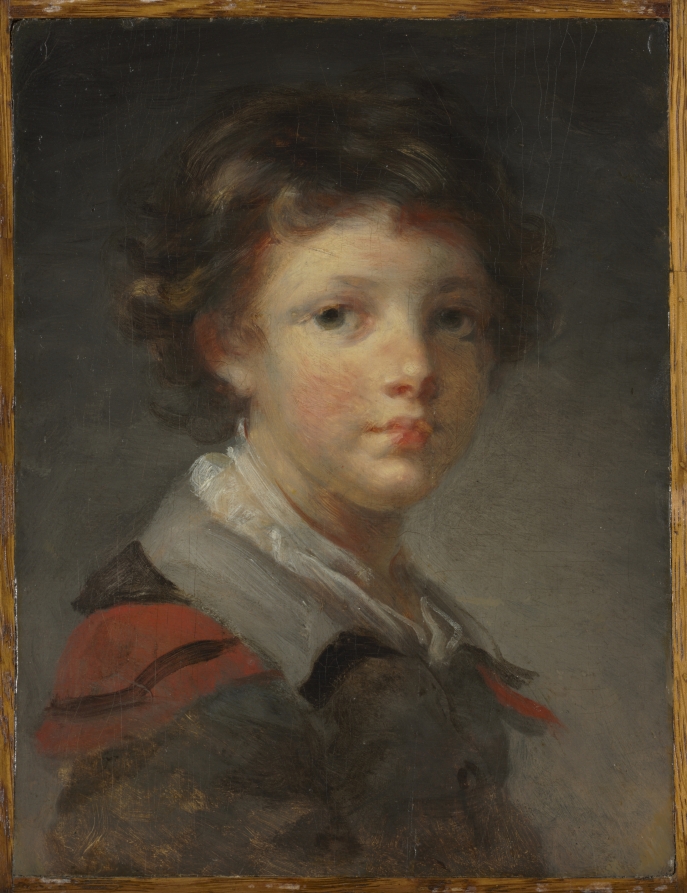
A Boy in a Red-lined Cloak, 1780s, by Jean-Honoré Fragonard
Jean-Honoré Fragonard · The Cleveland Museum of Art · Gift of Grace Rainey Rogers in memory of her father, William J. Rainey
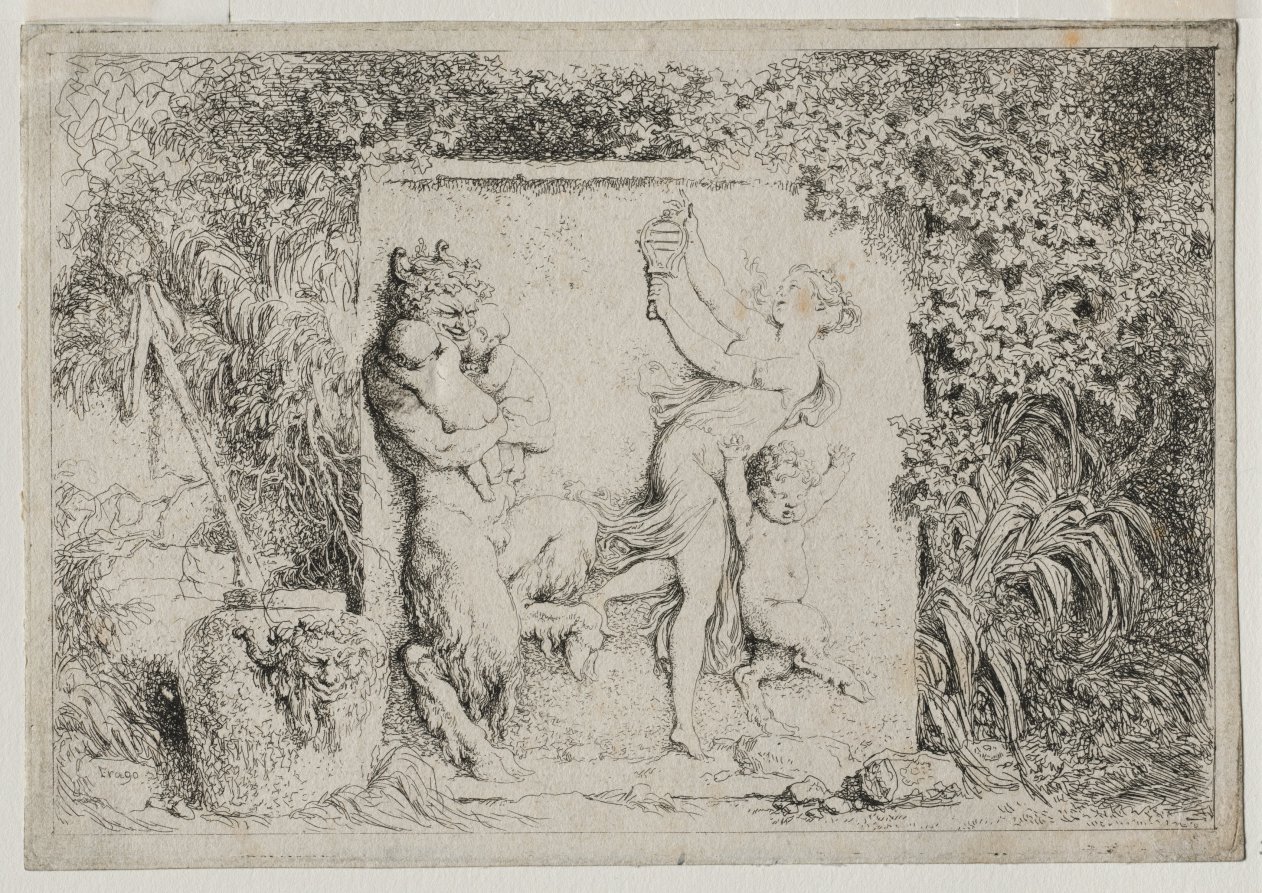
Bacchanales: The Satyr's Dance, 1763, by Jean-Honoré Fragonard
Jean-Honoré Fragonard · The Cleveland Museum of Art · Severance and Greta Millikin Trust
Legacy
For half a century or more, Fragonard was so completely ignored that Wilhelm Lübke's 1873 art history volume omits mention of his name. Later re-evaluations have re-identified his position among the all-time masters of French painting. The influence of his handling of local colour and expressive, confident brushstroke on the Impressionists (particularly his grand niece, Berthe Morisot, and Renoir) is undoubtable. Fragonard's paintings, alongside those of François Boucher, seem to sum up an era. One of Fragonard's most renowned paintings is The Swing, also known as The Happy Accidents of the Swing (its original title), an oil painting in the Wallace Collection in London. It is considered to be one of the masterpieces of the rococo era, and is Fragonard's best-known work. The painting portrays a young gentleman concealed in the bushes, observing a lady on swing being pushed by her spouse, who is standing in the background, hidden in the shadows, as he is unaware of the affair. As the lady swings forward, the young man gets a glimpse under her dress. According to Charles Collé's memoirs a young nobleman had requested this portrait of his mistress seated on a swing. He asked first Gabriel François Doyen to make this painting of him and his mistress. Not comfortable with this frivolous work, Doyen refused and passed on the commission to Fragonard. The Swing is seemingly referenced in The Great Gatsby by F. Scott Fitzgerald, in which the protagonist Nick Carraway describes an apartment "crowded to the doors with a set of tapestried furniture [... with] scenes of ladies swinging in the gardens of Versailles." Fragonard is also referenced in Milan Kundera's novel Slowness, which talks about Fragonards paintings Progress of Love. The poem The Lamentation of the Old Pensioner by William Butler Yeats uses the description of a broken tree and a woman that turns her face as an allusion to Fragonard's The Swing, as the branch the woman uses to swing on is broken and facing the viewer. The Waste Land by T.S Eliot visually depicts the "carvéd dolphin" surmounted by winged cupids in Fragonard’s Progress of Love: The Pursuit.
Collections and holdings
Where the work is held
Collections and holdings
Institutional holdings are recorded as follows.
Documents and archives
Primary material
Documents and archives
Institutional database
- Wikidata, structured authority record Q127171: Jean-Honoré Fragonard
Scholarly · Wikimedia Foundation
reference work
- “Jean-Honoré Fragonard”, English Wikipedia, consulted as further reading
Reputable secondary · Wikipedia
authority file
- Gemeinsame Normdatei 10158660-7, Villa-Musée Jean-Honoré Fragonard.
General reference · Deutsche Nationalbibliothek
Notes from the source article
Cited by Wikipedia
Notes from the source article
These works are cited by the source article, in its own numbering. They are recorded as its citations, not as sources VALÉORINE has verified.
- 1.Rosenberg, Pierre. Fragonard. Metropolitan Museum of Art. 1 January 1988. 978-0-87099-516-3.
- 2.Edmond and Jules de Goncourt. L'Art du XVIIIe siècle. G. Charpentier. III. 241. 1881–1882. 978-2-35548-008-9.
- 3.Houël de Chaulieu, Philippe. L'histoire en marche; Anniversaire: Jean-Honoré Fragonard. Intermédiaire des chercheurs et curieux. 644. 571–574. May 2006. 0994-4532.
- 4.Harrison, Colin (2003). "Fragonard, Jean-Honoré". Grove Art Online. Retrieved March 2024.
- 5.Baetjer, K., & Metropolitan Museum of Art (New York, N.Y.). (2019). French Paintings in the Metropolitan Museum of Art from the Early Eighteenth Century through the Revolution. The Metropolitan Museum of Art. p. 250. .
- 6.Schwartz, Sanford (1990). Artists and Writers. New York: Yarrow Press. p. 286. .
- 7.Milam, Jennifer. Fragonard and the blindman's game: Interpreting representations of Blindman's Buff. Art History. 21. 1. 1–25. 1998. 0141-6790.
- 8.Chaumiére Italienne. lib.ugent.be.
- 9.Ferrand, Franck. Monsieur Fragonard. France Today. 23. 2. 30–31. 2008. 0895-3651.
- 10.Also known as "Roman d'amour de la jeunesse".
- 11.Donald Posner. The True Path of Fragonard's 'Progress of Love'. Burlington Magazine. August 1972.
- 12.The Project Gutenberg eBook of Encyclopædia Britannica, Volume X Slice VII – Fox, George to France. www.gutenberg.org.
- 13."Fragonard, Jean-Honoré", WebMuseum, Paris. Retrieved 22 June 2014.
- 14.Ingamells, John, The Wallace Collection, Catalogue of Pictures, Vol III, French before 1815, 165, Wallace Collection, 1989, ,
- 15.Collé, Charles. Journal et mémoires de Charles Collé sur les hommes de lettres, les ouvrages dramatiques et les événements les plus mémorables du règne de Louis XV (1748–1772). Firmin Didot Frères, Fils et Cie. III. 165–166. 1868.
- 16.Although his identity was not unveiled by Collé, it has been thought that it was Marie-François-David Bollioud de Saint-Julien, baron of Argental (1713–1788), best known as Baron de Saint-Julien, the then Receiver General of the French Clergy. However there is little evidence for this, according to Ingamells, 163–164.
- 17.Hays, Peter L. Fitzgerald and Fragonard. ANQ: A Quarterly Journal of Short Articles, Notes and Reviews. 19. 3. 27–30. May 2006. 0895-769X.
- 18.The Lamentation of the Old Pensioner, by William Butler Yeats. www.poetry-archive.com.
- 19.Aurora Triumphing over Night
- 20.Fernando, Real Academia de BBAA de San. Fragonard, Jean Honoré - El sacrificio de Caliroe. Academia Colecciones.
- 21.Jean Honoré Fragonard The Love Letter. The Metropolitan Museum of Art.
- 22.Jean Honoré Fragonard The Two Sisters. The Metropolitan Museum of Art.
- 23.1769 – JEAN HONORE FRAGONARD, A WOMAN WITH A DOG. Fashion History Timeline. March 17, 2018.
Bibliography printed in the source article · 22
- Fragonard, Jean-Honoré. 10. 772–773.
- cite book
- cite book
- cite book
- Lajer-Burcharth, Ewa. Fragonard in Detail. Differences: A Journal of Feminist Cultural Studies. 14. 3. 34–56. 2003. 1040-7391.
- Simon, Jonathan. The Theater of Anatomy: The Anatomical Preparations of Honore Fragonard. Eighteenth-Century Studies. 36. 1. 63–79. 2002. 0013-2586.
- Sheriff, Mary D. Invention, Resemblance, and Fragonard's Portraits de Fantaisie. Art Bulletin. 69. 1. 77–87. 1987. 0004-3079.
- Ferrand, Franck. Monsieur Fragonard. France Today. 23. 2. 30–31. 2008. 0895-3651.
- McEwen, J. Fragonard: Rococo or romantic?. Art in America. 76. 2. 84. 1988. 0004-3214.
- Milam, Jennifer. Fragonard and the blindman's game: Interpreting representations of Blindman's Buff. Art History. 21. 1. 1–25. 1998. 0141-6790.
- Milam, Jennifer. Playful Constructions and Fragonard's Swinging Scenes. Eighteenth-Century Studies. 33. 4. 543–559. 2000. 0013-2586.
- Cy Twombly, Untitled. The Guggenheim Museums and Foundation. 10 February 2025.
- 'The Swing (after Fragonard)', Yinka Shonibare CBE, 2001. Tate. 12 January 2022.
- cite book
- cite book
- cite book
- cite book
- cite book
- cite book
- Percival, Melissa. Fragonard and the Fantasy Figure: Painting the Imagination. Routledge. 2017. 978-1-4094-0137-7.
- Milton W. Brown, George R. Collins, Beatrice Farwell, Jane G. Mahler and Margaretta Salinger, "Jean-Honoré Fragonard" in Encyclopedia of Painting: Painters and Paintings of the World from Prehistoric Times to the Present Day, Myers S. Bernard (ed), Crown, 1955. pp182–83.
- Stein, Perrin. Fragonard: Drawing Triumphant. New York: Metropolitan Museum of Art, 2016.
References
Citations
References
Each reference names the institution holding it, so a reader may go to the document itself.
Institutional database
Wikidata, structured authority record Q127171: Jean-Honoré FragonardWikimedia Foundation
Institutional witnessreference work
Secondary witnessauthority file
Gemeinsame Normdatei 10158660-7, Villa-Musée Jean-Honoré Fragonard.Deutsche Nationalbibliothek
Secondary witness
Further particulars
Held on the record
Further particulars
Open the remaining particulars
This entry is compiled from 13 catalogued sources across 9 independent registers. The registers consulted are Crossref registry, Internet Archive, Wikipedia, Wikimedia Foundation, The Art Institute of Chicago, The Cleveland Museum of Art, DOAJ, Deutsche Nationalbibliothek and Wellcome Collection. Every statement above is held against the register that stated it; where the registers are silent, the entry is silent.
The Encyclopedia exists whether or not anything is for sale. Corrections are recorded rather than overwritten, and every version of this record is kept. Published 14 August 2026.
Elsewhere in Prints
4,138 published records in this field, each with its sources named.
- Jean-François JaninetEngraver
- Jean-François MilletEngraver
- Jean-François Pierre PeyronEngraver
- Jean-François RaffaëlliEngraver
- Jean-Jacques AvrilEngraver
- Jean-Jacques de BoissieuEngraver
- Jean-Joseph BalechouEngraver
- Jean-Joseph Benjamin-ConstantEngraver
Best supported in this field
For owners
Own a work by Jean-Honoré Fragonard?
A specialist will read what you send and tell you what the house can establish, what it cannot, and whether the object is suited to sale. There is no charge and no obligation. The object stays with you throughout; nothing is shipped to us unless it is arranged in writing beforehand.