
Jean-François Pierre Peyron
Jean-François Pierre Peyron (15 December 1744 – 20 January 1814) was a French Neoclassical painter, printmaker, and art collector.
Also recorded as Jean Francois Pierre Peyron · Jean-François-Pierre Peyron · Pierre Peyron · Jean François Pierre Peyron
Jean-François Pierre Peyron
Jean-François Pierre Peyron · Wellcome Collection, London · Wellcome Collection · Public Domain Mark
- Name
- Pierre Peyron
- Birth Name
- Jean-François Pierre Peyron
- Born
- 15 December 1744
- Birthplace
- Aix-en-Provence, France
- Died
- 20 January 1814
- Place of death
- Paris, France
- Education
- Beaux-Arts de Paris
- Movement
- Neoclassicism
- Awards
- Prix de Rome (1773) Pierre Péron
- Nationality
- France.
- Occupation
- painter and printmaker.
- Fields
- painting.
VALÉORINE Encyclopedia
VALÉORINE documentary reading
Documentary summary
Jean-François Pierre Peyron (15 December 1744 – 20 January 1814) was a French Neoclassical painter, printmaker, and art collector.
Admitted source layer · organised and presented by VALÉORINE
Note VALÉORINE
Jean-François Pierre Peyron (1744–1814) was a painter and printmaker, of French nationality. The painter was born in Aix-en-Provence and died in Paris. Jean-François Pierre Peyron was also known as Peyron, Jean François Pierre.
Jean-François Pierre Peyron was educated at Beaux-Arts de Paris. The painter worked for Beaux-Arts de Paris and worked in Paris and Rome. Activity centred on painting.
Among the works is Death of General Valhubert, December 2, 1805. Languages used include French. Works are held at Joslyn Art Museum, Musée de l'Histoire de France and Musée des Augustins, among others. Honours include Prix de Rome.
Composed from admitted, traceable facts · 01 October 2026
VALÉORINE
Reference Check
Propose documentary evidence for Jean-François Pierre Peyron. A contribution is never written directly as fact: identity, source, rights and evidence gates still decide.
Sign in to contribute
World of VALÉORINE
Documentary connections
Only confirmed graph relationships appear here. Images are shown only when their identity and reuse rights both pass the documentary gate.

Documentary evidence
Documentary basis
Authority files
wikidata · Q2559361 · wikipedia · Jean-François Pierre Peyron
In this article
Biography
Biography
Jean-François Pierre Peyron studied at Beaux-Arts de Paris. Training under Claude Arnulphy, Louis-Jean-François Lagrenée and Michel-François Dandré-Bardon is recorded. Horace Lecoq de Boisbaudran is recorded as having studied under Jean-François Pierre Peyron. The recorded working language is French. The field of work recorded is painting. Places of work recorded in the authority are Rome and Paris. Employment is recorded with Beaux-Arts de Paris. Works named in the authority record are Death of General Valhubert, December 2, 1805. Work by Jean-François Pierre Peyron is recorded in the collections of Musée de l'Histoire de France, Joslyn Art Museum, Musée des Augustins, Statens Museum for Kunst and National Gallery. Distinctions recorded are Prix de Rome.
![An allegory celebrating Dutch painters. Engraving by J.A. Pierron after P. Peyron., [1796], by Jean-François Pierre Peyron](https://iiif.wellcomecollection.org/image/V0049031/full/800,/0/default.jpg)
An allegory celebrating Dutch painters. Engraving by J.A. Pierron after P. Peyron., [1796], by Jean-François Pierre Peyron
Jean-François Pierre Peyron · Wellcome Collection, London · Wellcome Collection
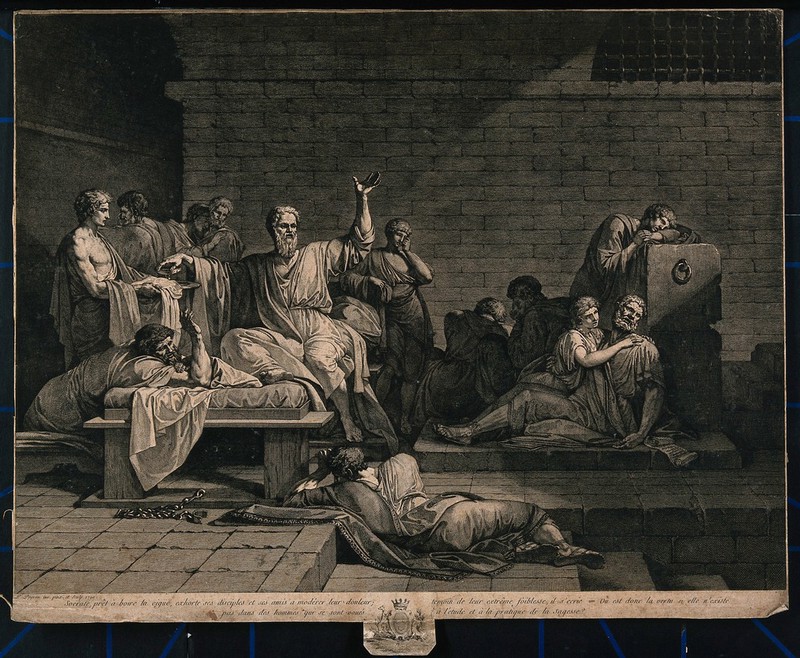
Socrates, preparing to kill himself, urges his grieving friends and students to moderate their grief. Engraving by J.F.P. Peyron, 1790., 1790, by Jean-François Pierre Peyron
Jean-François Pierre Peyron · Wellcome Collection, London · Wellcome Collection
Key facts
Key facts
• Name — Pierre Peyron • Birth Name — Jean-François Pierre Peyron • Born — 15 December 1744 • Birthplace — Aix-en-Provence, France • Died — 20 January 1814 • Place of death — Paris, France • Education — Beaux-Arts de Paris • Notable Works — The Death of Seneca • Movement — Neoclassicism • Awards — Prix de Rome (1773) Pierre Péron
Biography
Biography
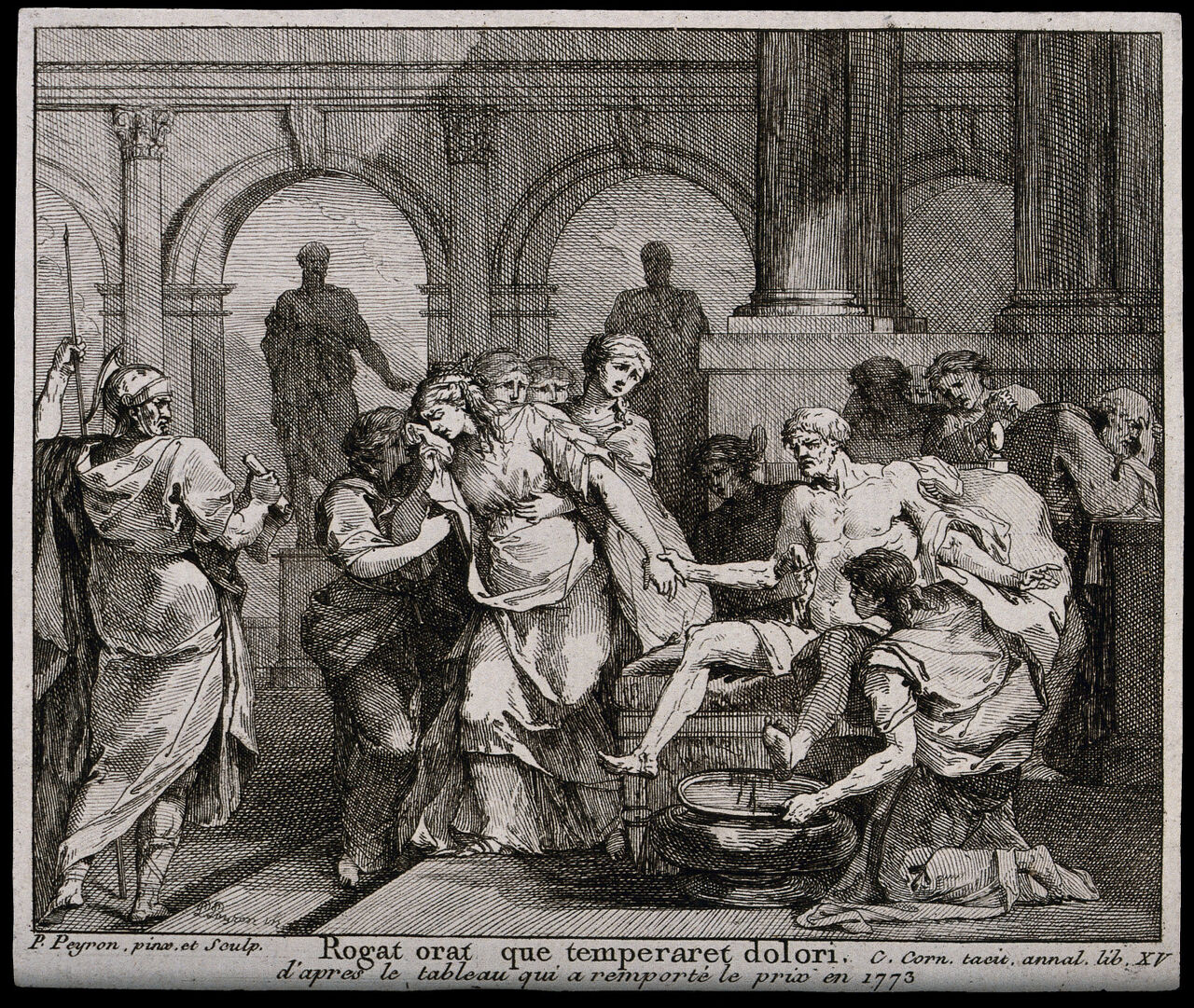
Peyron was born on 15 December 1744 in Aix-en-Provence in Southern France to a wealthy family. He studied law until the death of his father in 1765, at which point Peyron enrolled in the École de dessin (Drawing School) in Aix. There he learned from the history painter and etcher Michel-François Dandré-Bardon. In 1767, Peyron moved to Paris at the age of twenty-three where he entered the atelier of Rococo painter Louis Jean François Lagrenée. He was one of the first to re-apply the Classic principles of composition, in the manner of Poussin, while the prevailing fashion was in favour of Rococo. In 1773, the Académie royale de peinture announced that the theme for the next Grand Prix de Rome would be the death of Seneca as described by Tacitus, a favorite topic for French painters. Of the six artists approved to compete, first prize was awarded to Peyron for a now lost painting, but for which an engraving survives. He spent the years between 1775 and 1782 in Rome, with the Academy of France in Rome.
Relegation
Relegation
On his return to Paris, Peyron found that the career of his rival, Jacques-Louis David, had taken its rise and had completely eclipsed his own, relegating it to a minor role in the history of art – which became evident in the exhibitions at the Salon of Paris between 1785 and 1787. Following his fall from grace, Peyron was appointed inspector general of the Gobelins tapestry factory from 1786 to 1792. David would later pay homage to Peyron at the time of his funeral, stating: "He had opened my eyes".
Death
Death
Peyron died in Paris in 1814, aged 69.
List of works (partial)
List of works (partial)
• The Death of Seneca (1773) – a now-lost painting that earned Peyron the Prix de Rome • Athéniennes or Young Athenians Drawing Lots to be Sacrificed to the Minotaur (1778) – Wellington Museum, London • Belisarius Receiving Hospitality from a Peasant Who Had Served under Him (1779) – Musée de Augustins, Toulouse • Hagar and the Angel (1779) – private collection, Paris • Cornelia, Mother of the Gracchi (1781) – National Gallery, London • The Funeral of Miltiades (1782) – The Louvre, Paris • The Resurrection of Christ (1784) – Church of Saint-Louis-en-l'Île, Paris • Socrate arrachant Alcibiade des bras de la Volupté (1785) – Musée d'Art et d'Archéologie de Guéret, Guéret • The Death of Alcestis (1785) – The Louvre, Paris • The Death of Socrates (1786 or 1787) – National Gallery of Denmark, Copenhagen • Manius Curius Dentatus Refusing the Samnite Ambassadors (1787) – Musée des Beaux-Arts, Marseille • The Death of Socrates (1788) – Joslyn Art Museum, Omaha • Ulysse et Nausicaa (1791) – Staatliches Museum Schwerin, Schwerin • Time and Minerva (1799) – Ministère des Armées, Paris • King Perseus of Macedon in front of Aemilius Paulus (1802) – Museum of Fine Arts, Budapest • Paul-Émile, conqueror of Perseus, last king of the Macedonians (1804) – Exhibited at the Salon of 1804, then later deposited at the Museum of Fine Arts in Caen before being destroyed during World War II. A painted sketch from 1802 can still be found in Budapest. • The Death of General Valhubert (1808) – Musée de l'Histoire de France, Palace of Versailles • The School of Pythagoras (1812) – Exhibited at the Salon of 1812, now lost • L'Entretien de Démocrite avec Hippocrate (1812) – Exhibited at the Salon of 1812, now lost • Sainte Madeleine méditant – Musée Granet, Aix-en-Provence
Gallery
Gallery
• Illustration — The Death of Seneca (1773 or 1774). Copper engraving of the now-lost original that won the Grand Prix. • Illustration — Sainte Madeleine méditant • Illustration — Belisarius Receiving Hospitality from a Peasant Who Had Served under Him (1779) • Illustration — Cornelia, Mother of the Gracchi (1779) • Illustration — The Funeral of Miltiades (1782) • Illustration — La Résurrection (1784) • Illustration — The Death of Alcestis (1785) • Illustration — The Death of Socrates (1786 or 1787) • Illustration — Manius Curius Dentatus Refusing the Samnite Ambassadors (1787) • Illustration — King Perseus of Macedon in front of Aemilius Paulus (1802) • Illustration — The Death of General Valhubert (1808) • Illustration — The School of Pythagoras (1812). Contemporary sketch by French painter Charles Paul Landon. • Illustration — L'Entretien de Démocrite avec Hippocrate (1812). Contemporary sketch by French painter Charles Paul Landon.
Places
Named by the record
Places
Only places the record itself states, plotted where the house gazetteer settles their coordinates. Nothing is inferred from a name or a nationality.
Aix-en-Provence.
Birth place
Paris.
Death place
Notes from the source article
Cited by Wikipedia
Notes from the source article
These works are cited by the source article, in its own numbering. They are recorded as its citations, not as sources VALÉORINE has verified.
- 1.Jean François Pierre Peyron Poster. Joslyn Art Museum. 2018.
- 2.Stein, Perrin. Eighteenth-century French drawings in New York collections. The Metropolitan Museum of Art, New York. 200. 1999. 0-87099-892-7.
- 3.Ker, James. The Deaths of Seneca. Oxford University Press. 230. 2009. 978-0-19-538703-2.
- 4.Peyron Jean-François-Pierre. Musée des Beaux-Arts. 2008.
- 5.Socrate arrachant Alcibiade des bras de la Volupté. Réunion des Musées Nationaux (RMN).
- 6.Ulysse et Nausicaa. AGORHA (INHA Database).
- 7.Paul-Émile, vainqueur de Persée, dernier roi des Macédoniens. Louvre site des collections. 27 July 2022.
- 8.Rosenberg, Pierre. Pierre Peyron, 1744-1814. ARTHENA. 153–154. 1983. 9782903239022.
- 9.Landon, Charles Paul. Annales du musée et de l'école moderne des beaux-arts: Salon de 1812. Charles Paul Landon. 54–57. 1812.
References
Citations
References
Each reference names the institution holding it, so a reader may go to the document itself.
reference work
Secondary witnessreference work
Secondary witness
People, houses and institutions
Knowledge graph
People, houses and institutions
Teachers, collaborators, publishers and institutions recorded against this person, each on a stated basis.
Died at
1- ParisPlace
Established from a fact already recorded on a verified source.
The Encyclopedia exists whether or not anything is for sale. Corrections are recorded rather than overwritten, and every version of this record is kept. Published 16 August 2026.
Elsewhere in Prints
4,138 published records in this field, each with its sources named.
- Jean-Étienne LiotardEngraver
- Jean-François CarsEngraver
- Jean-François JaninetEngraver
- Jean-François MilletEngraver
- Jean-François RaffaëlliEngraver
- Jean-Honoré FragonardEngraver
- Jean-Jacques AvrilEngraver
- Jean-Jacques de BoissieuEngraver
Best supported in this field
For owners
Own a work by Jean-François Pierre Peyron?
A specialist will read what you send and tell you what the house can establish, what it cannot, and whether the object is suited to sale. There is no charge and no obligation. The object stays with you throughout; nothing is shipped to us unless it is arranged in writing beforehand.