
Jean-Antoine Watteau
Jean-Antoine Watteau (baptised 10 October 1684died 18 July 1721) was a French painter and draughtsman whose brief career spurred the revival of interest in colour and movement, as seen in the tradition of Correggio and Rubens. He revitalized the waning Baroque style, shifting it to the less severe, more naturalistic, less formally classical, Rococo. Watteau is credited with inventing the genre of fêtes galantes, scenes of bucolic and idyllic charm, suffused with a theatrical air.
Also recorded as Jean Antoine Watteau · Jean-Antoine Wataux · Antuan Vatto · Jean-Antoine Vatteau
Jean-Antoine Watteau
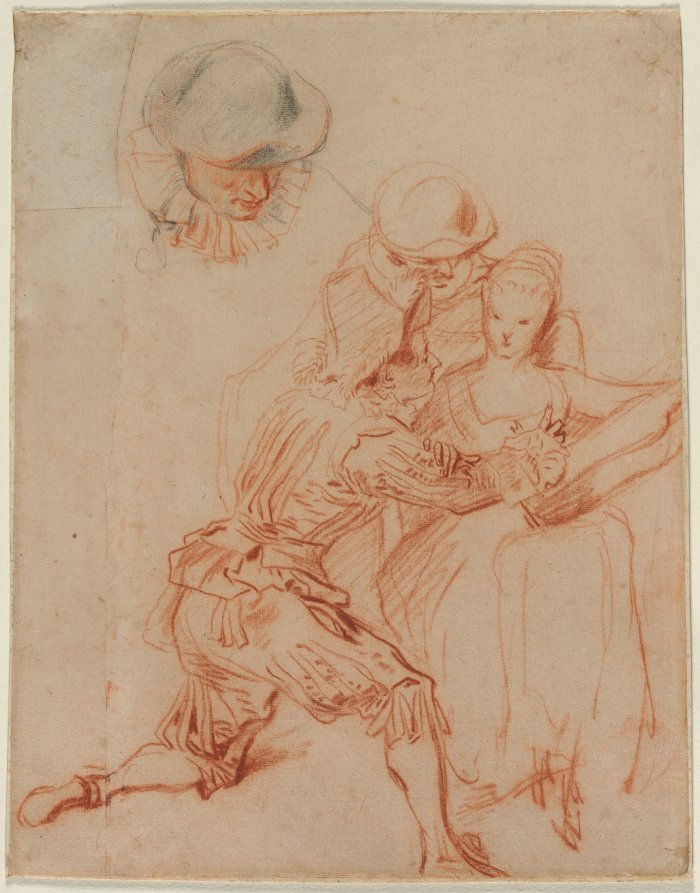
Jean-Antoine Watteau · The Cleveland Museum of Art · Dudley P. Allen Fund · CC0
- Name
- Antoine Watteau
- Birth Name
- Jean-Antoine Watteau
- Born
- baptised 1684 10 10
- Birthplace
- Valenciennes, French Hainaut, France
- Died
- 18 July 1721
- Place of death
- Nogent-sur-Marne, France
- Field
- Painting and drawing
- Movement
- Rococo
- Education
- * Claude Gillot
- Nationality
- Kingdom of France
- Occupation
- painter · graphic artist · draftsperson · artist · printmaker · architectural drafter · visual artist
- Fields
- Fête galante
VALÉORINE Encyclopedia
VALÉORINE documentary reading
Documentary summary
Jean-Antoine Watteau (baptised 10 October 1684died 18 July 1721) was a French painter and draughtsman whose brief career spurred the revival of interest in colour and movement, as seen in the tradition of Correggio and Rubens. He revitalized the waning Baroque style, shifting it to the less severe, more naturalistic, less formally classical, Rococo. Watteau is credited with inventing the genre of fêtes galantes, scenes of bucolic and idyllic charm, suffused with a theatrical air.
Admitted source layer · organised and presented by VALÉORINE
Reference Check
Propose documentary evidence for Jean-Antoine Watteau. A contribution is never written directly as fact: identity, source, rights and evidence gates still decide.
Sign in to contribute
Documentary evidence
Documentary basis
Authority files
wikidata · Q183221
In this article
Biography
Biography
Some of his best known subjects were drawn from the world of Italian comedy and ballet.
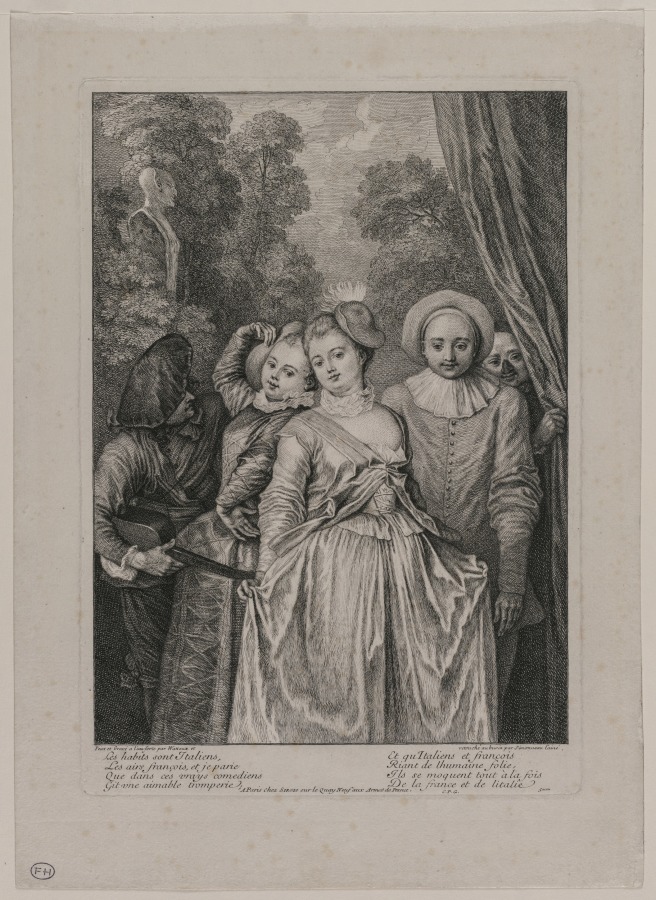
The Clothes are Italian, 1715–16, by Jean-Antoine Watteau
Jean-Antoine Watteau · The Cleveland Museum of Art · Dudley P. Allen Fund
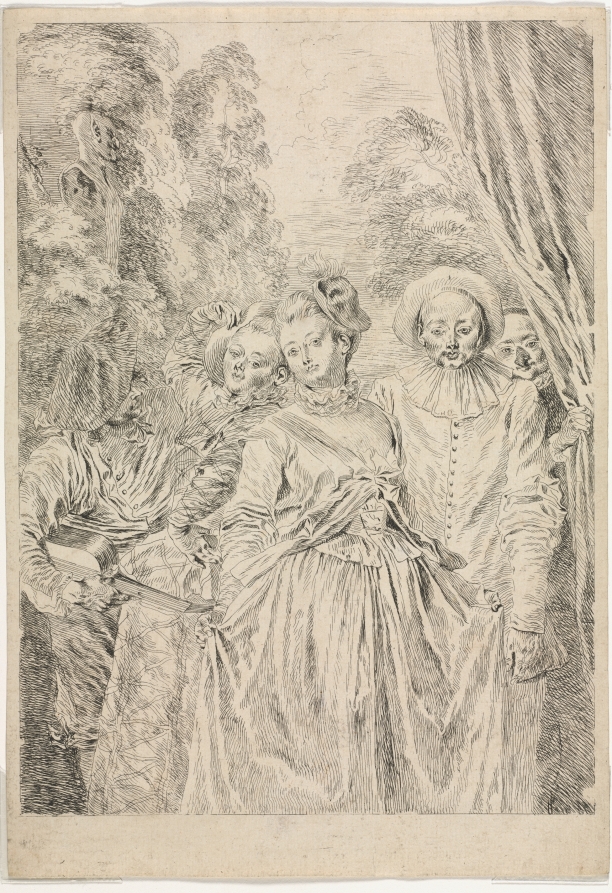
The Clothes are Italian, 1715–16, by Jean-Antoine Watteau
Jean-Antoine Watteau · The Cleveland Museum of Art · Severance and Greta Millikin Purchase Fund
Key facts
Key facts
• Name — Antoine Watteau • Birth Name — Jean-Antoine Watteau • Born — baptised 1684 10 10 • Birthplace — Valenciennes, French Hainaut, France • Died — 18 July 1721 • Place of death — Nogent-sur-Marne, France • Field — Painting and drawing • Movement — Rococo • Works — Embarkation for Cythera, 1717–1718 L'Enseigne de Gersaint, 1720–1721 • Education — * Claude Gillot • Claude Audran III • Patrons — * Jean de Jullienne • Pierre Crozat • Edme-François Gersaint
Early life and training
Early life and training
Jean-Antoine Watteau was born in October 1684 in Valenciennes, once an important town in the County of Hainaut which became sequently part of the Burgundian and Habsburg Netherlands until its secession to France following the Franco-Dutch War. He was the second of four sons born to Jean-Philippe Watteau (1660–1720) and Michelle Lardenois (1653–1727), and was presumed to be of Walloon descent. The Watteaus were a quite well-to-do family, although Jean-Philippe, a roofer in second generation, was said to be given to brawling. Showing an early interest in painting, Jean-Antoine may have been apprenticed to Jacques-Albert Gérin, a local painter, and his first artistic subjects were charlatans selling quack remedies on the streets of Valenciennes. Watteau left for Paris in 1702. After a period spent as a scene-painter, and in poor health, he found employment in a workshop at Pont Notre-Dame, making copies of popular genre paintings in the Flemish and Dutch tradition; it was in that period that he developed his characteristic sketchlike technique. His drawings attracted the attention of the painter Claude Gillot, and by 1705 he was employed as an assistant to Gillot, whose work, influenced by those of Francesco Primaticcio and the school of Fontainebleau, represented a reaction against the official art of Louis XIV's reign. In Gillot's studio, Watteau became acquainted with the characters of the commedia dell'arte (which moved onto the théâtre de la foire following the Comédie-Italienne's departure in 1697), a favorite subject of Gillot's that would become one of Watteau's lifelong passions. After a quarrel with Gillot, Watteau moved to the workshop of Claude Audran III, an interior decorator, under whose influence he began to make drawings admired for their consummate elegance. Audran was the curator of the Palais du Luxembourg, and from him Watteau acquired his knowledge of decorative art and ornamental design. At the palace, Watteau was able to see the series of canvases painted by Peter Paul Rubens for Queen Marie de Medici. The Flemish painter would become one of his major influences, together with the Venetian masters that he would later study in the collection of his patron and friend, the banker Pierre Crozat. During this period Watteau painted The Departing Regiment, the first picture in his second and more personal manner, showing influence of Rubens, and the first of a long series of camp pictures. He showed the painting to Audran, who made light of it, and advised him not to waste his time and gifts on such subjects. Watteau determined to leave him, advancing as excuse his desire to return to Valenciennes. He found a purchaser, at the modest price of 60 livres, in a man called Sirois, the father-in-law of his later friend and patron Edme-François Gersaint, and was thus enabled to return to the home of his childhood. In Valenciennes he painted a number of the small camp-pieces, notably the Camp-Fire, which was again bought by Sirois, the price this time being raised to 200 livres.
Later career
Later career
• Illustration — Pleasures of Love (1718–1719) • Illustration — The Feast (or Festival) of Love (1718–1719) • Illustration — The Embarkation for Cythera, 1717, Louvre. Many commentators note that it depicts a departure from the island of Cythera, the birthplace of Venus, thus symbolizing the brevity of love. In 1709, Watteau tried to obtain a one-year stay in Rome by winning the Prix de Rome from the Academy, but managed only to get awarded with the second prize. In 1712 he tried again and was persuaded by Charles de La Fosse that he had nothing to learn from going to Rome; thanks to Fosse he was accepted as an associate member of the Academy in 1712 and a full member in 1717. He took those five years to deliver the required "reception piece", one of his masterpieces: the Pilgrimage to Cythera, also called the Embarkation for Cythera. Watteau then went to live with the collector Pierre Crozat, who eventually on his death in 1740 left around 400 paintings and 19,000 drawings by the masters. Thus Watteau was able to spend even more time becoming familiar with the works of Rubens and the Venetian masters. He lacked aristocratic patrons; his buyers were bourgeois such as bankers and dealers. Among his most famous paintings, beside the two versions of the Pilgrimage to Cythera, one in the Louvre, the other in the Schloss Charlottenburg, Berlin, are Pierrot (long identified as "Gilles"), Fêtes venitiennes, Love in the Italian Theater, Love in the French Theater, "Voulez-vous triompher des belles?" and Mezzetin. The subject of his hallmark painting, Pierrot (Gilles), is an actor in a white satin costume who stands isolated from his four companions, staring ahead with an enigmatic expression on his face. Watteau's final masterpiece, the Shop-sign of Gersaint, exits the pastoral forest locale for a mundane urban set of encounters. Painted at Watteau's own insistence, "in eight days, working only in the mornings... in order to warm up his fingers", this sign for the shop in Paris of the paintings dealer Edme François Gersaint is effectively the final curtain of Watteau's theatre. It has been compared with Las Meninas as a meditation on art and illusion. The scene is an art gallery where the façade has magically vanished, and the gallery and street in the canvas are fused into one contiguous drama. Watteau alarmed his friends by a carelessness about his future and financial security, as if foreseeing he would not live for long. In fact he had been sickly and physically fragile since childhood. In 1720, he travelled to London, England, to consult Dr. Richard Mead, one of the most fashionable physicians of his time and an admirer of Watteau's work. However, London's damp and smoky air offset any benefits of Dr. Mead's wholesome food and medicines. Watteau returned to France, spending six months with Gersaint, and then spent his last few months on the estate of his patron, Abbé Haranger, where he died in 1721, perhaps from tuberculous laryngitis, at the age of 36. The Abbé said Watteau was semi-conscious and mute during his final days, clutching a paint brush and painting imaginary paintings in the air. His nephew, Louis Joseph Watteau, son of Antoine's brother Noël Joseph Watteau (1689–1756), and grand nephew, François-Louis-Joseph Watteau, son of Louis, followed Antoine into painting. • Illustration — Seated Woman (1716/1717), drawing by Watteau
Gallery
Gallery
• Illustration — Pierrot Content, c. 1711–1712, Thyssen-Bornemisza Museum, Madrid. • Illustration — Marriage Contract and Country Dancing, c. 1711, Prado Museum, Madrid. • Illustration — La Perspective (View through the Trees in the Park of Pierre Crozat), c. 1715, Museum of Fine Arts, Boston • Illustration — Savoyard with a Marmot, c. 1716, Hermitage Museum, St. Petersburg • Illustration — Mezzetino, c. 1717–1720, Metropolitan Museum of Art, New York • Illustration — Pierrot, c. 1718–1719, Louvre, Paris • Illustration — Quellnymphe, c. 1718, private collection • Illustration — The Love Song, c. 1717, National Gallery, London • Illustration — The Robber of the Sparrow's Nest, c. 1712, National Galleries of Scotland, Edinburgh • Illustration — The Dance, c. 1716–1718, Gemäldegalerie, Berlin • Illustration — Actors of the Comédie-Française, between 1711 and 1718, Hermitage Museum, Saint Petersburg • Illustration — Fêtes Vénitiennes, c. 1718–1719, National Galleries of Scotland, Edinburgh • Illustration — The Love Lesson, c. 1716–1717, Nationalmuseum, Stockholm • Illustration — Les Plaisirs du Bal, c. 1717, Dulwich Picture Gallery, London • Illustration — La Surprise, c. 1718, Getty Center, Los Angeles • Illustration — La Boudeuse, c. 1715–1718, Hermitage Museum, Saint Petersburg • Illustration — Pilgrimage to Cythera, c. 1718–1719, Charlottenburg Palace, Berlin • Illustration — The Italian Comedians, c. 1719–1721, National Gallery of Art, Washington, D.C. • Illustration — L'Enseigne de Gersaint, c. 1720–1721, Charlottenburg Palace, Berlin • Illustration — Ceres (Summer), c. 1717–1718, National Gallery of Art, Washington, D. C.
Work and production
Work and production
Works recorded as notable number 4: Nymph and Satyr, The Embarkation for Cythera, The Shop Sign of Gersaint and Pierrot. His recorded genre is Fête galante.
Life and career
Dated record
Life and career
The full dated record · 2 entries
1684
Jean-Antoine Watteau born at Valenciennes.
1721
Jean-Antoine Watteau died at Nogent-sur-Marne.
Critical assessment and legacy
Little known during his lifetime beyond a small circle of his devotees, Watteau "was mentioned but seldom in contemporary art criticism and then usually reprovingly". Sir Michael Levey once noted that Watteau "created, unwittingly, the concept of the individualistic artist loyal to himself, and himself alone". If his immediate followers, Lancret and Pater, would depict the unabashed frillery of aristocratic romantic pursuits, Watteau in a few masterpieces anticipates an art about art, the world of art as seen through the eyes of an artist. In contrast to the Rococo whimsicality and licentiousness cultivated by Boucher and Fragonard in the later part of Louis XV's reign, Watteau's theatrical panache is usually tinged with a note of sympathy, wistfulness, and sadness at the transience of love and other earthly delights. Famously, the Victorian essayist Walter Pater wrote of Watteau: "He was always a seeker after something in the world, that is there in no satisfying measure, or not at all." Watteau was a prolific draftsman. His drawings, typically executed in trois crayons technique, were collected and admired even by those, such as count de Caylus or Gersaint, who found fault with his paintings. In 1726 and 1728, Jean de Jullienne published suites of etchings after Watteau's drawings, and in 1735 he published a series of engravings after his paintings, The Recueil Jullienne. The quality of the reproductions, using a mixture of engraving and etching following the practice of the Rubens engravers, varied according to the skill of the people employed by Jullienne, but was often very high. Such a comprehensive record was hitherto unparalleled. This helped disseminate his influence round Europe and into the decorative arts. Watteau's influence on the arts (not only painting, but the decorative arts, costume, film, poetry, music) was more extensive than that of almost any other 18th-century artist. The Watteau dress, a long, sacklike dress with loose pleats hanging from the shoulder at the back, similar to those worn by many of the women in his paintings, is named after him. According to Konody's critical assessment in the Encyclopædia Britannica Eleventh Edition, in part, "in his treatment of the landscape background and of the atmospheric surroundings of the figures can be found the germs of Impressionism". His influence on later generations of painters may have been less apparent in France than in England, where J. M. W. Turner was among his admirers. A revived vogue for Watteau began in England during the British Regency, and was later encapsulated by the Goncourt brothers in France (Edmond de Goncourt having published a catalogue raisonné in 1875) and the World of Art union in Russia. In 1984 Watteau societies were created in Paris, by Jean Ferré, and London, by Dr. Selby Whittingham. A major exhibition in Paris, Washington and Berlin commemorated the 1984 tercentenary of his birth. Since 2000 a Watteau centre has been established at Valenciennes by Professor Chris Rauseo. A catalogue raisonné of Watteau's drawings has been compiled by Pierre Rosenberg and Louis-Antoine Prat, replacing the one by Sir Karl Parker and Jacques Mathey; similar projects on his paintings are undertaken by Alan Wintermute and Martin Eidelberg, respectively. From September 22–November 29, 2009, the Metropolitan Museum of Art exhibited Watteau, Music, and Theater in honor of Director Emeritus Philippe de Montebello. The exhibit displayed Watteau's paintings and drawings of the opera-ballet and theater, as well as musical instruments and porcelains. A catalog accompanied the exhibit. From July 12, 2016 to October 2, 2016, the Frick Collection exhibited Watteau's Soldiers: Scenes of Military Life in Eighteenth-Century France. The exhibit shows Watteau's focus “on the most prosaic aspects of war — marches, halts, and encampments. The resulting works show the quiet moments between the fighting, when soldiers could rest and daydream, smoke pipes and play cards.” The catalog was written by Aaron Wile From November 23, 2021–February 20, 2022, The J. Paul Getty Museum exhibited The Surprise: Watteau in the J. Paul Getty Museum, marking the 300th anniversary of Watteau's death and celebrating the Getty's acquisition of The Surprise. From 16 October 2024–3 February 2025, the Louvre exhibited A new look at Watteau An actor with no lines: Pierrot, known as Gilles. The exhibit examined Gilles and the painting's influence on other artists. A catalog, Pierrot, dit Le Gilles, de Watteau. Un comédien sans réplique, by Guillaume Faroult (in French) accompanied the exhibit.
Notes from the source article
Cited by Wikipedia
Notes from the source article
These works are cited by the source article, in its own numbering. They are recorded as its citations, not as sources VALÉORINE has verified.
- 1.cite LPD 3
- 2.cite EPD 18
- 3.Wine, Humphrey. Watteau. The Dictionary of Art. Grove's Dictionaries. 32. 913–921. 1996. 1-884446-00-0.
- 4.Germain, Jean. Dictionnaire des noms de famille en Wallonie et à Bruxelles. E. Racine. 1039. 2007. 978-2-87386-506-1.
- 5.Pierret, Jean-Marie. Phonétique historique du français et notions de phonétique générale. Peeters. 107. 1994. 9068316087.
- 6.Pohl, Jacques. Quelques caractéristiques de la phonologie du français parlé en Belgique. Langue française. 60. 6. 30–41. 1983. 10.3406/lfr.1983.5173.
- 7.Vangheluwe, Michel. Antoine Watteau, 1684-1721 : le peintre, son temps et sa légende. Champion — Slatkin. 7–9. 1987. 2852030381.
- 8.Levey, Michael. Painting and sculpture in France 1700-1789. Yale University Press. 29. 1993. 0300064942.
- 9.Voltaire. Oeuvres completes de Voltaire. Impr. de la Société littéraire-typographique. 12. 171 n. 6. 1784. 83543415.
- 10.Frederick II of Prussia. Oeuvres de Frédéric Le Grand. R. Decker. 27. 1. 75. 1856.
- 11.Woermann, Karl. Die Kunst der mittleren Neuzeit von 1550 bis 1750 (Barock und Rokoko). Bibliographisches Institut. 5. 196. 1920. 1045561032.
- 12.Huyghe, René. Art and the Spirit of Man. H. N. Abrams. 413. 1962. 1147729820.
- 13.Poinsignon, Jean-Claude. Gérin, Jacques-Albert. Allgemeines Künstlerlexikon. Saur. 52. 141–142. 2006. 3-598-22792-2.
- 14.Macchia, Giovanni. Watteau, (Jean-)Antoine. New Encyclopaedia Britannica. Encyclopaedia Britannica, Inc. 12. 529–530. 1986. 9780852294345.
- 15.Roland Michel, Marianne. Gillot, Claude. The Dictionary of Art. Grove's Dictionaries. 12. 637–638. 1996. 1-884446-00-0.
- 16.Eidelberg, Martin. Antoine Watteau, 1684-1721 : le peintre, son temps et sa légende. Champion — Slatkin. 45–57. 1987. 2852030381.
- 17.The Metropolitan Museum of Art. Watteau, Music, and Theater. 6. 2009. 978-1-58839-335-7.
- 18.Schwartz, Sanford. Artists and Writers. Yarrow Press. 140–141. 1990. 1-878274-01-5.
- 19.Hauser, Arnold. Rococo, Classicism and Romanticism. Vintage Books. 3. 24–25. 1958. 9780203981245.
- 20.Cunningham, Lawrence. Culture and Values: A Survey of the Western Humanities. Wadsworth Cengage Learning. 399. 2010. 9780495568773.
- 21.Pater, Walter. A Prince of Court Painters. Macmillan's Magazine. 52. 312. 401–414. October 1885.
- 22.Gowing, Lawrence, and Michel Laclotte. 1987. Paintings in the Louvre. New York: Stewart, Tabori & Chang. p. 506. .
- 23.Roland Michel, Marianne. The Rosenberg-Prat Catalogue of Watteau's Drawings. The Burlington Magazine. 140. 1148. 749–754. November 1998. 888091.
- 24.Melikian, Souren. A Watteau sets record at £12.36 million in an uneven Old Masters sale. The New York Times. 10 July 2008.
- 25.Osborne, Ruth. A Weight of Evidence: An Interview with Dr. Martin Eidelberg on the Watteau Abecedario. ArtWatch International. 5 December 2014.
- 26.Watteau, Music, and Theater. The Metropolitan Museum of Art.
- 27.Watteau’s Soldiers: Scenes of Military Life in Eighteenth-Century France. The Frick Collection. 2025-08-22.
- 28.La Surprise: Watteau in Los Angeles. Getty Museum.
- 29.A new look at Watteau. Le Louvre. 2024-09-24.
- 30.Pierrot Content. Museo Nacional Thyssen-Bornemisza.
- 31.Marriage Contract and Country Dance - The Collection - Museo Nacional del Prado. www.museodelprado.es.
- 32.State Hermitage Museum. La Boudeuse (The Capricious Girl). Hermitagemuseum.org.
Bibliography printed in the source article · 30
- Camesasca, Ettore. The Complete Paintings of Watteau. Harry N. Abrams. 1971. 0810955253.
- Crow, Thomas E. Painters and Public Life in Eighteenth-Century Paris. Yale University Press. 1985. 0-300-03764-3.
- Dacier, Émile; Vuaflart, Albert; Herold, Jacques (1921–1929). Jean de Julienne et les graveurs de Watteau au XVIII-e siècle (in French). Paris: M. Rousseau. Volumes 1, 2, 3, and 4 available via the Heidelberg University Library repository
- Dormandy, Thomas. The White Death: the History of Tuberculosis. New York University Press. 2000.
- Goncourt, Edmond et Jules de. L'art du XVIIIme siècle. G. Charpentier. 1. 1881. 1048224230.
- National Gallery of Art. Watteau, 1684-1721. 1984. 0-89468-074-9.
- Hind, Charles Lewis. Watteau. T.C. & E.C. Jack. 1910.
- Huyghe, René. Watteau: The Artist and His Drawings. Braziller. 1970. 9780269027093.
- Konody, Paul George. 28. 417–418.
- Levey, Michael. Rococo to Revolution: Major Trends in Eighteenth-Century Painting. Thames and Hudson. 1966. 1036855531.
- Mauclair, Camille. Antoine Watteau (1684-1721). Duckworth & Co. 1906.
- Michel, Christian. Le "célèbre Watteau". Droz. 2008. 978-2-600-01176-1.
- Mollett, John William. Watteau. S. Low, Marston, Searle & Rivington. 1883. 557720162.
- Perl, Jed. Antoine's Alphabet: Watteau and His World. Vintage Books. 2009. 978-0-307-38594-9.
- Phillips, Claude. Antoine Watteau. Seeley and co. Limited. 1895. 729123867.
- Plax, Julie Anne. Watteau and the Cultural Politics of Eighteenth-Century France. Cambridge University Press. 2000. 0-521-64268-X.
- Plomp, Michiel. Watteau: Der Zeichner. Hirmer. 2016. 978-3-941399-66-2.
- Posner, Donald. Antoine Watteau. Weidenfeld & Nicolson. 1984. 0-8014-1571-3.
- Roland Michel, Marianne. Watteau: an Artist of the Eighteenth Century. Trefoil. 1984. 0-86294-049-4.
- Hermann. Vies anciennes de Watteau. 1984. 2-7056-5985-4.
- Rosenberg, Pierre. Antoine Watteau: catalogue raisonné des dessins. Gallimard-Electa. 1996. 2-07-015043-7.
- Rosenberg, Pierre. Watteau: The Drawings. Royal Academy of Arts. 2011. 9781905711703.
- Schneider, Pierre. The World of Watteau. Time-Life Books. 1967. 680174683.
- University of Delaware. Antoine Watteau: Perspectives on the Artist and the Culture of His Time. 2006. 978-0-87413-934-1.
- Staley, Edgcumbe. Watteau and His School. George Bell and Sons. 1902.
- Stein, Perrin. Antoine Watteau (1684–1721). Heilbrunn Timeline of Art History. Metropolitan Museum of Art. October 2003.
- Vidal, Mary. Watteau's Painted Conversations: Art, Literature, and Talk in Seventeenth- and Eighteenth-Century France. Yale University Press. 1992. 0-300-05480-7.
- Walsh, Linda. The Changing Status of the Artist. Yale University Press. 2. 220–248. 1999. 0-300-07740-8.
- The Watteau Society Bulletin, London.
- Martin Eidelberg, watteauandhiscircle.org
References
Citations
References
Each reference names the institution holding it, so a reader may go to the document itself.
Institutional database
Wikidata, structured authority record Q183221: Jean-Antoine WatteauWikimedia Foundation
Institutional witness
The Encyclopedia exists whether or not anything is for sale. Corrections are recorded rather than overwritten, and every version of this record is kept. Published 14 August 2026.
Elsewhere in Prints
4,138 published records in this field, each with its sources named.
- Jean MorinEngraver
- Jean Pierre Marie JazetEngraver
- Jean WidmerEngraver
- Jean-Antoine GrosEngraver
- Jean-Baptiste AudebertEngraver
- Jean-Baptiste Camille CorotEngraver
- Jean-Baptiste CarpeauxEngraver
- Jean-Baptiste CorneilleEngraver
Best supported in this field
For owners
Own a work by Jean-Antoine Watteau?
A specialist will read what you send and tell you what the house can establish, what it cannot, and whether the object is suited to sale. There is no charge and no obligation. The object stays with you throughout; nothing is shipped to us unless it is arranged in writing beforehand.