
James Smetham
Illustration — Self portrait, 1855, oil on board, Westminster College, Oxford James Smetham (9 September 1821 – 5 February 1889) was an English Pre-Raphaelite Brotherhood painter and engraver, a follower of Dante Gabriel Rossetti.
Also recorded as Smetham
James Smetham
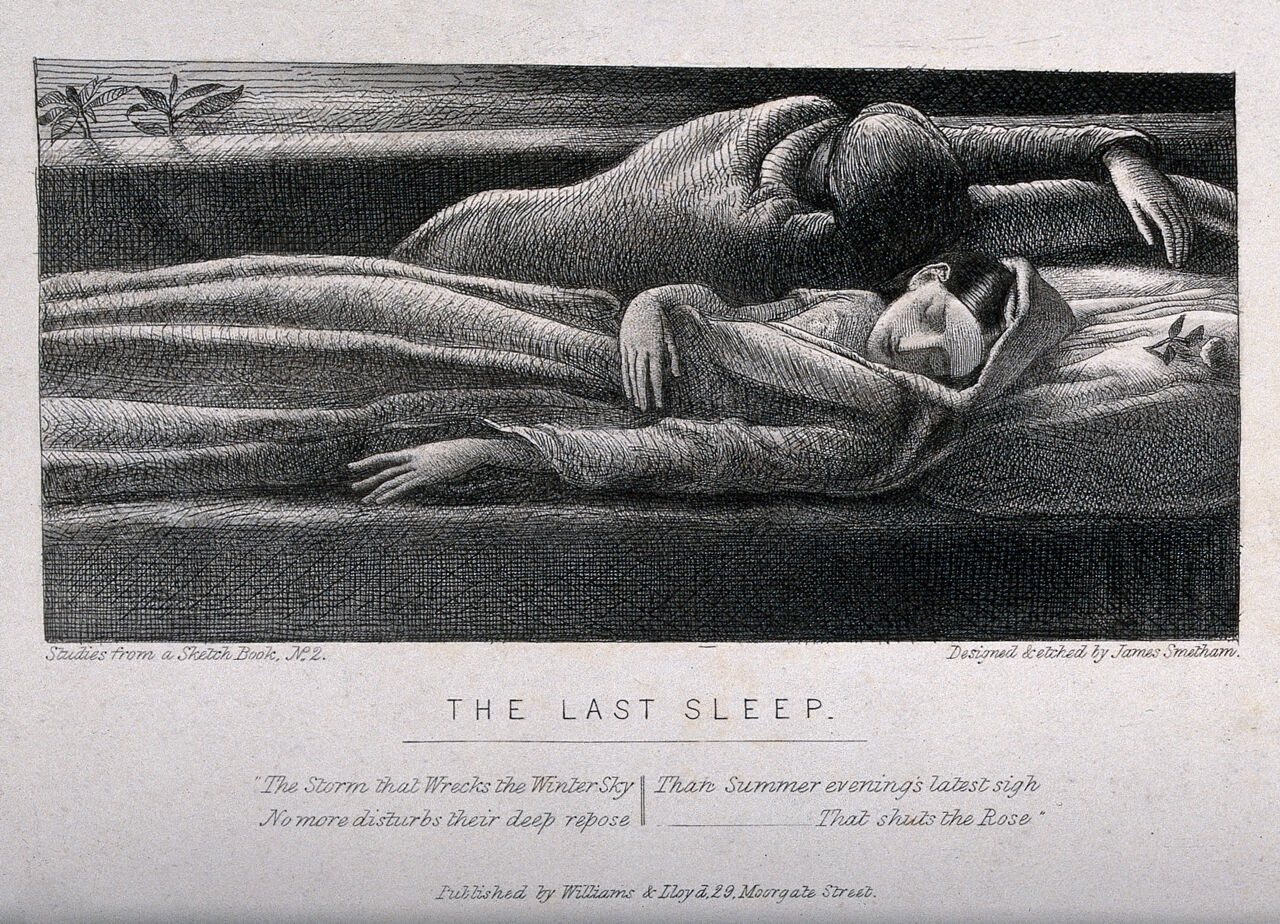
James Smetham · Wellcome Collection, London · Wellcome Collection · Public Domain Mark
- Born
- 1821 · Pateley Bridge.
- Died
- 1889 · Chipping Ongar.
- Nationality
- United Kingdom of Great Britain and Ireland
- Occupation
- painter · printmaker · poet · art critic · artist
- Languages
- English
VALÉORINE Encyclopedia
VALÉORINE documentary reading
Documentary summary
Illustration — Self portrait, 1855, oil on board, Westminster College, Oxford James Smetham (9 September 1821 – 5 February 1889) was an English Pre-Raphaelite Brotherhood painter and engraver, a follower of Dante Gabriel Rossetti.
Admitted source layer · organised and presented by VALÉORINE
Reference Check
Propose documentary evidence for James Smetham. A contribution is never written directly as fact: identity, source, rights and evidence gates still decide.
Sign in to contribute
Documentary evidence
Documentary basis
Authority files
wikidata · Q6143295 · wikipedia · James Smetham
In this article
Biography
Biography
Smetham was born in Pateley Bridge, Yorkshire, and attended school in Leeds; he was originally apprenticed to the Lincoln architect Edward James Willson before deciding on an artistic career. He studied at the Royal Academy, beginning in 1843. His modest early success as a portrait painter was stifled by the development of photography (a problem shared by other artists of the time). In 1851 Smetham took a teaching position at the Wesleyan Normal College in Westminster, and was the first Drawing Master for what would later become Westminster College, Oxford (today part of Oxford Brookes University). In 1854, he married Sarah Goble, a fellow teacher at the College. They would eventually have six children. Smetham worked in a range of genres, including religious and literary themes as well as portraiture; but he is perhaps best known as a landscape painter. His "landscapes have a visionary quality" reminiscent of the work of William Blake, John Linnell, and Samuel Palmer. Out of a lifetime output of some 430 paintings and 50 etchings, woodcuts, and book illustrations, his 1856 painting The Dream is perhaps his best-known work but his signal work is The Hymn of the Last Supper a very ambitious subject for him to undertake but one which worked out magnificently. His choice of subject was sometimes somewhat bizarre; one of his best paintings is The Death of Earl Siward which depicts the dying earl, dressed in full armour, standing up and being supported by his servants as 'He did not wish to die lying down like a cow'. He was also an essayist and art critic; an article on Blake (in the form of a review of Alexander Gilchrist's Life of William Blake), which appeared in the January 1869 issue of the Quarterly Review, influenced and advanced recognition of Blake's artistic importance. Other Smetham articles for the Review were "Religious Art in England" (1861), "The Life and Times of Sir Joshua Reynolds" (1866), and "Alexander Smith" (1868). He also wrote some poetry. • Illustration — Family grave of James Smetham in Highgate Cemetery Smetham was a devout Methodist, and after a mental breakdown in 1857, the second half of his life was marked by a growing religious mania and eventual insanity. "In one of his notebooks he attempted to illustrate every verse in the Bible." (Smetham habitually created miniature, postage-stamp-sized pen-and-ink drawings, in a process he called "squaring." He produced thousands of these in his lifetime.) He suffered a final breakdown in 1877 and lived in seclusion at his home in Stoke Newington until his death in 1889. He was buried in a family grave on the eastern side of Highgate Cemetery. Smetham's letters, posthumously published by his widow, throw light upon Rossetti, John Ruskin, and other contemporaries, and have been praised for their literary and spiritual qualities. His surviving journals and notebooks show that Smetham practised an almost stream of consciousness type of writing that he called "ventilating," as a method of religious self-analysis. These writings delineate the depression that came to dominate Smetham's outlook.
Gallery
Gallery
• Illustration — Thoughts Too Deep for Tears, 1844, oil on panel, Ashmolean Museum • Illustration — Counting the Cost, 1855, oil on canvas, Walker Art Gallery • Illustration — Pandora, 1865, oil on canvas, private collection • Illustration — Naboth in his Vineyard, 1856, National Gallery, London • Illustration — Girl with a Mandolin, oil on canvas, private collection • Illustration — The King's Bridal, c. 1860, watercolour and graphite on paper, British Museum • Illustration — The Death of Earl Siward, 1861, Tate Britain • Illustration — Imogen and the Shepherds, from Cymbeline, Act IV, scene ii, c. 1874, oil over ink on panel, Yale Center for British Art • Illustration — Saul Hiding, oil on wood, Tate Britain • Illustration — Paris and Oenone, brush drawing in brown wash, British Museum • Illustration — Beachy Head, oil on paper, Ashmolean Museum
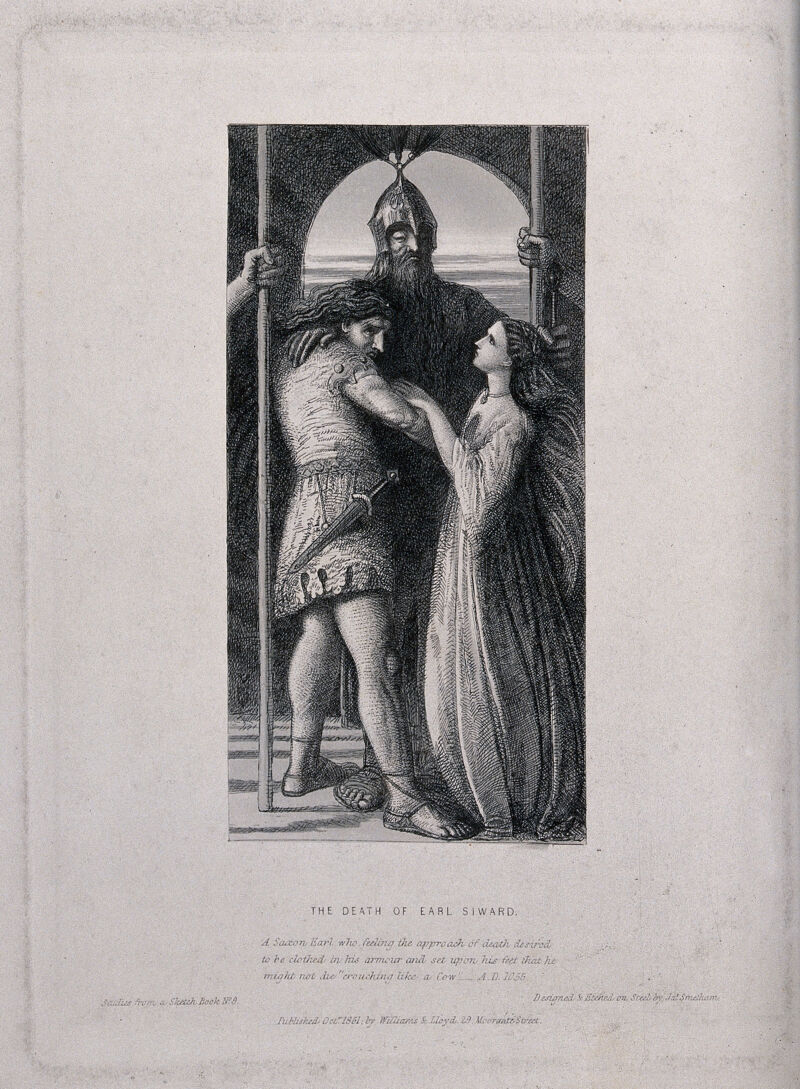
The dying Earl Siward clad in armour embraces a young man and woman. Etching by James Smetham, 1861., Octr. 1861, by James Smetham
James Smetham · Wellcome Collection, London · Wellcome Collection
Places
Named by the record
Places
Only places the record itself states, plotted where the house gazetteer settles their coordinates. Nothing is inferred from a name or a nationality.
Pateley Bridge.
Birth place
Chipping Ongar.
Death place
Citations
References
Each reference names the institution holding it, so a reader may go to the document itself.
reference work
Secondary witnessreference work
Secondary witness
The Encyclopedia exists whether or not anything is for sale. Corrections are recorded rather than overwritten, and every version of this record is kept. Published 16 August 2026.
Elsewhere in Prints
4,138 published records in this field, each with its sources named.
- James PrydeEngraver
- James RobertsonEngraver
- James RosenquistEngraver
- James S. DittyEngraver
- James StephensonEngraver
- James StowEngraver
- James Tibbits WillmoreEngraver
- James TorlaksonEngraver
Best supported in this field
For owners
Own a work by James Smetham?
A specialist will read what you send and tell you what the house can establish, what it cannot, and whether the object is suited to sale. There is no charge and no obligation. The object stays with you throughout; nothing is shipped to us unless it is arranged in writing beforehand.