
Iwasa Matabē
Iwasa • Illustration — Self-portrait, unusually early for Japanese art, said to have been painted as he was dying in 1650. Important Cultural Property. Iwasa Matabei; original name Araki Katsumochi 1578 – July 20, 1650) was a Japanese artist of the early Tokugawa period, who specialized in genre scenes of historical events and illustrations of classical Japanese and Chinese literature, as well as portraits.
Also recorded as Katsumochi · Hekishōkyo · Katsumochi Iwasa · Dōun
Iwasa Matabē

Iwasa Matabē · 岩佐又兵衛<新潮日本美術文庫 6> · Public domain
- Born
- 1578 · Itami.
- Died
- 1650 · Edo.
- Nationality
- Japan
- Occupation
- painter · artist
- Fields
- erotic art
- Teachers
- Kanō Naizen
- Known for
- Rakuchū rakugai zu (Funaki)
- Languages
- Japanese
VALÉORINE Encyclopedia
VALÉORINE documentary reading
Documentary summary
Iwasa • Illustration — Self-portrait, unusually early for Japanese art, said to have been painted as he was dying in 1650. Important Cultural Property. Iwasa Matabei; original name Araki Katsumochi 1578 – July 20, 1650) was a Japanese artist of the early Tokugawa period, who specialized in genre scenes of historical events and illustrations of classical Japanese and Chinese literature, as well as portraits.
Admitted source layer · organised and presented by VALÉORINE
Reference Check
Propose documentary evidence for Iwasa Matabē. A contribution is never written directly as fact: identity, source, rights and evidence gates still decide.
Sign in to contribute
Documentary evidence
Documentary basis
Authority files
gnd · 121312496 · wikidata · Q3156405
In this article
Notable works
Notable works
He was the son of Araki Murashige, a prominent daimyō of the Sengoku period who had been made to commit suicide, leaving Matabei to be raised with his mother's family name, Iwasa. Matabei's work was noted for its distinctive figures, with large heads and delicately drawn features, and he was effective both in colour and monochrome ink-wash painting, using an individual brush technique combining Tosa and Kanō elements. Although trained by Kanō Naizen of the Kanō school, he was more influenced by the traditions of the Tosa school, and signed a late series of portraits of the Thirty-six Poetry Immortals (1640) commissioned by the shōgun Tokugawa Iemitsu for a temple as "the artist Matabei of the later current from Tosa Mitsunobu". Matabei's oeuvre remains shrouded in a degree of mystery, as he was active in a period before the full development of print engraving, and few works can be attributed to him with absolute certainty; most of the surviving paintings depict female beauties with elongated faces and plump cheeks. The works of Matabei have an affinity with the early paintings of ukiyo-e, but there is a disagreement among scholars as to whether they are ukiyo-e themselves or not. In Japan, it is common to regard Matabei as the originator of ukiyo-e. On the other hand, there is a theory that Matabei is not the source of ukiyo-e, but rather an independent painter of the Tosa school, because his patrons were from high social classes. According to this theory, he is misunderstood as the source of ukiyo-e only because he is confused with the ukiyo-e painter of the same name (Ōtsu no Matabei) who appears in Chikamatsu's plays. His son Katsushige (d. 1673) was also a painter, known for dancing figures in a style like that of his father. The late Meiji-period ukiyo-e artist Kobayashi Kiyochika, despite the clear influence of Western art techniques on his own work, described himself as working in the style of Matabei and Hishikawa Moronobu.
Training under Kanō Naizen is recorded. The recorded working language is Japanese. The field of work recorded is erotic art. Subjects and genres recorded for the work are portrait. Places of work recorded in the authority are Kyōto, Fukui and Edo. Employment is recorded with Oda Nobukatsu. Works named in the authority record are Rakuchū rakugai zu (Funaki). Work by Iwasa Matabē is recorded in the collections of Minneapolis Institute of Art, The Nelson-Atkins Museum of Art, National Museum of World Cultures, Metropolitan Museum of Art and Cleveland Museum of Art.
The only work by Iwasa Matabei that has been designated a National Treasure is Rakuchu Rakugai Zu Byōbu (Funaki Version), which is held by the Tokyo National Museum. The term Rakuchu Rakugai Zu refers to folding screens depicting the scenery and customs of the urban and suburban areas of Kyoto. Numerous works were created from the Sengoku period to the Edo period, and only two works by Iwasa Matabei and Kanō Eitoku have been designated as National Treasures. Matabei's work depicts the Kyoto landscape around 1615 and is known as the "Funaki version" because it was owned by the Funaki family. It shows the Nijō Castle of the Tokugawa clan on the left and the Hōkō-ji Great Buddha Hall, symbolizing the Toyotomi clan, on the right. • Illustration — Left panel of the Rakuchu Rakugai Zu Byōbu (Funaki Version). National Treasure. • Illustration — Right panel of the Rakuchu Rakugai Zu Byōbu (Funaki Version). National Treasure. Hōkoku Sairei Zu Byōbu is a work depicting the festival held at Toyokuni Shrine in 1604 to commemorate the seventh anniversary of Toyotomi Hideyoshi's death. It has been designated as an Important Cultural Property and is housed in the Tokugawa Art Museum. Although the preparations for this festival were carried out under the direction of Tokugawa Ieyasu, the missionary Jean Crasset analyzes that Ieyasu's intention was to adopt Hideyoshi's achievements as his own. On the left side of the artwork, there is a scene of people in the city dancing enthusiastically in extravagant costumes against the backdrop of the Hōkō-ji Great Buddha Hall. On the right, there is a scene depicting the dedication of the traditional dances noh and dengaku at the Toyokuni Shrine. Matabei established a workshop and painted magnificent and long based on the text of. The MOA Museum of Art houses three masterpieces: Yamanaka Tokiwa Monogatari Emaki, Jōruri Monogatari Emaki, and Horie Monogatari Emaki. These three works are considered masterpieces, with the first two being designated as Important Cultural Properties. Yamanaka Tokiwa Monogatari tells the story of Ushiwaka's revenge for the murder of his mother, Tokiwa Gozen. Jōruri Monogatari depicts a romantic story involving Ushiwaka. Horie Monogatari tells the story of Horie Saburo's child who seeks revenge for the death of his parents. • Illustration — "Court Lady Enjoying Wayside Chrysanthemums" 17th century. Hanging scroll, ink and colour on paper. Important Cultural Property. The work titled Kanjo Kangiku Zu in the Yamatane Museum is one of the works created by dividing a pair of folding screens, each with six panels that originally depicting twelve different subjects into twelve parts, each of which was transformed into an individual hanging scroll. This particular work of art has been designated as an Important Cultural Property.

Street people in 17C's Kyoto especially watching play "Kabuki"
Iwasa Matabee · https: webarchives.tnm.jp/imgsearch/show/C0021446
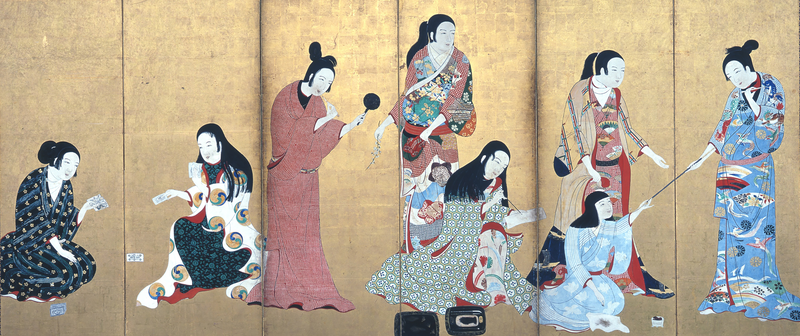
Pair of six-fold screens; color and gold on hello paper. It is called Matsura Byobu for its former owners, the Matsura family, daimyo of Hirado, in Kyushu. Their name (and the name of this screen) is often written as Matsuura, with two u's, but that is incorrect.
Iwasa Matabei (岩佐又兵衛) (1578–1650) · Hanasaku-online.com
Life and career
Dated record
Life and career
The full dated record · 2 entries
1578
Iwasa Matabē born at Itami.
1650
Iwasa Matabē died at Edo.
Places
Named by the record
Places
Only places the record itself states, plotted where the house gazetteer settles their coordinates. Nothing is inferred from a name or a nationality.
Itami.
Birth place
Edo.
Death place
Primary material
Documents and archives
authority file
- Gemeinsame Normdatei 121312496, Iwasa, Matabē.
General reference · Deutsche Nationalbibliothek
authority record
- Wikidata, structured authority record Q3156405: Iwasa Matabē
General reference · Wikidata
Notes from the source article
Cited by Wikipedia
Notes from the source article
These works are cited by the source article, in its own numbering. They are recorded as its citations, not as sources VALÉORINE has verified.
- 1.Encyclopædia Britannica, "Iwasa Matabei"
- 2.Encyclopædia Britannica, "Iwasa Matabei"
- 3.Paine, 249–250
- 4.Encyclopædia Britannica, "Iwasa Matabei"
- 5.Paine, 250
- 6.Paine, 250
- 7.Milone, Marco. Ukiyo-e. L'Erudita. 24. 2022. 9788867707270.
- 8.Kita, Sandy. The Last Tosa: Iwasa Katsumochi Matabei, Bridge to Ukiyo-e. University of Hawaii Press. 39. 1999. 978-0-8248-1826-5.
- 9.Kita, Sandy. Reading Asian Art and Artifacts: Windows to Asia on American College Campuses. Rowman & Littlefield. 149, 154–155. 2011. 978-1-61146-070-4.
- 10.Kotobank.
- 11.Chiba City Museum of Art.
- 12.Paine, 247–250
- 13.Paine, 250
- 14.Milone, Marco. Ukiyo-e. L'Erudita. 436. 2022. 9788867707270.
- 15.National Institutes for Cultural Heritage.
- 16.Tokugawa Art Museum.
- 17.MOA Museum of Art.
- 18.Yamatane Museum.
References
Citations
References
Each reference names the institution holding it, so a reader may go to the document itself.
authority file
Gemeinsame Normdatei 121312496, Iwasa, Matabē.Deutsche Nationalbibliothek
Secondary witnessauthority record
General reference
The Encyclopedia exists whether or not anything is for sale. Corrections are recorded rather than overwritten, and every version of this record is kept. Published 14 August 2026.
Elsewhere in Paintings
19,397 published records in this field, each with its sources named.
- Ivy de VerleyArtist
- Ivy HeitlandArtist
- Ivy Love GettyArtist
- Iwan BalaArtist
- IZ the WizArtist
- Izaak GodijnArtist
- Izaak van OostenArtist
- Izabella Elżbieta DziałyńskaArtist
Best supported in this field
For owners
Own a work by Iwasa Matabē?
A specialist will read what you send and tell you what the house can establish, what it cannot, and whether the object is suited to sale. There is no charge and no obligation. The object stays with you throughout; nothing is shipped to us unless it is arranged in writing beforehand.