
Imhotep
Imhotep ("(the one who) comes in peace"; late 27th century BC) was an Egyptian chancellor to the King Djoser, possible architect of Djoser's step pyramid, and high priest of the sun god Ra at Heliopolis. Very little is known of Imhotep as a historical figure, but in the 3,000 years following his death, he was gradually glorified and deified. The Westcar Papyrus of the Hyksos period, written in classical Middle Egyptian (likely around the 13th Dynasty), contains a story about an official performing a miracle for Djoser, possibly Imhotep.
Also recorded as Immutef
Imhotep

https: Gallery: https: Wellcome Collection gallery (2018-03-23) · CC BY 4.0
- Name
- M18-G17-R4:X1*Q3
- Born
- 2800
- Died
- 2700
- Nationality
- Ancient Egypt
- Occupation
- architect · engineer · astronomer · physician · master builder · writer
VALÉORINE Encyclopedia
VALÉORINE documentary reading
Documentary summary
Imhotep ("(the one who) comes in peace"; late 27th century BC) was an Egyptian chancellor to the King Djoser, possible architect of Djoser's step pyramid, and high priest of the sun god Ra at Heliopolis. Very little is known of Imhotep as a historical figure, but in the 3,000 years following his death, he was gradually glorified and deified. The Westcar Papyrus of the Hyksos period, written in classical Middle Egyptian (likely around the 13th Dynasty), contains a story about an official performing a miracle for Djoser, possibly Imhotep.
Admitted source layer · organised and presented by VALÉORINE
Note VALÉORINE
No house-authored Note is published until its assertions and sources pass the VALÉORINE evidence contract. The documentary article remains available in full while that enrichment is being consolidated.
Documentary enrichment in progress · no unsupported statement published
Reference Check
Propose documentary evidence for Imhotep. A contribution is never written directly as fact: identity, source, rights and evidence gates still decide.
Sign in to contribute
Documentary evidence
Evidence Panel
not yet certified
- Identity
- resolved
- Independent source families
- 0
- Admitted assertions
- 0
- Open conflicts
- 0
Authority files
getty · 500125211 · gnd · 135315824 · wikidata · Q131171 · wikipedia · Imhotep
In this article
Biography
Biography
However, this section is badly damaged and no mention of this character's name survived. Apart from the two short contemporary inscriptions that establish him as chancellor to the Pharaoh, the first surviving text to name Imhotep dates to the time of Amenhotep III (c. It is addressed to the owner of a tomb and reads: It appears that this libation to Imhotep was done regularly, as they are attested on papyri associated with statues of Imhotep until the Late Period (c. Gardiner finds the cult of Imhotep during the New Kingdom (c. 1550–1077 BC) sufficiently distinct from the usual offerings made to other commoners that the epithet "demigod" is likely justified to describe his veneration. The first references to the healing abilities of Imhotep occur from the Thirtieth Dynasty (c. Among fewer than a dozen non-royal Egyptians who were deified after their deaths. The center of his cult was in Memphis. The location of his tomb remains unknown, despite efforts to find it.
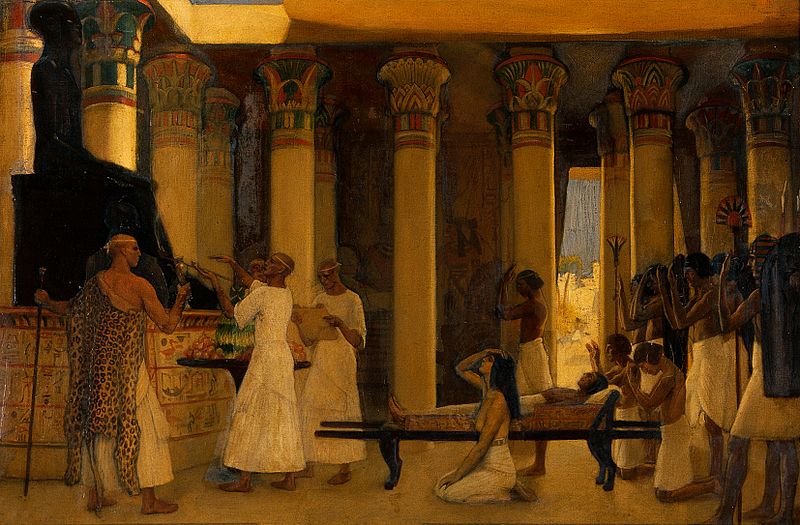
An invocation to I-em-hetep, the Egyptian deity of medicine. Oil painting by Ernest Board. Iconographic Collections
https: Gallery: https: Wellcome Collection gallery (2018-03-23)

Ancient Egyptian medical surgical tools replicas - Child museum in Cairo
Ashashyou
Key facts
Key facts
• Name — M18-G17-R4:X1*Q3 • Name Transcription — Imhotep Jj m ḥtp • Name Explanation — He who comes in peace • Name2 — M18-G17-R4 • Name2 Transcription — Jj m ḥtp • Name3 — M17-M17-G17-R4:X1*Q3 • Name3 Transcription — Jj m ḥtp • Name4 — M17-M17-G17-R4 • Name4 Transcription — Jj m ḥtp • Greek Expanded Title — Manetho variants: • Greek — * Africanus: Imouthes • Eusebius: missing • Eusebius, AV: missing
Key facts
Key facts
• Name — Imhotep • Burial — Saqqara (probable) • Style — chancellor to the King Djoser and High Priest of Ra • Tenure — c. 27th century BC • Siblings — Djoser (disputed)
Historicity
Historicity
• Illustration — Drawing of statue JE 49889 base inscription, which mentions Imhotep Imhotep's historicity is confirmed by two contemporary inscriptions made during his lifetime on the base or pedestal of one of Djoser's statues (Cairo JE 49889) and also by a graffito on the enclosure wall surrounding Sekhemkhet's unfinished step pyramid. The latter inscription suggests that Imhotep outlived Djoser by a few years and went on to serve in the construction of King Sekhemkhet's pyramid, which was abandoned due to this ruler's brief reign. Imhotep held the ambiguous title bity sensen or bity senwy, unique in ancient Egyptian history. This literally translates as "the King of Lower Egypt, the two brothers", and could be interpreted to mean that Imhotep might have been twin brother of Pharaoh, which would explain his high position; with no known individuals with similar titles, however, interpretation remains highly speculative. If not a blood relative, he might have been the King's confidant or childhood friend.
Architecture and engineering
Architecture and engineering
• Illustration — The step pyramid of Djoser Imhotep was one of the chief officials of the Pharaoh Djoser. Concurring with much later legends, Egyptologists credit him with the design and construction of the Pyramid of Djoser, a step pyramid at Saqqara built during the 3rd Dynasty. He may also have been responsible for the first known use of stone columns to support a building. Despite these later attestations, the pharaonic Egyptians themselves never credited Imhotep as the designer of the stepped pyramid, nor with the invention of stone architecture.
God of medicine
God of medicine
Two thousand years after his death, Imhotep's status had risen to that of a god of medicine and healing. Eventually, Imhotep was equated with Thoth, the god of architecture, mathematics, and medicine, and patron of scribes: Imhotep's cult was merged with that of his own former tutelary god. He was revered in the region of Thebes as the "brother" of Amenhotep, son of Hapu – another deified architect – in the temples dedicated to Thoth. Because of his association with health, the Greeks equated Imhotep with Asklepios, their own god of health who also was a deified mortal. According to myth, Imhotep's mother was a mortal named Khereduankh, she too being eventually revered as a demi-goddess as the daughter of Banebdjedet. Alternatively, since Imhotep was known as the "Son of Ptah", his mother was sometimes claimed to be Sekhmet, the patron of Upper Egypt whose consort was Ptah.
Key facts
Key facts
• Type — Egyptian • Name — Imhotep • Cult Center — Memphis • Hiero — ii-m-Htp:t*p • Parents — Ptah and Sekhmet or Khereduankh • Consort — Renpetneferet (sometimes sister) • Siblings — Amenhotep, son of Hapu, Renpetneferet (sometimes wife) • Greek Equivalent — Asclepius
Post-Alexander period
Post-Alexander period
The Upper Egyptian Famine Stela, which dates from the Ptolemaic period (305–30 BC), bears an inscription containing a legend about a famine lasting seven years during the reign of Djoser. Imhotep is credited with having been instrumental in ending it. One of his priests explained the connection between the god Khnum and the rise of the Nile to the Pharaoh, who then had a dream in which the Nile god spoke to him, promising to end the drought. A demotic papyrus from the temple of Tebtunis, dating to the 2nd century AD, preserves a long story about Imhotep. The Pharaoh Djoser plays a prominent role in the story, which also mentions Imhotep's family; his father the god Ptah, his mother Khereduankh, and his younger sister Renpetneferet. At one point Djoser desires Renpetneferet, and Imhotep disguises himself and tries to rescue her. The text also refers to the royal tomb of Djoser. Part of the legend includes an anachronistic battle between the Old Kingdom and the Assyrian armies where Imhotep fights an Assyrian sorceress in a duel of magic. As an instigator of Egyptian culture, Imhotep's idealized image lasted well into the Roman period. In the Ptolemaic period, the Egyptian priest and historian Manetho credited him with inventing the method of a stone-dressed building during Djoser's reign, although he was not the first to actually build with stone. Stonewalling, flooring, lintels, and jambs had appeared sporadically during the Archaic Period, even though it is true that a building the size of the step pyramid made entirely out of stone had never before been constructed. Before Djoser, Kings were buried in mastaba tombs.
Medicine
Medicine
Egyptologist James Peter Allen states that "The Greeks equated him with their own god of medicine, Asklepios, although ironically, there is no evidence that Imhotep himself was a physician." In his Pulitzer-prize winning “biography” of cancer – The Emperor of All Maladies – Siddhartha Mukherjee cites the oldest identified written diagnosis of cancer to Imhotep. Unfortunately, the therapy Imhotep laconically prescribed for it would be equally recognizable for millennia: “There is none”.
In popular culture
In popular culture
• Illustration — Ernest Board: An invocation to I-em-hetep, the Egyptian deity of medicine, c. 1912 Imhotep's name is shared by the antagonist of the 1932 film The Mummy, along with its 1999 remake and the latter's 2001 sequel.
Primary material
Documents and archives
authority file
- Gemeinsame Normdatei 135315824, Imhotep.
Unverified · Deutsche Nationalbibliothek
- Getty Union List of Artist Names 500125211, Imhotep.
Unverified · The Getty Research Institute
reference work
- Wikidata, structured authority record Q131171: Imhotep
Reputable secondary · Wikimedia Foundation
- “Imhotep”, English Wikipedia, consulted as further reading
Reputable secondary · Wikipedia
Citations
References
Each reference names the institution holding it, so a reader may go to the document itself.
authority file
Gemeinsame Normdatei 135315824, Imhotep.Deutsche Nationalbibliothek
Partially resolvedauthority file
Getty Union List of Artist Names 500125211, Imhotep.The Getty Research Institute
Partially resolvedreference work
Wikidata, structured authority record Q131171: ImhotepWikimedia Foundation
Partially resolvedreference work
Partially resolved
The Encyclopedia exists whether or not anything is for sale. Corrections are recorded rather than overwritten, and every version of this record is kept. Published 14 August 2026.
Elsewhere in Design
11,558 published records in this field, each with its sources named.
- Ilya BondarenkoDesigner
- Ilya ChashnikDesigner
- Ilya GolosovDesigner
- Iman AminlariDesigner
- Immanuel NobelDesigner
- Imre MakoveczDesigner
- Imre SteindlDesigner
- Iñaki ÁbalosDesigner
Best supported in this field
For owners
Own a work by Imhotep?
A specialist will read what you send and tell you what the house can establish, what it cannot, and whether the object is suited to sale. There is no charge and no obligation. The object stays with you throughout; nothing is shipped to us unless it is arranged in writing beforehand.